
 Advances in medical science and public health have benefited billions of people with longer and higher quality lives. Yet this crucial social asset has joined the list of those fields corrupted by the dash for climate cash. Increasingly, medical talent and resources are diverted into inventing bogeymen and studying imaginary public health crises.
Thus it is welcome news that confirmed Secretary of Health and Human Services (HHS) RFK Jr. has stopped funding of climate medicine at National Institutes of Health (NIH). Mother Jones reported its disapproval RFK Jr., Onetime Environmentalist, Kills NIH Climate Change Programs.
Subtitled: He pulled HHS support from projects that aim to protect Americans’ health. fight climate change. (my correction of MJ subtitle).
On February 14 of this year, his second day as secretary of the Department of Health and Human Services, he ended HHS funding for climate change and health programs at the National Institutes of Health, a move that will likely terminate this work.
That day, Ken Callahan, a senior adviser for policy and implementation in the Immediate Office of the Secretary for HHS, sent an email to Dr. Matthew Memoli, the acting director of NIH, noting that HHS would no longer support three programs run by the agency: theClimate Change and Health Initiative, the Climate Change and Health Research Coordinating Center, and the Climate and Health Scholars Program.
In the email, a copy of which was obtained by Mother Jones, Callahan cited Executive Order 14154, titled “Unleashing American Energy,” which President Donald Trump signed on his first day in office last month to revoke executive orders President Joe Biden had previously issued to implement actions to address climate change.
As Richard Lindzen predicted, everyone wants on the climate bandwagon, because that is where the money is. Medical scientists have pushed for their share of the pie, as evidenced by the Met office gathering on Assessing the Global Impacts of Climate and Extreme Weather on Health and Well-Being (following Paris COP). Not coincidentally, the 2nd Global Conference on Health and Climate was held July 7-8, 2016 in Paris. Following that the American Public Health Association declared: 2017 is the Year of Climate Change and Health.
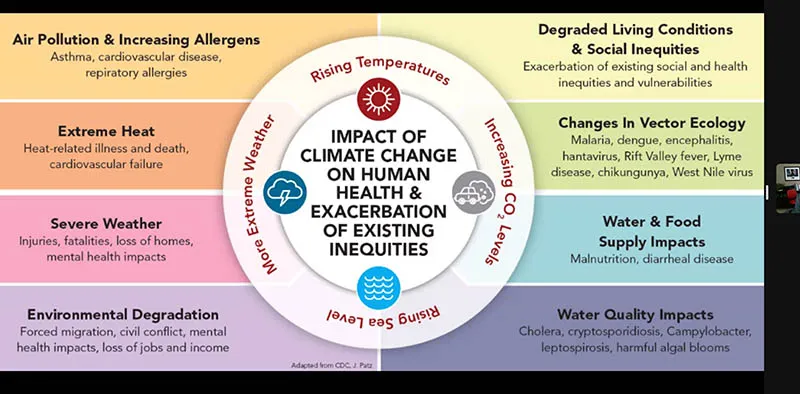
NIH: Why Climate Change Is a Health Threat
The NIH Climate Change and Health Initiative Strategic Framework claims:
For some time, international scientific consensus has been that climate
change poses an existential threat to human beings. A report of the
Intergovernmental Panel on Climate Change (IPCC), the United Nation’s
body for assessing the science related to climate change, concluded in
a recent report: “Any increase in global warming is projected to affect
human health, with primarily negative consequences (high confidence).”1
The report further concludes that, “Compared to current conditions, 1.5°C
of global warming would nonetheless pose heightened risks to eradicating
poverty, reducing inequalities, and ensuring human and ecosystem
well-being (medium evidence, high agreement)
and they conclude:
A mounting number of assessments and reports provide undeniable
evidence that climate change is resulting in increasingly profound changes
to the global environment with direct and indirect consequences for human
health and well-being. Closely intertwined with this threat are the more
tangible and proximal risks of natural disasters, a global pandemic,
societal unrest, and the ever-familiar menaces of poverty and inequity.
The need for NIH to lead this science-based initiative, in partnership with
communities throughout the world, is now warranted and vitally necessary
to address the imminent threat that climate change poses to our health,
humanity, and our planet.
Comment:
There are numerous posts here why the IPCC alarmist narrative is speculative and exaggerated, for example:
Thus it is high time to uncouple the globalist push to fuse health care with CO2 hysteria.
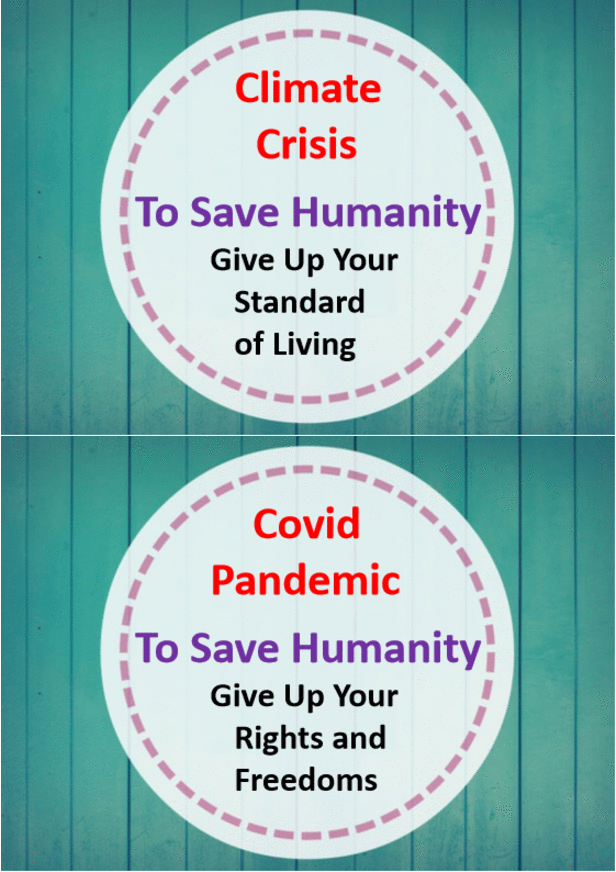
Two Sides of the Same Coin
Background:
via Science Matters
February 21, 2025 at 10:01AM
 Iowa Climate Science Education