
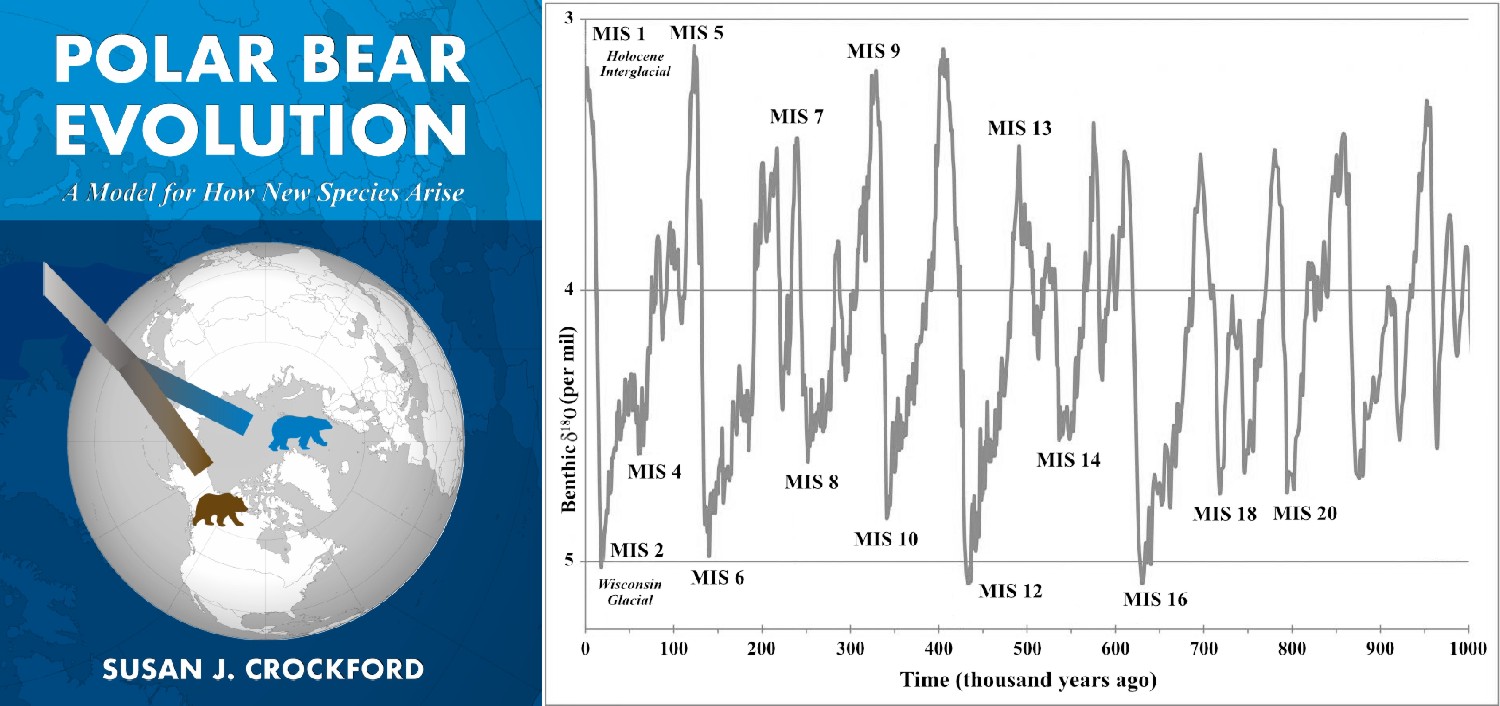
In honour of International Polar Bear Day coming up on Thursday February 27, I’ve discounted the price of my Polar Bear Evolution book by 40% for the next month in order to encourage evolutionary thinking about polar bears (in all markets: see links at the end of this post). Instead of asking whether polar bears will survive a bit of warming over the next few decades, ask yourself how they survived more than 100,000 years of unimaginable changes in Arctic climate (both much warmer and colder) before now?
No News is Good News
Aside from the usual rhetoric we’ve been accustomed to hearing from polar bear specialists—Hudson Bay bears on the verge of extinction! A new model predicts catastrophe for polar bears due to climate change! Vanishing sea ice threatens polar bear food chain! Polar bears suffering painful ice balls on their paws due to climate change!—nothing much new has happened since my State of the Polar Bear Report last year.

Conveniently, no new subpopulation survey results have been published, so polar bear specialists would still have you believe there have been no changes in global population numbers over the last 10 years. No reports of starving bears (or their new-age equivalent, wandering bears); no invasions of small Arctic towns or fatal attacks on people, both of which have been routinely blamed on lack of sea ice and so we’ve been told to expect increases due to declines in summer sea ice.
Presumably, then, polar bears are just getting on with their lives, dealing with small-scale changes in sea ice as they did during earlier parts of the Holocene and other warm interglacial periods (some lasting over 10,000 years) over the entire 100,000 years or so of their existence.
Getting on with life in East Greenland
Which brings me to this incident in East Greenland, in June 2024: more than 68 polar bears gathered to feed at a whale carcass embedded in the sea ice, including a sow with three cubs of the year, and were photographed by rich eco-tourists on a cruise (lots more photos than these two are available at the link).

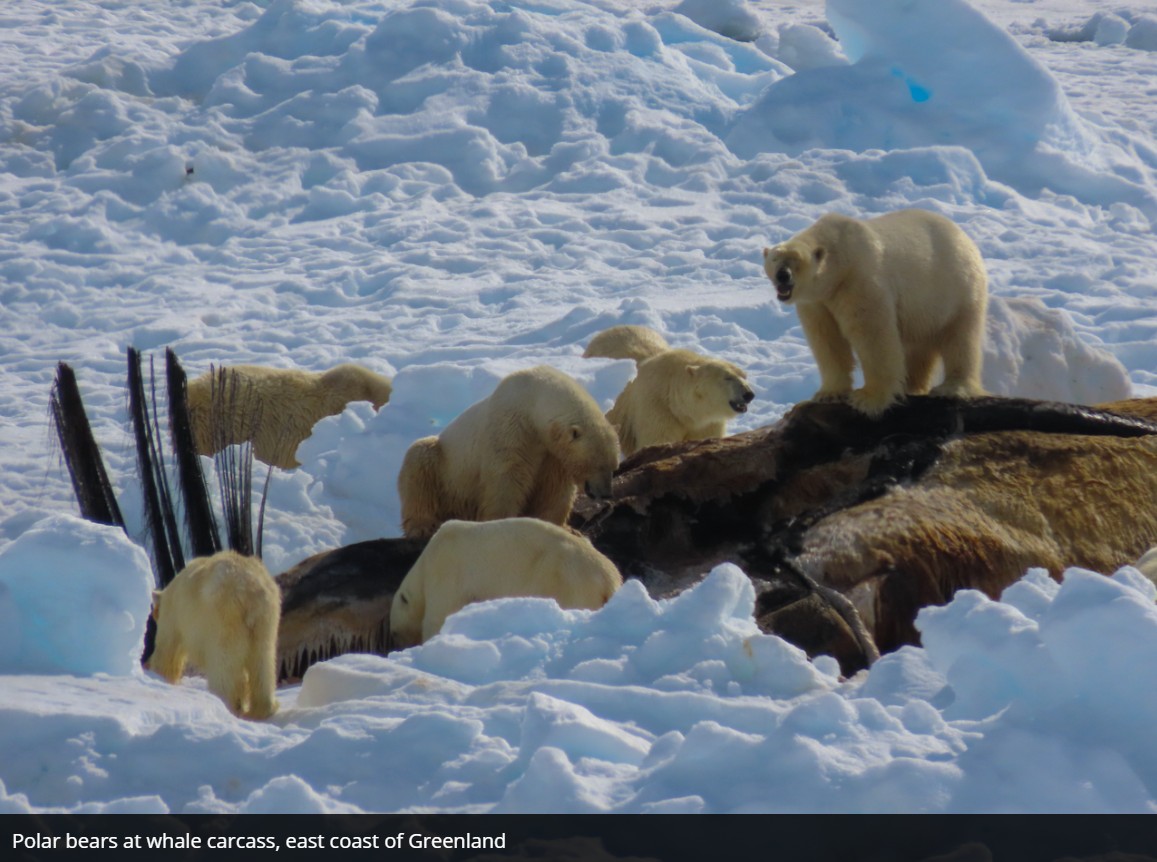
As the photos show, the sow with cubs appears to be in good condition but some others are quite thin. That’s usual for this time of year: most polar bears are in the worst shape of the year in late winter, which is why the boom of baby seals in spring is so important to their survival. Some young bears, who are not yet very good hunters and aren’t big enough to compete for scarce winter resources, routinely die of starvation: that the life of polar bears.1
See my video from 2018 on starving polar bears.
Apparently, the sea ice was so thick (up to 11m) off East Greenland in June 2024 that the ice-breaker the ecotourists were on couldn’t make it through to the little village in Scoresby Sound (Ittoqqortoormiit) the group had planned to visit:
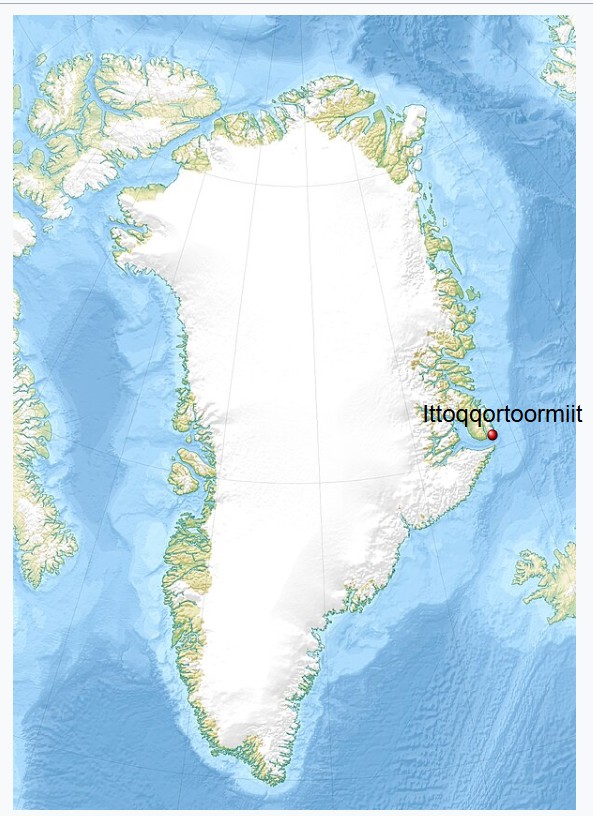
Sea ice conditions in East Greenland at mid-June 2024 don’t look so bad but apparently the ice was far thicker than expected:

Polar Bear Evolution on Sale!
You can quote me: “Modern polar bears are essentially pre-adapted to survive extended periods with ice-free summers because they lived through at least two of these events since they became a unique species. One of these, the Eemian, lasted at least 10 thousand years.” [Susan Crockford, 11 June 2023, author of Polar Bear Evolution: A Model for How New Species Arise]
This comprehensive look at polar bear evolution provides critical insight into why we should expect Ursus maritimus to survive in a warmer world. Polar bear physiology and behavior have been fine-tuned by natural selection to adapt the species to the highly dynamic Arctic environment of the late Pleistocene, including interglacial periods when sea ice was much scarcer than it is today and lasted thousands of years at a time.
Highlights
- We have known for a long time that polar bears evolved from a brown bear ancestor because of the close similarities between fossil bones of ancient bears and biological features of living animals.
- Despite more than a dozen genetic studies and several new fossil finds, before now no one has been able to reconcile all the evidence regarding when and where this speciation event happened.
- This book argues that polar bears almost certainly evolved off Ireland about 140 thousand years ago, during a very cold ice age.
- Uniquely, this account also provides an explanation for how this happened, using a testable theory that explains exactly how a brown bear could have transformed into a polar bear within a few generations.
- The same theory also explains how virtually all other species came to be, including domestic dogs, flightless birds, and dwarf island species.
- More than the complete story of polar bear origins, this book is a big-picture account of how evolution works for most organisms.
- Given their evolutionary history, polar bears must be pre-adapted to extended periods of ice-free summers, since we know they have survived at least two of these events, the first of which lasted at least 10 thousand years.
Polar Bear Evolution: A Model for How New Species Arise is available via Amazon marketplaces worldwide, in print and ebook formats. Read a sample by clicking on the Kindle or paperback icons.
USA https://www.amazon.com/dp/1778038328
UK https://www.amazon.co.uk/dp/1778038328
Canada https://www.amazon.ca/dp/1778038328
Australia https://www.amazon.com.au/dp/1778038328
Germany https://www.amazon.de/dp/1778038328

via polarbearscience
February 26, 2025 at 11:56AM
 Iowa Climate Science Education