
CFACT brought its signature brand of free-market environmentalism to the forefront of the youth conservative movement.
via CFACT
July 28, 2025 at 02:36AM
CFACT brought its signature brand of free-market environmentalism to the forefront of the youth conservative movement.
via CFACT
July 28, 2025 at 02:36AM
“Joe Romm soldiers on in a futile, quixotic crusade against energy and climate reality. No midcourse correction as his tent grows smaller and smaller. Angry Joe wants to stay that way.”
Perennially wrong Joseph Romm is now with Michael “Climategate’ Mann at the Pennsylvania State University’s Center for Science, Sustainability and the Media. And the news is bad, very bad, for both Romm and Mann as the general public is not buying climate alarm–and upset about “green” energy. Their Center, meanwhile, employs no critics of climate exaggeration and wind/solar/battery industrialization. It is in the tank for the Climate Industrial Complex.
So what is the latest from Romm, the subject of numerous posts over the last 15 years here at MasterResource? Before Trump 47, his habit (as always) was blaming ‘climate change’ for bad things, as well as fussing at a world going the other way. And now with the new regime reversing Podesta-Biden-Harris’s “whole of government” approach to climate alarm/forced energy transformation? More breathless warnings and despair.
Consider these social media posts:
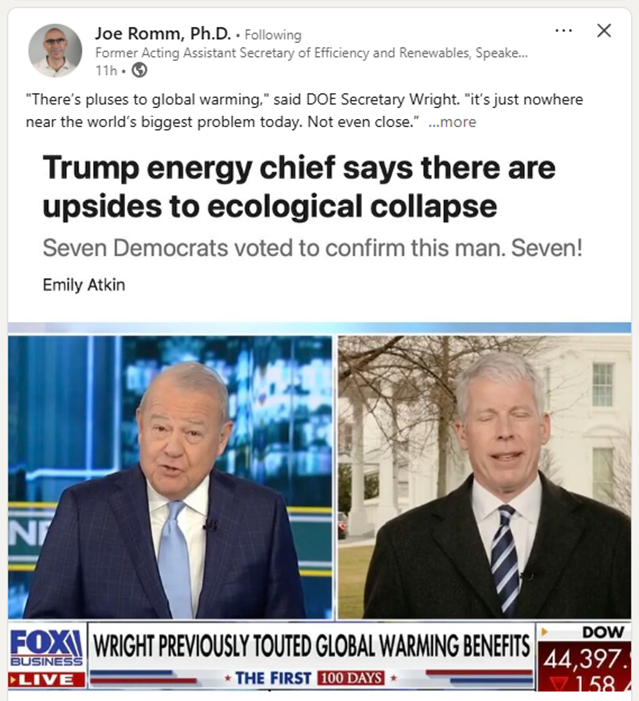
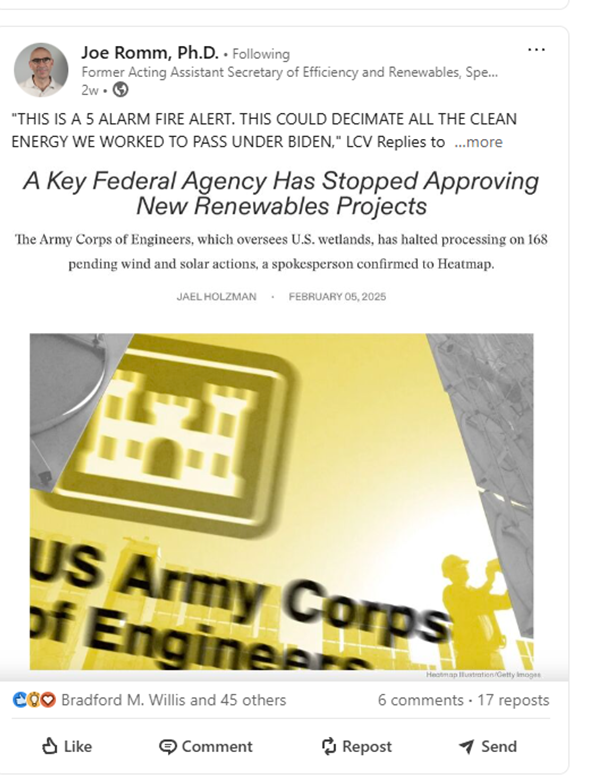
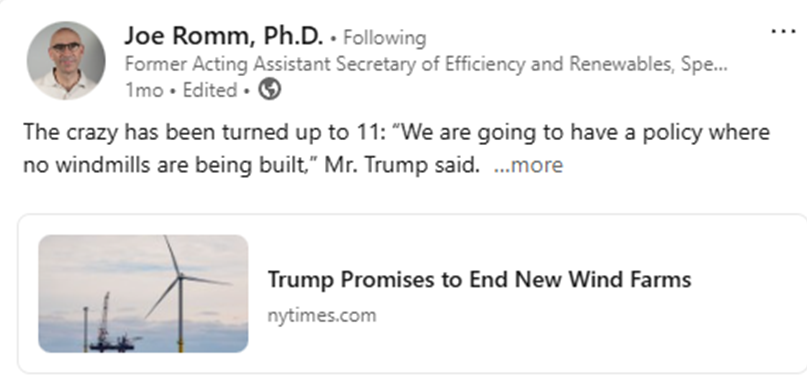
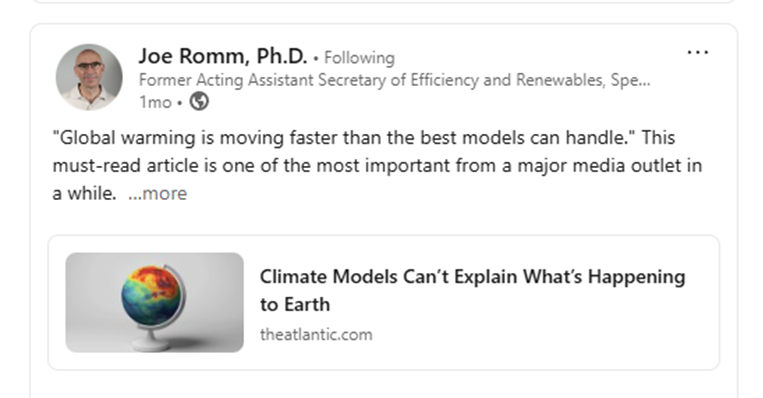

Romm is often his own worst enemy. And he gets pushback from the alarmist community. In response to an angry post by Romm on the link between solar/wind and the Spanish blackout, David McKeown politely wrote:
Joe, the setting forces me to repost not comment. I just want to ask you to use your influence differently. I have enjoyed and learned from many of your posts. But this one worries me.
Surely we need to understand the root causes properly? We also need to understand how those were worsened or lessened by current designs and arrangements and actions. This means objective analysis without regard to blame in the first instance.
If you encourage blame based on more noise, or suggest that increased weight of opinions (including ignorant and ill-informed) should direct future policy, you undermine the application of engineering and science. You also reduce trust in knowledge and competence.
Let’s not try to shout louder. Let’s try to focus everyone on the facts and single truth, (not my truth or their truth!!). I choose to believe that reports yet to be issued will clarify and seek truth not obfuscate.
Then let’s also try to understand why some actors may have got things wrong innocently or deliberately. We need to make assumptions explicit, especially across contractual and organisation/team boundaries. (Silo mentalities don’t help and especially entrenched positions from fear of blame.)
Sorry to be critical. But please think how your influence can help. Thank you.
No quarter from Joe Romm on this one. He soldiers on in a futile, quixotic crusade against energy and climate reality. No midcourse correction as his tent grows smaller and smaller. Angry Joe wants to stay that way.
The post Joe Romm Soldiers On (remnants of a failed crusade) appeared first on Master Resource.
via Master Resource
July 28, 2025 at 01:01AM
The U.S. Department of Energy (DOE) is warning about a serious issue that faithful readers of Climate Change Weekly have long been aware of: power outages across the nation are on the rise and are expected to get worse. This dark outcome is a result of the “all of the above (except for coal)” energy strategy in which politicians on both sides of the aisle force the integration of ever-more wind and solar power onto the grid, displacing both coal and, in some instances, nuclear power.
The DOE’s July 2025 annual resource adequacy report is in stark contrast with the previous report, issued by the DOE under former President Joe Biden. Under Biden, the report downplayed its core mission: understanding and encouraging electric power adequacy and the challenges the nation faces to maintain reliable, widely available, on-demand electricity. Instead, as Just the News reports, under Biden the annual report mentioned “climate change” 17 times, compared to zero mentions in this year’s report. Although both years’ reports discussed challenges, under Biden the main challenge the DOE foresaw was transitioning from fossil fuels to “renewable” power sources that don’t emit carbon dioxide during operations. Under Trump, the current report focuses laser-like on the goal of ensuring reliable power, CO2 emissions or no.
Upon the 2025 report’s release, Energy Secretary Chris Wright said in a statement the report shows the U.S. electricity grid is on an “unstable and dangerous path” and “[t]his report affirms what we already know: The United States cannot afford to continue down the unstable and dangerous path of energy subtraction previous leaders pursued, forcing the closure of baseload power sources like coal and natural gas.”
The central message of the report is that the foolhardy displacement of reliable baseload power sources with intermittent weather-dependent sources in the quixotic and exceedingly hubristic quest to control future weather is undermining the power grid that was once the envy of the world, resulting in ever-more local and regional blackouts. If current trends of displacement by wind, solar, and battery backup of coal, nuclear, and to a lesser extent natural gas and hydropower continue, power failures could increase 100-fold by 2030, the DOE warns.
Of course, this is not the first time organizations intimately familiar with supply and demand conditions and the physics of electric power have warned that wind and solar are compromising the grid. In both 2022 and 2023, representatives of the Federal Energy Regulatory Commission (FERC) testified before Congress that the transition to supposedly cleaner energy is happening too fast, with the potential for disastrous consequences.
“I think the United States is heading for a very catastrophic situation in terms of reliability,” Commissioner Mark Christie told the Senate Energy and Natural Resources Committee at a FERC oversight hearing in 2023. “The core of the problem is actually very simple. We are retiring dispatchable generating resources at a pace and in an amount that is far too fast and far too great and is threatening our ability to keep the lights on.”
In addition, the two largest Regional Transmission Organizations in the United States, the Mid-Continent Independent Systems Operators and PJM Interconnection, have each warned in testimonies and publications that the rapid replacement of baseload power generation, primarily fossil fuels and nuclear, with renewables, was causing an increase in blackouts and brownouts, a situation that has threatened to bring down entire regional grids as more demand is placed on an increasingly tenuous and undependable supply.
The country as a whole faces the grim prospect of the types of outages that strike California every summer, that left many Texans without power and dying during the winter in 2021, and that left Spain, Portugal, and parts of France without power earlier this summer—systemwide failure—and for the same stupid, avoidable reason: political interference in energy markets, favoring and/or even mandating wind and solar power in a purported effort to fight climate change. When political wishful thinking and virtue signaling replace engineering in the design of power systems, failure is the predictable and all too often deadly result.
Sources: Just the News; U.S. Department of Energy; FERC
Multiple lines of evidence suggest one of the single biggest interventions countries could take to reduce deaths due to extreme heat is to expand the use of air conditioning. In some regions of the world, primarily less-developed countries in Asia, Africa, and South and Central America, this would mean expanding (or developing) the supply of reliable electric power. Both the expansion of reliable electric power, which largely requires fossil fuels or nuclear power, and the increased use of air conditioning, of course, are anathemas as solutions to human ills because of the inane effort to control global climate. But evidence shows expanding air-conditioning use, on the back of fossil fuel-generated electricity, would do far more to alleviate human suffering and premature deaths from non-optimal heat than any effort to marginally reduce global average temperatures by the premature end of fossil fuel use.
The health and mortality benefits of expanded access to and use of air conditioning was the core message of a 2023 International Energy Agency study, “Sustainable, Affordable Cooling Can Save Tens of Thousands of Lives Each Year.” The study states,
Energy demand for space cooling has increased more than twice as fast as the overall energy demand in buildings over the last decade. …
Of the 3.5 billion people who live in hot climates, only about 15% owned AC in 2021, with even lower ownership levels in Sub-Saharan Africa and South Asia. Lack of access to indoor cooling puts much of the global population at high risk for heat stress, adversely affecting thermal comfort, labour productivity, and human health. …
[A]ccess to effective cooling has saved tens of thousands of lives; [between 2019-2021 – the study period], the average annual number of heat-related deaths averted by AC increased 3-fold, reaching an estimated 190,000 lives saved per year during 2019-2021.
Lack of access to indoor cooling puts much of the global population at high risk for heat stress, adversely affecting thermal comfort, labour productivity, and human health.
But it is not just in developing countries where air conditioning saves lives and could save more lives if access and use were expanded. As pointed out by the Hotline blog, air conditioning has benefitted the southern United States, contributing to its habitability and economic growth. In fact, Lee Kwan Yew, the first prime minister and often referred to as the founder of modern Singapore, called air conditioning “one of the signal inventions of history.”
A Hotline article notes that between 2000 and 2019, an average of 83,000 western Europeans lost their lives every year as a result of extreme heat. Britain and France restrict air conditioning use. By contrast, over the same time period in North America, where air conditioners are widely available and access is not limited by laws, only 20,000 North Americans died during periods of extreme heat.
Hotline provided a telling series of graphs comparing temperatures and deaths between European cities (where air conditioning has not been widely adopted) and cities in the United States where air conditioning, while not universal, is much more common:
In the past couple of years, Phoenix, Arizona has experienced extended periods of record-setting heat. While many blamed climate change for the lengthy periods of days exceeding 100℉, it is clear that the records were almost certainly due to Phoenix’s huge population growth and the associated development and urban heat island effect, as the timing of the higher temperatures and a comparison of Phoenix temperatures to the surrounding areas show.
Regardless of the cause, heat-related deaths in Phoenix have risen substantially over the past decade, but in 2023, despite the city experiencing a record 113 straight days of temperatures over 100℉, the number of heat-related deaths fell. This resulted largely from interventions taken to provide air-conditioned shelter to the city’s homeless and drug-using populations.
Forty-nine percent of those who succumbed to heat-related death were homeless, with an additional 9 percent’s residency status being unknown, possibly homeless. Only poor health related to drug abuse—nearly 60 percent of deaths—was a more significant factor. Of those succumbing to indoor heat-related deaths, 70 percent had no functioning air conditioning, 18 percent weren’t using the air conditioning they had, and 9 percent had no electricity at all, meaning 97 percent of indoor deaths attributed to heat were in homes lacking access to or not using air conditioning.
Phoenix successfully reduced the number of heat-related deaths by implementing several programs, such as a weatherization program and air conditioning assistance for low-income households and setting up air-conditioned centers and rooms set aside at libraries where the homeless and addicted could avoid the worst of the heat and receive hydration.
“[T]he city contributes about 60 facilities to a regional heat relief network of more than 200,” Governing writes. “Some are hosted by other municipalities, some by nonprofit or faith-based groups.”
Phoenix itself established eight 24/7 heat-respite centers (five standalone buildings, three in libraries), which served 5,000 unique visitors at the standalone centers (libraries did not keep a count) over the summer, accounting for 35,000 visits. The centers also provided access to other city services and health care. The point is that the primary factor Phoenix identified to reduce heat-related deaths was getting more people access to air conditioning.
Source: Unleash Prosperity; International Energy Agency; Issues & Insights; Governing
Climate scientist Judith Curry, Ph.D. and University of Southern California professor Harry D’Angelo, Ph.D. recently published a paper in the Journal of Applied Corporate Finance, in which they dismantle the apocalyptic climate change narrative.
Curry, as many readers of Climate Change Weekly know, has long argued that climate change is real but does not pose an existential threat to humanity. Curry has been widely criticized for this reasonable, evidence-based view.
Having left academia, Curry has been freed to pursue her research with other researchers who believe in sound science over fearmongering in the quest for funding and power, without fear of academic sanction or isolation.
The core discussion in the new paper is threefold. First Curry and D’Angelo present research that shows humans are less susceptible to climate risks, harms, and death than at any time in history:
Since the late 19th century, with 1.3°C of global warming, humanity has seen unprecedented increases in prosperity and well-being. Global population has increased from about 1.6 billion in 1900 to 8.2 billion people in 2024. In 1900, the global average lifespan was 34 years; in 2024 the global average lifespan more than doubled to 73 years. From 1961 to 2020, global agricultural output nearly quadrupled, with a 53% increase in per capita output despite a 2.6-fold increase in global population.
Since the early 1900s, per capita mortality from hurricanes, floods, droughts, and wildfires has decreased by almost 98%. These favorable trends in weather- and climate-related mortality rates reveal that the world is now much better at preventing deaths from extreme weather and climate events than it was a century ago. The sharp reduction in death rates has been accomplished through greater wealth (driven by energy derived from fossil fuels), which provides better infrastructure, superior advance-warning technologies, and greater capacity to recover from weather-related disasters.
Curry and D’Angelo go on to point out the recent warming has also been accompanied by a dramatic global greening (driven by the increase in CO2) and a sharp decline in overall deaths from non-optimum temperatures.
Second, a realistic assessment of energy use and emission trends does not support extreme warming claims for the future, and there is no evidence of “tipping points” leading to a cascade of catastrophic climate changes.
Third, the solutions posed by promoters of what Curry and D’Angelo call the Apocalyptic climate narrative, namely the rapid suppression of fossil fuel use, would be like “shooting ourselves in the foot,” the authors write.
Concerning fossil fuels, their analysis indicates,
The Apocalyptic climate narrative incorrectly portrays CO2 emissions as inherently and unequivocally dangerous and an economic “bad,” that is, a purely negative externality. This portrayal ignores the fact that CO2 yields direct benefits (e.g., it is plant food) and the inarguable technological reality that fossil fuels are currently irreplaceable inputs for producing food (via ammonia-based fertilizer), steel, cement, and plastics, which are central features of modern life.
The last 150 years have seen an enormous increase in human welfare that occurred to a large degree because of the use of fossil fuels for electricity, transportation, agriculture, and the material inputs for manufacturing and infrastructure construction. Fossil fuels have enabled huge advances in medicine, food production, communications, computing, ground and air travel, and much more. They have enabled billions of people to have lives of much higher quality, longer length, and generally greater material abundance than our ancestors—most of whom lived on the Malthusian margin of survival. …
The Apocalyptic climate narrative advocates aggressive near-term suppression of fossil-fuel use without considering the huge costs that such suppression would inflict on humans [and it] lacks a realistic sense of proportion about the risks/costs from continued global warming, which are manageable, not existential.
To sum up, the best real-world evidence suggests the planet doesn’t face an existential climate crisis. Current warming has produced few measurable harms and has been accompanied by substantial benefits, largely flowing from fossil fuel use. And finally, ending fossil fuel use before viable, reliable, affordable alternative sources of energy are developed and widely economically available would produce greater harms than any that might be realistically expected from climate change trends.
Sources: Climate Etc.; Journal of Applied Corporate Finance
H. Sterling Burnett, Ph.D., is the Director of the Arthur B. Robinson Center on Climate and Environmental Policy and the managing editor of Environment & Climate News.
Subscribe to get the latest posts sent to your email.
via Watts Up With That?
July 28, 2025 at 12:06AM
From the Friends of Science Society Newsletter, where they give our own Willis Eschenbach props and suggestions for his important recent work – Anthony
The Clouds and the Earth’s Radiant Energy System (CERES) project provides satellite-based observations of Earth’s radiation budget and clouds. CERES instruments on several satellites measure longwave and shortwave radiation from the Earth. The longwave radiation is the radiation emitted upward to space from the Earth’s surface and clouds. The upward shortwave radiation is the reflected solar radiation which doesn’t enter the climate system. If the outgoing longwave radiation is less than the absorbed solar radiation, there is a positive top-of-atmosphere radiative imbalance (imbalance) which increases the global average temperature.

Willis Eschenbach used the CERES database, which gives the monthly radiative fluxes in each 1° latitude by 1° longitude starting March 2000, to calculate the equilibrium climate sensitivity (ECS) to greenhouse gases. He produced a graph of imbalance versus the surface temperature by 1° latitude by 1° longitude with time averaged over 24 years. Eschenbach applied a lowess fit to the data. He calculated the slope of that fit and calculated the area weighted imbalance per degree of temperature change. Eschenbach asks “How much does the earth have to warm up to restore the 3.7 watts per square meter (W/m2) of TOA radiation imbalance that is said to result from a doubling of CO2 (2xCO2)?” Willis says the amount of warming required to rebalance the imbalance is called the ECS, but I believe that isn’t correct. The imbalance is not at an equilibrium state but is the result of a continual increase of greenhouse gases.
The transient climate response (TCR) is the change in temperature after a doubling of CO2 at a constant increase of a 1%/year, which would result in a doubling in 70 years. The actual average CO2 increase from 2000 to 2024 was 0.567%/year. Willis calculates the imbalance at 6.6 W/m2 per °C of surface temperature change. This equates to a TCR 3.7/6.6 = 0.56 °C, which is the TCR at 0.567%/year CO2 increase. I call this the “slowTCR”, to distinguish it from the normal TCR with a 1%/yr CO2 increase. Using a simple 1-D climate model tuned to 3-D models, with CO2 increasing at the actual rate, I calculated that the slowTCR of 0.56 °C corresponds to an ECS of 0.68 °C, which seem much too low compared to other observation-based estimates.
I did a similar calculation using the same CERES data. Each data point is 1° latitude by 4° longitude. I applied a 4th-order polynomial fit to the average 25-year data (16200 data points) as shown in this graph. I made another graph of the slope of the fitted curve and calculated a global average imbalance of 3.95 W/m2 per °C of surface temperature change, which corresponding to a slowTRC of 0.94 °C and an ECS of 1.14 °C. The lowess fit heavily discounts data further away from the mean to discount outliers. The polynomial fit might be better as all the data is of equally high quality. Changing the best fit method has a large effect on the results.
Several papers, see here and , here, argue that cloud cover can change due to atmospheric circulation changes caused by a temperature change. The analysis by Eschenbach and myself using time average CERIS data doesn’t account for this possible effect and assumes that any potential temperature-caused air circulation changes will not significantly change the relationship between imbalance and temperature over the next few decades of climate change. Therefore, I did the same calculation using the four coldest years of the CERES data (2000, 2001,2008, 2011) and the four warmest years (2018, 2019,2023, 2024). The global average temperature difference between these year groups is 0.68 °C. If the air circulation changes were causing more warming, the result of the warm years would show a lower imbalance change per temperature change than the cold years. In fact, the warm years analysis has a slightly smaller change of 0.13 W/m2/°C, so it appears that this effect is leading to more warming. Therefore, the method we used to estimate ECS is likely inaccurate. It is not a simple task to estimate the ECS.
Subscribe to get the latest posts sent to your email.
via Watts Up With That?
July 27, 2025 at 08:05PM
 Iowa Climate Science Education

