
“American Summers Are Starting to Feel Like Winter Extreme weather is keeping more people stuck inside.” American Summers Are Starting to Feel Like Winter – The Atlantic
via Real Climate Science
July 26, 2025 at 02:17PM
“American Summers Are Starting to Feel Like Winter Extreme weather is keeping more people stuck inside.” American Summers Are Starting to Feel Like Winter – The Atlantic
via Real Climate Science
July 26, 2025 at 02:17PM
Another day, another groaner of a climate alarmist press release—this time from the American Association for the Advancement of Science (AAAS), touting a new study that claims the 2023 marine heatwaves were “unprecedented” and may “signal a climate tipping point” posted at EurekAlert, July 24th, 2025.
The press release: 2023 marine heatwaves unprecedented and potentially signal a climate tipping point
The breathless tone is familiar, and the underlying logic is seriously flawed. But hey, if we scare people into action, we just might save the planet.
Let’s unpack this claim using a simple but often overlooked principle: context matters. Particularly in climate, which has cycles that span millennia, not just decades.
The foundational flaw in this study is its timescale. The research relies on satellite data beginning in 1982. That gives us about 40 years of observational history, which is virtually nothing in terms of Earth’s climate system. Prior to satellite coverage, comprehensive, high-resolution global measurements of sea surface temperatures simply didn’t exist. Claims of “unprecedented” events must be framed within that very limited context. As I’ve said before, declaring a “record” based on such a short window is like calling a coin flip streak a “trend” after four tosses.
Ocean temperatures fluctuate naturally over decadal, centennial, and even millennial scales. Our current observational capacity doesn’t cover even half of one oceanic oscillation cycle, such as the Pacific Decadal Oscillation (PDO), which paleoclimatology suggests runs as long as 50-70 years. To suggest a climate “tipping point” based on this short dataset is not just premature—it’s scientifically irresponsible.
The study makes much of the marine heatwaves’ “extreme” scale and persistence, yet it also quietly admits the 2023 heat spikes were linked to a strong El Niño. This is a naturally recurring phenomenon, not a man-made one. El Niño has been driving global climate variability for thousands of years, influencing ocean currents, sea surface temperatures, and atmospheric patterns.
The Tropical Eastern Pacific, one of the hottest zones in the 2023 event, is historically the epicenter of El Niño conditions. It should surprise no one that temperatures peaked there. What’s odd is the leap from observing a known, cyclical pattern to proclaiming it a new climate threshold.
The modeling mirage is strong with this one. Dong et al. used ECCO2 (Estimating the Circulation and Climate of the Ocean – Phase II), a high-resolution ocean model that ingests satellite data to reconstruct conditions like mixed-layer heat budgets. While ECCO2 is a valuable scientific tool, let’s not forget: models are not measurements. They are educated guesses constrained by initial assumptions and historical tuning.
All models are simplifications, and when dealing with something as complex as ocean-atmosphere interactions, even a small error can yield a wildly different output. Yet here, model outputs are used not just to analyze the past but to hint at an ominous future—a future where every warm patch of seawater is a harbinger of ecological doom.
The press release tries to go for the jugular by suggesting that these marine heatwaves might “portend an emerging climate tipping point”. That’s a phrase straight from the climate playbook of fear, designed to bypass critical thinking and stampede policymakers into hasty action. Even the photo supplied with the press release was chosen to look “hot” and drive fear. Nowhere in the abstract or methods is there clear empirical evidence linking this event to irreversible climate shifts. It’s pure conjecture, wrapped in technical jargon and served up with a greasy side of urgency.
According to the press release, the authors cite “region-specific drivers” for each major marine heatwave. In the North Atlantic, enhanced shortwave radiation and a shallower mixed layer were culprits. In the Southwest Pacific, the heat was attributed to reduced cloud cover and increased advection. The Tropical Eastern Pacific was influenced by oceanic advection.
Notice anything? These aren’t unified, global changes due to increased CO2. They are local, meteorological, and oceanographic phenomena—exactly the kinds of natural variability we should expect in a dynamic system. The fact that these local causes are acknowledged undercuts the paper’s own argument for a singular, global cause rooted in greenhouse gas emissions.
Bad science and an unjustified extrapolation is the gist of this study and press release. Perhaps the most egregious leap comes in the suggestion that the 2023 marine heatwaves might represent a “tipping point” in the Earth’s climate system. The term “tipping point” implies a sudden, irreversible shift—a planetary point of no return. But what evidence is there for this? The authors provide none beyond the temperature anomalies themselves and vague references to mixed-layer dynamics.
No historical precedent is given. No paleoclimatic comparisons are offered. No quantitative thresholds are defined. It’s all speculation dressed up in technical language.
Predictably, the press release connects the marine heatwaves to coral bleaching, fishery losses, and ecological disaster. While it is true that marine heatwaves can affect ecosystems, the narrative ignores the fact that marine species have adapted to variability over millions of years.
Corals, for instance, have survived past periods of much higher global temperatures. Many fish species migrate or dive to avoid surface heat. And let’s not forget: ecosystems are resilient. The doom-and-gloom language betrays a bias that prioritizes alarm over understanding.
My conclusion: another tale of confirmation bias
The 2023 marine heatwaves were notable, yes. But were they a sign of a planetary tipping point? Unlikely. The evidence is thin, the dataset is short, and the logic is stretched.
Here’s what we actually know:
Science should seek to inform, not frighten. The AAAS release on this study opts for drama over depth, projection over precision. In doing so, it exemplifies what’s wrong with climate discourse today: a preference for narrative over nuance.
Let’s not mistake a one year snapshot for a trend—or worse, for a crisis.
The paper: Record-breaking 2023 marine heatwaves
Dong et al., Science 24 Jul 2025 Vol 389, Issue 6758 pp. 369-374
https://www.science.org/doi/10.1126/science.adr0910
Abstract
The year 2023 witnessed an extraordinary surge in marine heatwaves (MHWs) across Earth’s oceans, setting new records in duration, extent, and intensity, with MHW activity totaling 53.6 billion °C days square kilometer—more than three standard deviations above the historical norm since 1982. Notable events include the North Atlantic MHW (276-year return period) and the Southwest Pacific (141 years). Using ECCO2 (Estimating the Circulation and Climate of the Ocean-Phase II) high-resolution daily data, we conducted a mixed-layer heat budget analysis and identified region-specific drivers: enhanced shortwave flux and a shallower mixed layer in the North Atlantic and North Pacific, reduced cloud cover and increased advection in the Southwest Pacific, and oceanic advections in the Tropical Eastern Pacific. The 2023 MHWs highlight the intensifying impacts of a warm climate and the challenges in understanding extreme events.
Subscribe to get the latest posts sent to your email.
via Watts Up With That?
July 26, 2025 at 12:02PM

Joe Oliver writes at Financial Post And suddenly, climate change hysteria is gone. Excerpts in italics with my bolds and added images.
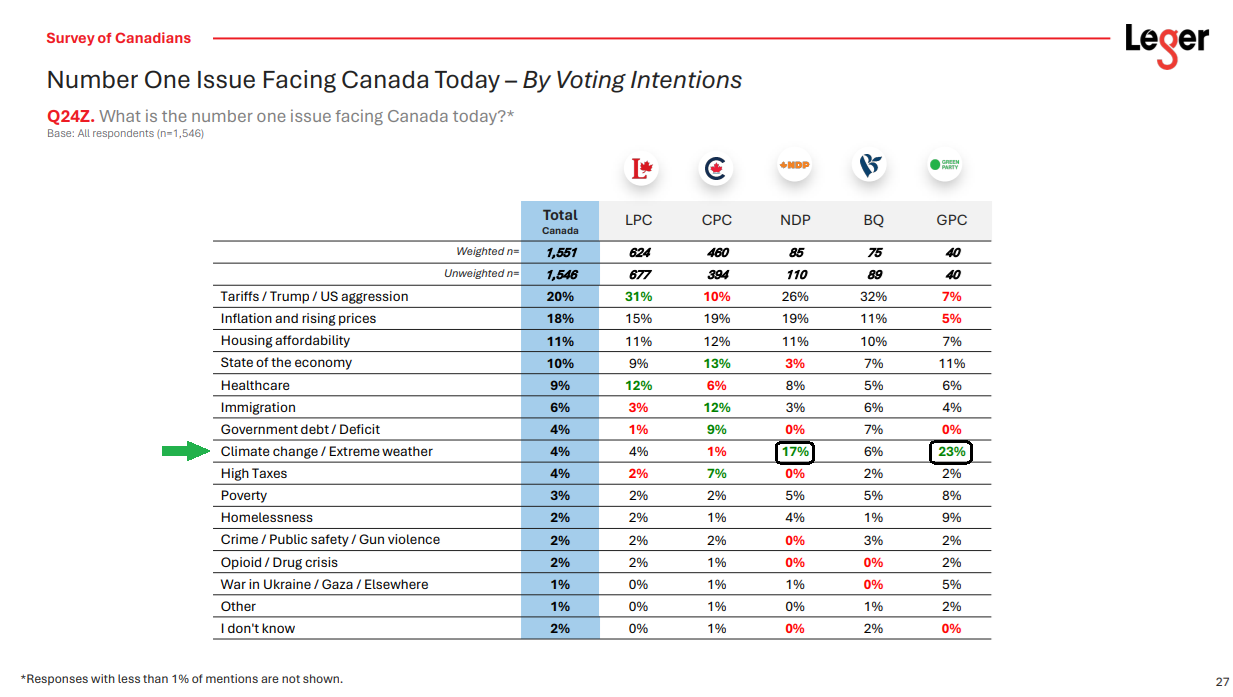
Only 4% of Canadians think climate change is our top problem.
But many of them are hard-core activists ready to block projects.
Over the past several months, public concern about climate change has declined dramatically, replaced by newfound enthusiasm for the development of Canada’s vast oil and gas reserves. The federal government is now under mounting political pressure to expedite the construction of pipelines to tidewater that will bring economic growth, employment, energy security and funding for social programs or tax relief.
What caused the sharp reversal in public opinion?
And will the government actually deliver?
Prime Minister Mark Carney has long championed climate catastrophism and a commitment to net zero, both in his various jobs on the world stage and in his 2021 book, Values. After entering politics, however, he has embraced fossil fuels, and the legacy media have joined him in a head-spinning abandonment of its obsessive focus on global warming’s alleged existential threat to humanity. Whether Carney’s transformation reflects transitory political expediency or is an overdue acknowledgment of economic and scientific reality is now key to Canada’s economic prospects.

Over the past four decades, incessant advocacy from the scientific establishment, media and opinion leaders made first global warming and then climate change the consensus view. Deviation jeopardized reputations and careers, especially for scientists and academics, who risked losing funding or even their jobs. It was no surprise, then, that in 2022, 73 per cent of Canadians believed we were confronting a climate emergency. But now, according to a recent Leger poll, only four per cent say climate change is the number one issue facing Canada.
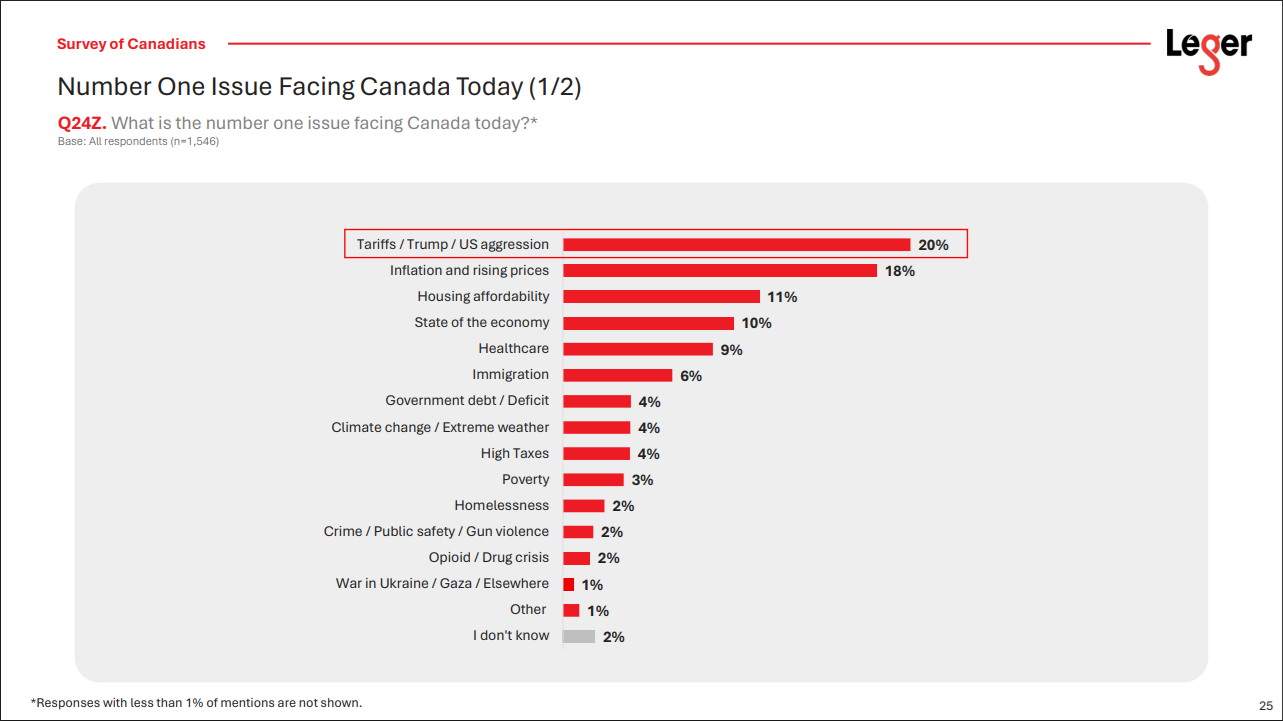
President Donald Trump’s shocking tariffs and 51st-state talk have diverted Canadians’ attention from climate change. And so have the exorbitant costs of green policies, the growing realization that nothing Canada does can measurably impact global temperatures, and the fact that green policies either weren’t adopted in many countries or have became politically toxic in countries where they were. Despite literally trillions of dollars being spent globally on reducing emissions, hydrocarbons still account for over 80 per cent of the world’s primary energy.
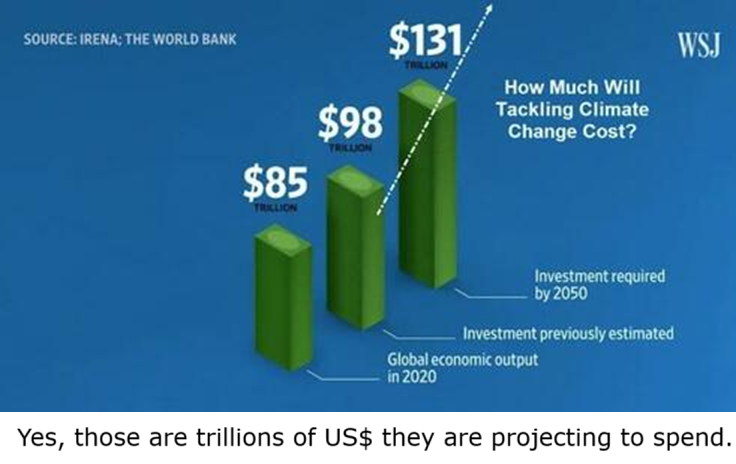
According to McKinsey, achieving net zero globally by 2050 would cost the Western countries a prohibitive $275-550 trillion. That makes it politically untenable.

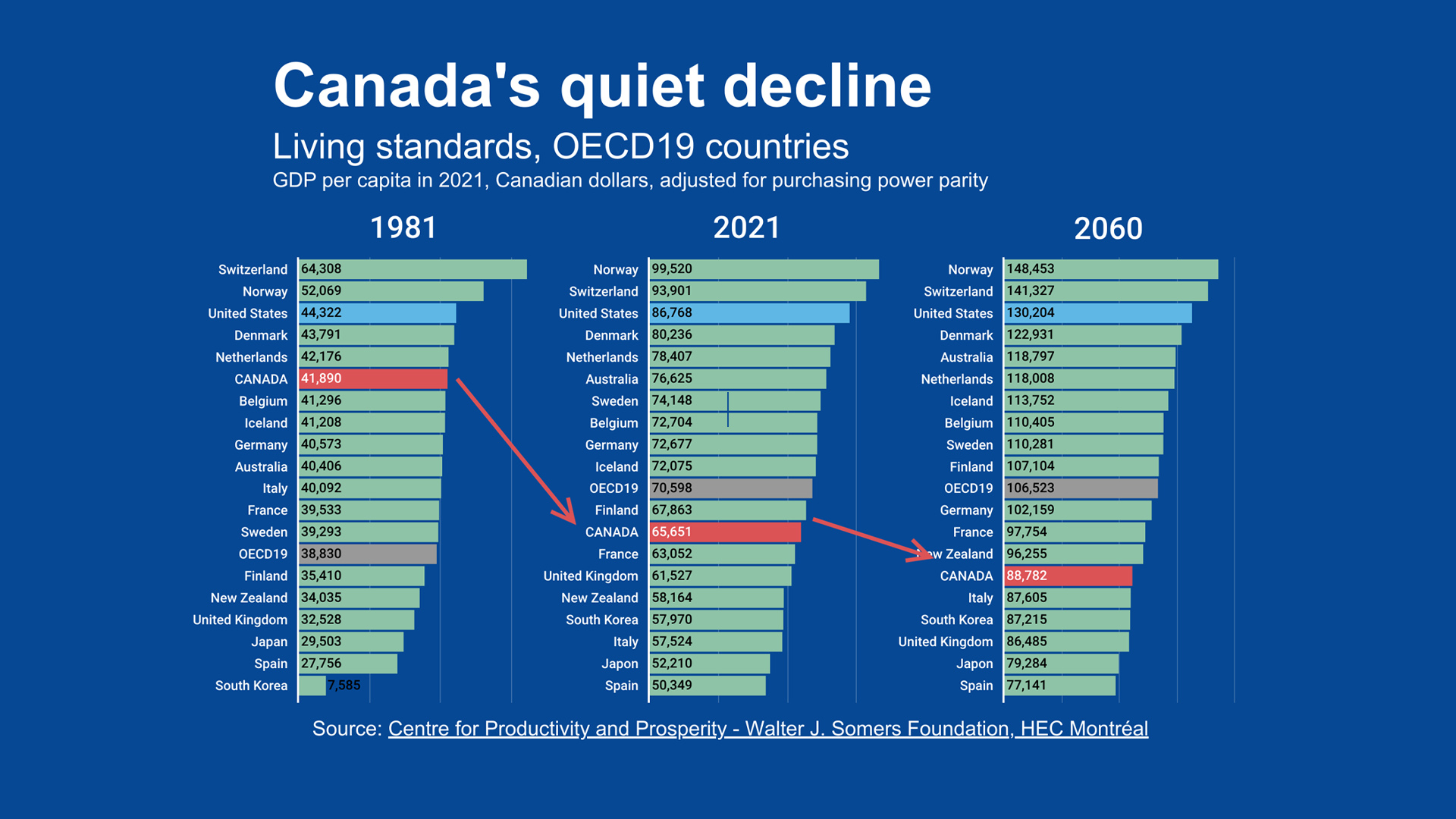
Wall Street Journal columnist Andy Kessler recently argued that green policies are largely responsible for European GDP falling from equal to American in 2008 to just two-thirds of it today. Soaring energy prices have led to de-industrialization, compounding the effects of high taxes and social spending, intrusive regulations and a protected workforce. Canada also, and for similar reasons, suffered a lost decade: growth of just half a per cent in real GDP per capita — compared with 20.7 per cent in the U.S.
And maybe the public has finally become skeptical of endless prophecies of impending disasters: “endangered” polar bears almost tripled in the past 50 years; hundreds of Pacific islands have increased in land size; death from extreme weather decreased by 99 per cent in the past 100 years; nine times as many people die from the cold as the heat; and so on. The Little Ice Age ended in the late 19th century with a gradual rise in temperatures — if not, we would still be in an ice age. Yet just 14 months ago, UN Climate Change Executive Secretary Simon Stiell said we had only two years to save the planet.

Future psychologists, economists and historians will examine the early 21st-century phenomenon of collective climate hysteria, what drove it, what ended it (if it has ended) and what damage it wrought. One thing is all but certain: there will be no admission of guilt for the enormous harm inflicted on Canada and other economies. Although the public has moved on, a hard-core group of climate militants is prepared to exploit every legal and regulatory impediment to resource development in Canada. The federal government will have to use all its legislative and executive authority to push the new energy projects it says it favours through to completion. Only then will Canadians know whether Mark Carney has truly changed his core beliefs.
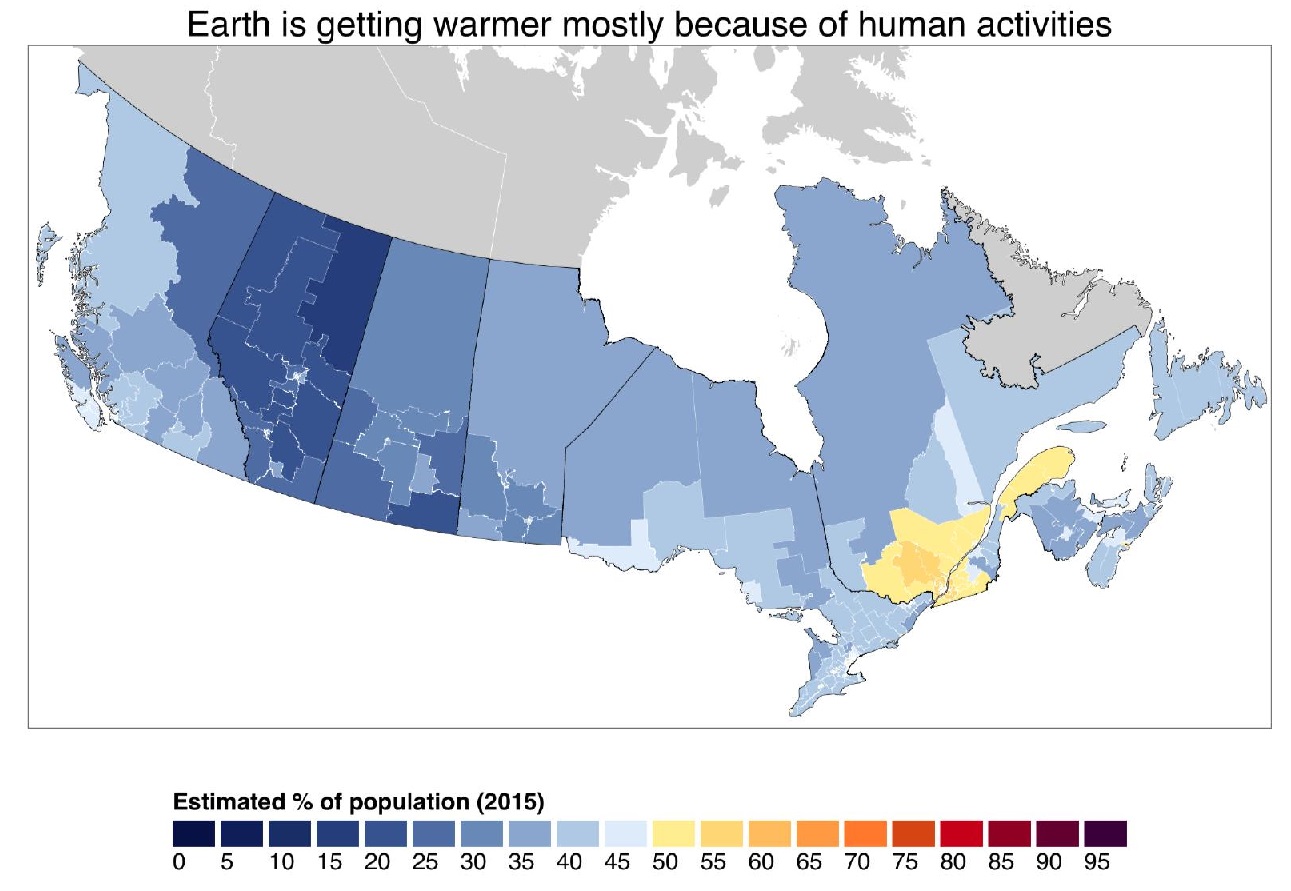
In 2015 Canadians were asked:
1. “From what you’ve read and heard, is there solid evidence that the average temperature on earth has been getting warmer over the past four decades?”
Yes
No
Don’t Know (volunteered)
2. [If yes, solid evidence] “Is the earth getting warmer mostly because of human activity such as burning fossil fuels or mostly because of natural patterns in the earth’s environment?”
Human Activity
Natural Patterns
Combination (volunteered)
Not sure / Refused (volunteered)
So the 79% who said there’s solid evidence of warming the last 40 years got a followup question: mostly caused by human activity or mostly natural? Slightly more than half said mostly human, thus a result of 44% believing both that it is warming and that humans are mostly to blame.
via Science Matters
July 26, 2025 at 09:47AM
 Iowa Climate Science Education