Yet more taxpayer money to be thrown at the cars nobody wants to buy!
The cost of some new electric cars will soon be reduced by up to £3,750 under grants being introduced by the government to encourage drivers to move away from petrol and diesel vehicles.
The discounts will apply to eligible vehicles costing up to £37,000, with the most environmentally friendly vehicles seeing the biggest reductions, the Department for Transport (DfT) said.
Carmakers can apply for funding from Wednesday, with the RAC saying discounted cars should start appearing at dealerships "within weeks".
But some drivers have previously told the BBC that ultimately, the UK needs more charging points to spur people to buy electric vehicles (EVs).
The government has pledged to ban the sale of new fully petrol or diesel cars and vans from 2030.
Under the scheme, discounts will range between £1,500 and £3,750 and buyers will be able to claim a discount at the dealership.
The grants to lower the cost of EVs will be funded through a £650m scheme, and will be available for three years.
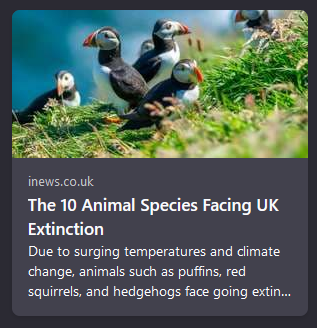
The “New Tab” on Firefox offers, as well as a grid of your favourite haunts, some curated stories from around the world. I once tried to get to the bottom of who selected them, perceiving a rather left-climate bias in the selections. However, despite a polite interaction with a volunteer, I ended up none the wiser. Probably the staff picks the stories. The staff is left-climate. Hence, so are the stories.
Today [actually by the time you’re reading this, it’s two days ago], one such story had the headline of this note, saving the snark quotes. Ten animal species were facing UK extinction, thanks to surging temperatures and climate change. The two factors are seemingly divisible now. It’s rather like saying a murder victim died of a 45 calibre bullet through the heart, and a gunshot wound.
What are these ten species? I wondered. I thought I’d try to guess, but before I could action that thought, I’d already read the sub head, which as you can see gives away three of the victims: puffins, red squirrels, and hedgehogs. [The featured image might be a clue to one of the other 7 too.]
Now I only had to guess the rump. The guessing involved a certain amount of second guessing, because I had to put myself in the mindset of someone determined to find peril in the most innocuous things. Should I stick to birds and mammals? What about insects, or fish? The idea that one of our few reptiles might suffer from surging temperature was of course ludicrous. Well, here’s what I came up with for the missing 7.
Ptarmigan
Capercaillie
Kittiwake
Swallowtail butterfly
Killer whale
Salmon
Char
A good spread of taxa, but who knows, might be well off the mark. Are any of them genuinely threatened by climate change? Well, the best shout is the ptarmigan, thanks to its high altitude life. When you live on the tops of the highest mountains, there’s nowhere to go if it gets any warmer. How many do I score out of 7?
Note that quite an impressive list could have been made along these lines:
Northern right whale
Large blue butterfly
Large copper butterfly
Lynx
Brown bear
Elk
Reindeer
Beaver
Wolf
Great auk
Sea eagle
Whoops! That’s eleven, not ten. An astute reader will know that these are species that are or have been driven to extinction in the UK in historical times. [One or two have been re-introduced on a small scale.] Note that none, so far as I know, suffered their fate at the hands of surging temperatures, or climate change; they were either hunted out, or met their fate due to land-use change. I wonder whether the iNews author is aware of all of them?
Asterisk: the large blue went extinct after the drought of 1976 – see Dead Butterfly Blues – but it had already been reduced down to a tiny remnant population by that time. Such populations are incredibly vulnerable to the vicissitudes of chance, and almost inevitably dwindle to nothing.
So, how did I do? Here is iNews’s list:
Turtle dove
Cuckoo
Red squirrel
Scottish wildcat
Hedgehog
Peregrine falcon
Short-eared owl
Barnacle goose
Puffin
Manx shearwater
Well, of the 7 I didn’t already know from the headline, I guessed exactly 0 of them. Are any of the 10 actually threatened by climate change? No, I don’t think so. Ptarmigan was a much better shout.
The iNews has its climate scientist to go to for absurd quotes. His name is Dr. Jesse Abrams. Quoth he:
“As the planet continues to warm, some of Britain’s most beloved wildlife face imminent threats: the turtle dove population has declined by 98 per cent since the 1950s and may disappear entirely, while hedgehog numbers have crashed by 95 per cent since the 1950s, with almost a third of the population lost since 2000 alone. Red squirrels are already all but extinct in England and Wales and the Scottish wildcat is critically endangered,” Dr Abrams said.
Those stats may be true, but it is disgraceful to try to stamp them with “Because teh climate.” The turtle dove has declined thanks to the sterilisation of the countryside. See all those weeds in the fields of wheat as you drive by them? Thought not. That’s why there are no turtle doves. The turtle doves can’t see them either, or eat their seeds. It would actually be quite easy to go through the list and explain the real reasons for the other species’ declines too.
But I’m not going to trouble you with that. [We have already discussed puffins.] I’m just going to pick one, and no I’m not going to pretend I chose randomly. I cherry picked! How evil of me. I want to pick…
Peregrine falcon
This species, which is allegedly threatened with extinction in the UK “because teh climate” is found all around the world. Literally. Here’s a distribution map from wiki (numbers represent different subspecies):
Somehow they manage to survive in tropical Africa, but in the UK, teh climate is gonna do for them! Nope: crass misinformation. Or probably disinformation, since the iNews is supposed to be an authoritative source. Well, it blew it. You can find peregrines in Australia, Fiji, India, Japan, South Africa, California…
But I want to draw your eye to a little * on the map. Do you see it? What might that represent? What about the green Es nearby? Well, I’ll tell you. Let me quote from an old book of mine, Leslie Brown’s Birds of Prey (1976). My bold:
In all developed countries of western Europe, Britain included, and North America it has become scarce or even – in eastern North America – extinct…
The primary cause of this decline seems absolutely clear. It is not due to persecution by gamekeepers, egg collectors, or pigeon fanciers, which the peregrines survived in a mild way until the fifties of this century. It is primarily due to pesticides used in agriculture…
And these tyros have the audacity to deliver lectures on the perils of teh climate.
Asterisk: peregrines have been re-introduced to eastern North America. That’s what the asterisk means. The Es show localised extinctions, thanks to DDT.
Here’s the EBBA 2 (European Breeding Bird Atlas) map of the peregrine’s present range in Europe:
It’s clinging to the extreme far north! Any sniff of more warmth, and it’s toast! Oh… wait… maybe we’re just talking BS to scare people into supporting pointless climate policies? [Note there is still a large gap in Eastern Europe, presumably a legacy of communist times.]
Now showing the change between the two atlases: 1980s for EBBA 1 and 2013-17 for EBBA 2. The blue shows where the bird is found in EBBA 2 but not EBBA 1 – i.e., where it has expanded from the 1980s onwards, from its nadir under the pummelling of our little friend DDT:
Same place, just click on the left for filters.
The lesson here is that when you stop poisoning birds, their population stops declining, and they start recolonising places where they’ve been wiped out.
Summary: Humans have laid waste to vast swathes of the Earth, but their attempts to kill things by increasing the CO2 concentration of the atmosphere have so far come to naught. This is just rubbish by iNews and its pet climate scientist. Guys, learn some ecology. Read some history. It did not begin when you were born. Don’t make authoritative statements unless you are damn sure what you are talking about. First, identify the real problems. Then, you can help to find the real solutions.
Editor’s Note: This concludes a two-part series with real-world examples of anticipating and ameliorating extreme weather events, a challenge throughout human history. Today’s post was originally published at MR on May 21, 2015.
Yesterday’s post explained how market incentives can address environmental issues, including the believed-to-be negatives of climate change. Prices of inputs and outputs, utilizing resources even if they are subject to the tragedy of the commons, incorporate dynamic environmental changes. Markets, in other words, offer the potential for dynamic responses.
If climate change reduces the productivity of land for wheat production, for example, the price of land will be high relative to its productivity. This generates an incentive for wheat farmers to seek new places for wheat production where land prices are lower. Hence, the 2012 Bloomberg news headline, “Corn Belt Shifts North With Climate as Kansas Crop Dies.” Therefore even if the atmosphere as a GHG sink and GHG emissions themselves are not priced, prices correlated with the effects of climate change will induce adaptation.
This is McKenzie Funk’s thesis in his book titled, Windfall: The Booming Business of Global Warming(2014). Changes in the arctic sea ice–“the Melt”—changes in water supplies—“the Drought”—and changes in coastal flooding—“the Deluge”—are the three central categories into which Funk pigeon holes entrepreneurial responses to climate opportunities. He asserts that his book is an answer to the increasingly urgent question: “What are we doing about climate change?” (Funk 2014, 11).
To be slightly more colorful, climate entrepreneurs aren’t just talking about the weather; they are doing something about it.
Consider the following examples:
Vintner Matthieu Elzinga moved from his vineyard in the Loire Valley of France to an emerging wine region in southern England. Such a move is consistent with the findings of a Conservation International and National Academy of Sciences study predicting that areas suitable for viticulture will decrease “25% to 73% in major wine producing regions by 2050” (Hannah et al. 2013). Reporting on the study, Bay Area: BizTalk’s 2013 headline read: “Wine from Wyoming? How Yellowstone and Yukon will Steal Napa’s Crown.” Adaptation at its finest.
John Dickerson, founder and CEO of Summit Global Management and its subsidiary, Summit Water Development Group, is positioning his company for more frequent water shortages, extreme weather events, flooding, and shifts in growing seasons, water markets are beginning to flourish. In a conversation with Funk, Dickerson noted that “We still have the exact same amount [of water] in our ecosphere,” so “the ultimate effect of global warming is that the percentage that is freshwater is getting smaller, the percentage that is salt water is getting larger, and the maldistribution of freshwater is getting much more severe” (As cited in Funk 2014, 119). Because these conditions inevitably will lead to higher prices of water in areas receiving less rainfall, Dickerson has positioned himself well in the water market by purchasing water rights in Australia and the American West.
Hedge fund managers are using derivatives to deal with climate variation. Ski resorts, for example, can purchase snow derivatives to hedge against low snow falls. The resort essentially bets against other investors, with the ski resort being paid if snow levels fall below a level specified in the contract or pay if it is above. This helps spread the risk associated with climate uncertainty.
Astute environmental entrepreneurs—enviropreneurs—are finding innovative ways to achieve their conservation goals in the face of climate variation. For example, the Fresh Water Trust in Oregon (see chapter 6) uses option contracts to lower the cost of restoring and preserving stream flows and fish habitat. When there is an abundance of runoff, it has nothing to worry about, but when there is little rain or snow in the mountains, it must compete with irrigators to keep the streams flowing. In some cases it simply purchases water rights and halts irrigation, but in others, it purchases options from farmers. When stream flows are low, the trust exercises its option and pays the farmer to stop irrigating, leaving the water for fish.
None of this is to say that entrepreneurs will succeed is solving every resource conflict. But to the extent that the market believes that future conditions are based on solid science, entrepreneurs will take note.
————————
Terry Anderson is the John and Jean De Nault Senior Fellow at the Hoover Institution and the executive director of the Property and Environment Research Center (PERC), a think tank in Bozeman, Montana, that studies free-market approaches to environmental challenges. Anderson’s research, epitomized in the new edition of his best-selling primer, Free-Market Environmentalism for a New Generation, helped launch the sub-discipline of environmental economics,free-market environmentalism.
Donald Leal, senior fellow emeritus at PERC , stepped down as research director at PERC after nearly 30 years. Dr. Leal is well known for his work on property rights in marine fisheries and has written and edited dozens of books, policy papers, and articles on fisheries, water, outdoor recreation, as well as timber and federal land use policy. A tribute to Dr. Leal from his friends in the free-market environmental movement describes his many contributions.




 Iowa Climate Science Education