Month: July 2025

Sea Ice Data Cut-off: Climate Alarmists Panic, But Is It Really a Crisis?

I’ve spent years at Watts Up With That debunking the overhyped narratives surrounding climate science, particularly the obsession with sea ice as a supposed “canary in the coal mine” for global warming. The recent Space.com article, dated July 10, 2025, titled “US military cuts climate scientists off from vital satellite sea-ice data,” has predictably stirred up alarmist rhetoric about the loss of data from the Special Sensor Microwave Imager/Sounder (SSMIS) operated by the Department of Defense.

The article claims this move blinds scientists to a critical climate indicator, but let’s take a step back and examine why this might not be the catastrophe it’s made out to be—and why sea ice data, in the grand scheme, isn’t the climate proxy it’s cracked up to be. The Space.com piece details how the National Snow and Ice Data Center (NSIDC) at the University of Colorado, Boulder, will lose access to SSMIS data, which tracks sea ice coverage. The article paints this as a devastating blow, tying sea ice loss to catastrophic glacier melting and sea level rise, while also noting commercial benefits like shorter shipping routes.

It mentions NSIDC’s pivot to Japan’s Advanced Microwave Scanning Radiometer 2 (AMSR2) data, but frets about a temporary data gap. Their tone is predictably dire, framing the decision as part of a broader attack on science, with references to budget cuts, NASA mission threats, and evictions of scientific institutions (like GISS).

Now, let’s cut through the hyperbole.

Sea ice has long-been a poster child for climate alarmism, but as we’ve discussed extensively at WUWT it’s a flawed and noisy proxy for climate change. First off, Arctic sea ice, while lower than its 1979-2000 average, has not vanished as predicted. Since the notable low in 2007, Arctic sea ice extent has stabilized at a new, lower plateau, fluctuating year to year but showing no consistent downward spiral toward an “ice-free Arctic” summer, despite endless model-based forecasts and bloviations from Al Gore.

Figure 1: Shows satellite derived summer minimum Arctic Sea ice extent values from 1979 to 2023, with dashed line showing the linear trend. The added trend line in red shows no change in summer minimum extent since 2007. Image source: NSIDC. Red trend line from 2007 and trend line examples under the title added by A. Watts

For example, we’ve covered how Arctic sea ice has remained stable for nearly 20 years. Meanwhile, Antarctic sea ice tells an even more inconvenient story. Contrary to models predicting ice loss in a warming world, Antarctic sea ice has shown periods of growth, particularly in recent years. We reported on this in 2014, noting that Antarctic sea ice reached a new record high extent. This growth directly contradicts the narrative that a warmer planet universally melts sea ice, exposing the oversimplification of tying ice extent to global temperature.

But even worse, as Willis Eschenbach has pointed out in the past, even the losses of Antarctic ice are insignificant in the much bigger picture of total ice in Antarctica.

Figure 2: (click to enlarge) Comparison of satellite data for Antarctic ice mass loss. Cumulative ice mass loss on the left and that same data compared to the total mass of ice on the right. Data source: http://imbie.org
Graphs originally by Willis Eshenbach, adapted and annotated by Anthony Watts.

Why is sea ice such a shaky climate proxy?

As we’ve long argued, it’s influenced by far more than just temperature. Wind patterns, ocean currents, and natural variability like the Arctic Oscillation play massive roles. For instance, we’ve discussed how changes in wind patterns affect Antarctic sea ice. In Antarctica, changes in atmospheric circulation, not just temperature, drive ice variability. Add to that the fact that sea ice data is riddled with measurement challenges—sensor calibration issues, satellite drift, and algorithm tweaks can skew results. The Space.com article’s claim that losing SSMIS data blinds us to climate change ignores these complexities and assumes sea ice is a straightforward thermometer, which it’s not.

Moreover, the article’s panic over a temporary data gap is overblown, especially given NSIDC’s history of downplaying data issues when it suits them. Back in 2009, I wrote about a significant data loss at NSIDC due to a catastrophic sensor failure on their satellite, leading to erroneous data and a gap in records. NSIDC’s Walt Meier dismissed it in comments as “not worth blogging about.” You can read the details in my article, “George Will’s battle with hotheaded ice alarmists”, where I highlighted the hypocrisy. Funny how a data gap was no big deal then, but now a similar issue is apocalyptic.

This selective outrage undermines NSIDC’s credibility and highlights the politicized nature of their narrative. Expanding on the article’s premise, the loss of SSMIS data isn’t particularly crippling for climate science because sea ice data, in the context I’ve described, has limited utility. It’s a noisy, multifaceted metric that doesn’t directly correlate with global warming or CO2 levels. Other datasets—like global temperature records, ocean heat content, or even alternative satellite sources like AMSR2—provide more robust insights. The article’s claim that sea ice is a “significant measure of climate change” overstates its importance, ignoring how natural variability and non-climatic factors muddy the signal. If anything, the DoD’s decision to prioritize military needs over feeding an alarmist narrative might force scientists to focus on more reliable metrics.

The Space.com article also glosses over practical realities. The DoD has its own priorities—ship deployments, national security—and isn’t obligated to subsidize NSIDC’s research. The pivot to AMSR2, while requiring calibration, isn’t insurmountable; Japan’s data is already available and comparable. The article’s fearmongering about a “blind spot” ignores that climate science has never relied solely on one dataset. So maybe a pause in data will prompt a reevaluation of these flawed predictions. Also check our coverage where models are shown failing on sea ice predictions.

In short, the Space.com article is another example of climate alarmism dressed up as science. Sea ice isn’t the climate oracle it’s made out to be, and the loss of SSMIS data is more inconvenience than catastrophe. Arctic ice has stabilized, Antarctic ice has grown, and natural variability trumps simplistic warming narratives. As we’ve said for years at WUWT, the climate story is far more complex than the headlines suggest. NSIDC’s past dismissal of data gaps, as I noted in 2009, only underscores the selective hysteria at play here. Time to move on to better metrics and less dogma.


Charles’s addendum:

Stripped of the political theater and media histrionics, the scientific value of obsessively tracking daily sea ice levels is, at best, marginal.

Let’s start with the most practical question: what can actually be learned from day-to-day sea ice measurements that isn’t already known from longer-term oceanic and atmospheric data? Sea ice is, fundamentally, a symptom—an end product influenced by wind, ocean currents, and short-term weather, as much or more than by global temperature trends. That means daily changes are a muddled mix of noise, short-term variability, and local conditions. Tracking these fluctuations at high frequency yields little actionable knowledge about the climate system. If anything, it produces more confusion than clarity.

Certainly, if someone wants to study polar ecosystems or seasonal animal migrations, knowing when and where ice forms or melts can have some limited biological application. But these are niche research interests and hardly justify the grandiose claims that daily sea ice monitoring is essential for understanding the global climate.

When it comes to navigation or resource management, mariners and industry rely on real-time, localized, high-resolution data, not the global extent numbers pumped out for press releases. The aggregate data on “how much sea ice is present today” is neither granular enough nor timely enough for practical shipping or drilling decisions.

As for long-term climate science, the true value—if any—lies in multi-decadal records, not in daily readings. Even here, the correlation between sea ice and global temperature is weak. Major fluctuations can and do occur independently of temperature changes, as seen repeatedly in both Arctic and Antarctic records. Moreover, the record itself is tainted by changes in measurement technology, algorithms, and satellite drift, making comparisons across decades fraught with uncertainty.

The bottom line: Tracking daily sea ice provides, at best, a rough indication of what’s happening in the polar regions, heavily filtered by natural variability and technical limitations. For actual climate science, it’s a highly indirect, noisy, and unreliable metric—one that tells us less about the climate than about the limitations of our models and the persistent urge to find a simple answer to a complex system. The scientific value is, therefore, minimal—especially when compared to the breathless importance often assigned to it.

In sum: Sea ice measurements have niche utility, but they are no oracle for climate or policy. Their scientific value, outside of specialized polar research, is overstated and often used as a proxy for arguments that lack better evidence.


Discover more from Watts Up With That?

Subscribe to get the latest posts sent to your email.

via Watts Up With That?

https://ift.tt/YTAZBrz

July 10, 2025 at 08:01PM

Pope Leo Appeals for More Climate Action

Essay by Eric Worrall

The first US pope is just as green as his predecessor.

Pope prays for world to recognize urgency of climate crisis as he celebrates Mass’ using new rite

BY  NICOLE WINFIELD Updated 11:47 PM AEST, July 9, 2025

ROME (AP) — Pope Leo XIV prayed Wednesday for the world to recognize the urgency of the climate crisis and “hear the cry of the poor,” as he celebrated the first papal Mass using a new set of prayers and readings inspired by Pope Francis’ environmental legacy.

The Mass, in the gardens of the Vatican’s new ecological educational center at the papal summer estate in Castel Gandolfo, indicated a strong line of ecological continuity with Francis, who made environmental protection a hallmark of his pontificate.

Wearing flowing green vestments, Leo presided at the liturgy in front of a statue of the Madonna and at the foot of a reflecting pool, immersed in the lush green gardens on an unusually cool summer day. He said the world needed to change its mindset about the planet and what is causing “the world to burn.”

“We must pray for the conversion of so many people, inside and out of the church, who still don’t recognize the urgency of caring for our common home,” he said. “We see so many natural disasters in the world, nearly every day and in so many countries, that are in part caused by the excesses of being human, with our lifestyle.”

Read more: https://apnews.com/article/pope-leo-green-mass-climate-justice-4a65f5d0897016d654589439032433b3

How depressing. Over the years US Catholic priests have notably pushed back against the increasingly radical green agenda of the church leadership, but I guess there is always an exception.


Discover more from Watts Up With That?

Subscribe to get the latest posts sent to your email.

via Watts Up With That?

https://ift.tt/rzjMWv9

July 10, 2025 at 04:06PM

Scotland’s Tidal Bet: Net Zero, Net Loss

Guest Post by Willis Eschenbach

Let me invite you to consider the Scottish coast, where the tides are large and the headlines are gushing—much like the capital outflow—over the MeyGen tidal project, a four-turbine, six-megawatt marvel whirring away beneath the waves. The headlines scream  Underwater turbine spinning for 6 years off Scotland’s coast is a breakthrough for tidal energy.

Me? I’m just a suspicious sort with too many years in the accounting trenches and a soft spot for arithmetic. So I thought I’d take a peek at the math behind the green curtain and see what’s really going on.

First, the basics. The capital cost for the four-turbine Phase 1A MeyGen project was £51 million at construction—call it £66 million in 2025 pounds, or about US$90 million at today’s exchange rate. No one seems keen to publish the total operation and maintenance (O&M) bill for Maygen, but industry estimates for similar tidal setups run 2–4 cents per kilowatt-hour (kWh). For 51 million kWh generated so far, that’s a ballpark $1–2 million for O&M.

So, $91 million spent, 51 million kWh produced. That’s $1.78 per kWh—over thirty times the US grid price for gas-fired power, which hovers around $0.04–0.06 per kWh. Ouch.

Now I can hear you thinking, “But that’s just the first seven years! The costs are front-loaded! Surely it gets better over time?” And you’re right. So let’s squint into the always-misty future.

Over the projected 25-year lifespan of the four turbines, the array is expected to generate about 164 million kWh. There’ll be two major overhauls—$3 million each—and 25 years of O&M at around $0.03 per kWh, totaling around $6 million. Add it all up: $90 million (capital) + $6 million (overhauls) + $6 million (O&M) = roughly $102 million.

Divide by the lifetime output, and you’re looking at a cool US$0.62 per kWh. That’s about ten times what gas power costs in the US.

Why are the costs so high? Well, in part it’s the “capacity factor”. That’s the percentage of the nameplate rating that they are actually generating. The individual turbines are rated at 1.5 megawatts. One has been operational for nine years, one for eight years, and two for 7 years. That’s 31 turbine-years, times 1.5 megawatts/turbine, times 8,766 hours per year, yields 407 gigawatt-hours (GWh) if they were running full-tilt.

But in the real world, they only put out 51 GWh, so their capacity factor is a pathetic 13% …

And that cost and capacity factor are assuming that there are no unexpected breakdowns in the next 18 years. Is that realistic, given that the ocean is one of the most corrosive natural environments on the planet.?

Well, a popular saying of my youth had it that “What goes around, comes around.”

But as a lifetime blue-water sailor, surfer, sport and commercial diver, and commercial fisherman, I can assure you that when the ocean is involved, the true saying is:

What goes around …

… stops.

And not only is the cost ludicrously high, but the output varies widely. There are two high and two low tides each day. So every 6 hours or so, at slack tides these megabuck machines are putting out exactly zero watts. That’s the reason for the low capacity factor. As a result, they require natural-gas-powered backup to balance them out by providing power for the four times daily when they wimp out.

And here’s where it gets truly Scottish, in the tragic sense of the Scottish Play. Scotland sits atop trillions of cubic feet of natural gas, but drilling for gas is banned in the name of meaningless virtue signaling.

The truth is that instead of tapping their own gas resources, the Scots import about 4 billion cubic meters of gas every year. They’re paying premium prices plus shipping costs for the same amount of gas, and they’re making zero difference to the amount of gas burned. It’s merely virtue signalling because they’re just burning Norwegian gas instead of Scottish gas. The only real gusher in Scotland these days is the steady stream of cash leaving the country.

How can the people pushing this madness think it’s a great plan? Don’t they own a calculator? I feel like the doctor in the Scottish Play when the Queen went mad, who said “This is a disease beyond my practice”

And here at the end of the story, my question is … how did the Scots ever get a reputation for being financially canny and tight with a pound?

My best to all, even those mistakenly pushing Net Zero and the Green Nude Eel,

w.

You know the drill. When you comment, quote the exact words you are discussing. Makes things far clearer.

References: [1] [2] [3] [4] [5] [6] [7] [8]


Discover more from Watts Up With That?

Subscribe to get the latest posts sent to your email.

via Watts Up With That?

https://ift.tt/qupwYB9

July 10, 2025 at 12:01PM

Why Shut Down US gov climate websites

July news is full of reports decrying the shuttering of federal government climate websites with headlines like these:

Top Website for Crucial U.S. Climate Information Goes Dark, Scientific American

Nation’s top climate science assessments removed from federal websites, UPI

Major climate change reports are removed from US websites, Los Angeles Daily News

etc., etc. etc.

Part of the missing context is this July 7 report:

Agencies plan to decommission hundreds of .gov websites following GSA review

Thomas Shedd, commissioner of GSA’s Technology Transformation Services, directed
agencies to eliminate the “low-hanging fruit” of unnecessary federal websites.

In an analysis led by the General Services Administration, the 24 largest departments and agencies inventoried more than 7,200 total websites. Documents obtained by Federal News Network show agencies plan to eliminate 332 of those websites — less than 5% of their total web presence.

According to documents obtained by Federal News Network, Thomas Shedd, commissioner of GSA’s Technology Transformation Services, said the “low-hanging fruit” of websites to cut include standalone sites for agency blogs, photo galleries and forums that would be housed elsewhere.

GSA also directed agencies to eliminate sites for events or initiatives that haven’t been relevant for a number of years, as well as standalone sites for “niche topics or working groups.”

Climate Doctrine Promoted at NASA, NOAA and Climate.gov

NASA

2024 is the Warmest Year on Record Climate change • Climate change refers to long-term shifts in temperatures and weather patterns. Human activities have been the main driver of climate change, primarily due to the burning of fossil fuels like coal, oil and gas. January 10, 2025.

Scientists have concluded the warming trend of recent decades is driven by heat-trapping carbon dioxide, methane, and other greenhouse gases. In 2022 and 2023, Earth saw record increases in carbon dioxide emissions from fossil fuels, according to a recent international analysis. The concentration of carbon dioxide in the atmosphere has increased from pre-industrial levels in the 18th century of approximately 278 parts per million to about  420 parts per million today.

NOAA

Richard Spinrad NOAA Administrator in 2023 NOAA Budget Summary

The next decade is a critical time to address the climate crisis. We have a small window to shift to a carbon neutral economy and hold climate impacts in check. With increased climate funding, we have a once-in-a-generation opportunity to advance climate services across the nation. To that end, NOAA’s climate ready nation initiative will target investments to address climate risks and build climate resilience, especially in our most vulnerable communities.

Climate.gov program manager Rebecca Lindsey 

What evidence exists that Earth is warming and that humans are the main cause?

We know this warming is largely caused by human activities because the key role that carbon dioxide plays in maintaining Earth’s natural greenhouse effect has been understood since the mid-1800s. Unless it is offset by some equally large cooling influence, more atmospheric carbon dioxide will lead to warmer surface temperatures. Since 1800, the amount of carbon dioxide in the atmosphere has increased from about 280 parts per million to 410 ppm in 2019. We know from both its rapid increase and its isotopic “fingerprint” that the source of this new carbon dioxide is fossil fuels, and not natural sources like forest fires, volcanoes, or outgassing from the ocean.

Finally, no other known climate influences have changed enough to account for the observed warming trend. Taken together, these and other lines of evidence point squarely to human activities as the cause of recent global warming.

Agencies Aligned with Politicians In Power

2024 presidential candidates on climate change

Democrat Joe Biden

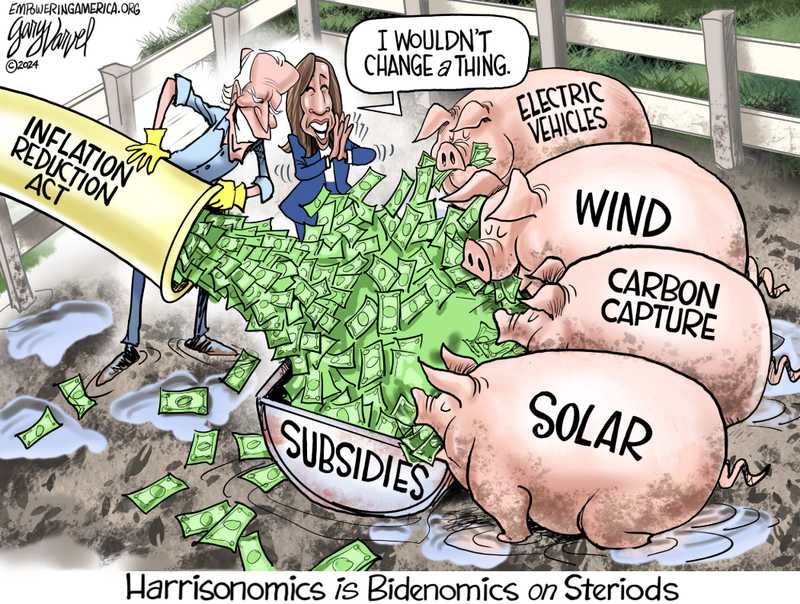
In a campaign speech Biden said, “We passed the biggest investment in history to combat climate change, because I believe climate change is the only existential threat we have. I mean that in a literal sense. Not a joke. If we don’t get it under control, we will have mortgaged not only the next generation, but mortgaged humanity. I believe that with every fiber of my being.” [source, as of 2023-09-28]

Democrat Kamala D. Harris

Harris’ campaign website said, “As President, she will unite Americans to tackle the climate crisis as she builds on this historic work, advances environmental justice, protects public lands and public health, increases resilience to climate disasters, lowers household energy costs, creates millions of new jobs, and continues to hold polluters accountable to secure clean air and water for all.” [source, as of 2024-09-09]

However, Voters Backed a Change in Priorities

Republican Ron DeSantis

DeSantis’ campaign website said he would, “Withdraw from Paris Climate Accords, Global Methane Pledge, and all ‘Net Zero’ commitments. Eliminate ESG regulations and prohibit government accounts and pensions from using ESG. […] Repeal Biden rules targeting gas stoves, furnaces, and appliances. Streamline the environmental review process for energy and infrastructure projects. Work with states to reduce time and duplication in permitting. Prevent abusive litigation by environmental groups and defund ideological activism.” [source, as of 2023-12-19]

Republican Donald Trump

Trump’s campaign website said, “President Trump will once again exit the horrendously unfair Paris Climate Accords and oppose all of the radical left’s Green New Deal policies that are designed to shut down the development of America’s abundant energy resources, which exceed any country’s in the world, including Russia and Saudi Arabia. […] President Trump will immediately stop all Joe Biden policies that distort energy markets, limit consumer choice, and drive-up costs on consumers, including insane wind subsidies, and DoE and EPA regulations that prevent Americans from buying incandescent lightbulbs, gas stoves, quality dishwashers and shower heads, and much more.” [source, as of 2023-12-21]

Summary

No surprise that “elections have consequences.”  A change in leadership means a change in political doctrine and priorities, and in this case, reopening the file on natural as well as human contributions to weather and climate fluctuations and what to do about it.

Climatists Deny Natural Warming Factors


via Science Matters

https://ift.tt/KwtjB4S

July 10, 2025 at 10:56AM