The question – who pays for the solar power which has to be discarded?
Australia is awash with solar power. Like flooding rain, experts say we can’t store it all
Story by energy reporter Daniel Mercer
…
The number of homes and businesses with a solar installation clicked past 4 million — barely 20 years since there was practically none anywhere in the country.
…
But all of this solar is prompting some hard questions, and gnashing of teeth, for one, simple reason — there is, at times, too much solar power in Australia’s electricity systems to handle.
To deal with this abundance, experts say Australia needs to come to terms what appears a counter-intuitive argument.
It needs to accept that much of this solar will have to be wasted — or spilled — sometimes.
…
“The minimum demand problem typically happens in the middle of the day on weekend days when you have a lot of solar output but maybe not a lot of demand,” Dr Wonhas said.
“At that time, the electricity grid effectively becomes a little bit unstable.
The author goes on to waffle about all the wonderful investment in batteries, which even in the most optimistic growth forecasts at best will cover a few minutes of national energy storage.
My question stands. Someone has to lose.
Will the cost of unwanted solar be passed to the owners of rooftop solar installations? Will they sometimes have to live with having their power bill benefit slashed, live with their rooftop systems not offsetting their power bills as much as they thought?
How would the curtailing of expected revenue impact those fancy “no cost solar” contracts many low income householders signed, in which repayments are supposed to be charged to the grid buyback income? Do the contracts have a small print clause which makes homeowners liable for servicing the debt out of their own pocket, if solar revenues drop below an expected threshold?
Or will the cost of unwanted solar be loaded onto everyone elses energy bills, including the bills of poor people who live in high-rise apartments, who have no means of getting a foot in the door of the solar electricity bill rigging game?
Or will the Aussie government sell out the grandkids to the international banking cartel, by borrowing hundreds of billions of dollars to purchase additional battery storage capacity to soak up all that excess solar energy on the odd occasions it is generated, in the hope the stored power can be used before the batteries lose their charge?
Who is paying for those conventional generators which are being squeezed out of the market, but still have to be kept on standby, for those occasions when both solar and wind fail for a prolonged period of time? Like what happened in June this year, in the middle of our Southern Hemisphere winter?
Just how unstable will the grid become on a sunny day? Or an overcast and windless day? Or a bitterly cold windless night? Aussies are still adding rooftop solar every day, squeezing out reliable fossil fuel powered generators, making it more expensive all the time to keep such generators on standby.
Someone has to lose – and nobody is saying who.
I guess we Aussies are about to find out. My big gasoline generator is ready for action. I think I’m going to need it.
The overwhelming focus of the environmental movement over the past three decades and more has been the push to eliminate the use of hydrocarbon fuels and transform the world’s energy system into something based on supposedly cleaner wind and sun. This effort has always been doomed to failure, because energy produced by wind and sun does not work satisfactorily and is wildly too expensive. So it has long been obvious to the well-informed that this whole effort will inevitably go away at some point. But after the desperate cries of crisis and alarm from thousands of activists for decades on end, and after the trillions of dollars government funds invested, how could that possibly occur?
My prediction has long been that at some point the whole thing would just quietly fade away, as if it had never happened. It would become like dozens of other (admittedly less pervasive) environmental scares of my lifetime, from acid rain to gypsy moths to alar to bee colony collapse and many more. One day there would just be no more news stories about these things, and they would pass from public attention. Despite the much larger effort behind the climate scare, there is no reason that the same thing could not happen. Nobody who had promoted the scare would ever admit they were wrong. Those people would just move on to the next cause without mentioning that this one had been forgotten.
Frankly, with regard to the global warming scare, I thought that this would have occurred well before now. However, somehow trillions of dollars of government funding can have a magical effect of motivating those feasting on the bounty to keep the scare going.
But very recently, something significant seems to be changing. It’s not only that Donald Trump just decisively won the presidency on a promise of “drill, baby, drill”; or that Kamala Harris, to try to win the swing states, decided to back off her prior promises to ban fracking and internal combustion cars. As an example that something bigger may be going on, how about this: Do you even know that one of the big annual UN climate conferences just got under way in Baku, Azerbaijan?
These annual UN conferences have been big news for almost as long as I can remember. They started back in 1992 following the UN’s so-called Framework Convention on Climate Change; and they have occurred almost every year since, going by the name of “Conferences of Parties,” or “COP.” COP 21, held in Paris in 2015, was the meeting when the Paris Climate Agreement was signed, supposedly committing all the nations of the world to emissions reductions and energy transformations. Lots of big names showed up, including then U.S. President Barack Obama. The world press reacted with glee. There were hundreds upon hundreds of stories. Six years later, after a year off for the pandemic, it was COP 26, held in Glasgow, Scotland. The UK chaired the conference, and wowed the world with enhanced pledges of emissions reductions. No fewer than 120 heads of state attended, just a few highlights being UN secretary-general António Guterres, United States president Joe Biden, Canadian prime minister Justin Trudeau, Dutch prime minister Mark Rutte, Egyptian president Abdel Fattah el-Sisi, European Commission president Ursula von der Leyen, French president Emmanuel Macron, German chancellor Angela Merkel, Spanish prime minister Pedro Sánchez, Indian prime minister Narendra Modi, Indonesian president Joko Widodo, Israeli prime minister Naftali Bennett, Japanese prime minister Fumio Kishida, Nigerian president Muhammadu Buhari, Polish prime minister Mateusz Morawiecki, and Swedish prime minister Stefan Löfven. Again, the zone got flooded with press coverage.
By contrast, this year’s conference is passing largely under the radar. This year’s event goes by the name COP 29, now being held for the second year running in a petro-state (last year it was in Qatar). It would be an understatement to say that this conference has been totally overshadowed by the U.S. election. At the New York Times, one of their climate activist reporters, David Wallace-Wells bemoans the new situation in an article yesterday with the headline “Climate Change Is Losing Its Grip on Our Politics.” Excerpt:
[Donald Trump’s] election is . . . a confirmation of an international turn in the politics of warming as much as it is a sharp or distinctly American break. Yes, a global renewables boom is well underway, with worldwide investment in clean energy reaching $2 trillion this year and total solar capacity doubling since 2022. But the climate logic of that transition increasingly goes unspoken in all but the most committed corners, replaced by chin-scratching about energy politics. Governments have retreated from even their legally binding promises to decarbonize, trusting markets to deliver comparatively meager emissions reductions instead, and activists have been unable to generate meaningful public outrage at the walkback.
It’s almost as if nobody cares any more. This is most notable in Wallace-Wells’s list of who failed to show up — in summary, everybody important:
When the COP29 climate conference comes to an end next week, it will have concluded without an appearance by President Biden. . . . The president-elect isn’t attending, either. Neither is Vice President Kamala Harris. . . . Hardly any of the world’s most powerful leaders will be making an appearance in Baku, Azerbaijan . . . . President Xi Jinping of China won’t be there, and neither will Ursula von der Leyen, the president of the European Commission. President Emmanuel Macron of France, . . . is skipping the conference, too. Also missing will be Lula da Silva, who is the leader not just of Brazil but also of the Group of 20. As recently as the Glasgow summit in 2021, the annual climate confab was a who’s who of global power politics. These days, it’s more about who’s missing.
A separate New York Times article here notes that over 50,000 people will be attending this year’s conference, including participants, observers and media. That is a lot, but well down from around 70,000 last year. And what will they all be doing? It seems that the main point of the meeting is the attempt to reach a new “climate finance agreement “ — otherwise known as the effort by the governing cliques in developing countries to shake down the rich countries for sums in excess of $100 billion per year, using the cover of “climate” to fill their Swiss bank accounts. From Reuters, yesterday:
The main task for nearly 200 countries at the U.N.’s COP29 climate summit is to broker a deal that ensures up to trillions of dollars in financing for climate projects worldwide. . . . Wealthy countries pledged in 2009 to contribute $100 billion a year to help developing nations cope with the costs of a transition to clean energy and adapting to the conditions of a warming world. . . . Those payments began in 2020 but were only fully met in 2022. The $100 billion pledge expires this year. Countries are negotiating a higher target for payments starting next year. . . .
Yes, outgoing President Biden fell for this scam and sent off billions of dollars of U.S. taxpayer funds. Put this at the top of President Trump’s agenda: zero this one out. Once it becomes clear that the U.S. isn’t going along any more, maybe we can even save the annual expense of sending thousands of people off to these remote corners of the world.
Crop yields have more than doubled since 1961. The press reports this as a 21% decline. “between 1961 and 2021, climate change reduced global agricultural yield by 21%.” How agriculture is exacerbating global warming | S&P Global Commodity Insights Crop … Continue reading →
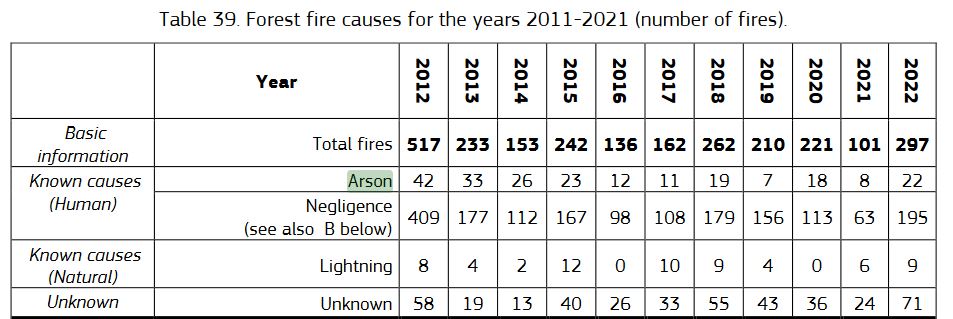
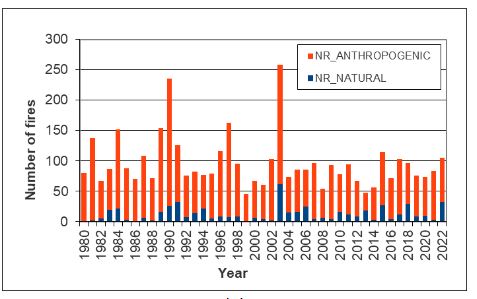
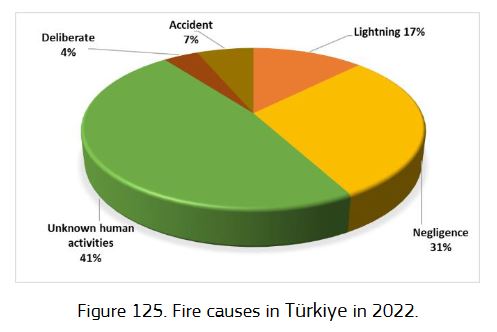
In Knowing Your Arson from Your Elbow, I skated over some of what I could find out about arson and wildfires, and promised to return with more. A year passed with no addition: but see more discussion under John’s piece, plus my transcript of the BBC’s coverage of the 2024 Greek wildfires. But yesterday I wondered whether the 2023 EFFIS report was out yet. It wasn’t. But I discovered that in the original blog post, I had not referred to the 2022 EFFIS report, which contains a few nuggets on arson in Europe.
EFFIS stands for European Forest Fire Information Service. While seemingly funded by the EU, external countries contribute to it, including North African and Middle Eastern countries with a Mediterranean coast. The annual reports consist of a mini-report on the year’s fires from all the constituent countries. There are also broader scale statistics, so that we can examine trends, if we care to. Of course, we don’t need to look at the actual data, do we? We already know how wildfires are changing thanks to Teh Climate Emergency.
Some countries, but not all, include data on the causes of fires. As this series is trying to get to the bottom of how important arson is as a cause of wildfires, it’s useful information. Now, it’s a long and dry document; I didn’t read it all. Instead I whizzed through instances of “arson” and “lightning” and otherwise skimmed for identified causes. Here’s a summary of what I found.
Reminder: fires can have natural or artificial causes. Dry lightning is almost the only natural cause. The artificial causes may be accident, infrastructure failure, carelessness, or arson.
Austria
82% of fires (178) human-caused. Negligence about 50%, discarded cigarettes 20%, hot ashes (presumably barbecues) 15%, arson suspected 10%. “The majority of naturally caused fires remained incipient or very small fires, similar to recent years.”
Bulgaria
The main causes for the forest fires during 2022 are as follows:
Carelessness – 321 in number (62%);
Arson – 16 in number (3%);
Natural – 21 in number (4%);
Unknown – 158 in number (31%).
Croatia – no data on causes.
Cyprus
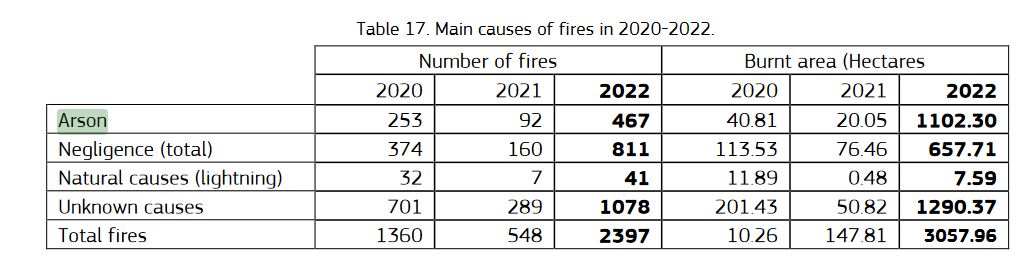
“Out of the 89 forest fires that occurred in Cyprus during 2022, 23 forest fires (26%) were of unknown origin. Regarding forest fires with known cause, most fires were intentionally set (35 fires – 53%). A percentage of 8% is due to natural causes (lightning), whilst the remaining percentage, amounting to 39%, is attributed to human negligence.”
Czechia
“The main causes for the forest fires are usually:
• Negligence 52%
• Human caused 33%”
Estonia
“In 2022, 12 of the 26 fires were of unknown origin, one was caused by lightning and the rest were of human origin, mostly vegetation management.”
Finland
“The most common cause of wildfires in Finland was human actions. These caused more than 70%, mainly from accidents. The second biggest reason was natural (less than 10% of fires). The reason for the fire could not be found in over 10% of the cases.”
France
“Only 6 312 fires, or 33% of the total, have a known cause. This percentage, higher than the 2006-2021 average of 26% of fires with a known cause, reflects progress in the search for causes. Of these fires with a known cause :
330 were attributed to a natural cause (lightning), i.e. 1% of all fires or 2% of fires with a known cause, which is below the average of 7% of fires with a known cause, and a far cry from the 2006 record (580 fires or 23% of known causes).
4 119 fires were accidental, i.e. 22% of all fires, or 67% of fires with a known cause, which is close to the average.
1 863 fires were of deliberate origin, i.e. 10% of all fires or 31% of fires with a known cause, which is slightly higher than the average of 27% of known causes.”
Germany
Greece – no data on causes.
Hungary
“99 % of forest fires are human induced (negligence or arson). Most fires are induced by negligence (adults and infants) and only a small proportion of fires are caused by arsonists. Typical forest fire causes are the incorrectly extinguished fires of hikers, illicit agricultural fires, discarded cigarette butts and sometimes slash burning.”
Ireland – no data on causes.
Italy
“Some 2% of forest fires are due to natural causes (lightning). This phenomenon is growing in the north-east of the country. With regard to man-made and intentional fires, the most frequent motivations are the renewal of pastures, while further reasons are linked to hunting activity, social unrest and pyromania. Unintentional causes are mainly due to activities of burning plant debris generated by agricultural activities as well as to recreational activities.”
Latvia – no data on causes.
Lithuania
“In many cases, the ignition source for fires is associated with traditional agricultural burning practices, although the fire causes for the majority of fire incidents remained unknown.”
Netherlands
“Anecdotal evidence suggests that the number of fires ignited by natural causes (lightning) or due to working activities near vegetation (EFFIS classification 304 –‘Works’) in the Netherlands is very small, with the great majority of fires caused by human behaviour (deliberate or accidental).”
Norway
“The primary triggers of forest and wildland fires are typically man-made. Examples: burning debris or grass in the spring, activities related to forestry, ignition by purpose etc. The primary natural cause is lightning during thunderstorms. These occurrences can lead to fires either instantaneously, or they might manifest the following day, ignited by the drying process.”
Poland
“Human activity was the main cause of forest fires; specifically arson represented almost half of the fires (40.93%), followed by negligence (27.88%) and accident (4.56%), whereas unknown causes accounted for 25.8%.”
Portugal
Republic of North Macedonia – no data on causes.
Romania
Serbia
Slovakia
Slovenia
“In 2022, 76 fires (35%) were of unknown origin. Of the remaining fires, 59 (27%) were deliberately started, 12 (6%) were of natural origin and the remaining 70 (32%) were reported as accidental or negligent, mostly because of agricultural burnings,”
Spain – no data on causes.
Sweden
“During 2022 almost half of the fires had unknown causes (46 %) and 15% were deliberate. 14% were caused by use of fire, 5% known but not specified, 5% recreation and 4% lightning.”
Switzerland
Turkey
Ukraine
I don’t know if Ukraine has contributed to these reports in the past, or whether this year’s entry is part of aligning itself with the EU. Either way, as you may imagine, there were a lot of fires in Ukraine caused by battles in 2022. Of course fire is and always will be a weapon of war, even in World War 4 (sensu Einstein). Recent innovations include drones dropping thermite, which one may assume to be about the most terrifying thing to have dropped on you in the height of summer.
United Kingdom – no data on causes.
Algeria – no data on causes.
Israel – no data on causes.
Lebanon
“A total of 73.59 % of the fires had unknown causes. Neglect was accounted for 15.37% of all fire causes while 10.16% of fire causes was due to Arson.”
Morocco – no data on causes.
Summary
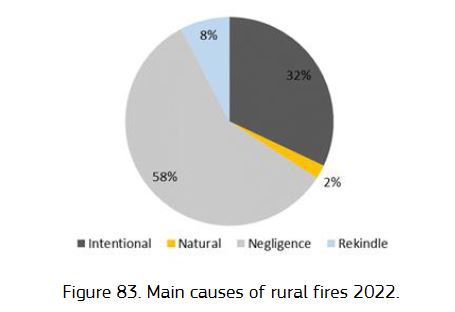
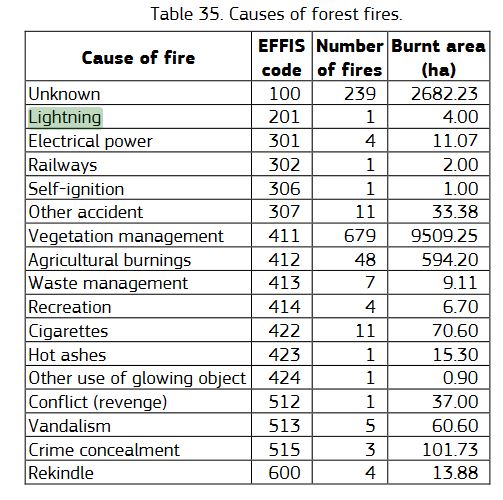
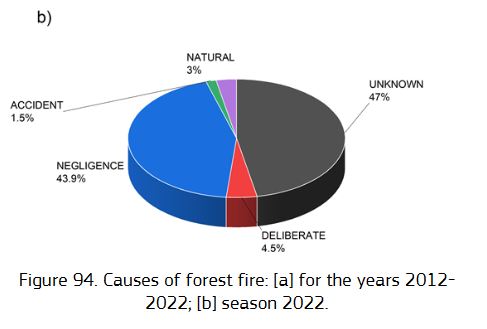
This canvassing of 2022 data shows that natural fires are a small or very small percentage of all fires (1-5% ish for the most part). That is the size of the problem that climate change is taking a wrench to. (ASTERISK: this says nothing about the consequences of fires, once they have ignited.) Accidents are more frequent than deliberately set fires, though the figures are often quite close and sometimes the other way (e.g. Cyprus).
The cynic says that the important people will never admit arson into the conversation. It is politically expedient to put all the blame on Teh Climate Emergency, rather than give a more balanced but necessarily less clear picture.
In choosing who to blame, the important people have chosen you, dear reader, although you were not there. The guy with the bic lighter and the jerry can does not matter in this crime scene. Rather than blame individuals for these grave conflagrations, they have to blame everyone for them. That gives them the excuse to enact laws that will do nothing to curtail wildfires, but will harm people who are just trying to get on. There is a degree of insecurity here: they do not trust us, the plebs, to understand a nuanced argument. Instead, fires have to be “caused” by Teh Climate Emergency, injected with steroids or something thanks to our diabolical use of a 2004 Land Cruiser.
The people whose job it is to fight the fires are far more interested in the facts. A fair few paragraphs are wasted damning the character of our shifting climate in this annual report, but it’s obvious that the serious people see this as irrelevant. Why? Because they can’t hose Teh Climate Emergency down, or cut a firebreak in it, or put it in cuffs and take it away.
A final ecological point, which I have made before: fire-adapted habitats that do not catch fire get more and more dangerous every year, until they do catch fire. At that point hot hell rages, and it is the fault of Teh Climate Emergency, and not 30 years of fuel building, a typical hot dry Mediterranean summer, and a spark.
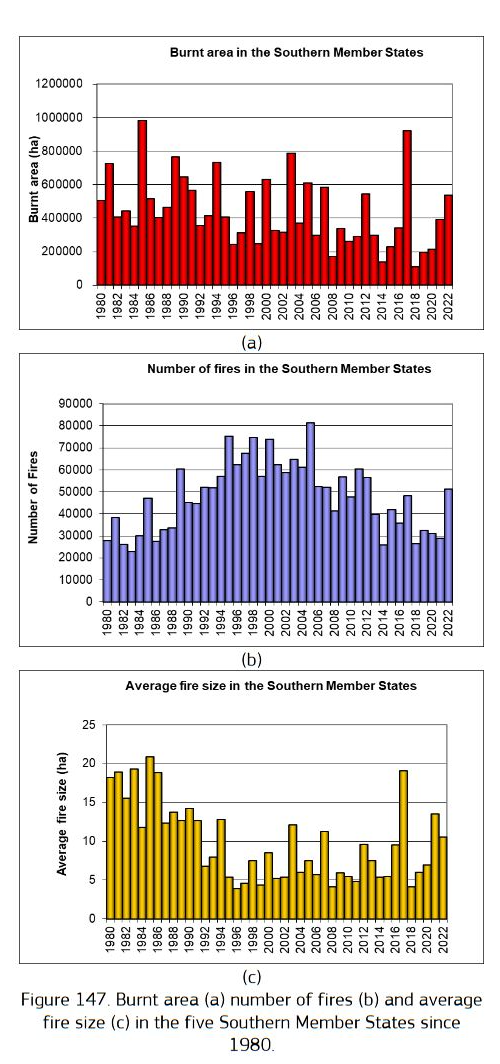
This figure shows wildfire statistics for the 5 southern EU states [Portugal, Spain, France, Italy and Greece] from 1980-2022. I can see the fingerprints of Teh Climate Emergency. Can’t you?