Author: Iowa Climate Science Education

Steeper Road for Zero-Emissions Vehicles

“A recent survey by the American Automobile Association (AAA) found that only 16% of potential buyers were either “likely” or “very likely” to buy a fully electric vehicle as their next car, … down from 25% in 2022 and was the lowest level of EV interest recorded by AAA surveys since 2019.”

The road to adoption of Zero Emissions Vehicles (ZEVs) is growing steeper. For over two decades, states used incentives and mandates to try to force a transition from gasoline vehicles to ZEVs. But softening market demand, shifting federal policies, and poor economics threaten to halt the ZEV revolution in the United States.

Zero Emissions Vehicles are cars and trucks that produce no tailpipe emissions. These are either electric vehicles (EVs) or hydrogen vehicles. California is the only state with a significant number of hydrogen cars, but its hydrogen car population is declining, so ZEVs mean EVs in practice.

Air pollution reached hazardous levels in the 1950s. The expanding population and automobile fleet in Los Angeles generated recurring episodes of smog, reducing visibility, causing nausea, and burning eyes. As a child, I recall having our car windows coated by pollutants from the steel mills of Gary, Indiana during a drive-by, forcing us to stop to clean our windshield.

To combat worsening air pollution, all states enacted legislation by 1970. Congress passed the Clean Air Act in 1963 and established the Environmental Protection Agency (EPA) as part of the Clean Air Act of 1970.

Early vehicle pollution regulations were enormously successful eliminating harmful vehicle exhaust. Unleaded gasoline, catalytic converters, and particulate filters dropped volatile organic compound emissions per mile by 98 percent from 1970 to 2023. Carbon dioxide (CO2) and water vapor remain the only significant gases exhausted from today’s gasoline vehicles.
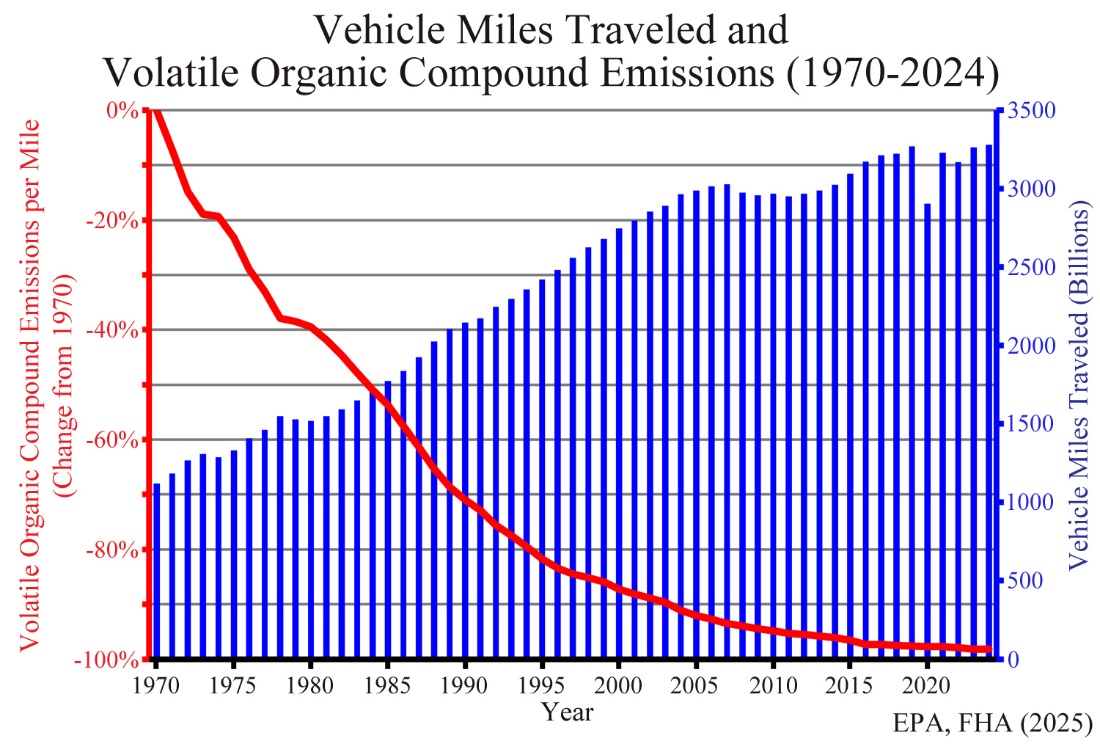
With hazardous emissions all but eliminated, the primary purpose of ZEV regulations is to force a transition to electric vehicles to reduce greenhouse gas emissions, primarily CO2. The first Zero Emissions Vehicle regulation was adopted by California in 1990. Today, 22 states have ZEV regulations, many requiring up to 100 percent of new car sales to be EVs by a future date, such as 2050. But the US ZEV transition has stalled due to three factors—weakening demand, changing federal policies, and poor economics.

The US market share of Battery Electric Vehicles (BEVs) in the second quarter of 2025 was only 7 percent of car sales, down from over 8 percent during last November, December, and January. BEV share in the US has been flat since spring 2023.

A recent survey by the American Automobile Association (AAA) found that only 16% of potential buyers were either “likely” or “very likely” to buy a fully electric vehicle as their next car, while 63% were “unlikely/very unlikely.” The “likely/very likely” category was down from 25% in 2022 and was the lowest level of EV interest recorded by AAA surveys since 2019.

Under President Joe Biden, the federal government provided a wide array of tax credits, subsidies, and loans for EVs. President Donald Trump shifted policy efforts to “eliminate the electric vehicle mandate,” including ending subsidies and mandates and rolling back state ZEV regulations.

Congress passed the One Big Beautiful Bill Act and President Trump signed it this month. The act eliminates tax credits for purchasing a new EV (up to $7,500) and a used EV (up to $4,000), effective September 30 of this year. Loss of tax credits will increase the cost of EVs, likely forcing US EV market share below 7% by the end of this year.

The 1970 Clean Air Act assigned responsibility for air pollution to the EPA but allowed the EPA to grant waivers to states for regulations that were stricter than federal limits. California has received more than 100 waivers under the Clean Air Act. Other states are allowed to adopt California pollution regulations. State ZEV standards require a waiver from the EPA.

But in June, President Trump signed three resolutions that rescinded California’s ZEV mandates. The principal resolution revoked the Clean Air Act waiver to California that was granted during the Biden administration. The waiver had allowed the state’s Advanced Clean Cars II regulation, which mandated that all light vehicles sold in California by 2035 must be zero emissions. The waiver also allowed Colorado, Maryland, Massachusetts, New Jersey, New York, Pennsylvania, Washington, and other states to adopt California’s regulations.

Another resolution signed by President Trump rescinded the EPA waiver that authorized California’s Advanced Clean Fleets regulation, which began January 2024. The ACF forced new heavy-duty trucks registered in California to be zero-emissions. Prior to the Trump rollback, trucking companies wrestled with severe cost, weight, and vehicle range issues of electric trucks mandated by the regulation.

California immediately sued the federal government to restore the EPA waivers and revive ZEV mandates. But without a legal victory, state ZEV mandates are dead in the US, at least until a new federal administration is elected.

Without federal tax credits and state ZEV mandates, vehicle purchasers face the full brunt of the unfavorable economics of EVs.  Advantages of EVs include the ability to charge at home and lower cost of operation for small daily travel distances. But their economic disadvantages include higher purchase prices, heavier vehicle weight, shorter driving range, higher maintenance and repair costs, higher insurance costs, and rising licensing fees.

The average US electric car purchase price in May was $57,734, about 17% higher than the average price for a gasoline car. Cancellation of the EV purchase tax credit will push this difference to over 20%. Electric trucks and buses are two to three times as expensive as diesel alternatives.

Thousand-pound EV car batteries are needed for a driving range approaching that of internal combustion engine (ICE) cars. As a result, EVs tend to be about 50% heavier than ICE cars. The 2024 Chevy Silverado EV weighs over 8,000 pounds, a four-ton pickup truck! Greater weight means that tires wear out sooner, raising maintenance costs. States receive no gasoline taxes from EVs, so states are now imposing EV license fees for road maintenance. EV road fees should be higher because of their weight.

Hertz Rental purchased 60,000 EVs, but found that maintenance, repair, and insurance costs were higher than ICE rentals, so they sold much of their EV fleet. An EV battery damaged in a collision must be replaced, a $5,000 to $20,000 charge. US insurance rates for EVs may be 70% higher.

Poor market demand, a halt to federal EV tax credits, the rollback of state ZEV regulations, and higher economic costs threaten to halt the ZEV revolution.

——————

Steve Goreham is a speaker on energy, the environment, and public policy and author of the bestselling book Green Breakdown: The Coming Renewable Energy Failure. His previous posts at MasterResource are here.

The post Steeper Road for Zero-Emissions Vehicles appeared first on Master Resource.

via Master Resource

https://ift.tt/TbUF6pI

July 23, 2025 at 01:06AM

Energy Secretary Chris Wright to IEA: Reform or the US Exits

From Tilak Doshi’s Substack

Tilak Doshi

The International Energy Agency (IEA), established in 1974 in the wake of the Arab oil embargo, was founded with a clear and vital mission: to ensure energy security for its member nations, with coordinated oil stockpiling and rigorous data and analysis to guide energy planning and investment. For decades, it served as a beacon of pragmatic, evidence-based policymaking. It was also an important source of data and energy best practice for policymakers of non-member states around the world.

Tilak’s Substack is a reader-supported publication. To receive new posts and support my work, consider becoming a free or paid subscriber.

However, like other major global institutions such as the World Bank and the International Monetary Fund, the IEA has strayed far from its original charter, as I have written about extensively (here, here and here). Over the past decade or so, it has morphed into a mouthpiece for the progressive-Leftist establishment, particularly the Brussels-based European Union elite and the US Democratic Party, peddling climate alarmism and promoting unrealistic ‘Net Zero’ policies aligned with the Paris Agreement. This ideological capture has undermined its credibility.

On Tuesday, the US Energy Secretary Chris Wright expressed his determination to either reform the IEA or withdraw from it — taking with it 18% of the agency’s budget. Mr Wright’s threat is a clarion call for accountability for an institution that should once again be made fit-for-purpose. This move is not an isolated act but part of a broader counter-revolution in energy policy under President Donald Trump’s administration. President Trump and his senior policy team seek to dismantle the politicised narratives that have infiltrated global institutions.

The IEA’s Fall from Grace

The IEA’s original mandate was straightforward: to safeguard energy security for its 31 member countries, primarily by coordinating responses to supply disruptions and providing data-driven insights for energy markets. Yet, over the past decade, the agency has pivoted to become a cheerleader for renewable energy while demonising fossil fuels, which still account for roughly 80% of global energy consumption. Its forecasts, once grounded in empirical analysis, now often reflect wishful thinking, overestimating the adoption rates of renewable energy and electric vehicles (EVs) while downplaying the enduring role of oil, gas and coal. This shift mirrors the priorities of the EU’s technocratic elite in Brussels and the US Democratic Party, which have embraced climate alarmism as a central tenet of their political identity.

The IEA’s transformation into a promoter of ‘decarbonisation’ narratives is not merely a departure from its mission but a betrayal of its responsibility to provide objective analysis. This betrayal is not restricted to the objective interests of its own OECD members. By giving credence to the globalist climate agenda and presumptions of an impending climate catastrophe, it has sided with the predilections of an affluent, virtue-signalling elite in the West against the needs of the poorest citizens of developing countries. These countries need access to cheap fossil fuels for their economic growth aspirations above all. There are no examples of countries attaining modern Western standards of living by dependence on intermittent, “thermodynamically incompetent” renewable energy technologies.

The IEA’s rosy scenario for renewable energy growth in its annual World Energy Outlook reports is called the ‘Stated Policies Scenario’ (STEPS), which assumes, unrealistically, that governments will successfully meet their clean energy commitments on schedule. It often ignores or downplays the intermittency of wind and solar and the costs of maintaining dispatchable power plants when the wind is not blowing or the sun is not shining. It adopts unrealistic assumptions of technical progress and lowballs the high costs of grid-scale storage. Land-use conflicts, loss of biodiversity and adverse impacts on fauna inherent in sprawling renewable projects are also ignored.

Its dismissive treatment of fossil fuels disregards their critical role in powering industrial economies and lifting billions out of poverty in developing nations. This bias has real-world consequences: misguided policies based on IEA projections can lead to energy shortages, higher costs and economic disruption, as seen in Europe’s energy crisis following its overreliance on renewables while cutting back on coal and nuclear power. This worsened after Europe banned piped natural gas imports from Russia after the start of the Ukraine war.

Chris Wright, a seasoned energy executive and sceptic of the ‘energy transition’ dogma, has rightly called out the IEA’s unrealistic forecasts. In his Bloomberg interview, he said: “We will do one of two things: we will reform the way the IEA operates or we will withdraw. My strong preference is to reform it.” He warned that the agency’s current trajectory undermines its credibility and risks misleading policymakers and investors.

His ultimatum — reform or face US withdrawal — reflects a growing frustration with the IEA’s alignment with the progressive-Leftist agenda. The US, as the agency’s largest single funder, has significant leverage to demand change. Wright’s stance is not merely a negotiating tactic but a reflection of a broader shift in US energy policy under Trump, which prioritises energy realism over ideological purity.

The Trump Administration’s Energy Counter-Revolution

Wright’s push to reform or exit the IEA is part of a larger movement within the Trump administration to reverse what has been described as the ‘long march through the institutions’ by progressive ideologies. This phenomenon, well-documented by the Manhattan Institute in its statement published on Monday on higher education, refers to the gradual infiltration of academia, media and global institutions by ideas rooted in neo-Marxism, DEI (diversity, equity, inclusion) mandates and climate alarmism. These ideologies have reshaped institutions like the IEA, World Bank and IMF, turning them into purveyors of approved narratives rather than objective arbiters of policy.

The Trump administration has taken decisive steps to counter this trend. In 2017, the US withdrew from the Paris Agreement under President Trump’s first term. He rejected the notion that unilateral emissions cuts by Western nations could meaningfully address global climate challenges while China and India continue to expand their coal-fired power capacity. In his second term as President, Trump withdrew from the Paris Agreement once again this year after his predecessor, President Biden, re-enrolled the US as a participant in the UN programme in 2021.

Similarly, the US exited the World Health Organisation (WHO) when it became clear that the agency’s priorities no longer aligned with America’s ‘Make America Healthy Again’ (MAHA) ambitions. The WHO was criticised particularly after its handling of the COVID-19 pandemic. These moves signal a broader rejection of globalist ‘consensus’ views that prioritise ideological conformity over national interests.

In the energy sector, Trump’s ‘energy dominance’ agenda has revitalised the US fossil fuel industry, rolling back the anti-energy policies of the Obama and Biden administrations. From approving pipelines to easing regulations on drilling, the administration has prioritised affordable, reliable energy over the costly and impractical push for Net Zero. The recent passage of the Big Beautiful Bill Act aims to “rapidly eliminate the market distortions and costs imposed on taxpayers by so-called ‘green’ energy subsidies’” for solar, wind, electric vehicle and other ‘green’ technologies. President Trump’s ‘energy dominance’ agenda has left the global climate juggernaut on the brink of collapse as other nations begin to question the feasibility of rapid decarbonisation in the face of energy security concerns.

Another example of President Trump’s counter-revolution in energy and climate change policies can be seen in the his administration’s efforts to restore scientific integrity at NASA. For years, the agency’s National Climate Assessments were criticised for promoting politicised narratives over rigorous science. These reports, often cited by climate alarmists, relied on speculative models and exaggerated worst-case scenarios to justify aggressive decarbonisation policies. According to Charles Rotter of Watts Up With That?, the National Climate Assessment has “long been a centrepiece in the grand theatre of climate fear, projecting dire futures with a laughable level of pseudo-certainty”.

In a bold move, NASA has begun removing these assessments from its website, signalling a return to the scientific method. Gregory Wrightstone, Executive Director of the CO2 Coalition stated that: “We applaud the brave leaders at NASA who are taking the bold steps needed to begin the process of bringing the scientific method back into government scientific agencies. For far too long, real science has been replaced by political science, consensus science and blatant misinformation.”

Further reinforcing this commitment, Trump signed an executive order on May 23rd, mandating “gold standard” scientific practices across federal agencies. This order aims to ensure that government-funded science is transparent, reproducible and free from political agendas. It requires arms-length peer review processes for accountability in reporting research results. The IEA, though not a US agency, would do well to heed this example. Its forecasts, which increasingly resemble advocacy rather than analysis, fail the test of scientific rigour and undermine its credibility as a global authority on energy.

The Long March and its Discontents

The IEA’s drift is emblematic of a broader trend across global institutions. The World Bank and IMF, originally tasked with fostering economic stability and development, have increasingly embraced climate-centric agendas that prioritise ‘sustainability’ – a weasel word of choice for environmental zealots and ESG enthusiasts – over economic growth. As I have written elsewhere, these institutions often push policies that penalise fossil fuel investments in developing nations, effectively denying them the affordable energy needed to industrialise and alleviate poverty.

This reflects the influence of the progressive-Leftist establishment, which has captured key decision-making bodies in Brussels, various EU capitals and, until recently, Washington, DC. The Trump administration’s pushback against this ideological capture is not limited to energy policy. Its efforts to dismantle DEI initiatives in universities and federal agencies, as well as its rejection of progressive ideology, demonstrate a broader commitment to restoring meritocracy and reason in American institutions. The IEA, as a critical player in global energy markets, cannot be allowed to remain a vehicle for these ideologies. Mr Wright’s demand for reform is a call to return the agency to its roots as a neutral, data-driven institution focused on energy security and economic prosperity.

The Path Forward: Reform or Exit

The stakes for the IEA are high. If it fails to reform, the US withdrawal could trigger a cascade of defections, as other nations sceptical of the Net Zero agenda such as New Zealand reassess their participation. A diminished IEA would struggle to maintain its global influence, leaving a vacuum that could be filled by more pragmatic organisations such as the US Energy Information Administration or the OPEC Secretariat, both of which already collect international energy data and conduct policy analysis.

Alternatively, root-and-branch reform – necessitating the removal of senior management including its Executive Director Fatih Birol – could restore the agency’s credibility, ensuring that its forecasts and policy recommendations reflect the realities of global energy demand, technological feasibility and economic constraints. Reform would require the IEA to abandon its advocacy of renewables at the expense of fossil fuels and focus on providing balanced, transparent analyses. This includes acknowledging the limitations of current renewable technologies, the critical role of fossil fuels for modern industrial prosperity and the importance of energy access for developing nations. It also means engaging with a broader range of stakeholders, including industry experts and policymakers from energy-producing nations, rather than catering to the narrow interests of the EU and progressive activists.

Chris Wright’s ultimatum to the IEA is a pivotal moment in the global energy debate. It reflects a growing recognition that institutions like the IEA, World Bank and IMF have been co-opted by a progressive-Leftist agenda that prioritises ideology over evidence. The Trump administration’s ‘energy dominance’ agenda, coupled with its broader efforts to restore scientific integrity and reject globalist dogmas, offers a blueprint for reclaiming these institutions. The IEA must choose: reform and return to its mission of ensuring energy security, or risk irrelevance as the US and potentially other countries exit the organisation. In an era of energy realism, the world cannot afford institutions that peddle favoured narratives at the expense of facts and rigorous, unbiased analysis.

A version of this article was first published in The Daily Sceptic (https://ift.tt/tZHybD1)


Discover more from Watts Up With That?

Subscribe to get the latest posts sent to your email.

via Watts Up With That?

https://ift.tt/8JTq5jd

July 23, 2025 at 12:08AM

Hail No! NBC, Climate Change Isn’t Making Hail More Damaging

In the NBC News video report titled “How climate change could make hail storms even more destructive,” viewers are warned that stronger storm updrafts caused by climate change might supercharge hailstones, making them up to 75 percent larger. This claim is false and misleading, lacking any evidentiary support. Scientific data—including that from the Intergovernmental Panel of Climate Change (IPCC)’s Sixth Assessment Report—shows no observable increase in hail intensity due to climate change. In fact, IPCC AR6 Chapter 12 concludes that there are no significant trends or projections of increased hail frequency or severity due to a warming climate.

Real-world data and atmospheric physics don’t align with NBC’s hype. Hail formation requires a very specific cocktail of atmospheric conditions, including strong updrafts and a freezing layer deep enough to support hail growth. Warmer temperatures tend to reduce the vertical depth of this freezing level, making it more difficult—not easier—for large hailstones to form and survive to ground level.

The most telling and absurd quote in the entire segment is this one: “Their latest research shows that climate change will make updrafts even stronger, which could make the biggest most destructive hail up to 75 percent larger…”. That statistic, plucked from speculative modeling and not grounded in observed trends, is presented as if it is established fact. Worse, it’s paired with ominous warnings about damage to crops and rising insurance claims, all without context or acknowledgment that hailstorms have long been a fact of life in agricultural regions.

Attributing hail damage trends to climate change is scientifically dubious and intellectually dishonest. Hail damage costs have increased over time primarily due to increased development and property values in hail-prone areas—not because hailstorms are getting worse. This mirrors the same pattern seen with hurricanes, tornadoes, and floods: more assets in harm’s way, not more severe weather, results in greater damage and higher costs.

A thorough analysis debunks the claim that hailstorms are intensifying. In fact, the data from the National Oceanic and Atmospheric Administration (NOAA) shows a slight decrease in reported significant hail events over recent decades. According to a 2019 peer reviewed study “The characteristics of United States hail reports: 1955-2014” says:

Hail days, in contrast to hail reports, show no national trend over the last 25 y. Regional and local influences on hail reporting are identified stemming from verification procedures and contributions from local officials. The change in the definition of severe hail size from 0.75 in (1.9 cm) to 1.00 in (2.5 cm) in 2010 has a particularly clear signature in the report statistics. The contribution of storm chasers and source of report factors beyond population to the hail dataset is also explored, and the difficulty in removing these changes discussed. The overall findings highlight the limitations and non-meteorological features present in hail observations.

Even the American Meteorological Society (AMS) in its journals has noted the difficulty of linking hail trends to climate change due to the limited reliability of long-term hail observations noting, “Estimating local‑scale hail frequency … or assessing long‑term trends in light of climate change are challenging tasks, particularly because direct, homogeneous, long‑term hail observations are mostly missing.”

Hail is notoriously hard to measure consistently over time. Its occurrence is often underreported in sparsely populated areas, and radar-based detection has only become reliable in recent decades. Thus, claims of increasing trends require more scrutiny than NBC or ICECHIP provides.

The IPCC’s Sixth Assessment Report clearly addresses hail concerns in Chapter 12,  stating: “There is low confidence in observed trends in hail and low confidence in the attribution of these trends to human influence.” It continues: “Future changes in hail are uncertain, and there is low confidence in model projections.”

Table 12.12 | on Page 90 – Chapter 12 of the UN IPCC Sixth Assessment Report. Emergence of Climate Impact Drivers (CIDs) in time periods, as assessed in this section. The color corresponds to the confidence of the region with the highest confidence: white colors indicate where evidence of a climate change signal is lacking or the signal is not present, leading to overall low confidence of an emerging signal. See the key at the bottom for the meaning of all colors. Note the section on Hail highlighted in yellow.

Massive hailstorms have occurred throughout history, long before anyone blamed climate change. The 1888 Moradabad hailstorm in India killed 246 people. The U.S. has recorded hailstones the size of volleyballs since the 1960s; no CO₂ fingerprint required. Looking at a deeper historical perspective quickly dismantles the “climate is causing it all” narrative pushed by NBC.

The real motivation behind NBC’s video seems to be continuing funding for a particular group of scientists, those participating in ICECHIP (Investigation of Convective Hail in the Plains), a project “made possible through the support of the U.S. National Science Foundation (NSF),” not an accurate assessment of hail threats. Nowhere on the site’s mission statement does ICECHIP mention climate change as a research objective. Their stated goal is to better understand the internal dynamics of hailstorms—not to link those storms to global warming aka climate change.

So, when NBC laments potential cuts to NSF funding, and suggests that the Trump administration threatens America’s ability to forecast weather hazards, it is not hard to see what’s really going on: special interests using climate change as a fear-inducing narrative to protect their federal funding.

Further, if we’re going to talk about research integrity, let’s ask why a group like ICECHIP would publicly tie its work to climate change only after securing federal funding. Their project materials don’t reference it, their mission statement doesn’t highlight it, and their methods are entirely focused on hail microphysics and not long-term climate attribution.

This is not to say that understanding hail formation isn’t important. It is. Improved hail forecasting can reduce economic losses and improve public safety. But turning every scientific endeavor into a climate crusade only erodes public trust in science. When every research grant proposal must include a climate angle, it encourages groupthink, skewing scientific priorities away from discovery and toward narrative compliance.

The United States has always experienced hail. It is an inherent feature of mid-latitude convective storms, particularly in spring and early summer. Suggesting with little or no evidence that recent hailstorms are somehow novel or worsening because of rising CO₂ is just propaganda.

NBC’s segment fails to question any of the claims made by the ICECHIP. NBC doesn’t reference the IPCC, it doesn’t compare historical hail trends, it fails examine the extent to which urban expansion in hail prone areas result in rising insurance payouts and rates, and it doesn’t even even distinguish between modeled projections and observed data.

Indeed, NBC’s hailstorm climate segment is a masterclass in misleading science communication, conflating speculation with certainty, omitting key data and historical context, and promoting a self-serving narrative designed to secure federal funding for a particular group of researchers. In this story, NBC acts like an advocacy organization rather than an objective news outlet.


Discover more from Watts Up With That?

Subscribe to get the latest posts sent to your email.

via Watts Up With That?

https://ift.tt/04A9Kdn

July 22, 2025 at 08:07PM

Why Should We Keep New Mexico’s Remaining Coal Plant in Service? It’s Essential.

By Jim Constantopoulos

Shut down New Mexico’s last remaining coal plant (Four Corners Generating Station), environmentalists say, and replace it with renewable energy. But coal is a practical fuel, affordable and dependable. Being generically against coal is no more useful than being generically against electricity. Electricity demand is rapidly rising. Electric vehicles, new AI data centers, and a growing economy simply mean we need more power. And we need reliable power.

While new additions of electricity generation remain dominated by intermittent wind and solar power, keeping what we already have on the grid will be critically important to meeting our energy needs and doing so affordably. Across the country, electricity prices have risen faster than the pace of inflation over the past few years. If we tear down our existing sources of reliable power at the very moment electricity demand begins to soar, even higher prices will be an inevitability.

With everyone I’ve encountered who is really immersed in energy issues, the common view is that we need every available energy source, ranging from renewables and nuclear power to coal, just to keep the lights on. Frankly, we all tend to take the on-demand delivery of electricity for granted. We shouldn’t. In just the past month, power demand eclipsed available supply in Louisiana, forcing the grid operator there to institute rolling blackouts (“load shed”) for 100,000 customers on a 90-degree day.

For years, the nation’s grid reliability regulators have been warning of emerging problems. In fact, the nation’s grid reliability watchdog warned that more than half of the nation could face the threat of blackouts over the next decade if we don’t take corrective action to boost our supply of power. This summer, the PJM interconnection grid operator said Maryland is at elevated risk of supply shortages during periods of peak demand. It may be hard to grasp, but we’re staring down a power supply crisis years in the making. Now, the collision of rapidly rising power demand with the loss of the nation’s coal fleet is coming to a head.

We desperately need the coal plants we have left, and the Department of Energy (DOE) has recognized it. In fact, Secretary of Energy Chris Wright recently issued an emergency order to keep a coal-fired power plant in Michigan running through the summer to bolster the MISO grid, which stretches from Louisiana all the way up through Michigan and Wisconsin. That plant was being forced off the grid 15 years before the end of its life by anti-coal regulatory policy. DOE’s position is a simple one: we can’t afford to lose existing plants with so many states critically short of power. The looming threat of power shortages is altering the national perspective about coal. Instead of a problem to solve, our coal plants are a critically important reliability backstop that we need as a bridge to our energy future.

For the foreseeable future, new sources of power should come on the shoulders of these reliability bulwarks, not in place of them. Rotating blackouts, rising prices and missed economic opportunities for lack of power are wholly avoidable if we simply embrace the full suite of energy resources at our disposal. Recognizing the ongoing importance of our coal plants is just the place to begin.

Dr. Jim Constantopoulos is a Professor of Geology and the Director of the Miles Mineral Museum at Eastern New Mexico University. 

This article was originally published by RealClearEnergy and made available via RealClearWire.


Discover more from Watts Up With That?

Subscribe to get the latest posts sent to your email.

via Watts Up With That?

https://ift.tt/wZ89lrB

July 22, 2025 at 04:05PM