Author: Iowa Climate Science Education

Leeds Professors: “Only 3 years left” to Avert Climate Catastrophe

Essay by Eric Worrall

Yet another climate deadline.

Only 3 years left – new study warns the world is running out of time to avoid the worst impacts of climate change

Published: July 20, 2025 2.20pm AEST

  1. Piers Forster Professor of Physical Climate Change; Director of the Priestley International Centre for Climate, University of Leeds
  2. Debbie Rosen Research and Innovation Development Manager for the Priestley Centre for Climate Futures, University of Leeds

Bad climate news is everywhere.  Africa is being hit particularly hard by climate change and extreme weather, impacting lives and livelihoods.

We are living in a world that is warming at the fastest rate since records began. Yet, governments have been slow to act.

But so far, only 25 countries, covering around 20% of global emissions, have submitted their plans, known as Nationally Determined Contributions. In Africa, they are Somalia, Zambia and Zimbabwe. This leaves 172 still to come. 

But arguably only one of the submitted plans – the UK’s – is compatible with the Paris Agreement.

Our report shows that human-caused global warming reached 1.36°C in 2024. This boosted average global temperatures (a combination of human-induced warming and natural variability in the climate system) to 1.52°C. In other words, the world has already reached the level where it has warmed so much that it cannot avoid significant impacts from climate change. There is no doubt we are in dangerous waters.

Just five of the G20 countries have submitted their 2035 plans: Canada, Brazil, Japan, the United States and the United Kingdom. But the G20 is responsible for around 80% of global emissions. This means that South Africa’s current G20 presidency can help to ensure that the world prioritises efforts to help developing countries finance their transition to a low-carbon economy.

Read more: https://theconversation.com/only-3-years-left-new-study-warns-the-world-is-running-out-of-time-to-avoid-the-worst-impacts-of-climate-change-261229

The referenced “our report”;

Indicators of Global Climate Change 2024: annual update of key indicators of the state of the climate system and human influence

Piers M. Forster,Chris Smith,Tristram Walsh,William F. Lamb,Robin Lamboll,Christophe Cassou,Mathias Hauser,Zeke Hausfather,June-Yi Lee,Matthew D. Palmer,Karina von Schuckmann,Aimée B. A. Slangen,Sophie Szopa,Blair Trewin,Jeongeun Yun,Nathan P. Gillett,Stuart Jenkins,H. Damon Matthews,Krishnan Raghavan,Aurélien Ribes,Joeri Rogelj,Debbie Rosen,Xuebin Zhang,Myles Allen,Lara Aleluia Reis,Robbie M. Andrew,Richard A. Betts,Alex Borger,Jiddu A. Broersma,Samantha N. Burgess,Lijing Cheng,Pierre Friedlingstein,Catia M. Domingues,Marco Gambarini,Thomas Gasser,Johannes Gütschow,Masayoshi Ishii,Christopher Kadow,John Kennedy,Rachel E. Killick,Paul B. Krummel,Aurélien Liné,Didier P. Monselesan,Colin Morice,Jens Mühle,Vaishali Naik,Glen P. Peters,Anna Pirani,Julia Pongratz,Jan C. Minx,Matthew Rigby,Robert Rohde,Abhishek Savita,Sonia I. Seneviratne,Peter Thorne,Christopher Wells,Luke M. Western,Guido R. van der Werf,Susan E. Wijffels,Valérie Masson-Delmotte,and Panmao Zhai

Abstract

In a rapidly changing climate, evidence-based decision-making benefits from up-to-date and timely information. Here we compile monitoring datasets (published at https://doi.org/10.5281/zenodo.15639576; Smith et al., 2025a) to produce updated estimates for key indicators of the state of the climate system: net emissions of greenhouse gases and short-lived climate forcers, greenhouse gas concentrations, radiative forcing, the Earth’s energy imbalance, surface temperature changes, warming attributed to human activities, the remaining carbon budget, and estimates of global temperature extremes. This year, we additionally include indicators for sea-level rise and land precipitation change. We follow methods as closely as possible to those used in the IPCC Sixth Assessment Report (AR6) Working Group One report.

The indicators show that human activities are increasing the Earth’s energy imbalance and driving faster sea-level rise compared to the AR6 assessment. For the 2015–2024 decade average, observed warming relative to 1850–1900 was 1.24 [1.11 to 1.35] °C, of which 1.22 [1.0 to 1.5] °C was human-induced. The 2024-observed best estimate of global surface temperature (1.52 °C) is well above the best estimate of human-caused warming (1.36 °C). However, the 2024 observed warming can still be regarded as a typical year, considering the human-induced warming level and the state of internal variability associated with the phase of El Niño and Atlantic variability. Human-induced warming has been increasing at a rate that is unprecedented in the instrumental record, reaching 0.27 [0.2–0.4] °C per decade over 2015–2024. This high rate of warming is caused by a combination of greenhouse gas emissions being at an all-time high of 53.6±5.2 Gt CO2e yr−1 over the last decade (2014–2023), as well as reductions in the strength of aerosol cooling. Despite this, there is evidence that the rate of increase in CO2 emissions over the last decade has slowed compared to the 2000s, and depending on societal choices, a continued series of these annual updates over the critical 2020s decade could track decreases or increases in the rate of the climatic changes presented here.

 – Discussion started: 05 May 2025

 – Revised: 11 Jun 2025

 – Accepted: 13 Jun 2025

 – Published: 19 Jun 2025

Read more: https://essd.copernicus.org/articles/17/2641/2025/

You have to delve into the study to find the 3 years reference;

The values in Table 8 are all greater than zero, implying that we have not yet emitted the amount of CO2 that would commit us to these levels of warming. However, including the uncertainty in ZEC (as in Table S8), non-CO2 emission and forcing uncertainty, and underrepresented Earth system feedbacks results in negative RCB estimates for limiting warming to low temperature limits with high likelihood. A negative RCB for a specific temperature limit would mean that the world is already committed to this amount of warming and that net negative emissions would therefore be required to return to the temperature limit after a period of overshoot. The assumption behind such a calculation is that we can treat the warming impact of positive and negative net emissions as approximately symmetric. While the claim of symmetry is likely valid for small emissions values, some model studies have shown that it holds less well for reversal of larger emissions (Canadell et al., 2021; Zickfeld et al., 2021; Vakilifard et al., 2022; Pelz et al., 2025). As such, larger exceedances of the RCB for a particular temperature target would decrease the likelihood that the temperature target could still be achieved by an equivalent amount of net negative emissions.

Note that the 50 % RCB estimate of 130 Gt CO2 would be exhausted in a little more than 3 years if global CO2 emissions remain at 2024 levels (42 Gt CO2 yr−1; see Table 1). This is not expected to correspond exactly to the time that 1.5 °C global warming level is reached due to uncertainty associated with committed warming from past CO2 emissions (the ZEC) as well as ongoing warming and cooling contributions from non-CO2 emissions. For comparison, our estimate of 2024 anthropogenic warming (1.36 °C) and the recent rate of increase (0.27 °C per decade) would suggest that continued emissions at current levels would cause human-induced global warming to reach 1.5 °C in approximately 5 years.

Read more: Same link as above

This deadline will no doubt join all the other 3 years or 5 years or 10 years to save the world nonsense deadlines which have come and gone. Even if we wanted to there is no plausible path to meaningfully reducing emissions in such a short timeframe.

The world has already touched 1.5C global warming, and nothing bad happened. This appears to have prompted some rather panicked spin, at least in some quarters, to downgrade 1.5C to more of a guideline than a climate emergency.

The most interesting part of the article for me was the reference to the US nationally determined contributions plan for 2035, which was submitted in December 2024 by the Biden administration. The Biden plan committed the USA to a 61-65% reduction in emissions compared to 2005.

That submission was effectively rendered null and void by President Trump’s withdrawal from the Paris Agreement. Perhaps in the UN bubble world the authors of the quoted article inhabit, the USA is still a full Paris Agreement partner. Or maybe they think President Trump is an anomaly, a brief pushback by conservative reactionaries before the inevitable return of business as usual.


Discover more from Watts Up With That?

Subscribe to get the latest posts sent to your email.

via Watts Up With That?

https://ift.tt/ZhPqY0a

July 21, 2025 at 04:01PM
Climate Oscillations 10: Aleutian Low – Beaufort Sea Anticyclone (ALBSA)

By Andy May

The Aleutian Low – Beaufort Sea Anticyclone climate index or ALBSA is designed to compare the Aleutian Low Pressure and the Beaufort Sea High Pressure Centers. The intent is to relate air circulation patterns in the North Pacific and Arctic to climate and the timing of spring sea ice and snow melt.

Calculation method:

The ALBSA index is calculated using 4 points from the NCEP/NCAR Reanalysis Dataset: The following 850mb geopotential height points are used in the calculation:

N: 75° N, 170° W

S: 50° N, 170° W

E: 55° N, 150° W

W: 55° N, 200° W (160° E)

ALBSA = [E – W] – [N – S]

Use of the ALBSA index

Christopher Cox and his colleagues at NOAA developed ALBSA as an indicator of snowmelt timing in the Pacific Arctic on the North Slope of Alaska (Cox, et al., 2019). The timing is influenced by the marine air drawn (advected) to the Beaufort Sea Arctic region from the Aleutian low pressure region. When air is drawn from the Aleutians to the Beaufort Sea, it warms the area, and an early snow melt is observed on the North Slope of Alaska. The pattern illustrated in figure 1 is for 2002 when an early snowmelt was observed in May.

Figure 1. The air circulation pattern for May 2002, when the North Slope snow melted early. The four points used in the computation of the ALBSA index are identified, the data used for the calculation is from the NCEP-NCAR reanalysis dataset. The precise points used are identified in the text above. The contours are temperature (K) and the arrows are wind vectors at 850 mb (~1.5 km). The blue dot is Utqiaġvik and the red dot is Oliktok, both towns are in Alaska. The dashed brown line is the high-pressure ridge. Source: (Cox, et al., 2019).

Figure 1 illustrates the typical circulation pattern for years with early melting snow and ice. The air from the Aleutian low pressure region moves eastward and then trends northward through the Bering Strait to the Chukchi and Beaufort Seas. The average ALBSA 850 mb geopotential height (GPH) anomaly in May 2002 was about 69 meters and for the entire spring (March-June) it was 91.1 meters.

For comparison the same map is presented for 1988 as figure 2, when the snowmelt was late. In that year it did not start until June.

Figure 2. A map of the ALBSA Index in 1988, a late snowmelt year. Notice the circulation is not through the Bering Strait, but to Northern Canada. The blue arrow is the Beaufort Sea anticyclone (“BSA”), with easterly winds, it only appears in late years. These winds delay the melt. “AL” identifies the Aleutian Low Pressure region. Source: (Cox, et al., 2019).

The major characteristic of late years is the presence of the Beaufort Sea Anticyclone (BSA), this pushes cold Arctic air to the North Slope which delays melting. For the month of June, the ALBSA 850 mb geopotential height (GPH) anomaly was 7.9 meters and for the 1988 spring it was -90.3 meters. That is the North-South difference was much larger than the east-west difference in 850 mb geopotential height.

Like many other climate oscillations, the ALBSA index has been trending positive in recent decades. That means the Beaufort Sea Anticyclone has been weakening, causing a warmer North Slope. This is illustrated in figure 3.

Figure 3. Both the spring ALBSA (gray) and the 5-year smoothed spring ALBSA (orange) are plotted. The late snowmelt year 1988, and the early snowmelt year of 2002 are marked. In addition, the 1977 and 1997 PDO climate shifts from post 8 are marked.

As illustrated in figure 1, the 2002 spring had an early melt and no Beaufort Sea Anticyclone. In that year the May ALBSA anomaly was +68.9 m and the average spring ALBSA anomaly was +91.1 m, the melt occurred May 23. In 1988 the melt was very late, June 18, and the spring average ALBSA anomaly was -90.3 m. That spring had a strong Beaufort Sea anticyclone, which kept the North Slope of Alaska cold for a longer period.

The correlation between ALBSA and HadCRUT5 is poor, and the trends do not match. However, it does correlate decently with the NPI, which was discussed in post #8. NPI and ALBSA are compared in figure 4. They are not perfectly correlated but they both trend positively since the 1980s.

Figure 4. A comparison of the ALBSA spring 850-mb GPH anomaly, both one-year and five-year averages to the full-year and five year average NPI from post #8.

ALBSA correlates with snowmelt in Northern Alaska and the onset of sea ice melting in the adjacent seas. It also captures some of the variability in the NPI.

Discussion

The timing of snow and sea ice melting is important because the albedo of ice and snow is very high, whereas the albedo of meltwater is very low. This contrast makes a significant difference in the absorption of solar radiation and the resulting warming rate of the surface and lower troposphere as the sun re-enters the polar sky in the spring. Measurements of absorbed energy on the North Slope of Alaska have shown that early melts, for example May 13, 2016, can absorb 30% or more solar energy than late melts, for example June 18, 2017 (Cox C., et al., 2018). Further, as sea ice melts, it allows heat trapped under the ice to escape into the atmosphere.

AR6 does not mention ALBSA or the NPI or discuss if they are reproduced in the CMIP6 climate models. However, given that the models do not reproduce the NAO or AO (see post 9) or the Aleutian Low very well (AR6, page 1381) we assume that ALBSA is not reproduced well by the models. The PDO is discussed in AR6, and it is related to both the NPI and ALBSA. The PDO is very poorly reproduced in the CMIP6 climate models (AR6, page 427 & 503). AR6 often refers to the PDO as “PDV” and claims that since the CMIP6 models cannot duplicate it, it must be random internal variablity, even though the PDO oscillations are statistically significant (Mantua, et al., 1997) & (Ebbesmeyer, et al., 1990).

It is logical that ALBSA affects the pattern of Northern Hemisphere warming and cooling, but it does not correlate well with HadCRUT5. The next post will discuss the Oceanic Niño Index or ONI, which is used to define the El Niño and La Niña ENSO states.

Download the bibliography here.

Previous posts in this series:

Musings on the AMO

The Bray Cycle and AMO

Climate Oscillations 1: The Regression

Climate Oscillations 2: The Western Hemisphere Warm Pool (WHWP)

Climate Oscillations 3: Northern Hemisphere Sea Ice Area

Climate Oscillations 4: The Length of Day (LOD)

Climate Oscillations 5: SAM

Climate Oscillations 6: Atlantic Meridional Model

Climate Oscillations 7: The Pacific mean SST

Climate Oscillations 8: The NPI and PDO

Climate Oscillations 9: Arctic & North Atlantic Oscillations


Discover more from Watts Up With That?

Subscribe to get the latest posts sent to your email.

via Watts Up With That?

https://ift.tt/pPjFOah

July 21, 2025 at 12:07PM

Climate Model Assumptions Contrary to Balloon Data

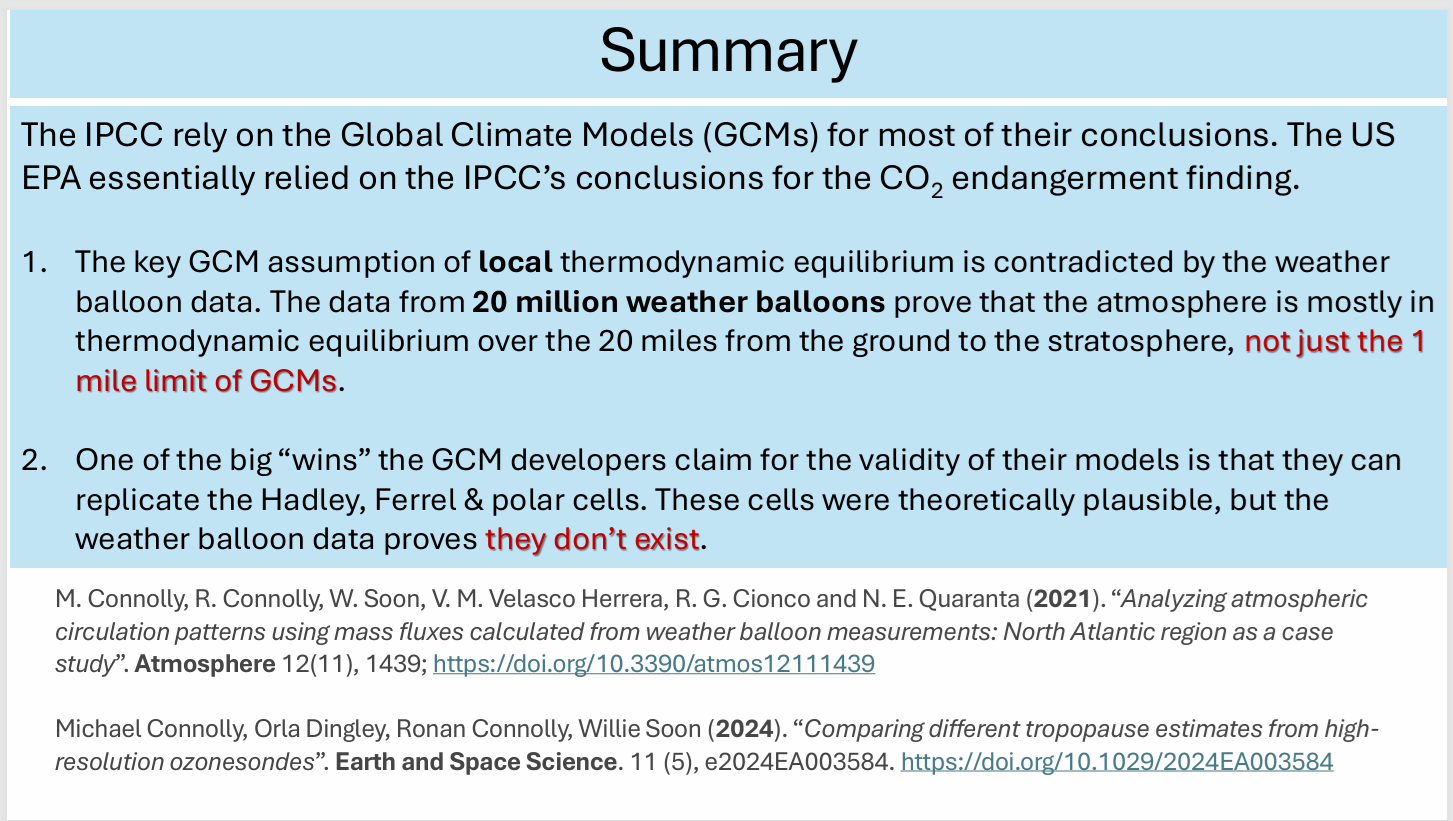
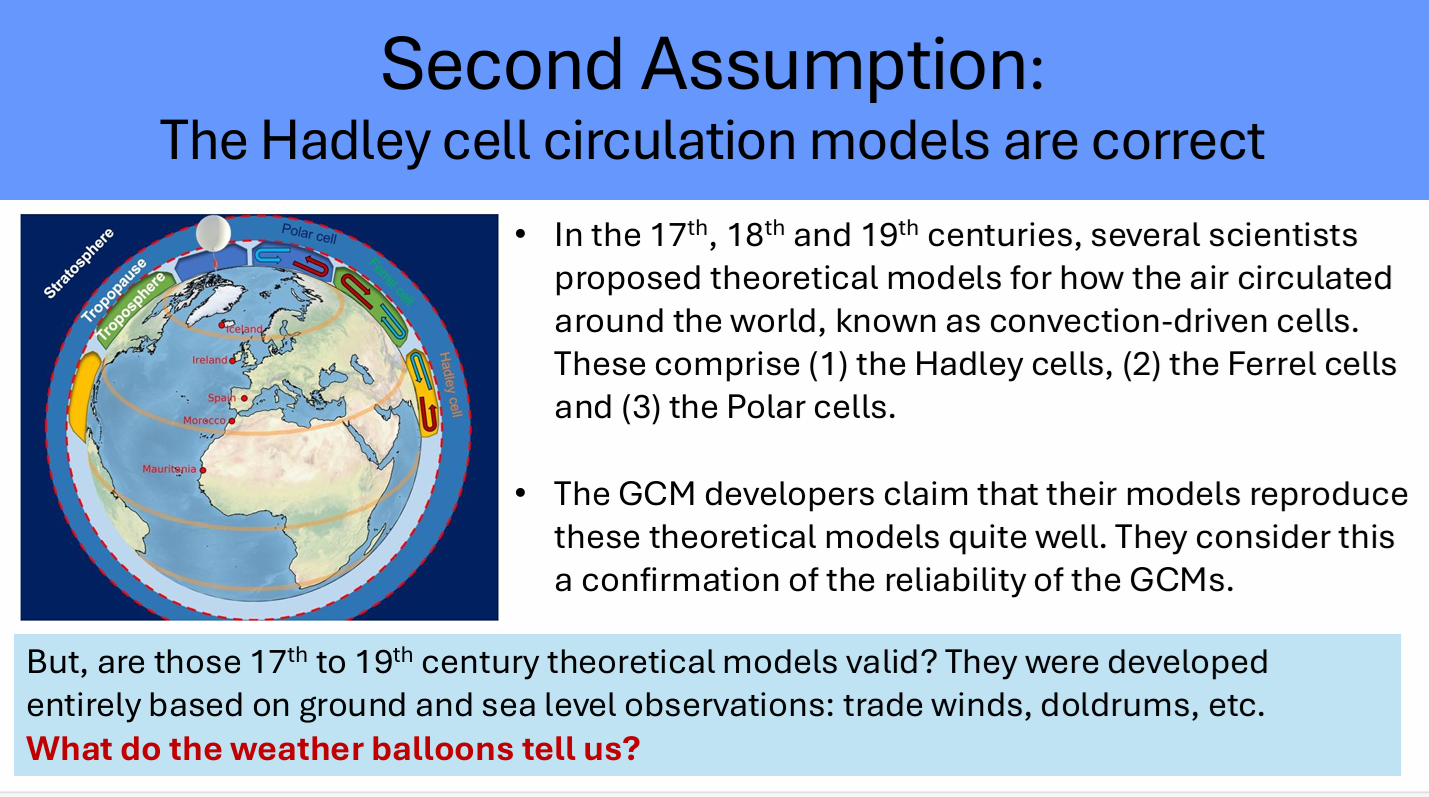
Recently Michael Connolly presented the evidence contradicting assumptions built into GCMs (Global Climate Models).  This post consists of the exhibits he used, and additional Connolly comments in italics from a similar talk this month to Doctors for Disaster Preparedness. (Video embedded later in post.)

Michael Connolly:

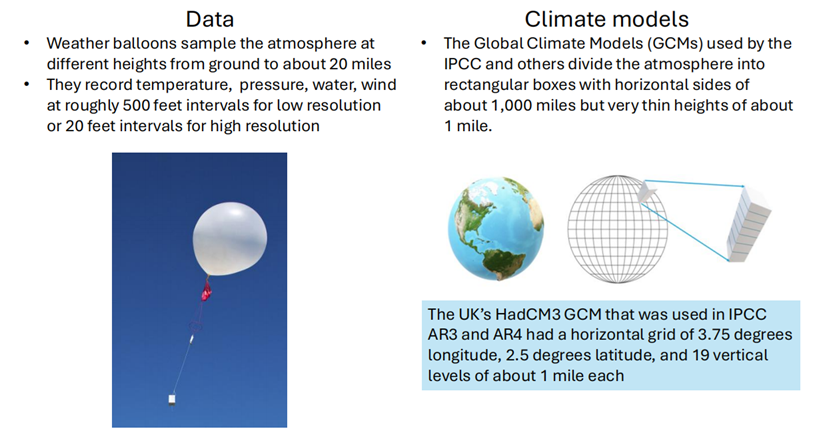
I’m an engineer and a scientist. As an engineer, I use computer models to design and make things. As a scientist, I look at the data to see if my computer models are correct. So, what we did at the center for environmental research and earth sciences (CERES) is that we looked at the data from 20 million radio balloons.

We then asked, can we look at this data and see how we can use it to check the computer models? And we found there’s two types of balloons. One: the average weather balloon does about a 100 measurements as it goes up to the stratosphere. But the ones which measure ozone do a measurement about once every second. So you have maybe four or 5,000 measurements on each sample. But all of the climate models, and by the way, nobody in the climate model community bothered to check the data to see if their models were correct, which I find very bizarre. But what all of the model community do is they divide the earth into a number of little boxes. So on a horizontal scale the boxes are about 1,000 mi long and on a vertical scale they’re about less than a mile in height.

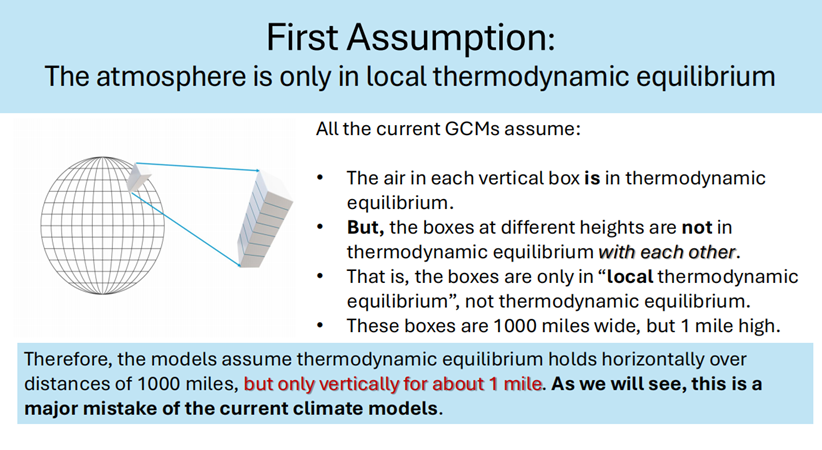
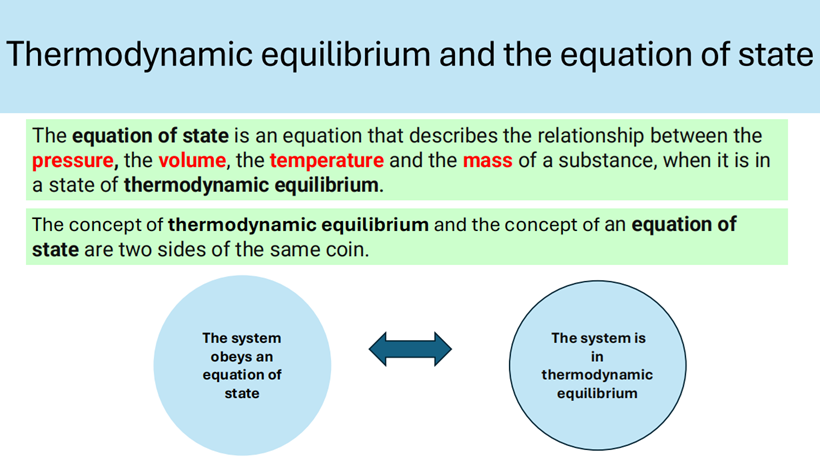
They then make a number of assumptions about how the air behaves within each of these boxes. So their first assumption is that the air in each box is in a state which we call thermodynamic equilibrium. which I’ll explain in a few minutes. So they assume that on a horizontal scale the air in a box is in equilibrium over a distance of a 1,000 miles. But on a vertical scale only in equilibrium for slightly less than a mile.

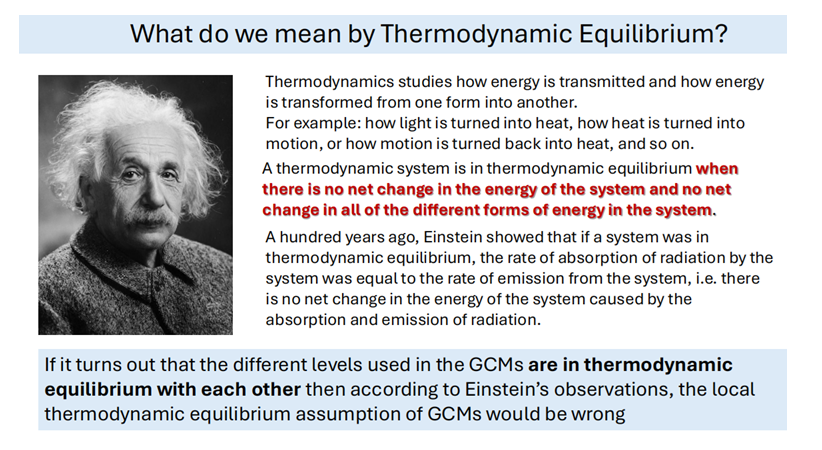
And they also assume that the different boxes are not in thermodynamic equilibrium with each other. Because if it turns out that the boxes are in thermodynamic equilibrium with each other, all of the assumptions of the climate models collapse because Einstein and his co-authors over a 100 years ago showed that if a system was in thermodynamic equilibrium, if you put in a greenhouse gas into that system, it would absorb more energy. But if it’s in thermodynamic equilibrium, it emits more energy. So increasing the level of greenhouse gases will increase the rate of absorption but also increase the rate of emission. So there’s no net change due to the radiation. So if it turns out that the assumption that the the different boxes aren’t in thermodynamic equilibrium is false, then the whole theory of man-made global uh warming collapses.

So how do we know if something is in thermodynamic equilibrium or not? Well, what you do is you take a system and you do all the measurements of the different parameters involved and if you can describe the system in what’s called an equation of state with using these parameters, then we say the state is in thermodynamic equilibrium. So in other words, obeying an equation of state is one side of the coin of being in thermodynamic equilibrium. They’re both different sides of the same coin.

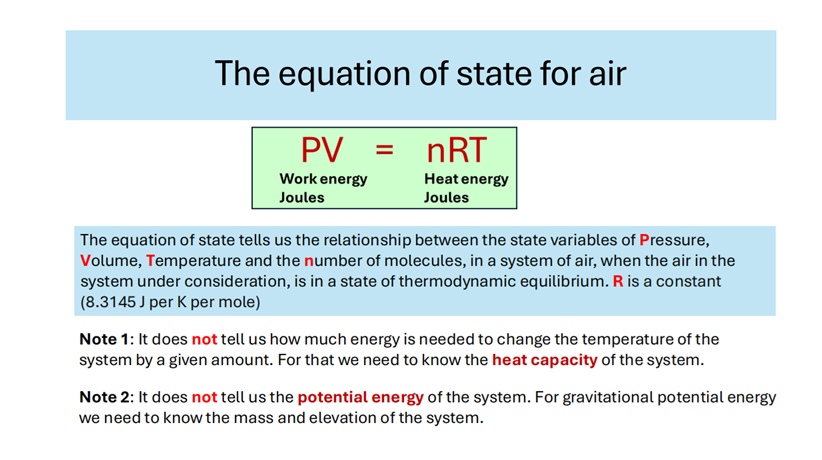
So for the air, the equation of state is this. It’s called the ideal gas law. And this is the equation that’s used by the climate modelers in treating the different boxes as being in thermodynamic equilibrium. You can see down there it tells you the relationship between the different parameters, but it doesn’t tell you how much energy it would take to change the temperature of a system. For that you need to know the heat capacity of the system. And it doesn’t tell you anything about potential energy. In other words, if I take a cubic meter of air and lift it up and keep it at the same temperature and pressure, it would obey the same equation, but it would have gravitational potential energy because it takes energy to lift it up. That’s not reflected in the equation of state.

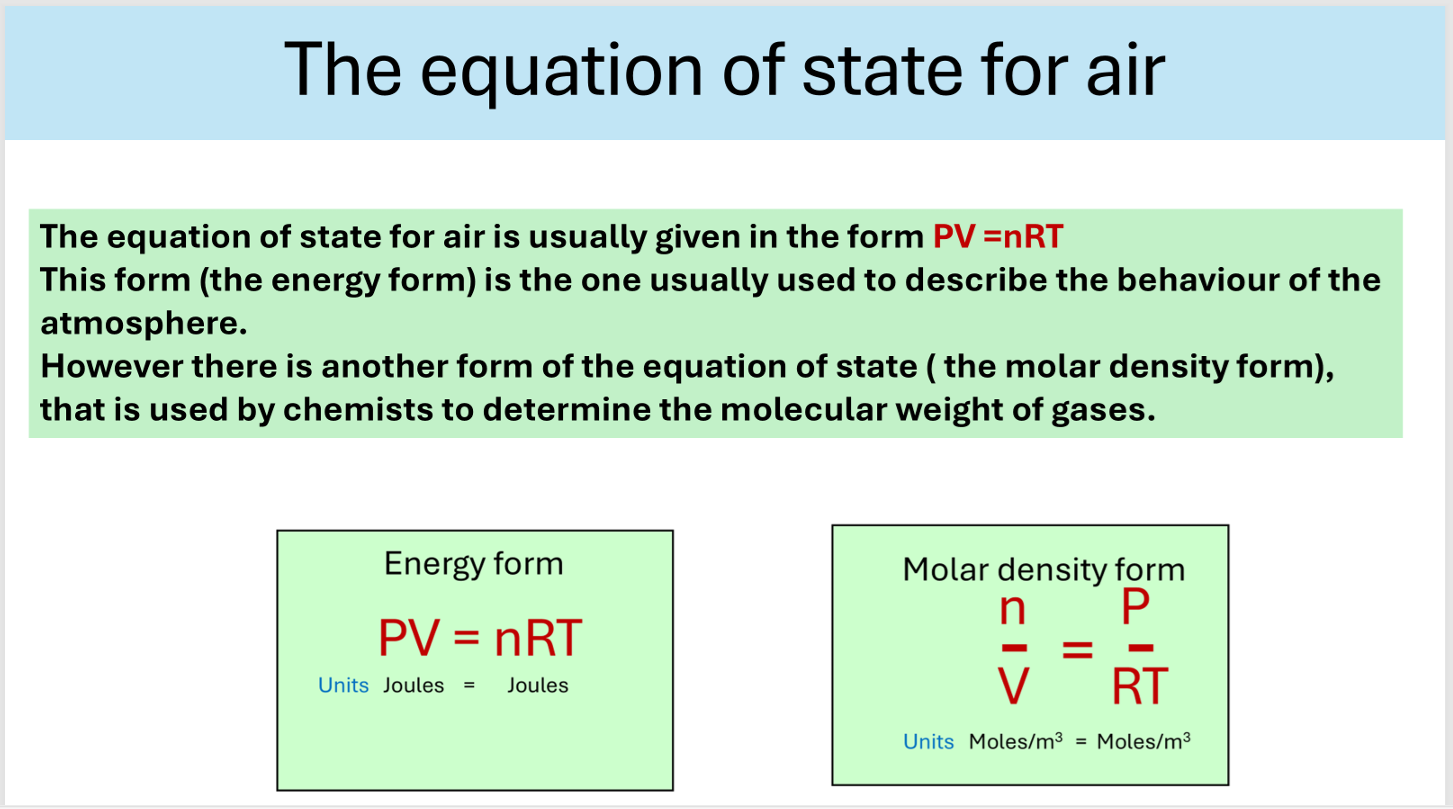
As a chemist I thought there was something dead obvious to do. The equation of state can be rewritten in a different form called the molar density form, and this form has been used by chemists for hundreds of years to determine the molecular weight of new gases. So we asked what happens if we describe the atmosphere in terms of molar density form instead of the energy form? We were the first and still the only people to have done this.

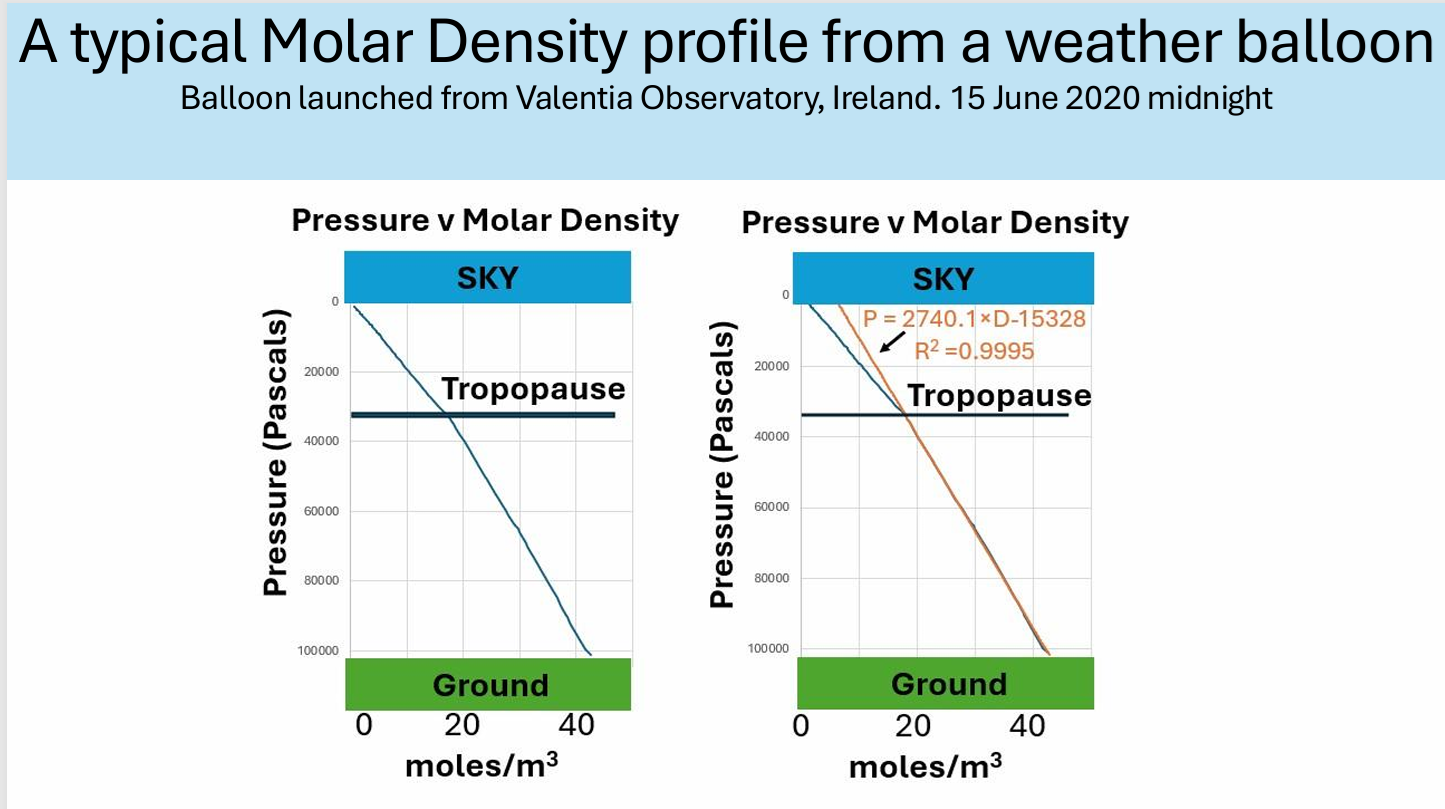
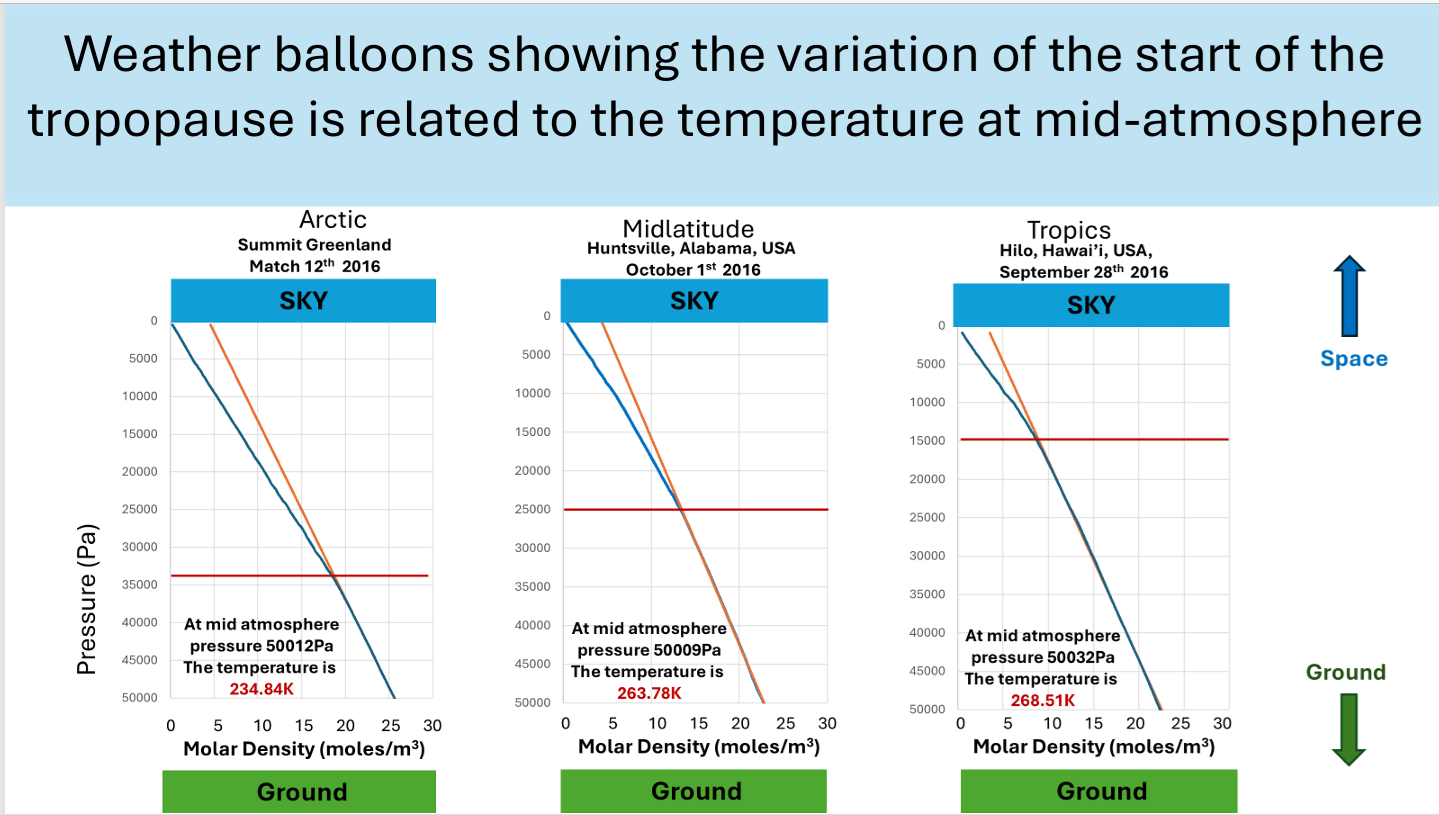
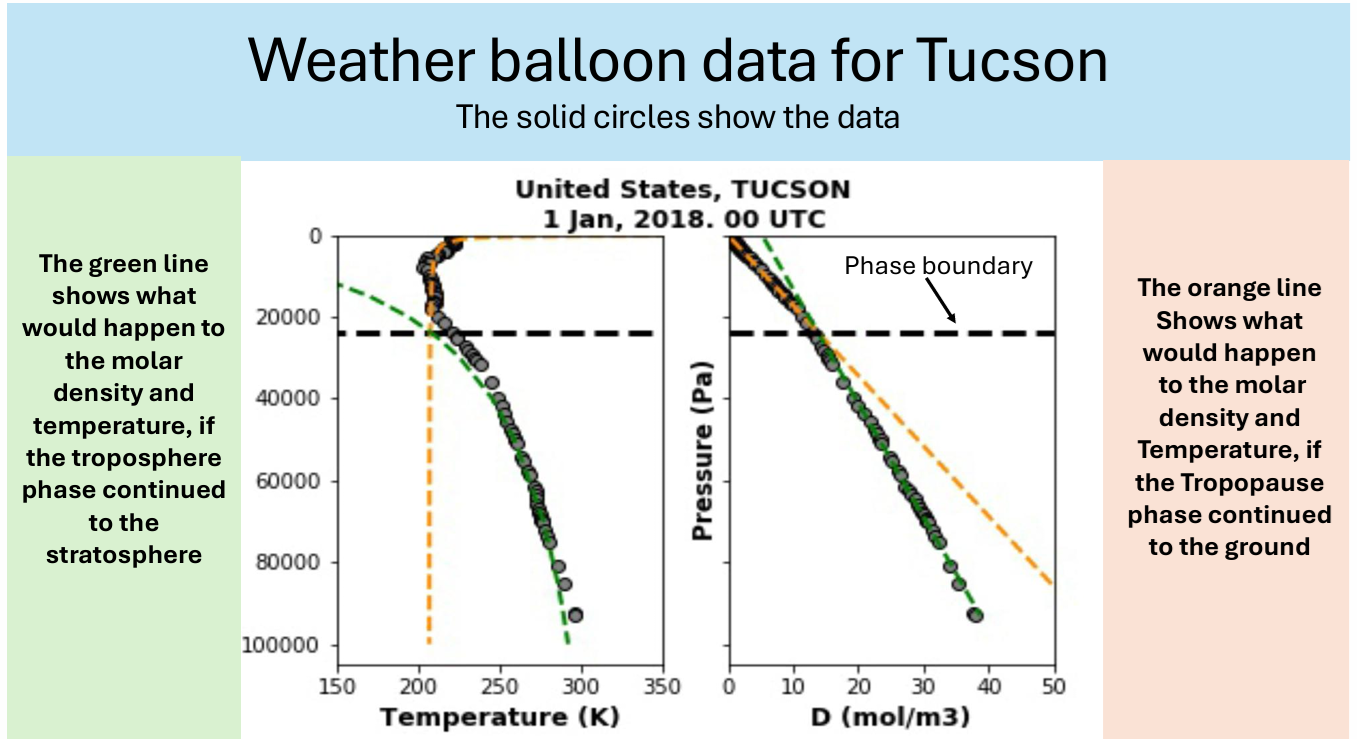
When we did that we got a big surprise. We found that if you plot the molar density versus pressure you get these two straight lines. Now this means that the atmosphere in the troposphere, that’s the lower bit, is obeying an equation of state. So that means it’s in thermodynamic equilibrium. And when you get to the tropopause it turns into another straight line. Now this is quite common in studying materials. If you can describe it in terms of one equation of state and then it changes into another equation of state, we call it a change of phase. For example, you can describe water using the gaseous water using the gas laws, but then when it turns into liquid water, you have to use a different equation of state.


Now we studied all the different weather balloons from all around the world and we found that this phenomenon occurred in all of them. The only difference was that in the tropics the change of phase occurred at a higher altitude and in the Arctic and polar regions it occurred at a lower altitude. So, when we were here in Tucson 5 years ago,  we made a video for the entire year of all of the radio balloon data for Tucson for 2018. And the reason for this video is that looking at a static graph like that, you don’t see any changes. Now, in the models that they’re using, the different boxes are isolated from each other, if you put energy into one of the boxes, it would kind of stay there. But if they’re in thermodynamic equilibrium, you put energy into one box, then all of the boxes will change because all of the energy will be distributed throughout the system. When you look at the video, the behavior of the boundary layer position moves up and down.

But also the temperature: if it moves to the right, the temperature is increasing. If it moves to the left, the temperature is decreasing. And what you will see once you watch the video, it’s all synchronized. In other words, if a change occurs, if the troposphere is warming up and the temperature is moving to the right, the tropopause moves down, the tropopause moves in the opposite direction. So in other words, when the troposphere heats up, the tropopause cools down. when the troposphere cools down the tropopause heats up and it does so in a synchronized way. So that synchronization shows that it’s thermodynamically connect connected. The idea that all of these boxes are not in thermodynamic equilibrium is contradicted by this data.  [The referenced video starts at 10 minutes into the embedded presentation below.]

So that’s the first assumption. Now looking at the second assumption.
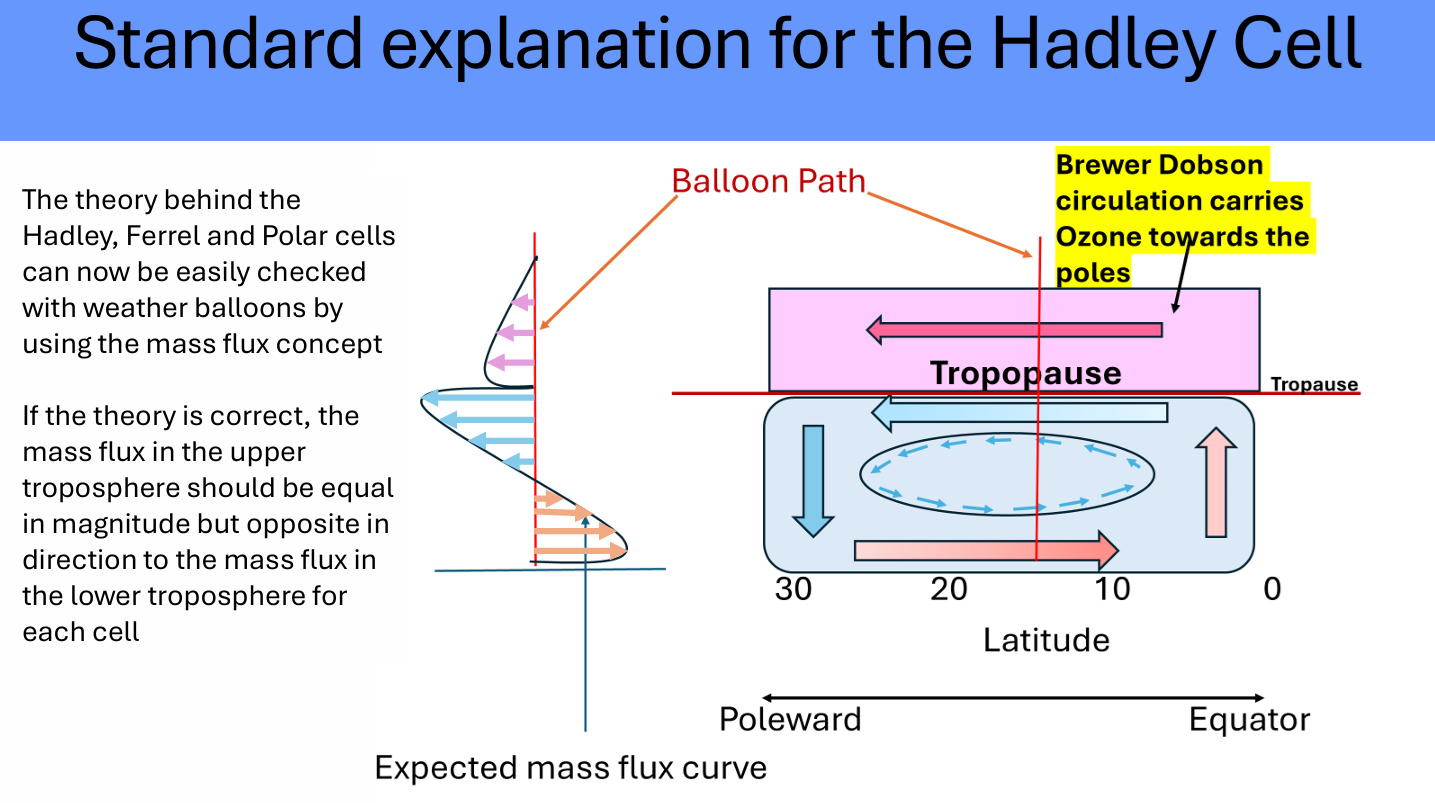
Back in the day when I was 17 or something, Hadley was looking to explain the trade winds. So he came up with this idea of what happens: The very hot temperatures landing on the equator heated up the atmosphere. here and this hot air then rose up. Then as it rose up it started to move towards the poles and as it moved towards the poles it cooled down and you got this circular phenomenon. They came up with three different types of circular cells: the Hadley cells; the ferral cells and the polar cells. But all of these this theoretical stuff was based on ground measurements.

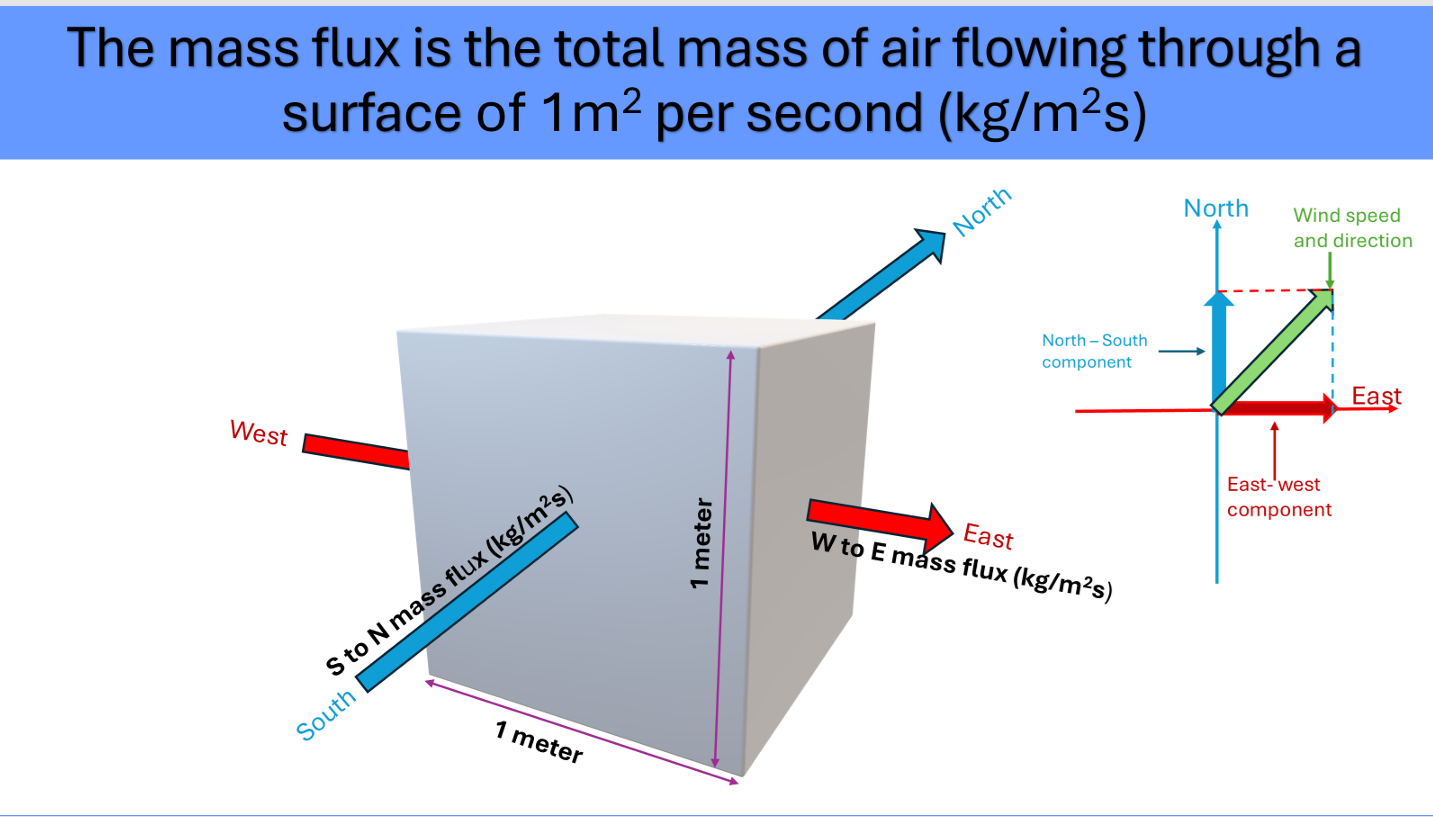
And again uh nobody bothered to check whether this is true or not. So I’ll just show how we checked it. But first of all I just want to explain what’s meant by mass flux. So if you take a a square meter and you measure the air flowing through it and what weight of air that is the mass flux. So in the weather balloons they give you the speed of the air and they give you the direction in which it’s it’s going. So you can use this to calculate the mass flux. So we said fine. So can we use this to check the idea of the Hadley cells and that and it turns out that you can. So we did and we published a paper two years ago.

We found first of all if you take a balloon and you launch it up through one of these cells then if Hadley is correct you would expect the hot air was rising here in the tropics and that drags in the air from the colder regions and then it hits the tropopause. Now, when Hadley came up with the idea, nobody knew the tropopause existed, and it’s only 30 years before I was born that it was actually discovered. So, that’s telling something about my age.

Anyway, if you send a balloon up through the atmosphere, you would expect the mass flux flow to flow in that direction down at the lower levels. And then as you go up at some stage it would shift over and start going in the opposite directions. So since that was available that mass flux we could measure from the balloon data we did that and we got a surprise.

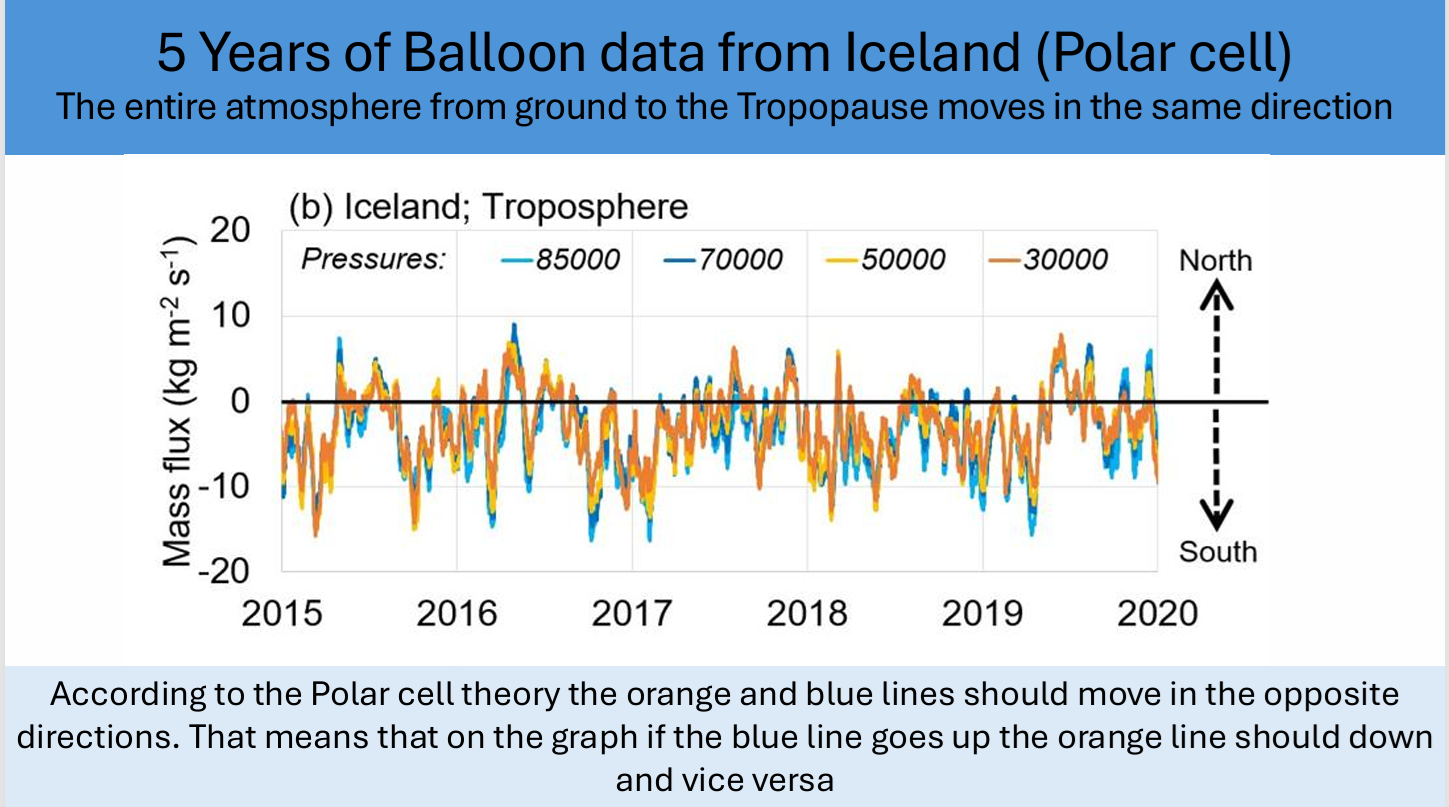
There was absolutely no circulation patterns at all. Instead what the atmosphere was doing. So if we point here you can see these ones are the lower ones. So you have the direction the north south direction of the mass flux. These are the ones at the lower half of the troposphere. These are the ones in the opposite half of the troposphere.

For a Hadley cell you would expect these ones to be flowing in the opposite direction to these ones. But instead what we find is they all flow in the same direction. And in a very unusual pattern. What happens is here it’s flowing south then the atmosphere slows down over a couple of days goes back and forth and so on. So instead of this circular pattern what’s happening is the whole atmosphere is moving like a giant pendulum back and forth. So we have the atmosphere going one way, then after a few days it turns around and comes back in the opposite direction. And this is for Iceland but we found the exact same thing occurred for all the different stations.

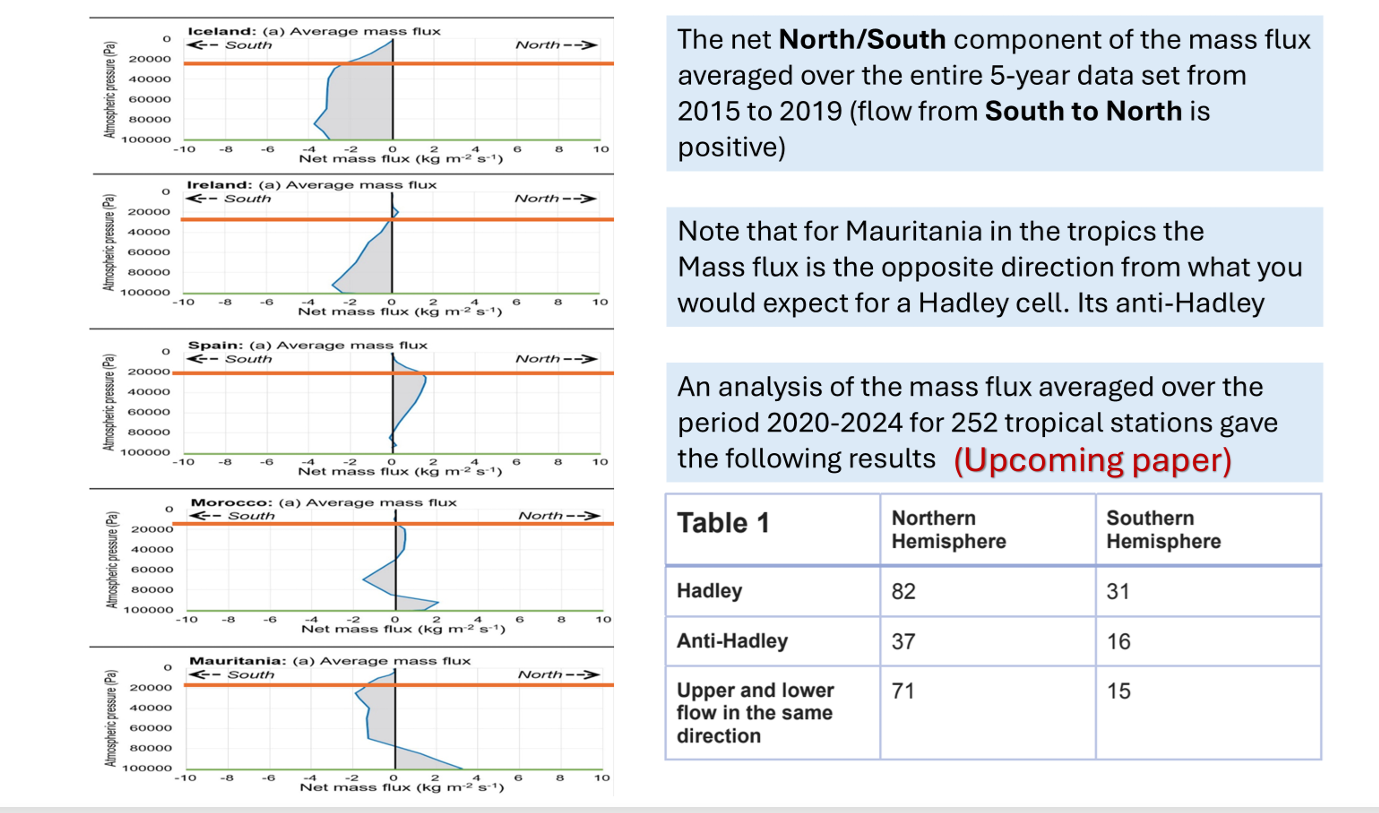
So in that published paper we we took a station from each of the different five climate types and we found the exact same sort of thing happened. Now people said: okay so maybe it’s going back and forward on a daily basis but over a period of a year it might average out. So we average the data over the five years for each of the stations.

And since we published that paper, we’ve analyzed over 250 of the weather stations in the tropics. And we found for these 82% of them are Hadley. 73 in the northern hemisphere. So the majority are not Hadley cells. And in the southern hemisphere they’re equally balanced. But the problem with even the ones that were Hadley cells is you can see here the mass flux grow flowing in this direction the area under the curve is not the same as the one up above. And if it was a proper Hadley cell, they’d have to be the same. So what we found is for none of them this worked out. So they don’t exist, right?


via Science Matters

https://ift.tt/8To6CHq

July 21, 2025 at 11:49AM

Port Henderson DCNN0440 – Who makes these decisions?

57.69582 -5.77707 Met Office CIMO Assessed CLASS 5 Temperature records from 1/10/2013

Port Henderson weather station is one of the more remote weather stations in north western Scotland. Quite why this area has so many once-daily read manual weather stations which are very little use in immediate weather forecasting often puzzles me. Port Henderson is just 7 radial miles from equally manual reporting Poolewe, and from automatic stations at Aultbea (12 miles), Kinlochewe (18 miles), Bealach-Na-Ba (20 miles.) and Resallach (30 miles). This whole geographic section of the UK is very heavily covered meteorologically for forecasting purposes as early indications of weather fronts, but it seems unrepresentative to have so many climate reporting points in such a small and very unrepresentative coastal area.

Firstly why was this station selected as a climate reporting station? At the risk of sounding cynical it seems for no other reason than to satisfy an amateur meteorologist’s hobby. As I have said many times before, I have no wish to belittle or denigrate anyone’s interests or dedication to help, but frankly it seems absurd to just include data regardless of quality simply because it is available. Port Henderson is yet another back garden hobby that is of completely unacceptable and unregulated Class 5 standard. Who made that inclusion decision is not known let alone why but they really should be held accountable.

I am very confident that, if asked, the general public would assume that Met Office “official” weather stations met the very highest of standards befitting their input into the £1.2 billion super computer project. I am equally confident that those same people would be horrified to discover that the input data fed into the super computer came from instruments in a little white box in the back garden just behind a repro street lamp, to the rear of the garage, alongside the tall hedge in front of a vegetable patch. If then told that very many sites such as Port Henderson were “officially” recorded as having readings with an “additional estimated uncertainty added by siting up to 5 °C” they might not be so willing to believe in reports of “global warming” quoted to the 100th of a degree. This is the Port Henderson “weather station” just visible from streetview centre screen.

I suggest that the reason that the Met office is withholding so much basic data from me and the general public when asked, is that they do not want to admit that data from junk sites such as Port Henderson and literally hundreds of others is being used to “fill in the gaps” and produce that Zombie site data.

I believe the term is GIGO. The Surface Stations Project will not be using the likes of Port Henderson in its historic temperature reconstruction – I believe in using reliable, quality data.

via Tallbloke’s Talkshop

https://ift.tt/hJa7mcN

July 21, 2025 at 10:24AM