Author: Iowa Climate Science Education

Toyota’s Pratt Wisely Puts Automotive Eggs in Many Baskets

By Duggan Flanakin

July 18, 2024

During a high-profile conversation with moderator Peter Bryant at the recent RealClearEnergy Future Forum, Gill Pratt, chief scientist at Toyota, said that his company’s philosophy focuses first on quality of life. From that perspective, he added, the automotive future must be a multi-pathway that respects human diversity and the diversity of uses for motorized vehicles (check the video above to see the Pratt section). 

Toyota, he said, recognizes the difference between decarbonization – which is the goal – and electrification, which is one means of reaching that goal. Toyota therefore is building hybrids, electric vehicles (EVs), and internal combustion engines that use hydrogen rather than gasoline or diesel as a fuel. In the developing world where electricity is in short supply, he added, the best choice may be low-carbon liquid fuels.

Prior to being recruited by Toyota to lead its research institute, Pratt had worked on robotics and neuromorphic computing at the Defense Advance Research Projects Agency, making machines that could help in disasters and computers that worked more like the human brain. There, he says, he learned that technological predictions are often unreliable and that we must expect to be surprised.

Today’s vehicles are so far advanced from those of just 20 years ago. Today, global positioning systems help guide drivers through both urban traffic and rural roads; we now have telephones and the internet in our vehicles; and today’s vehicular onboard computers are sophisticated enough to drive themselves safely with or without passengers.

But we have also concluded that the products of combustion of fossil fuels exceed the limits of human tolerance and threaten our future. The “quick fix” of electrifying everything has proven to be a stubborn challenge, if only for the sheer magnitude of battery-EVs needed to replace 300 million American vehicles and a billion and a half worldwide, most of which operate on gasoline or diesel fuel.

To achieve a safe self-driving vehicle, Toyota opted for a diverse approach with a focus on saving lives sooner. The company’s approach to decarbonization has also focused on diverse solutions, including battery-EVs, plug-in hybrids, and fuel-cell EVs. “We want to give people around the world from all walks of life the best tools to solve the global problem of climate change,” Pratt said in a 2021 Toyota Research Institute video.

“Different people,” he said then, “have different circumstances and different needs. Some live in areas with electric grids powered by renewables; others live in areas that will be powered by fossil fuels for some time. Some have convenient charging stations at home; others live in cities where that is more difficult. Some are wealthy; most are not.”

One benefit of this strategy is the wiser use of available lithium, the critical element in today’s EV batteries. Pratt explained that Toyota’s strategy focuses on maximizing the carbon return on investment of every battery cell produced, which is defined as grams of carbon dioxide reduced divided by grams of lithium used.

With the average U.S. daily commute of 32 miles a day, hauling around a 320-mile-range electric battery yields a low carbon ROI. Allocating the same components of these large EV batteries into multiple hybrids multiplies the carbon ROI for these expensive battery components. One battery-EVs uses about 90 times the lithium as one hybrid. On the other hand, braking energy adds to the efficiency of battery-EVs in city traffic.

Toyota has found that hybrid and plug-in hybrid vehicles have similar lifetime carbon emissions as battery-EVs at a lower cost to the consumer. Fully EVs may still be the better option wherever there are ample fast-charging options and sufficient electricity capacity at affordable prices.

But this is hardly the case in the developing world, nor even across much of the U.S. landscape today. That’s one reason Toyota has a focus on hydrogen-powered vehicles, which also have zero carbon tailpipe emissions. While hydrogen is a gas that must be cooled to near absolute-zero or pressurized for use in motor vehicles, there are ample supplies. The petrochemical industry alone creates enough hydrogen to fuel millions of vehicles.

Hydrogen has been used in racecar internal combustion engines, but Toyota believes its “sweet spot” may be in 18-wheeler trucks, tanks, cranes, and other large vehicles that would otherwise require huge electric batteries that add weight and reduce load capacity. While intensifying its European operations via Hydrogen Factory Europe, Toyota is applying fuel cell technology to buses and trucks, railways, ocean and river shipping, and even baseload electricity generation.

A recent article notes that Toyota’s hydrogen combustion engines provide great performance while utilizing efficiency in engine features. These engines can provide up to 400 horsepower, equivalent to many piston Atkinson cycle gasoline engines, and can reach a thermal efficiency of up to 45%, equal to that of the best diesel engines. The only emissions from these engines are clean water vapor.

Another recent article explains that Toyota’s hydrogen fuel cell system involves the chemical reaction of the hydrogen stored on the vehicle and the oxygen from the surrounding environment to produce electricity to the electric motor without the need for the heavy lithium-ion batteries utilized in battery-EVs.

Pratt compares the decision by Toyota to seek a multi-pathway approach to the automotive future to the old debate between VHS and Beta. Those who put all their eggs in the Beta basket ended up bankrupt as VHS proved more amenable to consumers than the technologically superior Beta. But, he says, in tomorrow’s automotive universe, battery-electric, hybrid, plug-in hybrid, and hydrogen powered vehicles may all play important roles.

The bottom line, though, is that the poor and middle class worldwide will continue to rely on gasoline- and diesel-powered internal combustion engines until these newer technologies can produce vehicles they can afford to buy and maintain and until fuel supplies (including ample electricity) are also conveniently available at affordable prices.

While the gasoline fuel hose and the electric charging cable area about the same size, the fuel hose today delivers ten times the power of the electric charger in a much shorter time frame. Multiply the charging time versus the liquid refueling time and you begin to see the magnitude of the challenge.

Texas-based Buc-ee’s just opened its largest station, with 120 pumps on a 75,000-square-foot lot. They would have to have 1,200 of today’s best chargers, covering perhaps 750,000 square feet, to service the same number of EVs today

With 80% of the EV chargers in the U.S. today being slow chargers, the transition even in the developed world may be slower than politicians and bureaucrats demand.

Duggan Flanakin (duggan@duggansdugout.com) is a senior policy analyst at the Committee For A Constructive Tomorrow who writes on a wide variety of public policy issues.

This article was originally published by RealClearEnergy and made available via RealClearWire.

via Watts Up With That?

https://ift.tt/c7zROUE

July 22, 2024 at 08:14PM

Offshore wind whale deaths indicated by statistical analysis

From CFACT

By David Wojick

Systematic statistical analysis indicates that offshore wind development has likely been killing lots of whales since it began around 2016. This long-standing conjecture that wind kills whales may be confirmed.

Call it forensic statistical epidemiology. The epidemic is the huge number of Northwest Atlantic whale deaths that were first officially observed by NOAA in 2016-17, and that continued to this day. It is forensic because killing whales can be highly illegal.

This math feat was performed by Apostolos Gerasoulis, a Rutgers professor emeritus of computer science. This is a computer math problem, not a biological one, so he is exceptionally qualified. See https://www.cs.rutgers.edu/people/professors/details/gerasoulis-apostolos

Professor Gerasoulis has confirmed with profound statistical evidence the widespread conjecture that offshore wind sonar surveys have been killing whales. There is now no reasonable doubt that the extensive sonar harassment authorized by NOAA since 2016 has caused the massive increase in whale deaths that NOAA first flagged in 2016-17.

Here is a lengthy article that provides some of that compelling evidence:

Given that I and others have been yelling at NOAA about this for two years, it is not a stunning discovery to us, just tragic proof that we were right. For example:

https://www.cfact.org/2022/09/27/how-to-kill-whales-with-offshore-wind

And https://www.cfact.org/2023/01/23/evidence-says-offshore-wind-development-is-killing-lots-of-whales/

I have repeatedly pointed out that the overall Humpback Whale death rate doubled when sonar blasting began. Gerasoulis finds that in the region where the surveying was most active, the death rate jumped to an astonishing five times greater.

It took a computer guru to do this pioneering work because it is a complex computation problem. He geographically logged all of the deaths and all of the sonar blasting routes over time, then looked at the correlations, which are profound. It is statistically impossible that these correlations between sonar blasting and dead whales are just a coincidence.

Note that the sonar blasting does not kill the whales outright. It is predicted by NOAA to change the whale’s behavior, so all it has to do is change it in deadly ways, such as causing a ship strike. It is actually expected by NOAA that some whales will be deafened.

Here is a telling analogy. A firecracker thrown at a dog causes it to run into the street and be struck by a car. The car killed the dog, but the firecracker caused the death. In science, this is called the first cause (firecracker) versus the final cause (car strike) of the dog’s death. Sonar blasting is like an endless string of firecrackers going off, lasting for hours or even days.

The press has consistently ignored the warnings, never reporting the potentially adverse effects of “harassment”, as it is officially called. That widespread acoustic harassment is actually predicted and authorized by NOAA is never even mentioned. Even worse, NOAA never mentions it in their online material on the whale death crisis despite it being pointed out to them repeatedly.

Unfortunately, the incredibly loud pile driving that is now starting at the offshore wind construction sites is even worse than the sonar blasting. The NOAA harassment authorization numbers are much higher, ten times higher in some cases. We, therefore, expect the deaths to increase unless decisive action is taken.

Now that the numbers indicate that authorized harassment is likely the cause of widespread whale death, something must be done to stop the carnage. If NOAA continues to authorize potentially deadly harassment without first studying the data, and if wind developers continue unabated, each whale death is a reckless violation of the Marine Mammal Protection Act. Gerasoulis‘s statistical model may even tell us when this happens.

Given this compelling new evidence, if NOAA still refuses to act, then either the President or Congress should do so. Acoustic harassment is ongoing, and whales may be dying from it. This reckless killing of whales must stop.

Photo creative commons Brocken Inaglory, CC BY-SA 3.0 https://creativecommons.org/licenses/by-sa/3.0, via Wikimedia Commons

via Watts Up With That?

https://ift.tt/i0hFaPO

July 22, 2024 at 04:06PM

The solar boom has busted: In the last six months Europe’s solar manufacturing has collapsed by half…

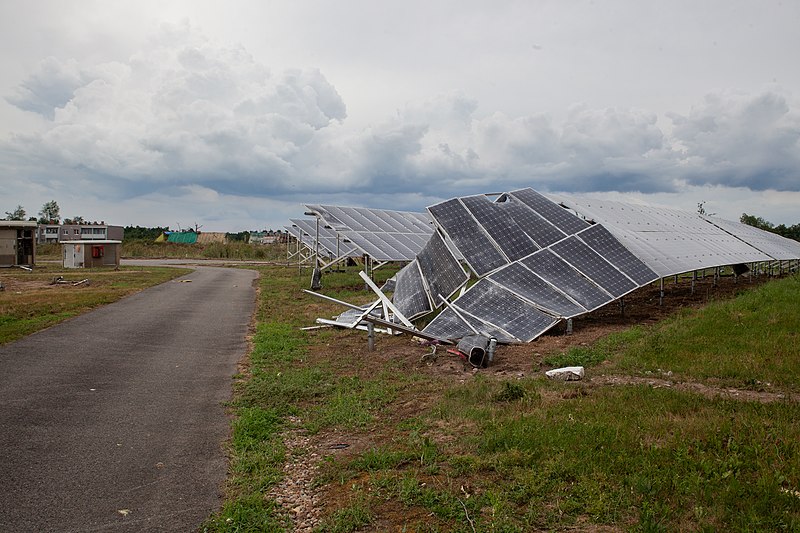
Solar panel damage

By Jo Nova

Europe’s solar manufacturers are in a crisis

Forty year old German solar panel producers are closing factories they only opened three years ago.

The world now has the capacity to make 1,600 GW of solar panels annually, but demand has unexpectedly flat-lined — staying at barely 500GW. In a world awash with solar panels that no one needs, prices have fallen dramatically, but that hasn’t solved the glut which is so bad, people are using solar panels for fencing in Europe.

The CCP has bet big that the exponential growth curve in solar customers was going to keep being exponential. Instead, demand flattened off suddenly. Currently, 80% of the world’s solar panels are pouring out of China.

With impeccable timing, just weeks ago the Australian Government threw a billion dollars at a program to help Australia become a solar panel superfactory just at the moment when China is practically giving them away.

Rachel Millard and Amanda Chu, Financial Times

“There is overcapacity in every segment, starting with polysilicon and finishing with the module,” said Yana Hryshko, head of global solar supply chain research at the consultancy Wood Mackenzie.

According to BloombergNEF, panel prices have plunged more than 60 percent since July 2022. The scale of the damage inflicted has sparked calls for Brussels to protect European companies from what the industry says are state-subsidized Chinese products.

Europe’s solar panel manufacturing capacity has collapsed by about half to 3 gigawatts since November as companies have failed, mothballed facilities, or shifted production abroad, the European Solar Manufacturing Council estimates.

The Salad Days of Solar Power are behind us

The sudden death of the solar boom is due to rising interest rates which take the fun out of getting a loan, but it’s also due to rising electricity costs, which increase the prices of everything, including solar panels themselves and the batteries they need to back them up.

But there’s an argument to be made that the grid itself has reached the limit. The Duck Curve has been quacking on grids in California and Australia for years. Ponder that in towns like Alice Springs the microgrid is in danger of falling over when a cloud rolls in, and only 1 in 4 homes there have solar panels. Indeed, in the sunny centre of Australia, the limit for solar power appears to be just 13% — meaning it’s hard to stabilize the grid when more than 13% of the annual supply is made from solar power.

When storms knocked over a high voltage line in South Australia the first thing the government did was to ask people to switch off their solar panels so they wouldn’t crash the grid.

Even on the big grids, there’s already such a glut of solar panels on homes, that the midday surge of “green” electrons is causing voltage surges which can damage other equipment. Solar “feed in” tariffs to homeowners are shrinking to nothing, or even going negative themselves. In Adelaide and Perth the government now insists people installing solar panels get smart meters so the grid managers can remotely switch off their panels. Worse, in Sydney solar home owners now have to pay to dump unwanted solar power on the grid at lunchtime.

Then there’s the mayhem of negative prices on national markets which is driving baseload providers off the grid and out of business. Large industrial generators are restructuring their businesses to accommodate the crazy pricing.

Last word: China already controls 80% of the market, would it really want to dump so many solar panels it drove the last 20% out of business, or was this  just one huge Big-Government mistake?

Photo: Tadeáš Bednarz


0 out of 10 based on 0 rating

via JoNova

https://ift.tt/yDOo0K2

July 22, 2024 at 03:44PM

New Study: Central Europe Was ‘2-5°C Warmer Than Present’ Throughout Most Of The Holocene

There were millennia during the past glacial (when CO2 levels were under 200 ppm) that were as warm or warmer than today.

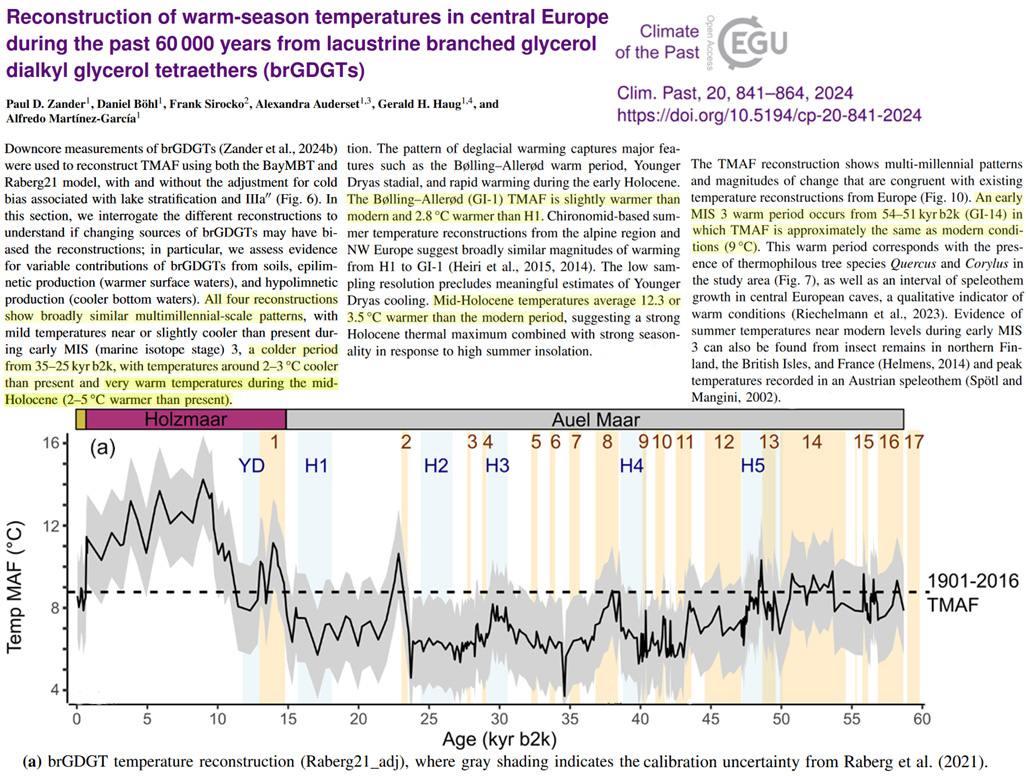
Four central Europe reconstructions, using collected evidence from disparate biomarkers, indicate there were periods (for example, 54,000 to 51,000 years ago, the Bølling–Allerød interstadial, 14,700 years ago) during the last glacial when temperatures were as warmer than (or similar to) today (Zander et al., 2024).

Temperatures throughout the Holocene (8,000 to 4,000 years ago), when CO2 hovered around 265 ppm, were 3.5°C (and up to 5°C) warmer than today. Modern temperatures are among the coldest of the last 10,000 years.

Image Source: Zander et al., 2024

via NoTricksZone

https://ift.tt/Uqml2oy

July 22, 2024 at 01:35PM