Category: Daily News

The Hill Allows a Clinton Crony to Lie About Climate Change Tearing Our Nation Apart

By Paul Homewood

Our descendants will be horrified when they allowed corrupt lefties to destroy their lives on the altar of a false prophet:

 image

The Hill posted an opinion piece by William S. Becker titled, “Climate denial is tearing our nation apart — we can’t wait much longer to act,” in which Becker asserts climate change is leading to both worsening weather and worsening politics. Becker is wrong on both counts. Polling consistently shows that although most people believe climate change is happening, the number very worried about it hasn’t changed much over the past few decades, and very few people are willing to sacrifice much in an attempt to reduce future climate change – so there is no evidence whatsoever climate “denial” threatens to rend the political fabric of the nation. In addition, data clearly prove Becker is simply wrong about worsening extreme weather.

“We know from decades of scientific research, and now from brutal experience, that global climate change is real,” writes William S. Becker, former U.S. Department of Energy official who founded its Center of Excellence for Sustainable Development under then President Bill Clinton. “Few, if any, places in the U.S. are safe from its many consequences. They are as quick as flash floods and as slow as rising seas, but they are undeniably real and growing worse.”

“One result is personal and society-wide cognitive dissonance — the mental and emotional discomfort we feel when our actions clash with reality or beliefs. a recent Gallup poll shows that 63 percent of Americans believe global warming is underway, and that 48 percent — a record — believe it will seriously threaten their way of life,” Becker continues. “Yet more Americans are moving into places with high risks of climate-related disasters rather than out of them.”

Becker is wrong, there is no cognitive dissonance in peoples’ positions, but rather it reflects a rational assessment of the relative importance of climate change as a threat to their lives and well-being when compared to other issues, like the economy, jobs, health care, education, crime, and illegal immigration.

Polls cited in Climate Realism, here, here, and here, for example, and at Climate Change Weekly, here, here, and here, consistently show that although a plurality of people believe climate change is occurring and are worried about it to some degree, it ranks last or near last in their list of concerns, and they are unwilling to pay much to prevent or mitigate it. The same polls also show the vast majority of those concerned about climate change are not willing to change their lifestyles very much, such as by reducing travel, buying electric vehicles, or giving up meat, to fight climate change.

Indeed, as recently as early July CNN’s senior data reporter, Harry Enten, reported on a new Gallup poll on climate change and natural disasters which found that the percentage of Americans “greatly worried” about climate change had declined by six percentage points since 2020, down to just 40 percent. That’s the same percentage of people surveyed who expressed worry about climate change in Gallups 2000 survey asking the same question. Meaning that despite 25 years of mainstream media constantly warning of climate doom, the public is largely unmoved.

This would seem to suggest that the majority of people understand that to the extent climate change threatens harm, the threat it poses is distant, and would have far less impact on their lives and neighborhoods than ensuring low crime, high quality health care, and continued economic growth. They also seem to instinctively understand that fossil fuels are the foundation for the modern society they take for granted. That’s not evidence of cognitive dissonance, rather that’s hardheaded resistance to propaganda.

In short, polls don’t show that climate denial, whatever Becker means by that, is tearing America apart, and he provides no evidence, direct or indirect, that it is doing so, just pseudo-psychobabble about the public suffering from cognitive dissonance. In case you are wondering, Becker is neither a psychologist nor a psychiatrist.

What about the instances of extreme weather and rising seas that Becker claims climate change is making worse or more severe?

Read the full story here.


Just suppose our Victorian ancestors had put a stop to the Industrial Revolution, on the sole basis that the weather might otherwise be a tiny bit warmer than their Little Ice Age, now known to be the coldest era sine the real Ice Age.

If you pay people to lie, they will carry on lying.

Mr Becker exemplifies this well.

via NOT A LOT OF PEOPLE KNOW THAT

https://ift.tt/bBxCg0z

August 1, 2025 at 03:31PM

The Windmills of Your Mind

Not only does the BBC have its brilliant Verify team with its world-leading fact-checking, but it can also understand why President Trump chooses to use the language that he does. In a sarcastic hit piece which was rushed out following the Donald’s criticism of “windmills” it told us that:

For clarity, there are no windmills in the North Sea.

Windmills mill grain into flour. What he’s seeing are wind turbines.

But making them sound like centuries old technology is a way to deride their worth.

As it happens, I share the BBC’s dislike of the mis-labelling of wind turbines as windmills, but for rather different reasons (although I agree that as they do not mill anything, they should not be called windmills). I am every bit as cynical as the BBC journalists who wrote that piece, but my cynicism sees things differently. I tend to assume that the people who refer to wind turbines as windmills are generally enthusiasts for the technology, and they prefer to describe them in this way because it makes them sound less industrial, more bucolic, and as though they fit in with the landscape. The reality, of course, is that they are getting ever taller, reaching heights of 250 metres, and before long they will probably be as tall as the Shard or the Eiffel Tower. And President Trump is correct – they do kill birds. In very large numbers. SSE’s own environmental impact assessment assumes that over the planned 35 year life of the newly-approved Berwick Bank offshore wind farm, it will kill 31,000 seabirds.

Speaking of Berwick Bank, here is Stephen Flynn MP declaring that the Berwick Bank approval is “Big news for all us windmill fanatics”. I suppose it’s possible that his use of the word windmills is a tongue-in-cheek pop at President Trump, or perhaps he thinks the use of the word makes the bird-mincers sound nicer?

When Andrew Kersley, a freelance journalist who writes, inter alia, for the Guardian, referred to “a new generation of floating windmillsin a 2020 article in Labour List, was he “deriding their worth”?

Similarly, when Boris Johnson (remember the “Saudi Arabia of Wind” claims?) said “...we will build windmills that float on the sea – enough to deliver one gigawatt of energy by 2030, 15 times as much as the rest of the world put together…” I suppose he was deriding the technology too.

When Ecotricity publicised exports by its Britwind subsidiary, it wrote:

Britain’s greenest energy company, Ecotricity, has sold more than £1 million of small windmills to Japan through its Britwind subsidiary, to become the country’s leading small wind exporter.

Britwind launched in November 2014, producing windmills that are designed and made in Britain and has now shipped 130 small 5kW wind turbines to Japan in the past 18 months, with a further 30 windmills set to be dispatched by the end of March – an order totalling more than £1.3 million.

This latest shipment will include the very first of Britwind’s new H15 windmills – a 15kW machine that can power the equivalent of 13 homes.

Deriding their worth?

A couple more, just to make the point – Lord Deben (he of the Climate Change Committee) on 23rd July 2013, during the 7th Day of the Committee stage of the Energy Bill, Lord Deben said: “Manifestly, in the long-distant future, it would be quite sensible to have a lot of windmills when there was wind and a lot of solar when there was sun.” Yes, that sounds like he’s denigrating turbines. Similarly Lord Rooker, speaking in a House of Lords debate on 18th September 2023, said “I find the windmills magnificent, whether they are in the Lake District, Cornwall or anywhere else…”. And yes, he was referring to wind turbines, not to actual mills.

In other words, BBC, please don’t presume to read the mind of President Trump when you choose to question his motivation. I suggest you stick to reporting facts instead.

Postscript

While I’m being grumpy about the BBC, I thought I would mention that on the BBC Radio 4 weather forecast earlier this evening, I was told that the upcoming “Storm Floris” is what we get in winter, not in summer. I can’t read Tomasz Schafernaker’s mind any more than the BBC can read President Trump’s, but I was left with the distinct impression that I was supposed to assume that this is another terrible example of anthropogenic climate change in action. That is a view reinforced by the BBC website article whose headline told me that “Storm Floris [is] to bring ‘unseasonably disruptive’ rain and wind to UK”.

As it happens, I am currently reading Stephen Church’s excellent “King John – England, Magna Carta and the Making of a Tyrant”. Referring to what was a disastrous year for King John, he says this of the summer of 1205:

At the end end of July, England was battered by hurricane-force winds and huge thunderstorms; to many this presaged the Day of Judgement.

Today, I have little doubt, they would rush out a weather attribution study and solemnly assure us that it’s all our fault – anthropogenic climate change and all that. I’m not entirely sure they would say it presaged the Day of Judgement, but give it time.

via Climate Scepticism

https://ift.tt/OsTdKwN

August 1, 2025 at 02:18PM

The Hill Allows a Clinton Crony to Lie About Climate Change Tearing Our Nation Apart

From ClimateREALISM

By H. Sterling Burnett

The Hill posted an opinion piece by William S. Becker titled, “Climate denial is tearing our nation apart — we can’t wait much longer to act,” in which Becker asserts climate change is leading to both worsening weather and worsening politics. Becker is wrong on both counts. Polling consistently shows that although most people believe climate change is happening, the number very worried about it hasn’t changed much over the past few decades, and very few people are willing to sacrifice much in an attempt to reduce future climate change – so there is no evidence whatsoever climate “denial” threatens to rend the political fabric of the nation. In addition, data clearly prove Becker is simply wrong about worsening extreme weather.

“We know from decades of scientific research, and now from brutal experience, that global climate change is real,” writes William S. Becker, former U.S. Department of Energy official who founded its Center of Excellence for Sustainable Development under then President Bill Clinton. “Few, if any, places in the U.S. are safe from its many consequences. They are as quick as flash floods and as slow as rising seas, but they are undeniably real and growing worse.”

“One result is personal and society-wide cognitive dissonance — the mental and emotional discomfort we feel when our actions clash with reality or beliefs. a recent Gallup poll shows that 63 percent of Americans believe global warming is underway, and that 48 percent — a record — believe it will seriously threaten their way of life,” Becker continues. “Yet more Americans are moving into places with high risks of climate-related disasters rather than out of them.”

Becker is wrong, there is no cognitive dissonance in peoples’ positions, but rather it reflects a rational assessment of the relative importance of climate change as a threat to their lives and well-being when compared to other issues, like the economy, jobs, health care, education, crime, and illegal immigration.

Polls cited in Climate Realismherehere, and here, for example, and at Climate Change Weeklyherehere, and here, consistently show that although a plurality of people believe climate change is occurring and are worried about it to some degree, it ranks last or near last in their list of concerns, and they are unwilling to pay much to prevent or mitigate it. The same polls also show the vast majority of those concerned about climate change are not willing to change their lifestyles very much, such as by reducing travel, buying electric vehicles, or giving up meat, to fight climate change.

Indeed, as recently as early July CNN’s senior data reporter, Harry Enten, reported on a new Gallup poll on climate change and natural disasters which found that the percentage of Americans “greatly worried” about climate change had declined by six percentage points since 2020, down to just 40 percent. That’s the same percentage of people surveyed who expressed worry about climate change in Gallups 2000 survey asking the same question. Meaning that despite 25 years of mainstream media constantly warning of climate doom, the public is largely unmoved.

This would seem to suggest that the majority of people understand that to the extent climate change threatens harm, the threat it poses is distant, and would have far less impact on their lives and neighborhoods than ensuring low crime, high quality health care, and continued economic growth. They also seem to instinctively understand that fossil fuels are the foundation for the modern society they take for granted. That’s not evidence of cognitive dissonance, rather that’s hardheaded resistance to propaganda.

In short, polls don’t show that climate denial, whatever Becker means by that, is tearing America apart, and he provides no evidence, direct or indirect, that it is doing so, just pseudo-psychobabble about the public suffering from cognitive dissonance. In case you are wondering, Beker is neither a psychologist nor a psychiatrist.

What about the instances of extreme weather and rising seas that Becker claims climate change is making worse or more severe?

To start, for a broad range of extreme weather, even the U.N. Intergovernmental Panel on Climate Change (IPCC) admits to having low confidence that trends have changed or gotten worse, and for most classes of extreme weather events. The IPCC also does not forecast any such signal to arise by 2050 or 2100, either. Data provides no support for claims that during the recent period of modest warming floodshurricaneswildfirestornadoes, or drought, have become more frequent or severe, despite what misleading headlines and unresearched stories in the mainstream media might lead one to believe. Globally sea level rise is not uniform, and the best evidence from tide gauges and historical analyses suggest that the present rate of warming is not unusually rapid historically.

In the end, much of Becker’s career has been founded upon promoting climate alarm in an effort to push an energy transition. His reputation depends on people accepting him as an expert and taking his views on the matter as authoritative. His book sales and funding for the various organizations he is associated with depends upon no one derailing the climate change gravy train. While Becker has a right to his opinion, and The Hill has a right to publish it, neither have facts on their side.

Truth will out! And solid science, such as is contained in the Climate Change Reconsidered series of reports and the recent U.S. Department of Energy report assessing the impacts of greenhouse gas emissions on U.S. climate, demonstrate that climate change, while undoubtedly real, poses no credible threat to human life or well-being. Real-world data also show that the fossil fuels Becker rails against in his Hill op-ed remain fundamental to growing economic prosperity and ongoing improvements in human health and longer lives.

H. Sterling Burnett

H. Sterling Burnett, Ph.D., is the Director of the Arthur B. Robinson Center on Climate and Environmental Policy and the managing editor of Environment & Climate News. In addition to directing The Heartland Institute’s Arthur B. Robinson Center on Climate and Environmental Policy, Burnett puts Environment & Climate News together, is the editor of Heartland’s Climate Change Weekly email, and the host of the Environment & Climate News Podcast.


Discover more from Watts Up With That?

Subscribe to get the latest posts sent to your email.

via Watts Up With That?

https://ift.tt/iZolk57

August 1, 2025 at 01:02PM

Strange Sea Ice Data July End 2025

Before presenting the MASIE and SII results for July, a note about a strange thing in today’s Sea Ice Index report.  I have sent a note to them requesting an explanation for why the values have been altered from those in the dataset just two days ago.  When attempting to add into my spreadsheets the final two July days, I noticed that all the previous values were now different.  Exploring further, going back to beginning of 2024 all values had changed, some showing larger extents and many showing smaller ice extents than previous recorded.

For 2024 the new values added ice extents with the average day gaining slightly (47k km2).  But in 2025 so far, the average day lost (-57k km2) compared to the values two days ago.  Curiously, since March 14, 2025 all days had lower values at a daily rate of -75k km2.  In sum, the altered values in 2025 removed ~11M km2 of ice extents, and nearly nearly -4M km2 since March 14.  In the report below, I excluded the altered SII values awaiting news from NSIDC.

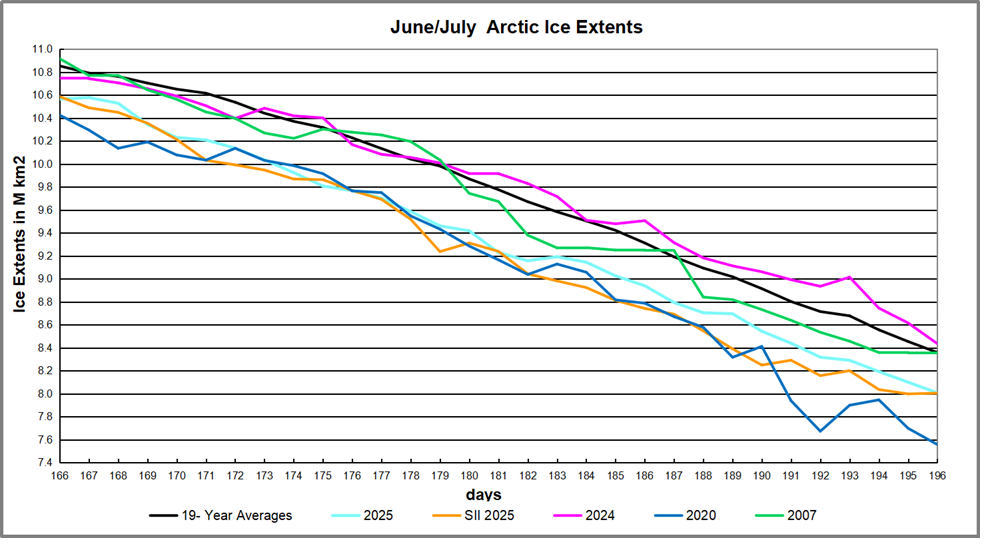
After a sub-par March maximum, by end of May 2025 Arctic ice closed the gap with the 19-year average. Then in June the gap reopened and in July the melting pace matched the average, abeit four days in advance of average. The chart shows the July Arctic ice extents decline from 9.7M to 6.9M km2. MASIE started July ~5M km2 in deficit to average and ended the month ~4M km2 down, continuing to melt about four days in advance of the average decline. SII matched MASIE the first half of July, then tracked slightly lower the second half.

The regional distribution of ice extents is shown in the table below. (Bering and Okhotsk seas are excluded since both are now virtually open water.)

Region 2025212 Day 212 2025-Ave. 2020212 2025-2020
 (0) Northern_Hemisphere 6555733 6941055 -385322 5880746 674988
 (1) Beaufort_Sea 944231 793206 151025 875454 68777
 (2) Chukchi_Sea 621236 555019 66217 533748 87488
 (3) East_Siberian_Sea 683122 751512 -68390 329453 353669
 (4) Laptev_Sea 329581 370847 -41266 61979 267602
 (5) Kara_Sea 32436 166826 -134390 95539 -63103
 (6) Barents_Sea 1131 29555 -28424 23940 -22808
 (7) Greenland_Sea 228078 296681 -68603 282403 -54325
 (8) Baffin_Bay_Gulf_of_St._Lawrence 117170 150751 -33581 35368 81801
 (9) Canadian_Archipelago 460908 547942 -87034 515499 -54592
 (10) Hudson_Bay 73633 139798 -66165 92861 -19228
 (11) Central_Arctic 3062678 3137162 -74483 3033706.07 28972

The table shows  most regions in deficit with Kara the largest, with Canadian Archipelago and Central Arctic also sizable.  Hudson Bay and Greenland Sea will lost the rest of their ice in upcoming weeks. Surpluses in Beaufort and Chukchi offset about 220k km2 of losses elsewhere.

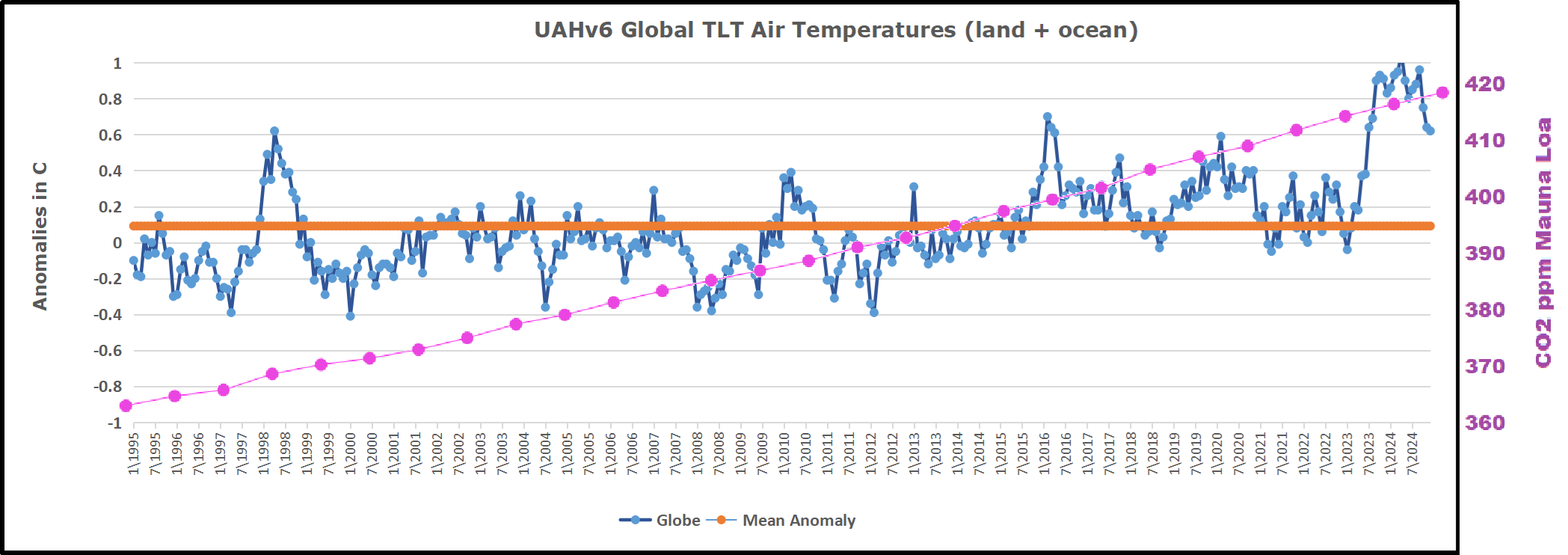
Why is this important?  All the claims of global climate emergency depend on dangerously higher  temperatures, lower sea ice, and rising sea levels.  The lack of additional warming prior to 2023 El Nino is documented in a post NH and Tropics Lead UAH Temps Lower May 2025.

The lack of acceleration in sea levels along coastlines has been discussed also.  See Observed vs. Imagined Sea Levels 2023 Update

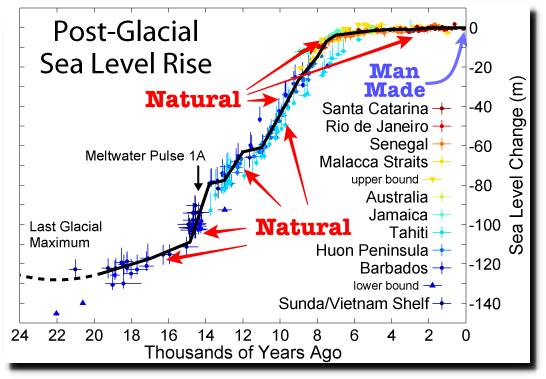
Also, a longer term perspective is informative:

post-glacial_sea_level

Illustration by Eleanor Lutz shows Earth’s seasonal climate changes. If played in full screen, the four corners present views from top, bottom and sides. It is a visual representation of scientific datasets measuring Arctic ice extents and NH snow cover.

via Science Matters

https://ift.tt/Epf0KCy

August 1, 2025 at 11:08AM