
CFACT researched it, CFACT advocated for it, and now it’s happening.
via CFACT
July 30, 2025 at 10:33AM
CFACT researched it, CFACT advocated for it, and now it’s happening.
via CFACT
July 30, 2025 at 10:33AM
Honestly, I never thought I’d see the day. To quote Mr. FOIA from ClimateGate, “A miracle has occurred.”
Yesterday’s release of the DOE’s A Critical Review of Impacts of Greenhouse Gas Emissions on the U.S. Climate is a watershed moment in the ongoing debate over climate policy in America. Why? Because for the first time, a major U.S. government agency—on official letterhead and with a blue-ribbon cast of authors (John Christy, Judith Curry, Steven Koonin, Ross McKitrick, and Roy Spencer)—has published an open challenge to the central claims, data handling, and even the motivations behind mainstream climate science and policy.
This isn’t just another technical report. It is a systematic rebuke of accepted climate “wisdom,” and it does so with unusual clarity, scientific rigor, and (at times) a sense of humor often absent in climate documents. Most importantly, it directly confronts the exaggerated and politicized rhetoric that has dominated headlines for decades.
The Executive Summary from the DOE web page:
This report:
What Makes This Report Unique?
CO2: Pollutant or Plant Food?
The DOE report begins by demolishing the notion that CO2 should be treated as a conventional pollutant, as regulated under the Clean Air Act. It cites OSHA exposure limits (5,000 ppm—orders of magnitude above outdoor levels) and presents robust evidence from plant physiology showing that rising CO2 enhances growth, improves water use efficiency, and has led to the global greening phenomenon observed by satellites.
Notably, the report details how IPCC assessments downplay or omit this global greening effect, despite its direct connection to rising CO2. Even the IPCC’s own Special Report on Land concluded “with high confidence” that greening has occurred, yet this is absent from summary reports intended for policymakers and the public.
Ocean “Acidification”: A Manufactured Crisis?
The report’s treatment of ocean acidification is a case study in scientific skepticism. It points out that “acidification” is a misnomer—oceans remain alkaline, and pH fluctuations are within historic norms. Life in the ocean evolved under a much broader range of pH conditions. More importantly, the DOE authors highlight the growing recognition of “publication bias”: studies with null or minimal impacts from declining pH are difficult to publish, leading to a skewed scientific record.
A meta-analysis cited in the report finds a strong “decline effect” in ocean acidification impacts on fish behavior: early alarming results are rarely replicated by later, larger studies, which usually show negligible impacts. In short, the “crisis” has been grossly exaggerated in the literature and the media.
Model Failure: The Emperor Has No Clothes
The centerpiece of the DOE critique is the performance of global climate models. The report notes that despite decades of effort and billions spent, model projections have failed to narrow the uncertainty in equilibrium climate sensitivity (ECS). In fact, the spread of ECS in the latest (CMIP6) models has grown wider, not narrower, and the majority of models produce too much warming compared to observations—both at the surface and throughout the troposphere.
Crucially, the report provides detailed side-by-side comparisons of model projections versus observed data (see page 33–37). It notes that only models with the lowest ECS values match the actual temperature record since 1979. The majority of models overestimate warming, in some cases by more than a factor of two.
The report also skewers the widespread misuse of “worst-case” emissions scenarios (RCP8.5) in research and media. It cites analysis showing that the vast majority of climate impact papers used RCP8.5 as a business-as-usual baseline, despite the scenario being grossly implausible and far above observed emissions trends.
Attribution and Natural Variability
The report spends several chapters dissecting the uncertainties around attribution—the attempt to link observed warming and extreme events specifically to human GHG emissions. The authors document the wide range of natural variability (including the still-uncertain role of solar variation), and show that statistical “fingerprinting” methods are often inconclusive or circular. In some key cases, model simulations of vertical temperature profiles and the geographic distribution of warming simply fail to match real-world data—a fact not honestly conveyed in mainstream summaries.
The Social Cost of Carbon: An Economic Mirage
One of the most policy-relevant chapters debunks the “social cost of carbon” (SCC) calculations used by regulatory agencies to justify massive economic interventions. The DOE report shows that SCC values are essentially “made up,” highly sensitive to a few subjective assumptions about climate sensitivity, discount rates, and economic damages. When updated with realistic parameters and best-estimate ECS values, the SCC drops dramatically, sometimes to near zero or even negative (i.e., net benefits from CO2 emissions due to agricultural gains).
U.S. Policy: All Pain, No Gain
Perhaps the most striking section (and one likely to cause heartburn in certain policy circles) comes at the end: the scale of the U.S. impact on the global climate. The report quantifies just how little effect even the most aggressive U.S. mitigation policies will have—using the very models and assumptions of mainstream climate science. The answer: “undetectably small” impacts, appearing only after centuries, if at all. This fact is never honestly presented in the typical policy debate.
Predictably, the release of the DOE report has drawn fire from mainstream outlets and climate advocacy groups. For example, the ever angry and alarmed, The Guardian wrote:
“Climate scientists have condemned the DOE’s new report as ‘dangerous disinformation,’ claiming it was designed to mislead the public about the risks of greenhouse gas emissions and to justify a rollback of U.S. climate policy. Several experts criticized the report for cherry-picking studies and downplaying the consensus on climate risks.”
LOL. Let’s address these lightweight claims, point by point:
Claim: The report is “disinformation” and “cherry-picks” studies.
Pushback: The DOE report is authored by respected scientists with deep experience in climate modeling, attribution, and atmospheric science—many of whom have published widely in peer-reviewed journals. The report is overwhelmingly referenced, including citations from the very IPCC reports it critiques, and in fact spends entire chapters reviewing both sides of contested issues. The presence of extended quotations from mainstream literature, including detailed reviews of opposing arguments, refutes the idea that it is simply “cherry-picking.”
Claim: The report “downplays the consensus” on climate risks.
Pushback: The DOE report does not deny climate change or human influence. It argues, with substantial evidence, that the level of risk is greatly overstated, that models exaggerate sensitivity, and that the costs of mitigation policies are vastly underestimated. It is not “disinformation” to present documented, peer-reviewed evidence that calls into question apocalyptic scenarios—especially when such scenarios are contradicted by the data.
Claim: The report is designed to justify policy rollbacks.
Pushback: The report’s authors explicitly state their independence and reject any suggestion of political vetting or pressure. They also include dissent and debate within the team. The report’s focus is on evidence, not policy prescription. The fact that it challenges established policy is a sign of its intellectual independence, not its bias.
Gavin Schmidt’s “RealClimate” website barely managed a whimper, starting an open thread, saying:
The EPA, along with the “Climate Working Group” of usual suspects (plus Judith Curry and Ross McKitrick) at DOE, have just put out a document for public comment their attempt to rescind the 2009 Endangerment Finding for greenhouse gas emissions.
I got a real laugh out of one of the four comments so far:
Secular Animist says
The proposed rule to rescind the 2009 Endangerment Finding is an ACT OF WAR against the human species by the fossil fuel industry.
LOL, bring it, you anonymous dork.
The DOE’s A Critical Review of Impacts of Greenhouse Gas Emissions on the U.S. Climate stands out as a landmark challenge to the status quo in climate science and policy. It is a detailed, referenced, and balanced review—one that will make uncomfortable reading for those invested in climate alarmism or rigid consensus. It doesn’t offer certainty; it offers scientific humility, transparency, and an honest assessment of the uncertainties and limitations in current climate science.
The real “dangerous disinformation” isn’t in this report—it’s in the repeated failure of the mainstream media and science to confront inconvenient evidence, model errors, and the economic reality of climate policy. It’s long past time for the climate debate to embrace the kind of open, skeptical, and evidence-based assessment represented in this DOE report.
REFERENCES:
DOE Report (Main Document)
Key Peer-Reviewed and Official References Used in the DOE Report
1. IPCC Assessment Reports
2. Climate Model Performance and Sensitivity
3. CO₂, Global Greening, and Fertilization
4. Ocean “Acidification” and Coral Reefs
5. Extreme Weather Data
6. Solar Influence and Natural Variability
7. Social Cost of Carbon and Economic Analyses
8. Emissions Scenarios Critiques
Official & U.S. Government Data
Additional Useful Reports for Context
Subscribe to get the latest posts sent to your email.
via Watts Up With That?
July 30, 2025 at 09:23AM
…and for floods across the U.S. and the world, the “scientific consensus” agrees.
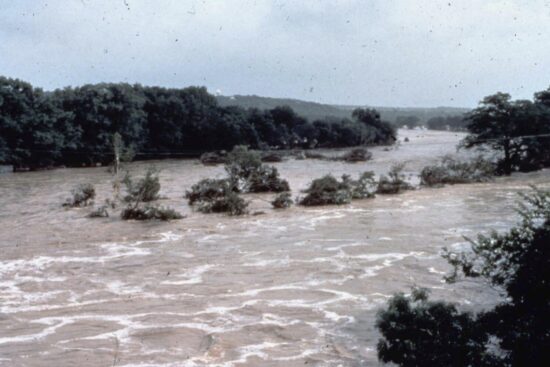
The catastrophic flooding of July 4, 2025 in the Texas hill country has left at least 130 dead. Many news outlets (predictably) have invoked climate change as a contributing cause, for example CNN, NPR, ABC News, The Texas Tribune, et al. As others have documented, there were more than adequate flash flood watches and warnings from the National Weather Service, and there was no shortage of either NWS staff or weather data.
It has long been known that this region is considered “Flash Flood Alley“, where the local topography and little soil covering the rock underneath leads to large amounts of runoff into the Guadeloupe and other nearby rivers in the event of heavy thunderstorms.
Clearly, one weather event is not evidence of climate change. We need to examine long-term weather statistics to evaluate claims that severe weather, of any type, is getting worse. This is especially true of heavy rainfall events, which are notoriously sporadic, with long-term statistics which are not well-behaved.
Flash floods require more than just heavy rainfall; they also require (1) rain to accumulate over a very short period of time, (2) the storms need to stay over the same area, and (3) the geography and hydrology features (little soil, sloping terrain) need to rapidly funnel most of the water into streams and rivers. The Flash Flood Alley region of Texas can deal with, say, 5 inches of rain if it falls steadily over 2 days. But if it falls in only 6 hours, flash flooding is much more likely. As is the case with tornadoes, a catastrophic flash flood requires specific ingredients that seldom occur all at the same time and location. There is a large element of randomness involved.
The Catastrophic Floods of 1978
While the 1987 flood (pictured above) was also severe, it has been nearly 50 years since a flood of similar magnitude to the July 4th flood occurred, and that was in 1978. This San Antonio Express-News article is a fascinating read regarding that event. Like this year’s disaster, the cause was a dissipating tropical storm (Amelia in 1978, T.S. Barry this year). That flood killed 25 people in the Hill Country. What I find especially interesting is that the flood uprooted ancient cypress trees, up to 6 ft. in diameter, estimated to be several hundred years old.
133 Years of Heavy Rainfall Events in the Texas Hill Country
John Christy (UAH) provided me some heavy rainfall statistics for several stations in the Kerrville, TX area. For years John has been going through old daily weather summary forms that were never digitized, extending observational records back into the late 1800s. This is tedious and time-consuming work, but necessary if one has any hope of examining long-term trends in heavy rainfall events.
From those data, here are the last 133 years of the heaviest 2-day rainfall events in each year at Kerrville, TX (since 1893).
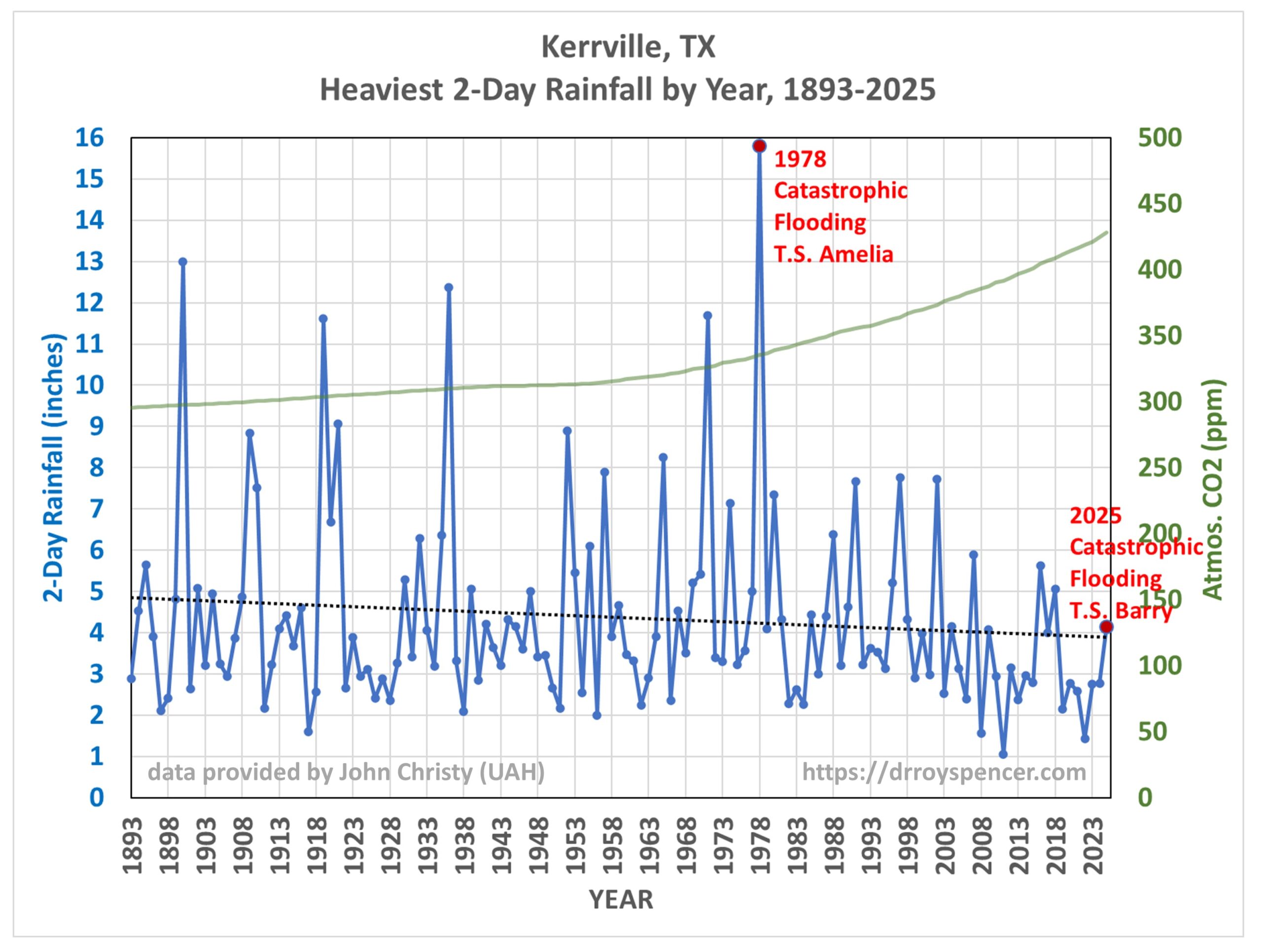
Clearly, there has been no long-term change in heavy rain events at Kerrville, Texas in spite of increasing atmospheric CO2 concentrations (also shown in the above plot). Even the EPA shows maps for the 50-year period 1965-2015 that indicate slight downward trends in river flooding magnitude and frequency over most of Texas, as well as the rest of the U.S.
From the Kerrville plot above you might wonder, why did the 2025 flood have so little rainfall at Kerrville? This is because most of the rain occurred upstream of Kerrville. Flash floods can occur at locations where no rain has fallen, as the water flows downstream from where the heavy rainfall occurred. Because of this effect, not all of the heavy rainfall peaks shown in the above plot produced serious flooding, and some of the documented flood events at Kerrville had only modest rainfall amounts.
Instead, the rainfall statistics at Kerrville should be viewed as evidence to address the question, are heavy rainfall events in Texas Hill Country getting worse? At Kerrville, at least, the answer is “no”.
But that’s just one station. John Christy also provided me data for 3 other nearby stations: Boerne, Fredericksburg, and Hondo Texas (not shown). For the same period (1893-2025) the trend lines for those stations are all essentially flat to slightly downward.
Climate Change, Heavy Rainfall, and Flooding: What Is The “Scientific Consensus”?
As we document in our Department of Energy report released yesterday entitled, A Critical Review of Impacts of Greenhouse Gas Emissions on the U.S. Climate, when one looks at rainfall statistics across the U.S. extending back to the mid- to late-1800s, there is little evidence for anything that might be considered related to human-caused climate change.
And don’t take just our word for it.
For flooding, the most recent IPCC report (AR6) said there is “low confidence for observed changes in the magnitude or frequency of floods at the global scale.”
For the U.S., the 4th National Climate Assessment stated that “trends in extreme high values of streamflow are mixed” with both increases and decreases, and there is no “robust evidence” that any trends are attributable to human influences.
So, for the usual suspects trashing our report to the media (Michael Mann, Andy Dessler, and Zeke Hausfather), maybe they should look at what we actually wrote, and the “consensus” sources we relied upon.
The public has been misled on climate science, and we are trying to set the record straight.
via Roy Spencer, PhD.
July 30, 2025 at 08:56AM
 Iowa Climate Science Education