Category: Daily News

Scotland’s Tidal Bet: Net Zero, Net Loss

Guest Post by Willis Eschenbach

Let me invite you to consider the Scottish coast, where the tides are large and the headlines are gushing—much like the capital outflow—over the MeyGen tidal project, a four-turbine, six-megawatt marvel whirring away beneath the waves. The headlines scream  Underwater turbine spinning for 6 years off Scotland’s coast is a breakthrough for tidal energy.

Me? I’m just a suspicious sort with too many years in the accounting trenches and a soft spot for arithmetic. So I thought I’d take a peek at the math behind the green curtain and see what’s really going on.

First, the basics. The capital cost for the four-turbine Phase 1A MeyGen project was £51 million at construction—call it £66 million in 2025 pounds, or about US$90 million at today’s exchange rate. No one seems keen to publish the total operation and maintenance (O&M) bill for Maygen, but industry estimates for similar tidal setups run 2–4 cents per kilowatt-hour (kWh). For 51 million kWh generated so far, that’s a ballpark $1–2 million for O&M.

So, $91 million spent, 51 million kWh produced. That’s $1.78 per kWh—over thirty times the US grid price for gas-fired power, which hovers around $0.04–0.06 per kWh. Ouch.

Now I can hear you thinking, “But that’s just the first seven years! The costs are front-loaded! Surely it gets better over time?” And you’re right. So let’s squint into the always-misty future.

Over the projected 25-year lifespan of the four turbines, the array is expected to generate about 164 million kWh. There’ll be two major overhauls—$3 million each—and 25 years of O&M at around $0.03 per kWh, totaling around $6 million. Add it all up: $90 million (capital) + $6 million (overhauls) + $6 million (O&M) = roughly $102 million.

Divide by the lifetime output, and you’re looking at a cool US$0.62 per kWh. That’s about ten times what gas power costs in the US.

Why are the costs so high? Well, in part it’s the “capacity factor”. That’s the percentage of the nameplate rating that they are actually generating. The individual turbines are rated at 1.5 megawatts. One has been operational for nine years, one for eight years, and two for 7 years. That’s 31 turbine-years, times 1.5 megawatts/turbine, times 8,766 hours per year, yields 407 gigawatt-hours (GWh) if they were running full-tilt.

But in the real world, they only put out 51 GWh, so their capacity factor is a pathetic 13% …

And that cost and capacity factor are assuming that there are no unexpected breakdowns in the next 18 years. Is that realistic, given that the ocean is one of the most corrosive natural environments on the planet.?

Well, a popular saying of my youth had it that “What goes around, comes around.”

But as a lifetime blue-water sailor, surfer, sport and commercial diver, and commercial fisherman, I can assure you that when the ocean is involved, the true saying is:

What goes around …

… stops.

And not only is the cost ludicrously high, but the output varies widely. There are two high and two low tides each day. So every 6 hours or so, at slack tides these megabuck machines are putting out exactly zero watts. That’s the reason for the low capacity factor. As a result, they require natural-gas-powered backup to balance them out by providing power for the four times daily when they wimp out.

And here’s where it gets truly Scottish, in the tragic sense of the Scottish Play. Scotland sits atop trillions of cubic feet of natural gas, but drilling for gas is banned in the name of meaningless virtue signaling.

The truth is that instead of tapping their own gas resources, the Scots import about 4 billion cubic meters of gas every year. They’re paying premium prices plus shipping costs for the same amount of gas, and they’re making zero difference to the amount of gas burned. It’s merely virtue signalling because they’re just burning Norwegian gas instead of Scottish gas. The only real gusher in Scotland these days is the steady stream of cash leaving the country.

How can the people pushing this madness think it’s a great plan? Don’t they own a calculator? I feel like the doctor in the Scottish Play when the Queen went mad, who said “This is a disease beyond my practice”

And here at the end of the story, my question is … how did the Scots ever get a reputation for being financially canny and tight with a pound?

My best to all, even those mistakenly pushing Net Zero and the Green Nude Eel,

w.

You know the drill. When you comment, quote the exact words you are discussing. Makes things far clearer.

References: [1] [2] [3] [4] [5] [6] [7] [8]


Discover more from Watts Up With That?

Subscribe to get the latest posts sent to your email.

via Watts Up With That?

https://ift.tt/qupwYB9

July 10, 2025 at 12:01PM

Why Shut Down US gov climate websites

July news is full of reports decrying the shuttering of federal government climate websites with headlines like these:

Top Website for Crucial U.S. Climate Information Goes Dark, Scientific American

Nation’s top climate science assessments removed from federal websites, UPI

Major climate change reports are removed from US websites, Los Angeles Daily News

etc., etc. etc.

Part of the missing context is this July 7 report:

Agencies plan to decommission hundreds of .gov websites following GSA review

Thomas Shedd, commissioner of GSA’s Technology Transformation Services, directed
agencies to eliminate the “low-hanging fruit” of unnecessary federal websites.

In an analysis led by the General Services Administration, the 24 largest departments and agencies inventoried more than 7,200 total websites. Documents obtained by Federal News Network show agencies plan to eliminate 332 of those websites — less than 5% of their total web presence.

According to documents obtained by Federal News Network, Thomas Shedd, commissioner of GSA’s Technology Transformation Services, said the “low-hanging fruit” of websites to cut include standalone sites for agency blogs, photo galleries and forums that would be housed elsewhere.

GSA also directed agencies to eliminate sites for events or initiatives that haven’t been relevant for a number of years, as well as standalone sites for “niche topics or working groups.”

Climate Doctrine Promoted at NASA, NOAA and Climate.gov

NASA

2024 is the Warmest Year on Record Climate change • Climate change refers to long-term shifts in temperatures and weather patterns. Human activities have been the main driver of climate change, primarily due to the burning of fossil fuels like coal, oil and gas. January 10, 2025.

Scientists have concluded the warming trend of recent decades is driven by heat-trapping carbon dioxide, methane, and other greenhouse gases. In 2022 and 2023, Earth saw record increases in carbon dioxide emissions from fossil fuels, according to a recent international analysis. The concentration of carbon dioxide in the atmosphere has increased from pre-industrial levels in the 18th century of approximately 278 parts per million to about  420 parts per million today.

NOAA

Richard Spinrad NOAA Administrator in 2023 NOAA Budget Summary

The next decade is a critical time to address the climate crisis. We have a small window to shift to a carbon neutral economy and hold climate impacts in check. With increased climate funding, we have a once-in-a-generation opportunity to advance climate services across the nation. To that end, NOAA’s climate ready nation initiative will target investments to address climate risks and build climate resilience, especially in our most vulnerable communities.

Climate.gov program manager Rebecca Lindsey 

What evidence exists that Earth is warming and that humans are the main cause?

We know this warming is largely caused by human activities because the key role that carbon dioxide plays in maintaining Earth’s natural greenhouse effect has been understood since the mid-1800s. Unless it is offset by some equally large cooling influence, more atmospheric carbon dioxide will lead to warmer surface temperatures. Since 1800, the amount of carbon dioxide in the atmosphere has increased from about 280 parts per million to 410 ppm in 2019. We know from both its rapid increase and its isotopic “fingerprint” that the source of this new carbon dioxide is fossil fuels, and not natural sources like forest fires, volcanoes, or outgassing from the ocean.

Finally, no other known climate influences have changed enough to account for the observed warming trend. Taken together, these and other lines of evidence point squarely to human activities as the cause of recent global warming.

Agencies Aligned with Politicians In Power

2024 presidential candidates on climate change

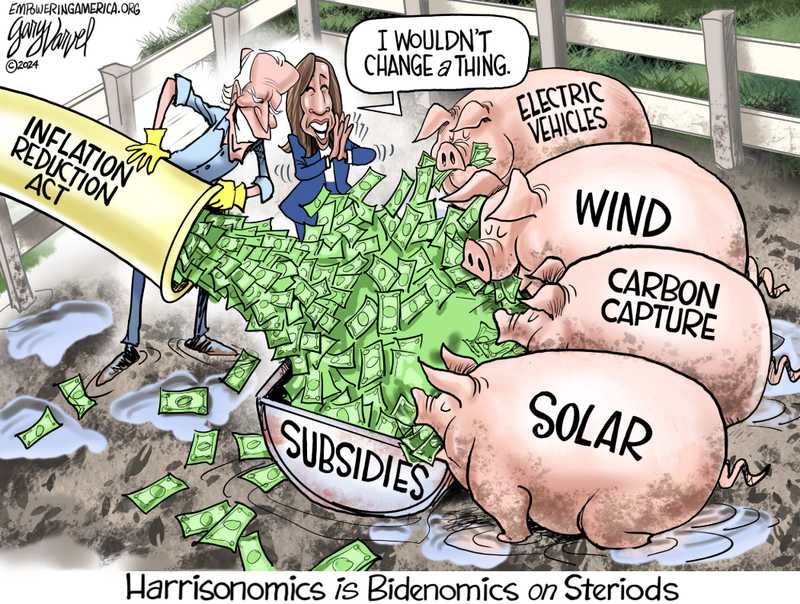
Democrat Joe Biden

In a campaign speech Biden said, “We passed the biggest investment in history to combat climate change, because I believe climate change is the only existential threat we have. I mean that in a literal sense. Not a joke. If we don’t get it under control, we will have mortgaged not only the next generation, but mortgaged humanity. I believe that with every fiber of my being.” [source, as of 2023-09-28]

Democrat Kamala D. Harris

Harris’ campaign website said, “As President, she will unite Americans to tackle the climate crisis as she builds on this historic work, advances environmental justice, protects public lands and public health, increases resilience to climate disasters, lowers household energy costs, creates millions of new jobs, and continues to hold polluters accountable to secure clean air and water for all.” [source, as of 2024-09-09]

However, Voters Backed a Change in Priorities

Republican Ron DeSantis

DeSantis’ campaign website said he would, “Withdraw from Paris Climate Accords, Global Methane Pledge, and all ‘Net Zero’ commitments. Eliminate ESG regulations and prohibit government accounts and pensions from using ESG. […] Repeal Biden rules targeting gas stoves, furnaces, and appliances. Streamline the environmental review process for energy and infrastructure projects. Work with states to reduce time and duplication in permitting. Prevent abusive litigation by environmental groups and defund ideological activism.” [source, as of 2023-12-19]

Republican Donald Trump

Trump’s campaign website said, “President Trump will once again exit the horrendously unfair Paris Climate Accords and oppose all of the radical left’s Green New Deal policies that are designed to shut down the development of America’s abundant energy resources, which exceed any country’s in the world, including Russia and Saudi Arabia. […] President Trump will immediately stop all Joe Biden policies that distort energy markets, limit consumer choice, and drive-up costs on consumers, including insane wind subsidies, and DoE and EPA regulations that prevent Americans from buying incandescent lightbulbs, gas stoves, quality dishwashers and shower heads, and much more.” [source, as of 2023-12-21]

Summary

No surprise that “elections have consequences.”  A change in leadership means a change in political doctrine and priorities, and in this case, reopening the file on natural as well as human contributions to weather and climate fluctuations and what to do about it.

Climatists Deny Natural Warming Factors


via Science Matters

https://ift.tt/KwtjB4S

July 10, 2025 at 10:56AM

Tropical timings – Kepler’s ‘trigon’ motion of Jupiter and Saturn


At the time of publishing previous ‘tropical timings’ posts I hadn’t seen this classic effort from planetary theory pioneer Johannes Kepler, published over 400 years ago, so here it is. Let’s have a closer look.

He described a 40 conjunction model of the orbits of Jupiter and Saturn with the Sun in the diagram shown above. The position of each conjunction is numbered and linked to the next one (1 is mid-right, 2 lower left, 3 upper left, 4 next to 1 and so on), indicating a near triangular movement of the axis for every 3 conjunctions, which he called a trigon.

Our post linking those orbit periods to Earth’s rotating reference frame (link here) described how such a system works, with screenshot examples from Arnholm’s solar simulator (link here).

As noted before (see here), there are 15 solar barycentric orbits (SBO) every 179 years, or per 9 Jupiter-Saturn conjunctions (ref. J. Blizard in that link).

This is the basis of the movement of both these planets and the Sun itself, sometimes described as a tri-lobed epitrochoid. A simple example might look like the animation here [credit: mathcurve.com].

The difference between that and the solar barycentric motion is that the SBO has all sorts of variations in length, time and relative position to the actual barycentre. These variations are mainly due to the combined effects of Jupiter and Saturn, but those of Uranus and Neptune also play a lesser part.

The Sun also returns to, or close to, the barycentre occasionally, typically at intervals of 9 J-S, or twice per 9 J-S (e.g. 7 and 2 J-S). Examples occur in 1632, 1811 and 1990 (179~ year intervals).

The ratio of the mean SBO to mean solar cycle length is very close to 13:14. However both have significant variations in individual period length.

In conclusion, Kepler looks about right as far as the diagram goes. It shows the need for three occurrences of its total period (i.e. 120 J-S conjunctions) to reach a whole number of solar barycentric orbits, since 1 trigon = 5 barycentric orbits (again, using mean values) and 40 J-S isn’t a whole number of trigons of 3 J-S each. Hence number 40 is next to number 3, for example. We can also note in 120 J-S that J = 201 orbits and S = 81 orbits (201-81=120), so this is the period when both planets exceed the imaginary 5:2 ratio (times 40 = 200:80) by exactly one orbit.

via Tallbloke’s Talkshop

https://ift.tt/uECleA4

July 10, 2025 at 09:19AM

ABC News’ Claim that Climate Change Is Causing Sleep Apnea Is Absurd

In a recent article titled “Climate change making it harder for us to sleep, study says,” ABC News claimed that climate change is now not just responsible for hurricanes, wildfires, and flooding—it’s also robbing us of our sleep. This evidence for this is at best scientifically flimsy and at worst flatly false. Data does not show that heat waves or nighttime temperatures are increasing globally in a way that would significantly disrupt human sleep patterns.

“If temperature keeps rising the way they project it to, the burden and prevalence of sleep apnea may double, increasing by 20-100%, depending on greenhouse gas emission reduction,” Bastien Lechat, the lead author of the study that ABC News based its story on, told the news service.

First, it’s important to note that a large portion of the measured temperature rise in cities is due to the well-known Urban Heat Island (UHI) effect, not long-term climate change. Studies show that local temperatures, particularly nighttime temperatures, are elevated in urban areas because of concrete, asphalt, and heat retention from human activity. This effect can easily be mistaken for broader climate warming if not properly controlled for in studies. As noted by Climate Realism, the UHI effect significantly skews local temperature readings and has not been adequately accounted for in many of the studies used to bolster claims of increasing nighttime heat waves.

The article’s alarm about rising nighttime temperatures is further undermined by the fact that global average temperatures have risen by mere tenths of a degree over the past several decades. According to the National Oceanic and Atmospheric Administration (NOAA), global nighttime minimum temperatures have increased by only about 0.15°C per decade since 1950. Even if this rate continued, the changes would be too small to create the sort of sweeping health crisis ABC is forecasting.

Most of the year is well below the extreme nighttime temperature pegged by the authors of the Nature study as leading to increasing incidences of sleep apnea. Winter nighttime lows could rise from 30℉ to even 50℉ and not have an impact. During the summer, average nighttime low temperatures across the U.S. and China, for example, even in July, are in the 60s and 70s. So temperatures there would have to rise regularly by more than 10 degrees, to meet or exceed 81.4℉ temperature cited in the study as problematic, but temperatures have only risen less than 2℉ since 1950. ABC missed this fact entirely.

Attributing the rise in sleep apnea to climate change is a medical misdiagnosis. The primary causes of obstructive sleep apnea (OSA) are well-known and have nothing to do with ambient temperatures. According to the Mayo Clinic, the main risk factors for sleep apnea include obesity, thick neck circumference, narrowed airways, family history, use of alcohol or sedatives, smoking, nasal congestion, and certain medical conditions such as high blood pressure. Nowhere in this list does “climate change” appear. And nowhere in the study does it indicate that it controlled for these known risk factors to tease out any additional suffering from warming.

Additionally, a systematic review in the journal Sleep Medicine Reviews confirmed that weight gain and anatomical factors are the dominant contributors to sleep apnea worldwide. It is simply not credible for ABC to suggest that a few tenths of a degree in nighttime temperature could double sleep apnea cases globally.

ABC also misses the mark when it tries to link restless nights to warmer temperatures. According to Harvard Medical School, the most common contributors to insomnia and poor sleep include stress, anxiety, depression, irregular sleep schedules, and lifestyle factors such as caffeine or alcohol use. Temperature can play a role, but as a relatively minor factor when compared to these well-documented causes.

Even studies that explore the relationship between temperature and sleep quality, including the one cited by ABC, acknowledge that the observed changes in sleep duration and quality are often minimal—sometimes amounting to a few minutes per night. These small statistical changes are hardly the public health emergency ABC is suggesting.

Furthermore, the claim that a 40 to 45 percent increase in sleep apnea episodes on hot days is contextually void. This claim, that ABC News pulled from the Nature Communications study, is based on comparing extreme heat days to cooler ones, but this does not establish a causal relationship over time. It also does not account for confounding variables like UHI effects, indoor climate control (air conditioning is common in most of the developed world), and individual health status.

On top of this, the article’s sweeping predictions rely heavily on speculative future warming scenarios, specifically the high-emission RCP8.5 pathway, which is now widely regarded by climate scientists as implausible. Basing health projections on worst-case emissions scenarios that climate science itself has walked back is scientifically suspect if not invalid.

Also, global access to air conditioning is increasing steadily, particularly in regions where warmer nighttime temperatures might otherwise cause discomfort. If temperature impacts sleep apnea, indoor air temperatures are what matters, not outdoor air, and with air conditioning indoor air can be controlled. A report from the International Energy Agency (IEA) highlights that the growing adoption of air conditioning will continue to mitigate heat-related health risks, including poor sleep. Ignoring this technological adaptation is yet another oversight in the ABC article.

To summarize: urban heat islands skew local temperature readings, medical literature firmly identifies lifestyle and anatomical factors as the primary causes of sleep apnea, and modern adaptation technologies like air conditioning can mitigate heat impacts. The global warming trend, when properly accounted for, is insufficient to explain any significant increase in sleep apnea cases or widespread sleep deprivation.

In the end, ABC has cobbled together a tenuous connection between climate change and a growing health concern—sleep apnea—while ignoring the substantial medical and social factors that contribute to the problem and technological factors that could mitigate or reduce it regardless of outside temperatures.

ABC News should be embarrassed by this piece that borders on the absurd. Climate change is causing sleep apnea. Really? Next, they’ll tell us climate change is making our toast burn in the morning.

Anthony Watts

Anthony Watts is a senior fellow for environment and climate at The Heartland Institute. Watts has been in the weather business both in front of, and behind the camera as an on-air television meteorologist since 1978, and currently does daily radio forecasts. He has created weather graphics presentation systems for television, specialized weather instrumentation, as well as co-authored peer-reviewed papers on climate issues. He operates the most viewed website in the world on climate, the award-winning website wattsupwiththat.com.

Originally posted at ClimateREALISM


Discover more from Watts Up With That?

Subscribe to get the latest posts sent to your email.

via Watts Up With That?

https://ift.tt/vSNd7T1

July 10, 2025 at 08:01AM