Category: Daily News

The Politics of Tragedy

There are only three certainties in this world: death, taxes and the BBC exploiting every weather-related tragedy in order to heighten anxiety over climate change. The recent Texas flooding, in which over 100 people lost their lives, provides the most recent example. The horror of the event cannot help but cause distress to anyone prepared to pause for a moment to contemplate the fate of all those poor children. This is surely not the time to argue the toss over the science behind the tragedy. But I’m afraid I am going to have to do so, if only because the BBC has already beaten me to it with its most recent report.

As is often the case nowadays, the report initially gives no clue as to where it is headed; seemingly providing a straightforward account of the weather conditions leading to the event, together with a recognition that the area is notorious for flash flooding (hence the local name, ‘flash flood alley’). It would seem that history, geography and local weather conditions, combined with highly questionable decision-making, do more than enough to explain the cause of the horror that unfolded. Not, however, enough for the BBC. Despite opening with the headline, “Volatile weather, unusual humidity and the Texan landscape all contributed to scale of destruction”, the article closes with:

The influence of climate change cannot be ignored as another factor in extreme weather events like this. Whilst it is difficult to directly attribute the influence of the warming planet to one particular weather event, sea surface temperatures in the Gulf of Mexico, where some of the air originated from, continue to be warmer than normal. Warmer waters mean more evaporation and so more available moisture in the atmosphere to feed a storm.

Nice theory, but scepticism is all about resisting the “theorizing disease”. The empirical sceptic prefers instead to focus upon the data, to see if there has been a recent trend that supports the idea that this tragedy has all the hallmarks of a climate change catastrophe. As Cliff Mass reports, this is what the precipitation history data looks like for nearby San Antonio:
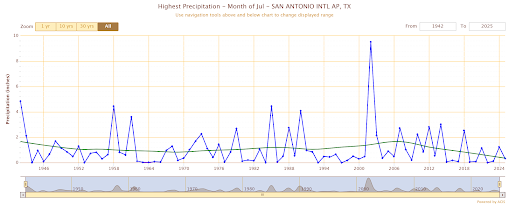
I’m not going to dwell on this; the data speaks for itself and I’m finding the whole idea of discussing such matters whilst the death toll is still rising quite distasteful. We should instead just pause to reflect upon the human dimension; a dimension that most certainly encompasses human frailty, grief and horror, but must also involve a determination to learn from obvious failings. A failure to meet Net Zero may be uppermost in the minds of the average environmental journalist, but surely the proximate failure of those in charge to respond to the more than adequate weather alerts should, at least for the time being, be the greater concern.

Meanwhile, anything the BBC can do, the Guardian can do much better. Even as the bodies and teddy bears still float down the river, the Guardian takes the opportunity to attack Trump, with the suggestion that “Deadly floods could be new normal as Trump guts federal agencies”. As the article explains:

It remains unclear why the early warning system failed to result in the timely evacuation of Camp Mystic, where 700 girls were camped on a known flood plain on the Guadalupe River, but there is mounting concern that the chaos and cuts instigated by Trump and his billionaire donor Elon Musk at the National Weather Service (NWS) and Federal Emergency Management Agency (Fema) may have contributed to the death toll.

Why do I feel sickened by this?

via Climate Scepticism

https://ift.tt/My8NK2U

July 8, 2025 at 06:00AM

Louisiana’s Leadership on Breaking America’s Decades-Long Energy Stagnation

By Kyle Moran

America has been sleepwalking through nearly three decades of stagnant energy production. In Louisiana, Governor Jeff Landry has put an end to this by signing HB692 into law.

This couldn’t come at a more critical time. While China has exploded its electricity generation nearly eight times over since 2000, the U.S. has barely budged. We’ve spent decades in regulatory paralysis, which has made it nearly impossible to build serious energy infrastructure just as artificial intelligence is driving unprecedented electricity demand. The result? We’re about to lose our technological edge not by being outsmarted, but because we lack the capacity to power the future.

Of particular importance is the growth of artificial intelligence systems, which is driving unprecedented electricity demand. Data centers alone are projected to more than double their electricity consumption by 2030, accounting for nearly half of the growth in new electricity demand. Consumers play a large role in this, too: A single ChatGPT query consumes roughly 10 times more energy than a traditional Google search, and AI trends are only becoming more mainstream.

Louisiana’s move would encourage and expand both natural gas and nuclear energy production — and this is just the kind of energy realism the U.S. needs. Critics will complain that deprioritizing renewables somehow compromises environmental goals, but this couldn’t be further from the truth: Recognizing that you cannot power an entire state—let alone a country—with renewables is necessary to making progress towards adopting more environmentally friendly approaches. Natural gas, for instance, burns significantly cleaner than coal—and it’s not even close. As for nuclear, it’s truly emissions-free and can far outproduce its renewable alternatives.

Meanwhile, states with renewable-only mandates are discovering the pitfalls of their approach the hard way. California residents — it really is always California, isn’t it? —pay nearly double the national average for electricity and face rolling blackouts, while Germany faced an energy crisis so severe that one of their ministers publicly advocated heating only one room during the winter to cut costs.

We are in a sort of arms race with China on the AI front—and so far, we’re narrowly in the lead, in part thanks to our hardware advantage due to our friends in Taiwan who produce some of the most advanced chips in the world that power everything from iPhones to Nvidia’s AI processors.

It would be snatching defeat from the jaws of victory to squander this competitive lead , not by being outsmarted or out-engineered, but simply lacking the power that these systems will require. China now generates nearly eight times the energy it did in 2000, and the growth shows no signs of slowing down. So much for their non-binding pledges from the Paris accord.

The economic implications ought to command the attention of every governor in the country. Louisiana is already seeing approximately $98 billion in combined announced and in-progress investments for energy-hungry data centers and energy-producing initiatives. Meta has chosen the state as the site for its new $10 billion data center, which will be powered by three new natural gas plants that provide clean, reliable power and support the more than 300,000 men and women working in the energy field.  

This is no coincidence. It’s what happens when a state breaks free from decades of regulatory paralysis that has prevented them from building serious energy infrastructure for a generation.

The U.S. must adapt to the world we live in, and that starts with bills like HB692, which demonstrate how states can reclaim control over their energy destiny from federal bureaucrats and environmental extremists. The outcome is clear: After decades of stagnation in energy production, Louisiana has shown that breaking free from this paralysis is possible. The only question now is which states will follow Louisiana’s lead.

Kyle Moran is an analyst specializing in international affairs and national security. His research has been published in the American Enterprise Institute’s Critical Threats Project, and his commentary has been featured widely in outlets including RealClearPolitics and the Washington Examiner.

This article was originally published by RealClearEnergy and made available via RealClearWire.


Discover more from Watts Up With That?

Subscribe to get the latest posts sent to your email.

via Watts Up With That?

https://ift.tt/0ZhKVwo

July 8, 2025 at 04:03AM

Dale Fort DCNN8122 – Another site forgotten by the Met Office, probably just as well!

51.70292 -5.15201 Met Office CIMO Assessed Class 4S Archived temperature readings from 1/1/1959

Dale Peninsula protrudes from the south west of Wales in the old ceremonial county of Pembrokshire. The Fort was built in the mid 19th century as a coastal artillery defense that has since been adopted by the Field Studies Council as an educational facility. Unfortunately over recent years the husbandry of the weather station has fallen to the FSC and therein lies a major problem.

The CEDA archives have only digitally transcribed readings from 1959, this is odd in that records are readily available from 1950 onwards. It is worth noting that the transcribers of the 1959 to 1961 readings operated to the Met Office “rounding up” process making 31°F equate to – 0.6°C with 33°F becoming + 0.6°C unlike Faskally where rounding down was operated generating different conversions with a 0.2°C discrepancy.

Reading frequency up to the early 2000s was highly commendable as it should be for every manual climate reporting station. However, as is so typical of almost every FSC run site, the readings became erratic to the point of rarely being taken. As the Met Office enquiries desk offered to Dave Woolcock who was searching for data from Mickleham .

Looking at Mickleham it is a Field Studies Council site.
This means that it has a high turnover of staff usually with a new observer each year. They tend to need to have one committed member of staff to keep engagement going, even if they are the supervisor not necessarily taking the readings. When they move on engagement drops off sharply. I would guess that is what happened at this site.
Over the last 10 years or so, there has been a general drop off in observations from all of our FSC sites. We get peaks when a new person starts and is enthused, then it drops off again as they get busy with other duties.”

Given that the sole purpose of any weather station is to supply instrumental readings, there really is little point if no readings are taken. A typical recent example year (not the worst) was 2016 when only 138 readings (38% of the year) were actually taken. It is not only the infrequency that is of concern though, actually reading LIGTs is a trained skill in order to avoid parallax reading errors. This site was fitted with a digital PRT in 2017 but that only records maxima in manual stations with LIGT still employed for minima. If observers are not adequately trained or committed to the task, errors are inevitable. A point that always confuses me is the recent nature of this observing infrequency generally. As I noted in reviewing the premier quality Lake Vynwy, in the latter 20th century readings were meticulously taken however adverse the conditions, this diligence seems to have been lost at far too many sites and not just FSC run sites.

So what of the site characteristics – well they really are far from ideal. The weather station will not have been established for the purposes of creating a long term climate record rather for very localised military purposes. As the Met Office itself used to openly admit many years ago

The location of the site should be selected in such a way that the observations are representative on a scale required from the station; a station in the synoptic network should make observations to meet synoptic scale requirements, a rainfall station should measure the impact of local orography on the rainfall amount, while an aviation station should observe the local conditions at the aerodrome.

A weather station at a coastal artillery defense base does not report conditions with the inland area in mind so will never be representative of anywhere else. Again this adoption of inappropriate weather stations for general climate use was similarly acknowledged after having detailed the site requirements they state.

It is unavoidable that some sites do not meet all these requirements, particularly where a station set up for one purpose gradually takes on a different role, for example an airport site originally established for aviation observing may become a key synoptic or climate station while suffering the effects of urbanisation. A few sites are in city centres and may be unsuitably located close to large obstacles or even on the roof of a building.”

Dale Fort weather station sits in a semicircular concrete emplacement surrounded by a wide range of huge stone and concrete structures and is astonishingly unnatural. The FSC produced a drone flyover film for publicity on Youtube that gives a very good insight to the overall unsuitable nature of the site for climate reporting. The weather station is clearly visible at around 1 minute in and is by the wind mast mid right of centre in the still below.

The Met Office assesses the site as Class 4S with the addition of the “S” intended to indicate severe shading effects to be taken into “consideration”. Presumably the walling around the site and the few shrubs and trees are the cause of this problem, in which case I fail to see why the site is simply not considered Class 5. It really is a poor site for climate reporting which now has a very poor reporting record – put together, no use at all despite a long term record.

To add typically perverse logic to Met Office data presentation we move onto their inevitable 60 year rolling climate averaging. With a continuous observations record from 1950, Dale Fort, in theory, would be a suitable candidate for their location specific long term climate averages reports…….or maybe not if they do not recall having a climate station there. “Sorry we don’t have any climate stations at or nearby that location” Really?

So putting in the FSC postcode SA62 3RD we are invited to examine comparative data from 4 miles away at Brawdy.

Brawdy (better known originally as RAF Brawdy) is, of course, one of those sites that are totally inappropriate – “for example an airport site originally established for aviation observing may become a key synoptic or climate station” To add further perversity Brawdy was opened in 1955 (subsequent to Dale Fort) and closed 33 years ago in 1992. The Met Office prefers to portray its “data” for climate averages purposes from fabricated numbers for non existent sites in lieu of real numbers from existing ones…… And then they refuse to divulge which site’s data were used in this fabrication. If Dale Fort and RAF Brawdy are only 4 miles apart why not simply use the real site’s data for the entire period of 1961 to 2020 rather than computer generated numbers from a largely “imaginary” site?

The Met Office cannot be allowed to continue in a manner that accepts multiple “slap dash” readings from a multitude of wholly inappropriate sites in order to computer fabricate unaudited alarmist figures from their pet Zombie sites which are kept a “state secret”.

via Tallbloke’s Talkshop

https://ift.tt/iug1FDN

July 8, 2025 at 03:22AM

Jackson on OAN: Biden’s Green agenda was out of touch with black communities

"It would have given undue influence to NGOs who could assert their will over the voters instead of focusing on what the community really needs." 

via CFACT

https://ift.tt/C5BP7VE

July 8, 2025 at 01:39AM