Category: Daily News

Grok Defending The Climate Scam

Interesting conversation with Grok, defending NOAA adjustments.  Grok was wise not to answer my final question, because either way it loses.  Either the adjustments are bogus, or UHI is much larger than acknowledged. (18) Tony Heller on X: “@grok @MohelRabbi … Continue reading

via Real Climate Science

https://ift.tt/gKt8FM4

July 6, 2025 at 03:49PM

“Climate Change” in Leftist Eyes

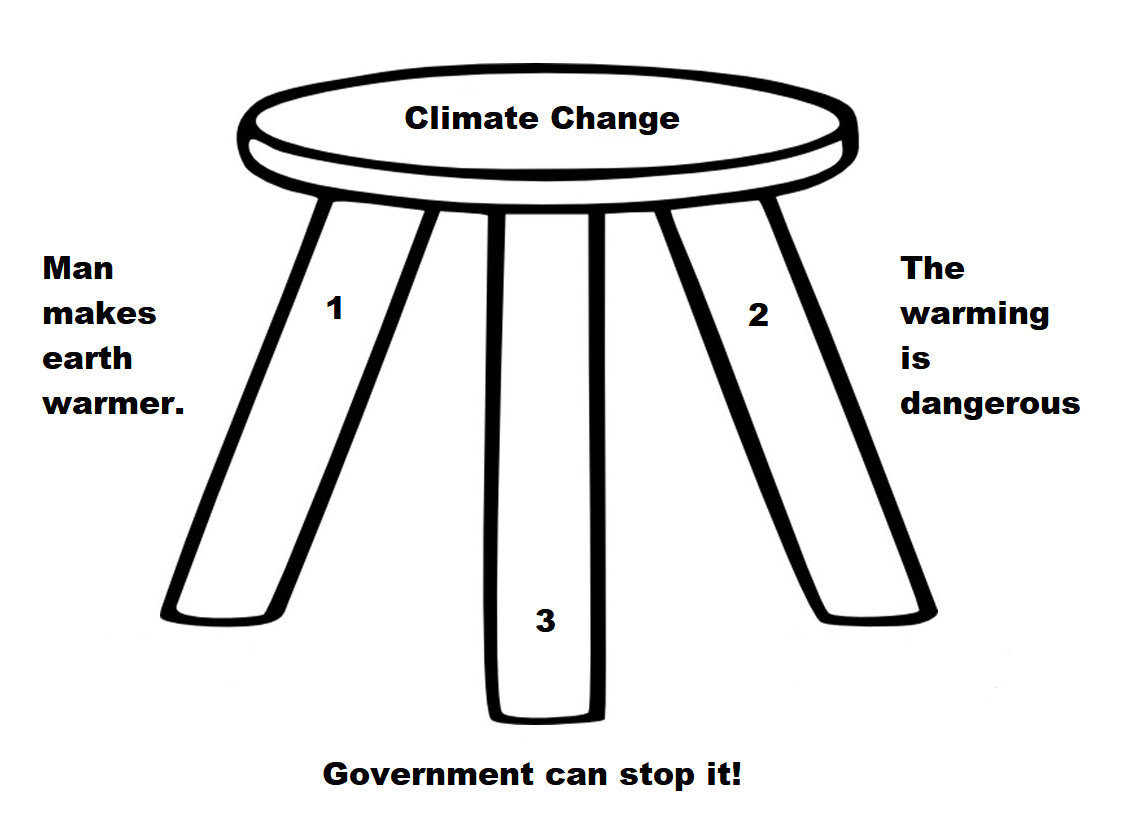
The Climate Change threat depends on three assertions, and collapses if any of them fall.

Linnea Lueken writes at American Thinker “Climate Change” means whatever the Left wants it to mean.  Excerpts in italics with my bolds and added images.

In a recent interview with Sen. Bernie Sanders (I-VT), Joe Rogan touched on the issue of climate change, a favorite talking point for Sanders.

Predictably, Sanders insisted that climate change is not a “hoax.” To this, Rogan raised some of the problems with the common media and political narratives surrounding claims of a climate crisis. The exchange reminded me, though, that despite how silly and absurd climate alarmists look to most of us, the way they have structured the climate debate is pretty smart.

How frustrating is it when they say things like “climate change is real,” or, as Sanders told Rogan, “climate change isn’t a hoax,” with such gravity?

Yes, climate change is real. This beautiful planet we are blessed to call home has multiple types of climate regions and they all constantly change in one way or another, both subtly and sometimes dramatically, over time. Stasis has never existed on Earth. Change is the natural order. An unchanging planet is a dead rock — deader than dead, because even other lifeless planets in our solar system experience seasons and long-term changes. Thus, climate change is not a hoax.

But that’s not what alarmists mean when they say, “climate change.”

When President Trump says climate change is a hoax, he is obviously not saying that natural climate change does not happen, he may not even be asserting that humans have no impact.

 Climate change, in the way activists, the media, politicians, and many scientists commonly use it, comes loaded with a presupposition that it is an unnatural change. Specifically, that most of the warming of the past century or so is anthropogenic — originating from human activities like farming and driving cars — and that such change is an existential threat. In short, one can accept the fact that climate change is a natural phenomenon and still be called a climate denier if you don’t agree with people like Sanders, who declare that windmills, solar panels, electric vehicles, and global socialism are the only proper responses to the changing climate.

To those who value truth and precision, this is aggravating
because it is incomplete, vague, and for all intents and purposes, false.

This is by design, and I think it is mostly tied to the utility of the “denier” label.

It allows interested parties to dismiss people who don’t take a very narrow view of the subject and ostracize scientists who disagree even marginally from the dominant narrative. The truth of the matter is that the science is not settled. Every single element of the anthropogenic climate change theory is up for debate, with varying degrees of disagreement.

It is also dangerous. For example, people in positions of power, like former U.S. Attorney General Loretta Lynch and Sen. Sheldon Whitehouse (D-RI), have expressed interest in prosecuting “climate deniers.” They want to intimidate freethinkers who “follow the science,” while ignoring the fact that we live in a constitutional republic, not a scientific dictatorship.

The facts and data don’t dictate a particular course of action. How to respond to the information, if we even need to, is a decision for individuals and sometimes the political realm. This should be based on our values and an understanding of the trade-offs and risks and benefits of courses of action — scientists have no particularly valuable expertise or insights above the rest of us when making such decisions.

Because the term “climate change” is so nebulous and ubiquitous, anything connected to persecuting or suppressing critics of policy surrounding “climate change” can also be shifted as easily as the alarmists want.

It is smart and tactical, and easy to weaponize. It is easy to smear scientists who are skeptical of the dominant narrative by even mere degrees, silence dissent, and possibly worse, without ever needing to clarify the fullness of the alarmist position or defend the often very extreme political policies that come tied to it.

We need to see realist or skeptical politicians and media figures put the alarmists on their back feet by demanding they define exactly what they mean by “climate change” when the term is used. If Joe Rogan had asked Sanders to define the term “climate change” in addition to the other good points Rogan made, we may have been able to see Sanders forced to solidify the term and have his positions questioned in a more direct and devastating way.

We also need to force alarmists to defend the policy fixes they endorse.

They need to admit their effects on liberty and economic prosperity, their impacts on people in poorer countries, and they must explain exactly how (or if) those policies will change the climate and weather for the better. They need to prove it on time scales where they can actually be held accountable. They need to tell us how much temperature and sea level rise will be prevented, how many lives saved, etc., rather than accepting their ambiguous assurances that if we end fossil fuel use, the world will magically be a better place.


via Science Matters

https://ift.tt/629bZ34

July 6, 2025 at 02:21PM

UK Consumption Emissions – Update with 2022 Data

Back in March, when the heatwave hysteria was just a gleam in the BBC’s eye, I showed some statistics on the UK’s Consumption Emissions (capitalised Donald Trump style here to show that it is a variable as well as a name).

If you remember, Imported Emissions are difficult to calculate, so the ONS produces them at a three-year lag. Thus, in March, all I could show was data up to 2021. Today, I decided to go back to the ONS today to see whether the statistics had been updated for 2022.

Well, they had.

OK, so now we just add another row to the spreadsheet for 2022 and…

Hold on a minute, the numbers for 2021 don’t match.

OK, maybe the previous year has been revised. Let’s just check the numbers for the first year in the series – 1996.

They don’t match, either.

Rather bizarrely, the UK’s emissions for almost every year in the series have been revised, mostly up. I say “appear” there because I don’t have a pristine version of the 1996-2021 spreadsheet. I edited it by adding columns of data to the right. There is a finite chance that I did something bad to the raw data somehow. Knowing me, I think this is highly unlikely. But I note it anyway as a possibility. In terms of Consumption Emissions, there is considerable recent variation with the new update; 2016’s value has been revised up by 14%. [The Territorial Emissions for that year have been revised downwards slightly.]

The problem here is that we can’t really discuss emissions figures to any purpose if they are going to be subject to revisions of the order of 10% some years after the event.

That said, I’m going to show the new dataset now, but caveat emptor, or cave canem, or cave next year’s revision.

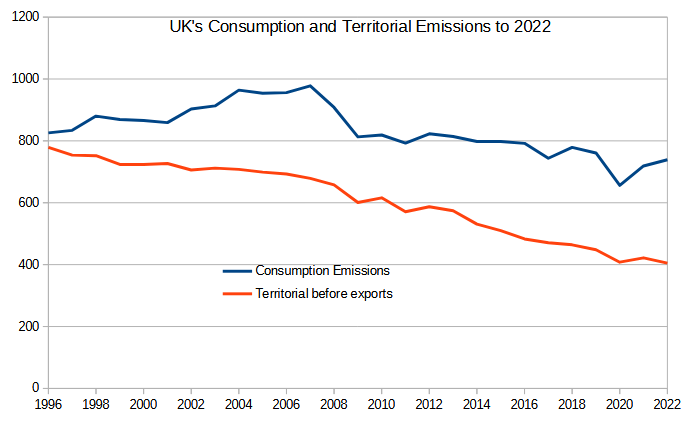
So, without further ado, here are the UK’s Consumption Emissions and our Territorial Emissions Before Exports, including the wholesale changes in the 2022 update:

The story is essentially the same as before, with a somewhat rapidly-declining Net Zero-relevant metric (orange line) and a Consumption Emissions metric (i.e our actual emissions) that is hardly declining at all. The gap between the two is inevitably widening. If you put a line (ordinary least squares) through the two datasets, you will predict that we’ll hit Net Zero in 2050, but that our Consumption Emissions in that year will still be 557 Mt CO2e. Those emissions would be entirely imported, by definition. [In 2022, Imported Emissions are already well over half of our Consumption Emissions.]

What this means is that we will hit our Net Zero target on time, but still be emitting more CO2 in 2050 than many people think we are emitting today. We’ll say we’re on 0, but we’ll be on 557 Mt.

In fact, somewhat spookily, the orange line reaches Y = 0 when the year = 2050.2. On the present data we hit Net Zero exactly in 2050. Coincidence? [We wouldn’t hit Y = 0 on Consumption Emissions until 2130, on a wild extrapolation of this data.]

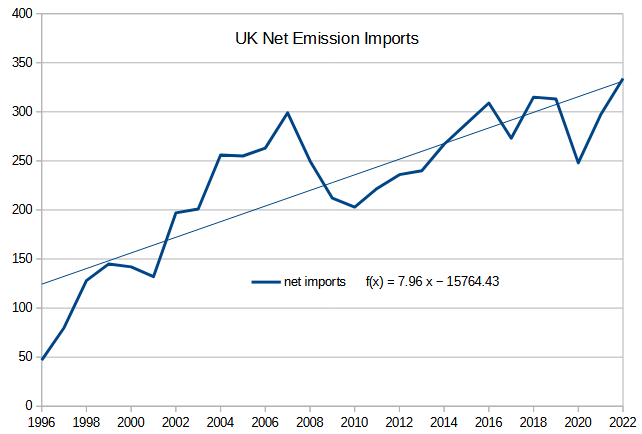
This figure shows our Net Emission Imports (i.e. Imported – Exported) as far as the latest update. The only way is up.

Conclusion: all the blather about how necessary Net Zero is to save the planet is incoherent for several reasons. Top is that, if the UK reaches Net Zero, the grand total of the world’s emissions will hardly notice. A close second comes the observation that we are just displacing our emissions to other countries, making our triumphant parade to Net Zero a mere accounting trick.

It’s as if we had pledged to give up keeping slaves, and when we reached the target of Zero Slaves, we all jumped around, slammed trebles, and popped party popping things, etc. Most of the public in that halcyon day would be blissfully unaware that we were still vicariously keeping slaves by importing goods from – shall we say – less scrupulous countries.

My suggestion would be that we need to impress upon our leaders that they are chasing the wrong number in Territorial Emissions Before Exports. But there’s no point pursuing the Consumption Emissions down to Net Zero, either, because success on that metric would result in the destruction of the UK as a functioning country. [I don’t exaggerate.] There’s no way that anyone could pretend otherwise, meaning that recognising Consumption Emissions as the appropriate target for our self-sacrifice would necessitate its abandonment as insane.

Or that’s what happens in a version of reality that I’d like to live in.

via Climate Scepticism

https://ift.tt/eHhDatW

July 6, 2025 at 01:21PM

Ocean “Reversal” Hysteria: Facts Not Included

Guest Post by Willis Eschenbach

Every so often, the climate media machine spits out a headline so breathless you’d think the laws of physics had just been accidentally repealed by a badly-worded executive order. Case in point: bne IntelliNews in Germany recently told us that a “major ocean current in the Southern Hemisphere has reversed direction for the first time in recorded history,” and that climatologists are calling it a “catastrophic” tipping point. It also quotes a climatologist as saying “The stunning reversal of ocean circulation in the Southern Hemisphere confirms the global climate system has entered a catastrophic phase.”

And the headline for that hysteria?

Southern Ocean current reverses for first time, signalling risk of climate system collapse

The implication: pack your bags, the climate apocalypse is here, and don’t forget your floaties.

But as is so often the case, the devil isn’t just in the details—it’s in the words they didn’t mention. The article, like a magician with something up both sleeves, never links to the actual scientific study.

So, after a bit of digital spelunking, I dug up the source. It’s an article in PNAS, the Proceedings of the National Academy of Sciences, yclept “Rising surface salinity and declining sea ice: A new Southern Ocean state revealed by satellites.”

To start with, here’s the Southern Ocean Overturning Circulation (SMOC) that they are claiming has “reversed”.

Figure 1. Ocean currents around Antarctica. The Bottom Water descends from the edge of the continent and runs towards the Equator along the ocean floor. Above that, the Deep Water flows towards Antarctica, rises to the surface, and moves back toward the Equator. When it hits the Circumpolar Current it splits into the Intermediate Water and Mode Water. Not sure what a “reversal” of that would look like.

And when I got to the study, what do you know? The study doesn’t mention “tipping point,” “collapse,” “current reversal,” “Southern Ocean current” or even “overturning circulation.” The only “reversal” in the paper refers to satellites detecting a reversal in surface salinity trends from decreasing to increasing, not a reversal in the the direction of the Southern ocean’s most complex circulation shown above.

So what did the study actually say? Here’s the paper’s abstract:

“For decades, the surface of the polar Southern Ocean (south of 50°S) has been freshening—an expected response to a warming climate. This freshening enhanced upper-ocean stratification, reducing the upward transport of subsurface heat and possibly contributing to sea ice expansion. It also limited the formation of open-ocean polynyas. Using satellite observations, we reveal a marked increase in surface salinity across the circumpolar Southern Ocean since 2015. This shift has weakened upper-ocean stratification, coinciding with a dramatic decline in Antarctic sea ice coverage. Additionally, rising salinity facilitated the reemergence of the Maud Rise polynya in the Weddell Sea, a phenomenon last observed in the mid-1970s. Crucially, we demonstrate that satellites can now monitor these changes in real time, providing essential evidence of the Southern Ocean’s potential transition toward persistently reduced sea ice coverage.”

I love how in the very first line, the earlier freshening (decreased salinity) of the polar Southern Ocean is described as “an expected response to a warming climate”. This is to demonstrate how well they understand what happens as the Earth warms, they knew it was going to freshen …

… but then they failed to mention that the increase in salinity post-2015 is an unexpected change that was unforeseen by either climate numerologists or computer haruspicy. But to be sure, they’ll gladly tell us what the climate will be like in 2100 AD.

In any case, let’s translate the actual science: For decades, the surface of the polar Southern Ocean (south of 50°S) was getting fresher—a little less salty—thanks to melting ice and increased precipitation, which the climate modelers assured us was exactly what a warming world would do. But then, around 2015, the trend did a U-turn. Suddenly, the surface started getting saltier, not fresher, and sea ice coverage dropped like a rock. The study’s main points? Satellites are now good enough to watch these swings in real time, and the ocean’s surface salinity is a lot more jumpy than either the models or the scientists predicted.

The media, meanwhile, went straight from “salinity trend reversal” to “ocean current reversal” to “climate system collapse.” It’s like watching a game of telephone played by people who skipped science class and majored in panic. But don’t worry, we’re assured it’s legit because bne IntelliNews said the study “was confirmed by Spanish marine scientists at El Institut de Ciències del Mar (ICM-CSIC) in Barcelona”.

Discouragingly, it’s not just the media. Even the scientists at the aforementioned Spanish Ocean Sciences Institute managed to headline their press release “Major reversal in ocean circulation detected,” despite the fact that the study didn’t detect any such thing. Antonio Turiel, ICM-CSIC researcher and co-author of the study, even said:

“We are witnessing a true reversal of ocean circulation in the Southern Hemisphere—something we’ve never seen before. While the world is debating the potential collapse of the AMOC [Atlantic Meridional Overturning Circulation] in the North Atlantic, we’re seeing that the SMOC [Southern Meridional Overturning Circulation] is not just weakening, but has reversed. This could have unprecedented global climate impacts.”

YIKES! EVERYONE PANIC!

Want to know the kicker? I mean, other than the fact that neither “reversal” nor “SMOC” are even mentioned in the study?

This isn’t even the first time it’s happened. Check out the Abstract again. The study itself notes that the Maud Rise polynya—a big seasonal hole in the sea ice—was visible in the 1970s under similar conditions, and is currently visible again. But you wouldn’t know that from the headlines, which prefer to treat every wiggle in the data as a sign of imminent doom.

The real lesson here is the one my grandmother Dorothy Greene, an amazing woman, handed down to her descendants:

“You can believe half of what you read, a quarter of what you hear …

… and an eighth of what you say.”

Although for popular reports of climate science, you might want to divide by sixteen. The next time you see “catastrophic tipping point” in the news, do yourself a favor—find the actual study, read the abstract, and remember that in climate science, as in life, reality is usually a lot less dramatic than the press release.

My warmest wishes to everyone for crisp mountain mornings, or warm summer evenings, or sunlight far-reaching on the sea, the best of whatever you dream to you all,

w.

Yep. I’ll say it again: When you comment, please quote the exact words you are discussing. I can defend my words. I can’t defend your unclear claims as to what I said.


Discover more from Watts Up With That?

Subscribe to get the latest posts sent to your email.

via Watts Up With That?

https://ift.tt/9iPfVrA

July 6, 2025 at 12:05PM