Category: Daily News

Dramatic slowdown in melting of Arctic sea ice ‘surprises’ scientists


Years of alarmist claims of the imminent end of Arctic summer sea ice have blown up big-time, so excuses have to be found. They claimed CO2 from human causes was the dominant driver of modern warming, while any other CO2 source was natural and OK. Their models predicted a relentless rise in temperatures, with Arctic sea ice the obvious evidence of the supposed climate problem. They still claim the Arctic is warming 4 times (or some other multiple) faster than the rest of the planet. Now they say: Natural climate variation is the most likely reason for the ‘slowdown’ as CO2 hasn’t declined, but it’s only a ‘temporary reprieve’. Twenty years and counting is a lot of ‘temporary’ non-effectiveness of their greenhouse gas ideas. Cognitive dissonance springs to mind.
– – –
The melting of sea ice in the Arctic has slowed dramatically in the past 20 years, scientists have reported, with no statistically significant decline in its extent since 2005, says The Guardian.

The finding is surprising, the researchers say, given that carbon emissions from fossil fuel burning have continued to rise and trap ever more heat over that time. [Talkshop comment – only surprising to those who thought CO2 was a dominant factor in climate].

They said natural variations in ocean currents that limit ice melting had probably balanced out the continuing rise in global temperatures.

However, they said this was only a temporary reprieve and melting was highly likely to start again at about double the long-term rate at some point in the next five to 10 years.

The findings do not mean Arctic sea ice is rebounding. Sea ice area in September, when it reaches its annual minimum, has halved since 1979, when satellite measurements began. [Talkshop comment – but it was rising for years before 1979, at the same time that CO2 was rising].

The climate crisis remains “unequivocally real”, the scientists said, and the need for urgent action to avoid the worst impacts remains unchanged.

The natural variation causing the slowdown is probably the multi-decadal fluctuations in currents in the Atlantic and Pacific oceans, which change the amount of warmed water flowing into the Arctic.

The Arctic is still expected to see ice-free conditions later in the century, harming people and wildlife in the region and boosting global heating by exposing the dark, heat-absorbing ocean. [Talkshop comment – why would people in the Arctic not want a bit more warmth?]

Full article here.

via Tallbloke’s Talkshop

https://ift.tt/fxKodHJ

August 21, 2025 at 01:43PM

UN: Renewables are So Cheap They Need Lots of Subsidies

Essay by Eric Worrall

Watch out for big oil saboteurs, who are more interested in pumping oil than making money.

AUGUST 20, 2025

Inflexion Point: Renewable Energy Is Cheaper Than Fossil Fuels

PRABIR PURKAYASTHA

The tipping point between renewable energy and fossil fuels has been reached, says a new United Nations (UN) report. The UN Secretary-General Antônio Guterres said that we are entering a renewable era and leaving the era of fossil fuels. According to the report, ‘In 2024, renewables made up 92.5% of all new electricity capacity additions and 74% of electricity generation growth’. While almost the entire world has increasingly switched to renewables, the United States stands out as the sole ‘dissident’, with the Trump administration denying climate change and still backing fossil fuels.

The long-talked-about renewable transition is finally here! The question is, do we have the political will to do what is not only necessary in climate terms but also economically a better option for all of us? Or will the old fossil lobby, particularly in the US, sabotage humanity’s transition to a low-carbon future?

Not surprisingly, an analysis—Li, M., Trencher, G., & Asuka, J., Feb 16, 2022, PLOS ONE —of their business activities shows, ‘a continuing business model dependence on fossil fuels…We thus conclude that the transition to clean energy business models is not occurring, since the magnitude of investments and actions does not match discourse’. In other words, oil companies are continuing with their business as usual under the cloak of carbon capture, grey hydrogen, etc., along with a lot of hot air. Incidentally, these four companies alone are responsible for 10% of all global warming in the world since 1965.

The only country acting as the spoiler is the United States, which, though it is no longer competitive in manufacturing, believes that it can extract ‘rent’ from others. This is the new G1’s ‘Trump-based world order’, instead of the G7’s so-called ‘rule-based world order’.

Read more: https://www.counterpunch.org/2025/08/20/inflexion-point-renewable-energy-is-cheaper-than-fossil-fuels/

What about that cited UN report?

Seizing the moment of opportunity

Supercharging the new energy era of renewables, efficiency, and electrification

Executive summary

The plummeting costs mean that solar and wind have become the fastest growing sources of electricity in history, and growth in renewable energy is now outpacing that in fossil fuels in the power sector. In 2024, renewables made up 92.5% of all new electricity capacity additions and 74% of electricity generation growth. Between 2015 and 2024, global annual electricity capacity of renewables increased by around 2,600 gigawatts (GW) (140%), while that of fossil fuels increased by around 640 GW (16%). Consequently, the shares of fossil fuels and renewables in global installed electricity capacity now stand at almost 1:1. In terms of global annual electricity generation, renewables increased by 4,470 terawatt- hours (TWh) (81%), while fossil fuels increased by 2,150 TWh (13%). Meanwhile, the sales of EVs have increased by 3,300%, from 0.5 million (1% of all car sales) in 2015 to over 17 million (>20% of all car sales) in 2024. Experts believe that solar, wind, and EVs have irreversibly crossed a positive tipping point and entered a virtuous cycle of cost decline and widespread adoption.

Despite this, renewable energy is not replacing fossil fuels in energy systems at the pace and scale needed. To enable all countries to seize the benefits of the emerging clean energy economy, structural barriers and major challenges will need to be overcome. These include: developing enabling policy and regulatory frameworks that provide a level playing field for clean energy; prioritizing modernization and expansion of critical enabling energy infrastructure such as grids and storage; enhancing the resilience and diversity of clean energy supply chains; increasing the availability, accessibility, and affordability of energy-transition finance for developing economies; and addressing political resistance from vested fossil fuel interests

Read more: https://www.un.org/sites/un2.un.org/files/un-energy-transition-report_2025.pdf

So let’s see if I have this right.

We have a record breaking tipping point which although on a par with fossil fuel energy production is not replacing fossil fuel, because governments aren’t providing enough “enabling policies” like battery storage, and there is a risk political resistance from oil companies will sabotage the unstoppable renewable revolution because they are more interested in pumping oil than making money.

Riiight.

That seems believable, yes?

I guess it would be rude to ask questions like “if you add the cost of battery storage and grid upgrades and maintenance, are renewables still the cheapest option”? Because if renewables were still the cheapest option when all the enabling infrastructure has been added to the ledger, there would be no need for “enabling policies” and special government “energy-transition finance”.


Discover more from Watts Up With That?

Subscribe to get the latest posts sent to your email.

via Watts Up With That?

https://ift.tt/7o3U4d5

August 21, 2025 at 12:07PM

No Climate Crisis in Texas

CO2 Coalition analyzed the data and concluded that Texas has no climate crisis to fear.  The report is Texas and Climate Change: No Climate Crisis in the Lone Star State.  Excerpts in italics with my bolds and added images.

EXECUTIVE SUMMARY

This report will examine the scientific basis for claims of harmful effects from climate change in Texas. Assertions have been made that many areas around the world are experiencing negative impacts from unusual and unprecedented warming driven by increasing human emissions of carbon dioxide (CO2). Texas is no different. Promotion of the need to achieve “net zero” emissions is predicated on fear of existing and future devastating calamities resulting from CO2-enhanced warming.

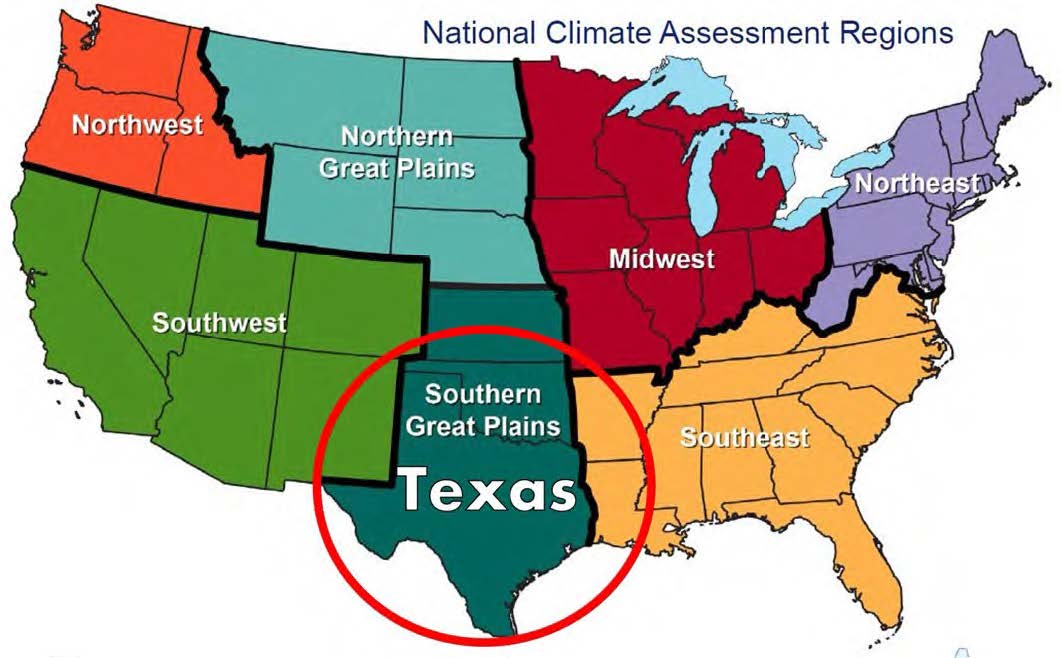
The Fifth National Climate Assessment (NCA5) report (USGCRP, 2023) says that climate change is “putting us at risk from climate hazards that degrade our lands and waters, quality of life, health and well-being, and cultural interconnectedness.” The NCA5 report lists “warmer temperatures, more erratic precipitation, and sea level rise,” as well as “drier conditions” and “extreme heat and high humidity,” as the “climate hazards” affecting the Southern Great Plains, which encompasses the State of Texas (Figure 1).

In addition, Texas A&M University has published a Texas-specific report, Future Trends of Extreme Weather in Texas (Nielsen-Gammon et al., 2024), which warns of future harm to the citizens of Texas from man-made climate change. Predicted effects include increasing temperature, precipitation, drought, floods, storms, sea-level rise and wildfires.

Within this report, we analyze scientific data from various sources, including the National Oceanic and Atmospheric Administration (NOAA), the United States Environmental Protection Agency (U.S. EPA), the National Aeronautics and Space Administration (NASA), the United States Department of Agriculture (USDA) and reports published in peer-reviewed journals.

Based on these data, we arrived at the following key findings:

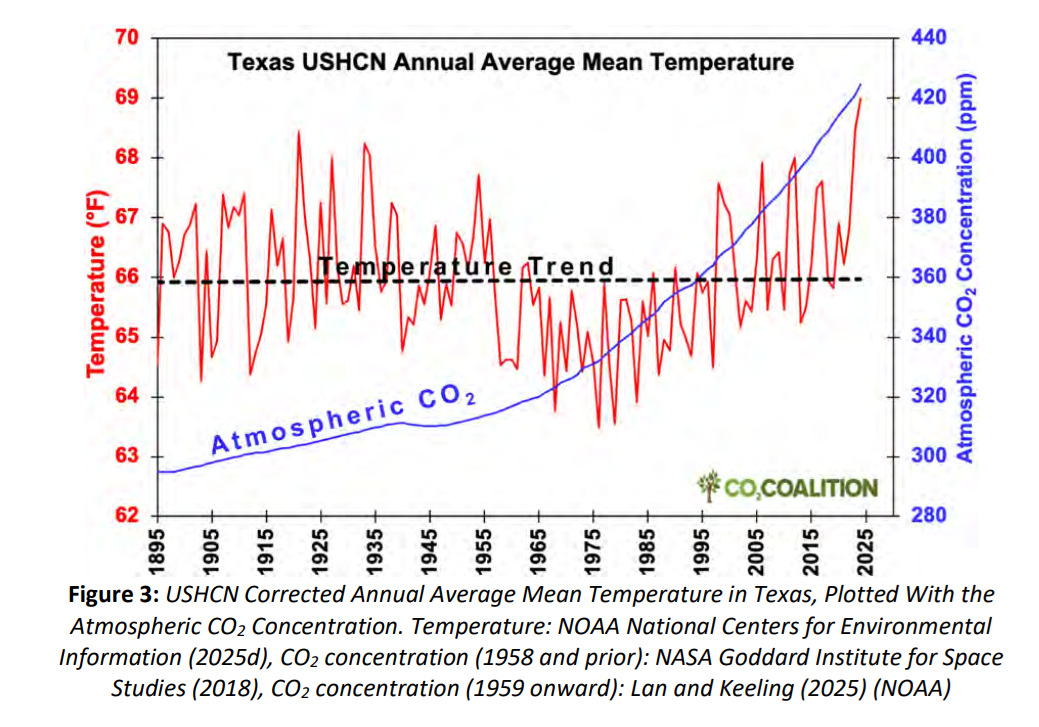
  • The temperature in Texas has shown no unprecedented or unusual warming, despite
    increasing atmospheric carbon dioxide (CO2). Recent temperatures in Texas are similar
    to those found more than 100 years ago.
  • The annual number of 100 °F days in Texas has an overall decreasing trend.
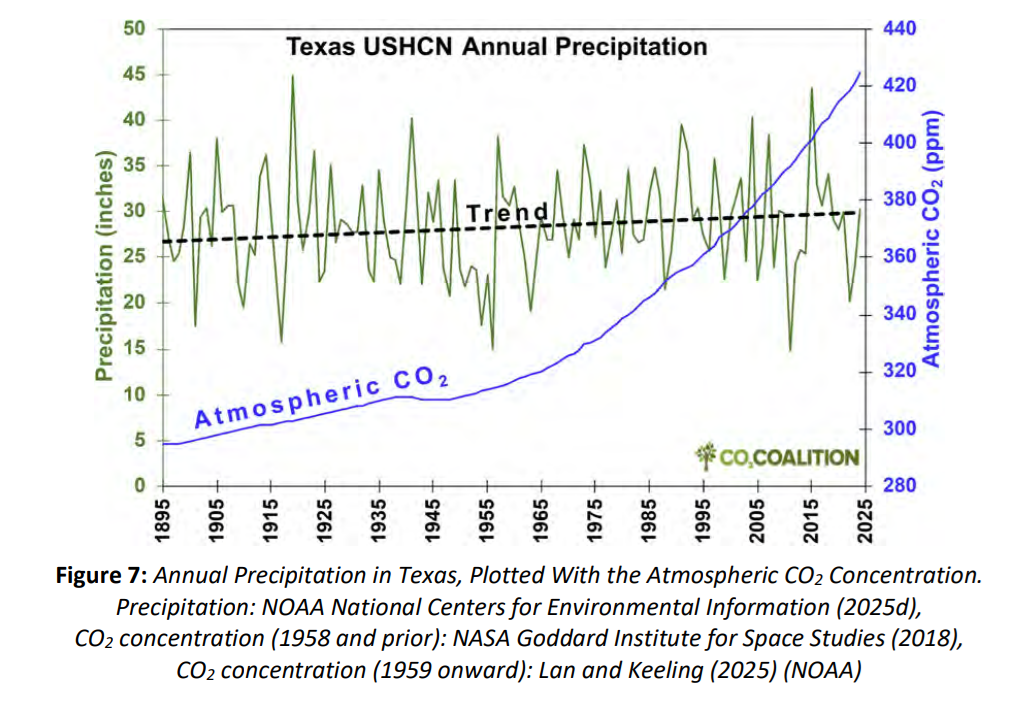
  • Texas has had a modest increase of 0.0245 inches per year of precipitation during 1850–
    2023, which means that Texas is in no immediate danger of becoming drier.
  • Droughts in Texas are not becoming more severe or numerous.
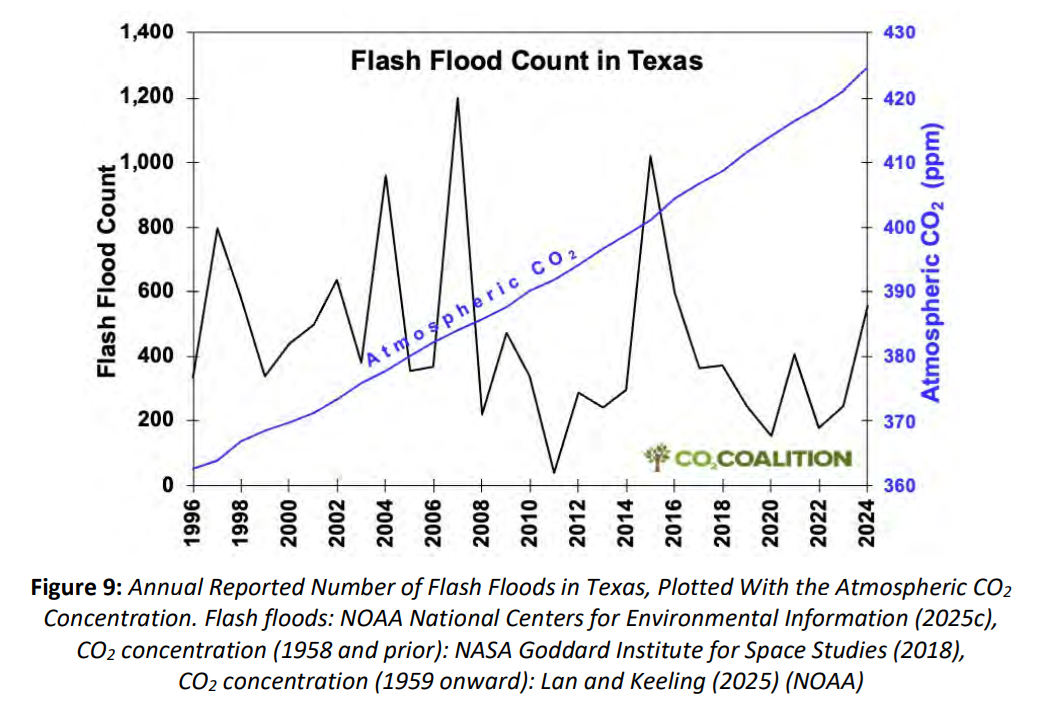
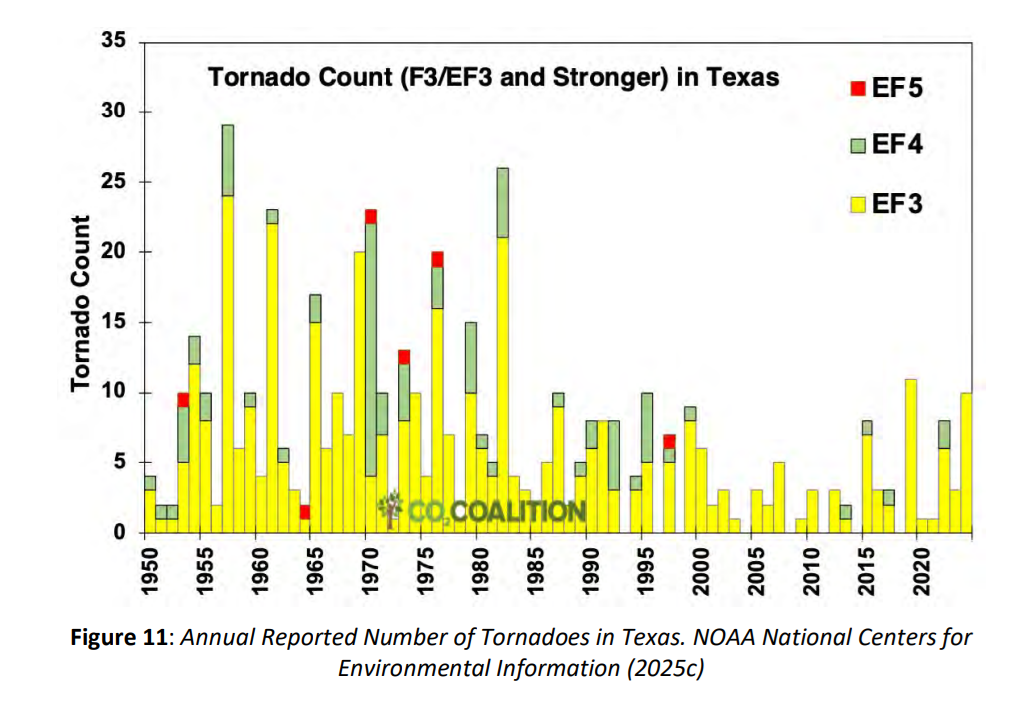
  • Tornadoes, hurricanes, and floods are not becoming more frequent in Texas.
  • Sea-level rise and coastal subsidence are not threatening or inundating the Texan coast.
  • Wildfires are not becoming more frequent or severe in the United States.
  • Air quality in the United States is generally good and getting better.
  • Agriculture in Texas is thriving.
  • Carbon dioxide (CO2) is essential and beneficial for life on Earth, as CO2 greens the Earth
    and more CO2 allows plants to grow bigger, produce more food and better resist
    drought.

The evidence presented here is clear: there is no climate crisis in Texas. Not only is CO2 beneficial, but it is essential for life on Earth. Therefore, any measures for combating a purported climate crisis and for reducing CO2 emissions are not only unnecessary and costly but would also cause considerable harm to agriculture with no benefit.

The complete publication is Texas and Climate Change which includes exhibits like these:

via Science Matters

https://ift.tt/b08h4Pn

August 21, 2025 at 11:18AM

The Battery Storage Delusion

By Paul Homewood


Dr Lars Schernikau exposes the harsh reality about grid-scale batteries:


 image

My first moped when I was fourteen, back in East Berlin, had no starter battery. The only way to get it running was to kickstart it which, back then, seemed perfectly normal. Batteries were expensive and heavy.

My current modern motorcycle (apologies to the Harley owners, because as a German I ride a BMW ) has a battery powerful enough to drive it in reverse and operate a complex control and entertainment system.

Batteries have evolved, they have become better, more efficient, safer, and lasting longer, and today entire cars run on batteries for hundreds of kilometers. But it doesn’t stop there.

The expansion of grid-scale (or utility-scale) batteries for providing grid storage especially for solar is one of the “hottest” topics of the “energy transition” these days. For instance, many provinces in China still have the mandatory requirement that solar projects are to include battery storage. There is no doubt that utility-scale batteries have many benefits, but let’s honestly consider what batteries do to our environment and to the net energy efficiency.

It is therefore high time that we explore the capabilities and short-comings of grid-scale batteries, the production thereof and the impact they have on our energy systems.

Read the full post here.

via NOT A LOT OF PEOPLE KNOW THAT

https://ift.tt/qwCEMAL

August 21, 2025 at 11:01AM