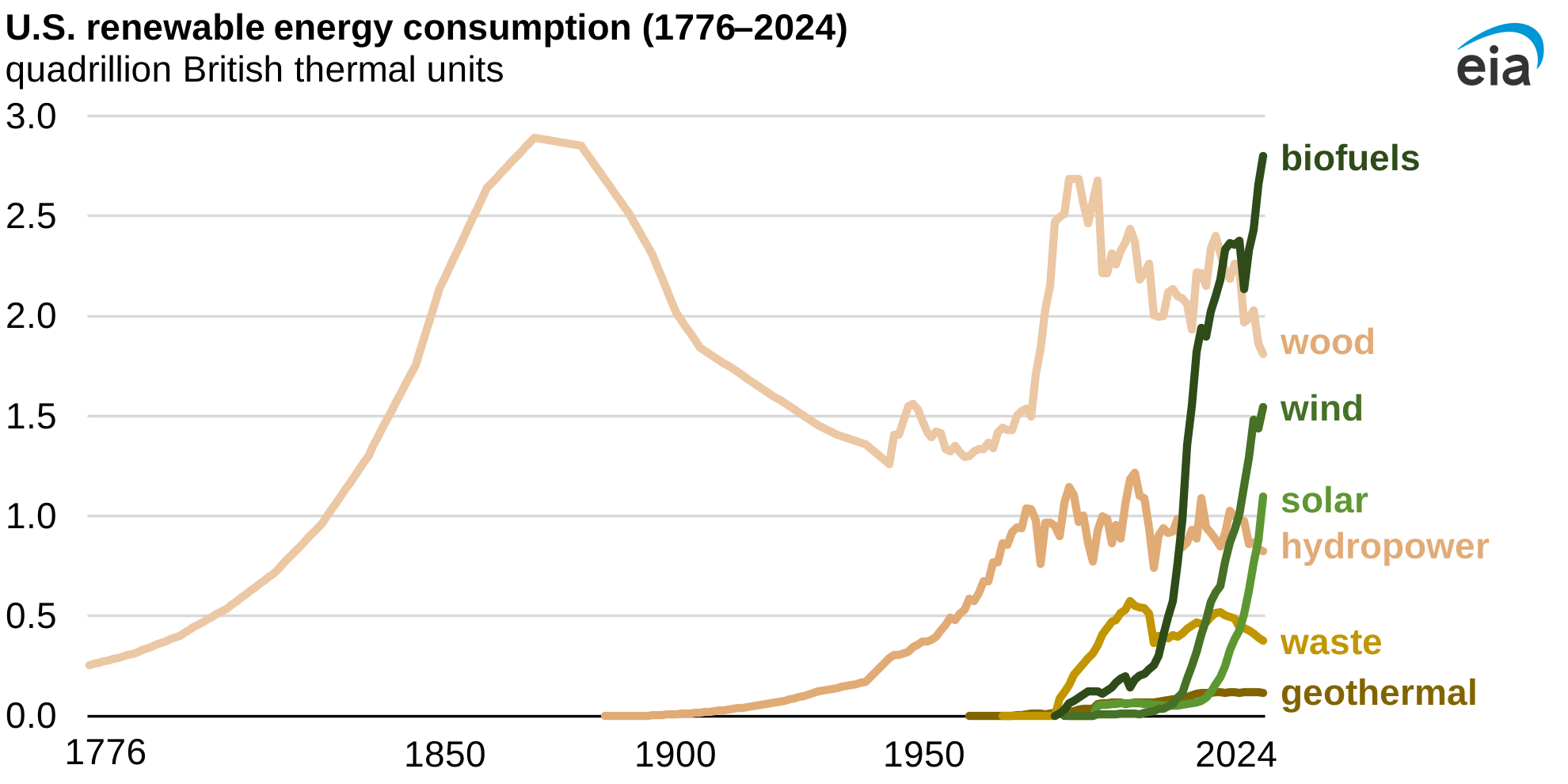
In 2024, the United States consumed about 94 quadrillion British thermal units (quads) of energy, a 1% increase from 2023, according to our Monthly Energy Review. Fossil fuels—petroleum, natural gas, and coal—accounted for 82% of total U.S. energy consumption in 2024. Nonfossil fuel energy—from renewables and nuclear energy—accounted for the other 18%. Petroleum remained the most-consumed fuel in the United States, as it has been for the past 75 years, and nuclear energy consumption exceeded coal consumption for the first time ever.
When the Declaration of Independence was signed in 1776, wood, a renewable energy source, was the largest source of energy in the United States. Used for heating, cooking, and lighting, wood remained the largest U.S. energy source until the late 1800s, when coal consumption became more common. Wood energy is still consumed, mainly by industrial lumber and paper plants that burn excess wood waste to generate electricity.
Coal was the largest source of U.S. energy for about 65 years, from 1885 until 1950. Early uses of coal included many purposes that are no longer common, such as in stoves for home heating and in engines for trains and ships. Since the 1960s, nearly all coal consumed in the United States has been for electricity generation.
Petroleum has been the most-consumed source of energy in the United States since 1950. Petroleum products such as motor gasoline, diesel, jet fuel, and propane are commonly used across all sectors of the U.S. economy, from transportation to industrial chemicals and plastics.
Natural gas is the second-largest source of U.S. energy consumption, as it has been most years since it surpassed coal in 1958. Natural gas was once considered a waste byproduct of crude oil production but now has become a common energy source for heating and electricity generation.
Early use of water to power grist, lumber, and other milling operations is not well quantified and not included in our data, but such mills were common throughout early U.S. history. The first industrial use of hydropower to generate electricity in the United States was to power lamps at a chair factory in Grand Rapids, Michigan, in 1880. The world’s first hydroelectric power plant to sell electricity to the public opened on the Fox River near Appleton, Wisconsin, in 1882.
Other forms of renewable energy did not become significant contributors to U.S. energy production until more recently. In 2016, biofuels—including the fuel ethanol mixed in motor gasoline—became the most-consumed U.S. renewable energy source.
Electricity generation from some zero-carbon sources, such as wind and solar, has increased rapidly in recent years, while generation from others, such as hydropower and nuclear, has remained relatively flat. In 2022, U.S. energy consumption from renewable sources surpassed nuclear energy for the first time since 1984, and in 2023, renewables surpassed coal for the first time since around the early 1880s. The United States now consumes more energy from wind and solar sources individually than from hydropower.
To compare different forms of energy, we convert to common units of heat, called British thermal units. Appendix A of our Monthly Energy Review has the conversion factors that we use for each energy source, and Appendix E explains how we convert noncombustible renewable energy sources.
We never transitioned from wood to coal. In 2024, we consumed as much energy from wood as we did in ~1900.
We simply add new energy sources on top of legacy sources.
The notion that we are transitioning from fossil fuels to renewables is patently absurd.
Guess what? We really did have an energy transition. From 1860 to 1920, we literally did transition from renewables to fossil fuels.
I stand corrected. If I have to explain sarcasm, there’s no point in being sarcastic.
Happy Fourth of July! Happy 249th birthday to the USA!
In Congress, July 4, 1776
The unanimous Declaration of the thirteen united States of America, When in the Course of human events, it becomes necessary for one people to dissolve the political bands which have connected them with another, and to assume among the powers of the earth, the separate and equal station to which the Laws of Nature and of Nature’s God entitle them, a decent respect to the opinions of mankind requires that they should declare the causes which impel them to the separation.
We hold these truths to be self-evident, that all men are created equal, that they are endowed by their Creator with certain unalienable Rights, that among these are Life, Liberty and the pursuit of Happiness.-
The project has been abandoned, partly due to ‘security risks and doubts about its viability’. Not hard to figure that out from the start? In any case it’s a way of not having to say: ‘far too expensive’, a yardstick little used in UK renewables projects.
– – –
A proposed infrastructure link connecting the Moroccan energy grid with the UK has been dropped by the government due to it not being in the “UK national interest at this time”, says E+T magazine.
The UK government’s Department for Energy Security and Net Zero (DESNZ) has rejected the £24bn power project to bring solar and wind power from the Moroccan desert to the UK via 3,800km-long high-voltage direct current (HVDC) subsea cables.
If built it would be the world’s longest undersea power cable.
Led by developer Xlinks with financial backing from a number of partners including Octopus Energy Group, the project included a proposal to create 10.5GW of renewable generation, 20GWh of battery storage and a 3.6GW HVDC interconnector.
With Morocco’s consistent weather, Xlinks said the solar panels could produce three times more energy than they would in the UK, supplying up to 8% of the UK’s power needs.
In September 2023, the then net zero minister Claire Coutinho confirmed that the proposal had been given the ‘Nationally Significant Infrastructure Project’ status, which means it can bypass normal local planning requirements in a bid to get it built faster.
Since then, Xlinks had approached the government seeking support for the project through the Contracts for Difference scheme, the main mechanism for securing clean energy infrastructure for Britain. This contract would have guaranteed a fixed price per MWh of electricity supplied for the life of the contract.
However, in a blow to the project, DESNZ has released a written statement to parliament confirming that having “evaluated the viability and merits” of the project, it has “after careful consideration” decided not to support it.
The statement outlined that the project is not in the “UK national interest at this time” as it “does not clearly align strategically with the government’s mission to build homegrown power here in the UK”. It believes that domestic projects would bring economic benefits to the UK through jobs and supply chain development.
The department also said the project presented “a high level of inherent risk, related to both delivery and security”.
Ed Miliband, energy secretary, concluded that the project did not “stack up” and that it had too many “holes”, people familiar with the situation told The Financial Times.
Full article here.
– – – Image: Solar power project in Morocco
At the end of spring the Met Office put out a press release, which claimed that “this spring shows some of the changes we’re seeing in our weather patterns, with more extreme conditions, including prolonged dry, sunny weather, becoming more frequent.”
As there is no evidence at all that dry springs are becoming more common, I asked the Met Office to provide for their claim.
This is their reply:
The UK Climate 2023 report referenced offers this conclusion on the section Page 31 to 36:
In other words, dry seasons if anything are on the decrease.
The section from page 74 merely looks at future projections, which therefore have no relevance at all..
Meanwhile the Christidis study is also irrelevant, as it looks summers in Europe. Similarly the Kendon study is only concerned with projections for summer.
The Met Office have been unable to offer any evidence for Emma Carlisle’s claim. Indeed they cannot, because none exists.
Her incorrect statement should be retracted and a correction published.
Discover more from Watts Up With That?
Subscribe to get the latest posts sent to your email.
It’s about time the legacy media criticised the Met Office!
Matt Ridley in the Telegraph:
I gather it’s been hot down south. My sympathies. As Londoners were sweltering, we had a chilly breeze off the North Sea in Northumberland. The UK Met Office says it is “virtually certain” that June (the hottest in England since 1884, second hottest in the UK) was made hotter by human activity.
Duh! Even if temperatures were not affected by greenhouse gases, which they are, the 34.7C (94.5F) recorded in St James’s Park on Tuesday might have something to do with that weather station being a low-reliability “class 5” site with an error rating of “up to 5C”. It’s next to a very busy tarmac path. Plus, it is in the middle of a city and therefore subject to a more general “urban heat island” effect. Research by Arup reckons London’s heat island is worth 4.5C extra warmth on average. So yes, the heat is indeed partly man-made – but not necessarily in the way the Met Office means.
Besides, it’s not exactly unusual to have hot days in summer: it reached 36.7C (98.1F) in Northamptonshire in 1911.
The Met Office exists to forecast the weather. But increasingly it seems bored by the day job so it likes to lecture us about climate change. And here it seems to have been embarrassingly duped by activists. Go on its climate pages and you find a forecast for the year 2070, that summers will be between one and six degrees warmer and “up to” 60 per cent drier, depending on the region. A lot of wriggle room in those caveats, note.
Then it admits: “We base these changes on the RCP8.5 high emissions scenario.” Aha! Unbelievably, shockingly, this national forecasting body has chosen as its base case for the future of weather a debunked, highly implausible set of assumptions about the world economy that was never intended to be used this way.