Category: Daily News

Quiet Archipelago’s Embrace of Hydrocarbons Speaks Loudly

By Vijay Jayaraj

While Western leaders and climate activists obsess over the smokestacks of India and China, they ignore the quiet giant of Southeast Asia: Indonesia, the world’s fourth most populous nation and an economic powerhouse, is making grand moves in securing sources for fossil fuels.

With an economy expected to expand annually by more than 5% and a population swelling to 300 million by 2030, energy demand is surging and Indonesia is relying largely on hydrocarbons to meet it. Suppliers of the energy will range from state-owned oil and gas giant Pertamina to major Western companies to new alliances with Russia and Malaysia.

A fragmented archipelago with limited “renewable” sources, Indonesia looks at fossil fuels not as a “bridge” in a contrived transition to a “green” future but as the road to economic success. Coal accounts for more than 60% of electricity generation, while oil fuels transportation and supply chains.

Indonesia’s road map is practical: build what works, scale what’s reliable, and invest where returns are guaranteed. That means oil, gas, coal and the infrastructure to move them – pipelines, refineries, tankers and export terminals.

When it comes to imports, the country is not shy about tapping geopolitically alienated sources. Following high-level visits, including one by President-elect Prabowo Subianto, Indonesia is exploring increased imports of Russian oil and gas.

The Indonesian government is also in advanced talks with Russian oil giant Rosneft for a massive investment for the Tuban oil refinery project in East Java, which is estimated to be valued at $24 billion.

In April, Indonesia awarded five new oil and gas blocks in the Gaea offshore exploration area to a consortium of global players: Britain’s Enquest, BP and China’s CNOOC. The Gaea and Gaea II blocks in West Papua have a combined potential of 18 billion barrels of oil and as much as 107 trillion cubic feet of natural gas.

Chevron’s potential return to Indonesia marks another seismic shift. The American oil giant is scouting large gas reserves in East Kalimantan and has confirmed talks to reenter Indonesia’s upstream sector, citing enormous untapped reserves in the Kutai Basin.

In June, TotalEnergies secured a share of almost 25% in the Bobara Block, off West Papua. This deal with Malaysian-owned Petronas marks the French company’s reentry into Indonesia’s upstream gas portfolio. Bobara represents a high-stakes, high-output deep-sea gas play.

Not solely reliant on foreign capital, Indonesia is empowering its own assets. Pertamina International Shipping, the maritime logistics arm of the state-owned giant, is undertaking a colossal $8 billion fleet expansion.

Pertamina’s upstream arm, meanwhile, secured the Binaiya Block in Maluku, with estimated reserves of 6.7 billion barrels of oil and 15 trillion cubic feet of gas. Pertamina’s refinery plans a capacity increase of 150% to reduce dependency on imports and foster energy sovereignty.

Indonesia’s energy influence extends beyond Asia. A new partnership was forged between Italy’s Eni and Malaysia’s Petronas, which will together manage combined assets in Indonesia and Malaysia and extract hydrocarbons for decades to come. Recently, Ghana’s Petroleum Commission engaged with Indonesia’s Honorary Consul to explore joint oil and gas ventures.

The country’s influence also can be felt in the international climate policies. Indonesia’s annual energy-related CO2 emissions, which totaled about 717 million metric tons in 2023, will rise by as much as 400 million metric tons within the next decade. This projected increase from Indonesia alone could neutralize up to 80% of the EU’s total planned reduction of emissions by 2030.

This is not a criticism of Indonesia. A country of 280 million people has every right to pursue a better life for its citizens. However, it is an illustration of the futility of policies seeking to reduce carbon dioxide emissions at the expense of economic growth and the well-being of people. The belief that the West can dictate global emission standards by deindustrializing its own economies is a dangerous delusion.

From London to Beijing, from Kuala Lumpur to Seoul, the energy market recognizes that Indonesia is open for business. The sheer scale of the country’s initiatives promises a torrent of new oil and gas that will flow for a generation, contrary to “Net Zero” rhetoric and timelines.

The archipelago’s embrace of hydrocarbons has it on the move, and those dawdling on the climate policy fence should take notice.

This commentary was first published at Real Clear Energy on June 30, 2025.

Vijay Jayaraj is a Science and Research Associate at the CO₂ Coalition, Fairfax, Virginia. He holds an M.S. in environmental sciences from the University of East Anglia and a postgraduate degree in energy management from Robert Gordon University, both in the U.K., and a bachelor’s in engineering from Anna University, India.


Discover more from Watts Up With That?

Subscribe to get the latest posts sent to your email.

via Watts Up With That?

https://ift.tt/koMbaV0

July 3, 2025 at 08:06AM

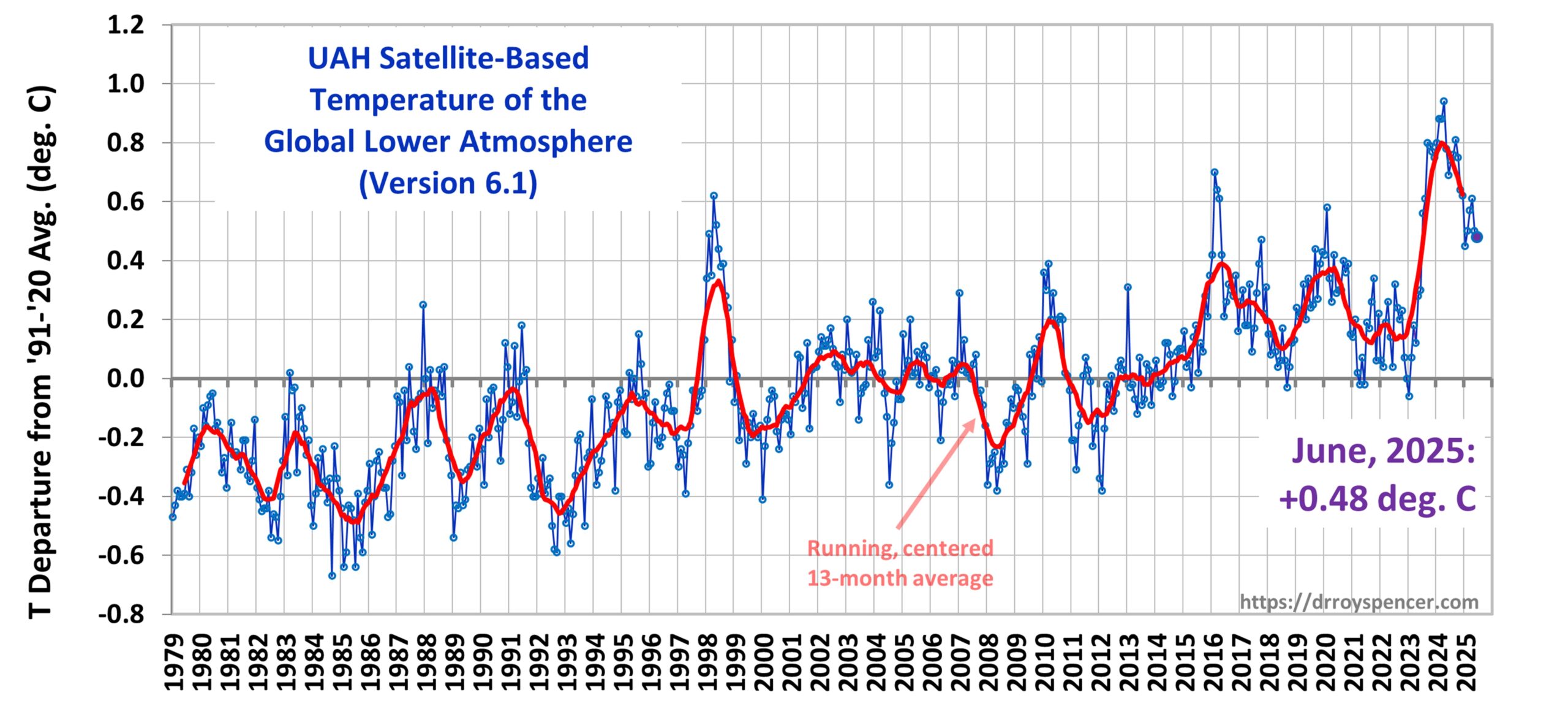
UAH v6.1 Global Temperature Update for June, 2025: +0.48 deg. C

The Version 6.1 global average lower tropospheric temperature (LT) anomaly for June, 2025 was +0.48 deg. C departure from the 1991-2020 mean, down slightly from the May, 2025 anomaly of +0.50 deg. C.

The Version 6.1 global area-averaged linear temperature trend (January 1979 through June 2025) now stands at +0.16 deg/ C/decade (+0.22 C/decade over land, +0.13 C/decade over oceans).

The following table lists various regional Version 6.1 LT departures from the 30-year (1991-2020) average for the last 17 months (record highs are in red).

YEAR MO GLOBE NHEM. SHEM. TROPIC USA48 ARCTIC AUST
2024 Jan +0.80 +1.02 +0.58 +1.20 -0.19 +0.40 +1.12
2024 Feb +0.88 +0.95 +0.81 +1.17 +1.31 +0.86 +1.16
2024 Mar +0.88 +0.96 +0.80 +1.26 +0.22 +1.05 +1.34
2024 Apr +0.94 +1.12 +0.76 +1.15 +0.86 +0.88 +0.54
2024 May +0.78 +0.77 +0.78 +1.20 +0.05 +0.20 +0.53
2024 June +0.69 +0.78 +0.60 +0.85 +1.37 +0.64 +0.91
2024 July +0.74 +0.86 +0.61 +0.97 +0.44 +0.56 -0.07
2024 Aug +0.76 +0.82 +0.69 +0.74 +0.40 +0.88 +1.75
2024 Sep +0.81 +1.04 +0.58 +0.82 +1.31 +1.48 +0.98
2024 Oct +0.75 +0.89 +0.60 +0.63 +1.90 +0.81 +1.09
2024 Nov +0.64 +0.87 +0.41 +0.53 +1.12 +0.79 +1.00
2024 Dec +0.62 +0.76 +0.48 +0.52 +1.42 +1.12 +1.54
2025 Jan +0.45 +0.70 +0.21 +0.24 -1.06 +0.74 +0.48
2025 Feb +0.50 +0.55 +0.45 +0.26 +1.04 +2.10 +0.87
2025 Mar +0.57 +0.74 +0.41 +0.40 +1.24 +1.23 +1.20
2025 Apr +0.61 +0.77 +0.46 +0.37 +0.82 +0.85 +1.21
2025 May +0.50 +0.45 +0.55 +0.30 +0.15 +0.75 +0.99
2025 June +0.48 +0.48 +0.47 +0.30 +0.81 +0.05 +0.39

The full UAH Global Temperature Report, along with the LT global gridpoint anomaly image for June, 2025, and a more detailed analysis by John Christy, should be available within the next several days here.

The monthly anomalies for various regions for the four deep layers we monitor from satellites will be available in the next several days at the following locations:

Lower Troposphere

Mid-Troposphere

Tropopause

Lower Stratosphere

via Roy Spencer, PhD.

https://ift.tt/8yMhOp0

July 3, 2025 at 05:25AM

BBC Complaints Director Takes Six-Month Sabbatical to Learn How to Promote ‘Climate Crisis’

From THE DAILY SCEPTIC

by Chris Morrison

The BBC Complaints Director Colin Tregear has enrolled on the green grooming course run as a six-month sabbatical by the Oxford Climate Journalism Network (OCJN). The course is funded by the Green Blob and aims to make the ‘climate crisis’ a central element in the journalism of the attendees. Tregear is said to have responsibility for climate complaints at the BBC. Quite why the British TV taxpayer should fund this activist boondoggle for a man who is supposed to independently consider matters that often involve disputed areas of science is not immediately clear. In the past, attendees have been asked to consider that fruit such as mangoes aren’t as tasty as a year ago due to climate change. A previous speaker is on record as speculating on the need for “fines and imprisonment” for those expressing scepticism about “well supported” science.

Tregear is joined on the jolly by Maeve Campbell who is a TV climate reporter on Channel 4 in the UK. Her inclusion is less surprising since she is an identikit activist fully up to speed on the need for fear mongering to support the Net Zero fantasy. She should fit in well at the OCJN. Recently, she wrote that all over the world “fertile land is gradually becoming dry, barren and unable to support plants animals or people, as climate change causes temperatures to rise”. At the risk of imprisonment, it might be kind for someone to point out to her that the recent small rise in atmospheric carbon dioxide has led to a massive ‘greening’ of the planet, significant de-desertification and record yields of staple crops around the world.

The OCJN is run by the Reuters Institute, which is funded by the Thompson Reuters Foundation. The overall steering committee is chaired by Alan Rusbridger, who in his time as the editor of the Guardian helped turn the newspaper into an hysterical proclaimer of a coming climate apocalypse. Direct funding for the course, which seeks to influence journalists around the globe, has been provided by the European Climate Foundation (ECF) and the Laudes Foundation. The ECF is heavily supported by the Extinction Rebellion funder Sir Christopher Hohn, while Laudes chipped in £1 million in 2024 to support the network’s course activities until 2027.

The Green Blob paymasters are well represented on the OCJN Advisory Board, which is said to be dedicated to “improving the quality and impact of climate change journalism worldwide”. Katy Hartley is the Director of Strategy, Innovation and Narrative and is a member of the Laudes management team. In a previous job, she was part of a “cross-entities team exploring how all the philanthropic entities could respond to climate breakdown”. Other interesting advisers are Leo Hickman, the Editor of Carbon Brief, an activist blog funded by the ECF, and Dr Friederike Otto who runs a Green Blob-funded pseudoscientific weather attribution outfit from Imperial College London. Regular readers will of course recall that Otto was one of the leading instigators in the infamous Alimonti affair, when a group of activists and journalists forced Nature to withdraw a paper that had stated a climate emergency was not supported by the facts – the facts being those provided largely by the Intergovernmental Panel on Climate Change. Otto claimed the authors “of course” were not writing in good faith. The distinguished science writer Dr Roger Pielke Jr later noted that “shenanigans continue in climate science, with influential scientists teaming with journalists to corrupt peer-review”.

Perish the thought that anything like this will be plotted at the OCJN. But its deliberations and relentless agitprop will hopefully be helpful to Colin Tregear as he faces all those impertinent complaints from the public about the BBC’s biased coverage of climate change. He has good form in shutting down debate. In February 2014, Nigel Lawson, a prominent Conservative minister in the Governments of Margaret Thatcher, told the Today programme on BBC Radio 4 that global temperatures had paused over the last decade. Responding to the complainer, Tregear replied: “I hope you will accept my apologies on behalf of the BBC, for the breach of editorial standards you identified”. In fact the pause, although highly inconvenient, was well known at the time and the Met Office even wrote a paper about it titled, The Recent Pause in Global Warming. Within a short period, the BBC moved to close down all sceptical comment on a science that was declared “settled”, a ban that is strictly enforced to this day.

Meanwhile for his ‘mango’ contribution, your correspondent helpfully suggests the following. Use AI to tell you why its taste has declined because of climate change and you will have mainstream media-ready copy within seconds. Try asking it, as I did, for an alternative view that mangoes are now tastier than before and again, before you can say bananas, a plausible article appears. The point of course is that if mainstream media is simply being groomed to write copy within strict pre-set narrative guidelines, what is the point of employing the journalists in the first place? The entire over-staffed climate desk at the BBC could be closed down, and Mr Grok tasked with supplying a never-ending stream of ‘scientists say’ propaganda designed to induce mass climate fear and nudge the general public to accept the controlling Net Zero elitist fantasy.

Chris Morrison is the Daily Sceptic’s Environment Editor. Follow him on X.


Discover more from Watts Up With That?

Subscribe to get the latest posts sent to your email.

via Watts Up With That?

https://ift.tt/tDEnfx3

July 3, 2025 at 04:10AM

Fiery deaths for electric buses and autos continue

Spontaneous combustion and nearly impossible to extinguish. What could go wrong?

via CFACT

https://ift.tt/f3bcvmS

July 3, 2025 at 04:04AM