Category: Daily News

UK Pulls Plug on £24 Billion Desert Power Fantasy

Charles Rotter

It comes as little surprise that yet another grandiose techno-utopian vision has ended not with a triumphant march toward Net Zero, but with a flick of the off-switch. Last week, Britain’s energy secretary quietly announced that the government “has pulled the plug on a £24 billion plan to bring Moroccan wind and solar power to Britain via the world’s longest subsea electricity cable, citing concerns over security and costs” . In other words, after years of hype, headline-grabbing simulations and talk of “reliable clean power for 19 hours a day,” the reality of risk and expense finally intruded—and the dream of Sahara sun for all has been consigned to the scrapheap.

The scheme, championed by Xlinks and backed by big-name investors from Abu Dhabi’s Taqa to TotalEnergies, was unveiled in 2022 with a headline price tag of £16 billion. By the time official talks fizzled, project costs had ballooned to between £22 billion and £24 billion—and the fixed, subsidised price for UK consumers had climbed from a promising £48/MWh in 2012 terms to a sobering £70-80/MWh, on par with Hinkley Point C’s notorious £92.50/MWh deal from a decade ago . It was a textbook illustration of how techno-optimism meets political reality: grand ambitions crashing headlong into the twin walls of finance and geopolitics.

Perhaps the most telling line came when officials admitted this “first-of-a-kind mega project” carried “a high level of inherent, cumulative risk, delivery, operational, and security.” In plainer terms, nobody quite trusted a 3,800-mile subsea cable stretching from the Sahara to Devon to keep the lights on—or to fend off hostile actors, accidental damage or simple technical failure . For all the talk of homegrown power, the reality was a foreign-built supergrid running through disputed waters, vulnerable to every storm, saboteur or bureaucratic blunder.

And yet just a few years ago, this venture was presented as the ultimate win-win: millions of desert acres covered in solar panels and wind turbines, exporting 3.6 GW of “reliable” energy to 7 million homes and displacing imported gas. Xlinks even claimed it could reduce UK wholesale prices by over 9 percent in its first year of operation—implying that the very costs of this colossal scheme would pay for itself. Leave aside the challenge of storing or transmitting intermittent deserts-of-power and the gargantuan batteries needed to smooth out every dust storm, and one must ask: who was really buying into this fairy tale—investors or ideologues?

No doubt Sir Dave Lewis, Xlinks’s chairman and former Tesco boss, felt the sting of rejection when he spoke of being “hugely surprised and bitterly disappointed.” It is, after all, hard to maintain the sheen of global-scale green enthusiasm when home departments balk at underwriting your vision. One can almost hear the collective shrug from Westminster: enough with offshore daydreams—build some turbines in Yorkshire, drill holes for storage in the Midlands, train some electricians in Glasgow and call it a day. For all the vaunted “diversity of supply,” it appears domestic alternatives won the argument over exotic imports.

There is a delicious irony in the timing. As ministers tout an “accelerated path to net zero at least risk to billpayers and taxpayers,” they have effectively walked away from the single largest overseas renewable venture ever proposed . The very same people who once celebrated cross-continental cables as the crowning achievement of global cooperation now invoke security concerns and “national interest” as their exit ramp. One wonders how abruptly the narrative will shift next time a British-funded project in Kazakhstan or Canada hits a bump—will it be “not in the British interest” to proceed with those, too?

This turn of events also exposes the fundamental flaw of top-down climate technocracy: it treats citizens as passive units in a planetary control scheme, not discerning voters with budgets to balance. When the public wises up to the fact that imported Sahara sun arrives at a price rivaling home-grown nuclear—and carries with it a risk of outages, sabotage or diplomatic spats—they recoil. They learn that the cable would thread through multiple jurisdictions, remote islands and fierce currents, any one of which could jeopardize supply. At some point, scepticism ceases to be a political liability and becomes simple common sense.

Consider the broader lesson: no matter how enthusiastically globalists embrace “interconnected grids,” the strings always end back at national treasuries and war-rooms. The cable’s 1,500 square-mile solar-wind-battery complex in Morocco was to be the crown jewel of decarbonization, yet it was contingent on political goodwill in Rabat, cable-manufacturing in Asia, local security in the Sahara and stable undersea trench conditions for 3,800 miles—any of which could unravel faster than a hastily signed bilateral MoU. The government’s conclusion that “stronger alternative options” exist closer to home may be the most uncontroversial statement of 2025 .

Detach for a moment from the partisan fray and savour the schadenfreude: this megaproject was touted as the elixir to Britain’s energy woes, yet it collapsed under its own hubris. The very proponents who decried fossil-fuel inertia now cry foul when asked to stump up real money. The same voices that demand “global solidarity” balk when that solidarity requires underwriting risks in unstable deserts. And as for “green jobs” and “supply-chain opportunities”—it turns out that Asia still makes the cables and Morocco still controls the sun.

The demise of Xlinks’s Sahara venture may not end the net-zero narrative, but it does puncture a hole in the myth of techno-utopian inevitability. When a scheme promising 8 percent of Britain’s electricity—at a price echoing nuclear—and requiring unprecedented security guarantees is deemed “not in the national interest,” one must wonder: how many more exotic grand plans will be ditched before realism returns? The answer, for now, seems to be one.

Let us not pretend this was a minor failure. It represented the epitome of climate-policy excess: outsourcing critical infrastructure to distant deserts, bemoaning gas-price volatility while embracing solar-dust storms, and swapping local accountability for a vague vision of interconnected utopia. Watching it crumble offers a rare moment of clarity amid the Net Zero hysteria: true energy security still resides in domestic control, not pipelines and cables stretching half-a-continent away.

In the aftermath, expect Xlinks to regroup, rebrand and regroup again—perhaps pitching Canadian hydro next. But the core lesson stands: citizens will not subsidise fantasy-grid fantasies when they can invest in less risky generation at home. And bureaucrats will not ignore security and cost overruns when climate dogma collides with the hard calculus of budgets and ballots.

There is an understated joy in witnessing this particular techno-dream deflate. It reminds us that even the most elaborate green schemes are only as sound as their financial footings and geopolitical foundations. When those falter, the utopian narrative gives way to something far more earthy: the simple recognition that expensive, complex, and foreign-dependent projects rarely survive contact with reality. As the Sahara sun fades—quite literally—from policymakers’ agendas, one hopes the next set of proposals will be a little more modest, a bit less global, and anchored firmly within UK borders.


Discover more from Watts Up With That?

Subscribe to get the latest posts sent to your email.

via Watts Up With That?

https://ift.tt/25LJfDm

June 27, 2025 at 08:01PM

ABC News: Mitigate Climate Anxiety by Convincing Neighbours to Give UP Their Lawns

Essay by Eric Worrall

Don’t forget the lightning bugs.

Climate change takes an emotional toll. Here’s how to manage anxiety

Anxiety, grief, sadness, anger

By LEANNE ITALIE AP lifestyles writer
June 25, 2025, 2:00 PM

NEW YORK — Anxiety, grief, anger, fear, helplessness. The emotional toll of climate change is broad-ranging, especially for young people.

Activists, climate psychologists and others in the fight against climate change have a range of ways to build resilience and help manage emotions. Some ideas:

Feeling isolated? Find ways to connect with like-minded people and help nature, said climate psychologist Laura Robinson in Ann Arbor, Michigan. There are many ways to get involved.

Work locally to convince more residents to give up grass lawns and increase biodiversity with native plants, for instance. Help establish new green spaces, join projects to protect water, develop wildlife corridors, or decrease pesticide use to save frogs, insects and birds. Work to get the word out on turning down nighttime lighting to help birds and lightning bugs.

Read more: https://abcnews.go.com/Lifestyle/wireStory/climate-change-takes-emotional-toll-manage-anxiety-build-123181446

You could suggest climate panicked kids try all of this. Or you could try demanding teachers focus on providing an education, instead of stoking adolescent climate anxiety and mental illness with a nonstop stream of toxic green propaganda.


Discover more from Watts Up With That?

Subscribe to get the latest posts sent to your email.

via Watts Up With That?

https://ift.tt/HSk9FC1

June 27, 2025 at 04:07PM

Agriculture: It’s Worse Than We Thought, Again

A week ago, the compliant media was happily swallowing, and regurgitating, yet another “worse than we thought” study, this time on the topic of how future climate change was going to starve humanity.

“Worse than we thought” is, when you pop your ten-gallon sceptic’s hat on, a synonym for “exactly what we thought.” By which I mean, the news has to be terrible, and worse than the previous news, for it to get traction in today’s world of transient thought bubbles.

The study, “Impacts of climate change on global agriculture accounting for adaptation,” was published in the once-great magazine Nature, and is authored by Andrew Hultgren and a motley crew of divers others, too many to count at a blink (i.e. more than nine). One of the authors, Soloman Hsiang, was quoted in one story as saying the losses due to climate change were going to be equivalent to us all giving up breakfast, or words to that effect – though I can’t find that page any more, it is now buried in the others that I visited to read up on how the study was being reported.

According to this press release by Rutgers, the more than nine researchers spent eight years on the research. Time well spent, I say, especially as the answer was so surprising.

What of the study itself? As we know, most of us don’t read the study in “study says…”: we simply take the media’s regurgitation of its talking points at face value. Well, I wanted to (skim) read it, because my sceptic’s radar was picking up strong echoes of bullshit. Was 50% loss of yield remotely plausible? Instinct says no. What of the CO2 fertilisation effect? This should counteract some of the “climate” yield losses. What of the climate model used? RCP8.5, or something remotely plausible?

Hultgren et al, et al, can be found here, and some respect is due to the authors for making the study free to read. (I have long been of the opinion that all science should be free to read. Of course, it means that the gatekeepers, Nature et al, would no longer have a business case. How would we differentiate gold-standard science from frass? Perhaps a system of voluntary readers could be set up, and studies could get reviews and star ratings, like in Amazon. Impossible of course, owing to the politicisation of science today.)

Skim skim skim…

Search for “fertilization” with a z…

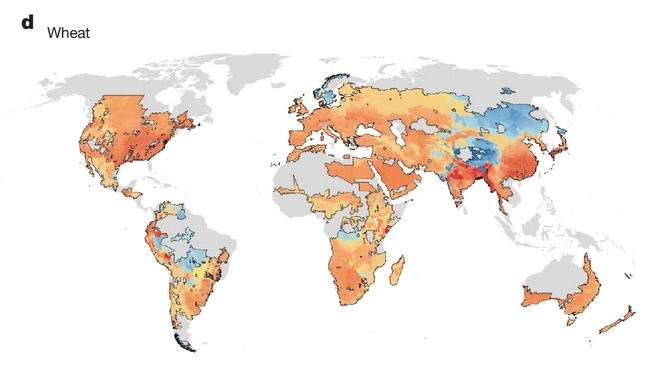
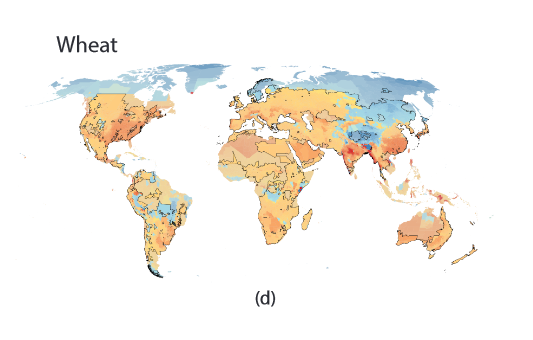
Several references to fertiliser of the non-gaseous kind, then a mention in Figure 2’s legend. The figure is the first showing results. Its title is: Projected end-of-century change in crop yields resulting from climate change, accounting for adaptation to climate and increasing incomes. [I’m only showing the wheat panel here. Looks bad for the U.S., huh? But at least we can grow wheat in Mongolia, and on the north coast of Norway….]

The relevant parts of the legend read:

Colours indicate central estimate in a high-emissions scenario (RCP 8.5), net of adaptation costs and benefits, for maize (a), soybean (b), rice (c), wheat (d), cassava (e) and sorghum (f) for 2089–2098.

And

See Extended Data Fig. 7 for a moderate-emissions scenario (RCP 4.5) and Supplementary Information, section J for results adjusted by CO2 fertilization.

So, if we are to get what might be termed, “plausible” results, we cannot even read the paper itself: we have to delve into Supplementary Information, and Extended Data. The authors have presented something here that they must know is wrong, and that any reviewers must have known was wrong, and that Nature’s editors must have known was wrong. Who cares? It got a headline. Or eleventy-six.

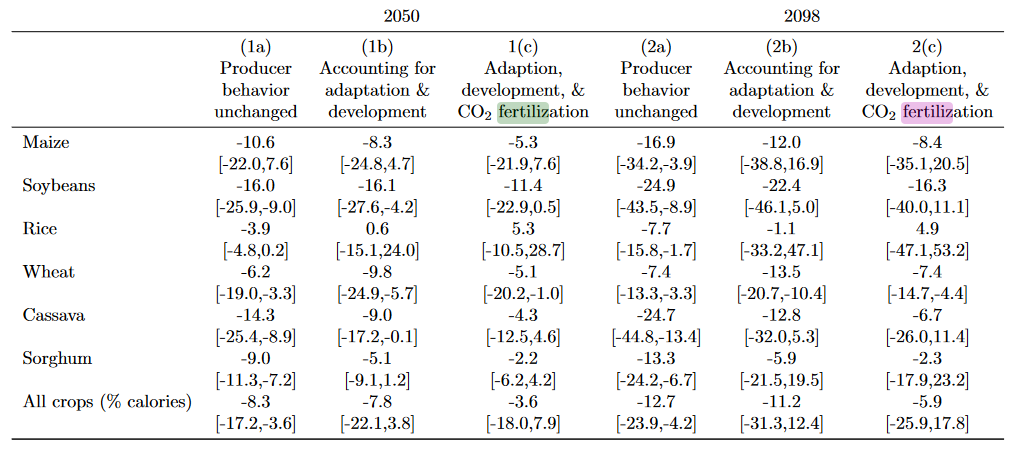
The Supplementary Information runs to nearly 100 pages. Am I alone in thinking that Supplementary Information is out of control these days? Anyway, searching for “fertilization” again finds table S11 on page 66. The column of numbers to take notice of is the one furthest right, showing the model’s prediction of yields under the realistic RCP4.5, with CO2 fertilisation, and with farmers actually doing their job, not growing crops that won’t make them money. The first number next to each crop is the prediction of average yield changes. The numbers in square brackets are the 5% and 95% ends of the distribution. [Note: this means that 90% of the distribution is within the brackets.]

Here we see that the predicted yield distributions for five of six crops overlap 0. In other words, they are not significantly different from zero, and that no change in crop yield is a viable interpretation of the results. The exception is wheat, which is negative (but we can’t say for sure it is significantly negative, thanks to the extra margin on the confidence interval).

So: production could drop by 50%.

Or: production could remain the same.

Next: is the fertilisation effect realistic?

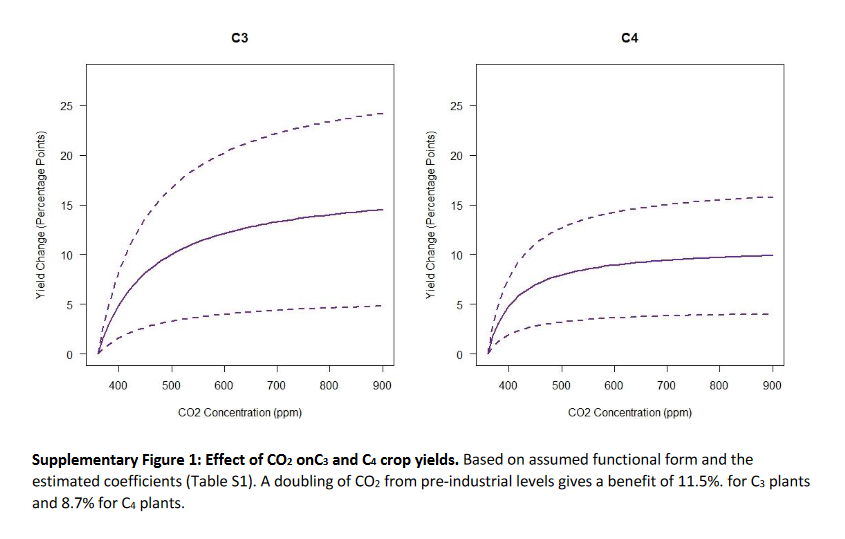
We know that CO2 is plant food, although the alarmists hate the idea with zeal. It’s easier to photosynthesise when there is more CO2, and that is not a controversial statement. It’s also non-controversial that C3 plants like wheat and rice will benefit more from CO2 enrichment than C4 plants like corn. [C4 plants can be thought of as plants that have evolved to eke out a living in a world where the food supply – CO2 – has dwindled over aeons until plants are half-starved.] The authors’ treatment of CO2 fertilisation is described on p.69 of the S.I.: does it pass the fairness test? Or did they pick a fertilisation model that downplays the likely effect?

At end-of-century, the CO2 fertilization effect under RCP8.5 increases yields by 9.8% and 5.2% for C3 and C4 crops. Under RCP 4.5 end-of-century yields increase by 5.8% and 3.5% for C3 and C4 crops.

I’m sorry – what? RCP8.5 increases yields by a mere 10% for C3?

Hultgren et al draw their CO2 fertilisation model from a meta-analysis by Moore et al. 2017. [The link takes you to their response function.]

Moore et al present revised damage functions from climate change – and you guessed it! They told us what we already knew. Things are “worse than we thought.” Is Moore et al’s CO2 fertilisation model fair? Only a cynic would suspect otherwise, right?

Well, it might be fair, I’m not sure about that, but it’s clearly wrong. Here’s how the modelled relationship works:

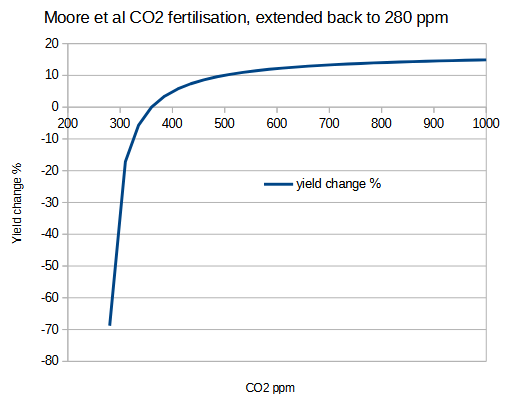
The baseline CO2 is 360 ppm, which is not “pre-industrial,” usually given as 280 ppm. The result is that at 360 ppm the change in yield is 0, by definition. The parameters used mean that half of the CO2 fertilisation for C3 plants occurs in the first 100 ppm (from 360 to 460 ppm) and rapidly tails off thereafter. Starting at 360 ppm is mad, because if you trace the curve back to 280 ppm, you end up with a yield of about -70% of the “modern” baseline of 360 ppm. In other words, if this figure represented reality, everything was dead in the pre-industrial era. Here’s my emulation of their figure for C3 plants, but going back to 280 ppm.

Now, you might say that the figure is and should only be valid in the range it is modelling. Maybe; but it clearly shows that the beginning of the curve is too steep. Here’s a different view of CO2 fertilisation, what you might call an ecologist’s view, as annotated by Dave Burton of sealevel.info:

Here, C3 have plenty of gains in their pockets as the ambient concentration of CO2 goes up.

Note also that using 360 ppm as a baseline for yields means you have banked quite a bit of CO2 fertilisation and effectively zeroed it out: the benefits of increasing CO2 from 280-360 ppm are null.

Here’s what Hultgren et al did:

To apply these estimates of CO2 fertilization to our projections, we estimate this CO2 fertilization effect for each future year using RCP-specific CO2 concentrations from [201], and we subtract off the CO2 fertilization effect for the year 2015 (the end of our baseline period).

So most of the CO2 fertilisation has been banked and zeroed out, and what is left is not enough to balance out the “climate” impacts.

At end-of-century, the CO2 fertilization effect under RCP8.5 increases yields by 9.8%

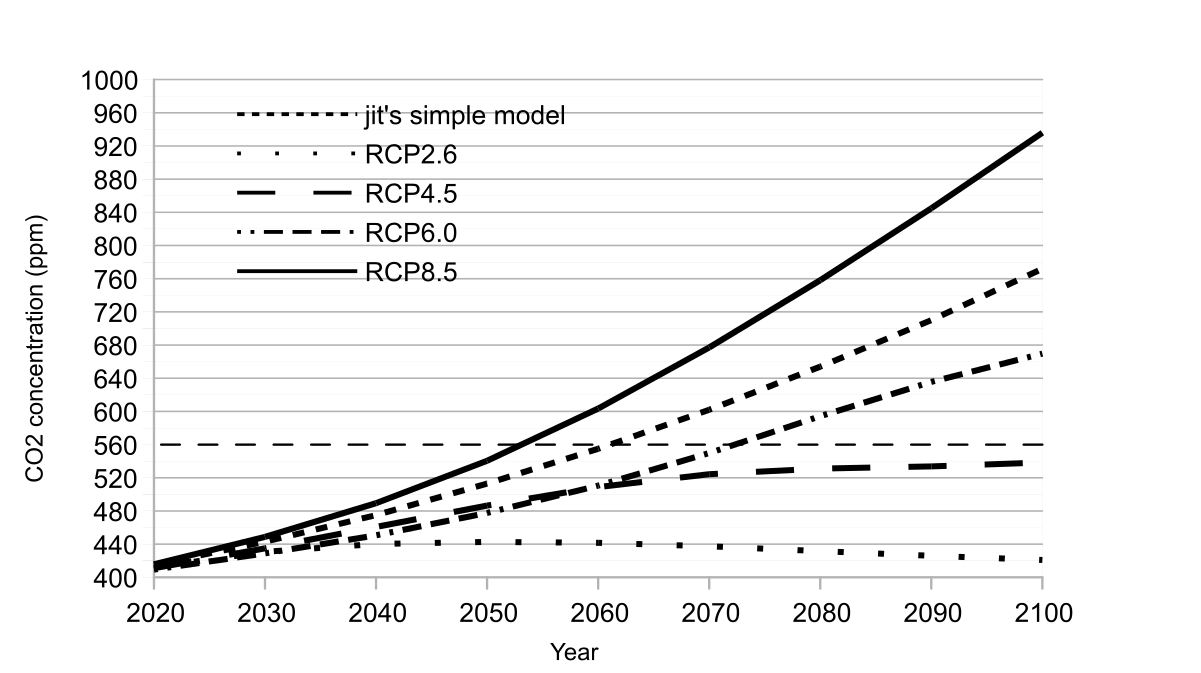
This figure shows the CO2 concentration in 2100 under the RCP8.5 scenario (Figure reproduced from Denierland, data from climatechange2013.org (AR5). [Ignore “jit’s simple model”; one of these days, I’ll check to see how it is doing prediction-wise.]

The 2100 concentration under RCP8.5 is 936 ppm, up from the baseline year (2015 for Hultgren et al) of 400 ppm. And the effect of CO2 fertilisation, they say, for that change (more than a doubling) is only +10%? I think this is low.

This NBER paper (“not peer reviewed”) by Taylor & Schlenker (2023) found that we are still firmly in the linear response phase (cf. the figure annotated by Dave Burton above):

We consistently find a large CO₂fertilization effect: a 1 ppm increase in CO₂ equates to a 0.4%, 0.6%, 1% yield increase for corn, soybeans, and wheat, respectively.

Now, Taylor & Schlenker’s numbers may be optimistic. I wouldn’t be surprised (their response curve is more of a cloud – it’s one of those where if you have enough data, a cloud can have a significant slope). But this range in interpretations is somewhat concerning. After 40+ years of climate research, we still don’t know what effect CO2 will have on crop yields.

As to the story about agricultural apocalypse, it’s another case of paper published, hysterical headlines published, good job well done, move on to the next “worse than we thought” headline-hunting journal article.

Meanwhile, what are Hultgren et al, et al’s results for the more realistic RCP4.5, with their (in my eyes) questionable CO2 fertilisation bonuses?

[Same key as above.] Thankfully, under the realistic scenario we can grow wheat on the Himalayas, Svalbard, and Kaffeklubben Island off the north coast of Greenland. [Snipped from Supplementary Figure S.14, p.71 of the S.I.]

/message ends

via Climate Scepticism

https://ift.tt/5svPnOp

June 27, 2025 at 02:56PM

A 485-million-year history of bad science

Guest Post by Willis Eschenbach, with thanks to Charles The Moderator for the above image.

A few days ago I published another analysis of mine, called pHony Alarmism. Take a moment to read that if you haven’t, because this is a sequel. Both are about a new study in Science Magazine yclept “A 485-million-year history of Earth’s surface temperature”, paywalled, of course.

A short digression. One of the ways I truly benefit from publishing the results of my scientific investigations on the web and interacting with the commenters is that my mistakes don’t last long. When I go off the rails, and notice I didn’t say “if” I go, my mistakes rarely last more than a day before they’re pointed out and I can consider and correct them.

But that’s only one of the ways that it’s beneficial to write for the web and then stick around. Perhaps more importantly, it lets people ask me interesting questions and point out overlooked avenues to investigate.

Here’s an example. In a reply to my post yesterday, I got this …

Jeff Alberts, June 25, 2025 4:26 pm

No graph with the co2 and pH together?

To which I answered …

They’re sampled at different times. I could interpolate both ways. Thought about it, then decided that was enough for one post. Hang on … we know pH is proportional in some sense to the log of the CO2. Give me a minute …

In a bit I came back to say:

…well, of course it takes more than a minute but most interesting.

Looks like that will be the subject of my next post. Stay tuned.

w.

This is that next post. End of digression.

One of the reasons that I didn’t look at graphing pH versus CO2 was that I was given to understand that the procedure for calculating the pH was very complex. The paper says (or at least the Supplementary Information (PDF) says, the paper is paywalled:

4.3 Estimating the temporal variability of pHsw [pH of saltwater]

Both 18Ocarbonate and Mg/Ca values are affected by changes in pHsw (102, 125). Temporally, surface water pH largely varies as a function of atmospheric CO2, although other aspects of the carbonate system, such as alkalinity, do exert a control. Here, we took two approaches to estimating pHsw and, similar to our approach with the global 18Osw, we run assimilations utilizing both methods.

In the first approach, we forward-modeled global average pHsw from the model priors (i.e., the “model prior pH” method). We used the prescribed CO2 and global mean SST from each ensemble member to estimate pHsw using the CO2SYS function for Matlab (126). We assigned globally-averaged alkalinity as the second constraint on the carbonate system, which we assumed to be normally distributed with values randomly drawn from [N(2300, 100)], based on the modern distribution described by the GLODAPv2 gridded product (127) (mean modern alkalinity = 2295 µ/kg). We also drew global salinity values from a normal distribution of [N(34, 2)] based on the World Ocean Atlas 2013 gridded product, which indicates a global mean salinity of 34.5 psu. Note that the CO2SYS calculation is not very sensitive to the salinity.

In the second approach, we estimated pHsw using the CO2 values from our proxy data reconstruction (i.e., the “CO2 proxy pH” method; Fig. S10; see Section 7;). We generated an ensemble of 2,500 potential pHsw values for each stage of the Phanerozoic using the CO2 ensemble described below (see Section 7) and the CO2SYS function for Matlab (126). We again randomly assigned alkalinity by drawing from [N(2300, 100)], and salinity from [N(34, 2)]. We also drew values of temperature from a broad uniform distribution [U(10, 35)] (Fig. S10D).

The first approach reflects the truest form of forward modelled proxy estimates (Yest) in that the pHsw values are specific to each ensemble member and based on prior information. An added advantage of this method is that the estimates of GMST are completely independent of the CO2 reconstruction, enabling us to investigate the relationship between these two variables without the risk of circularity. Nevertheless, the fidelity of the results is predicated on the assumption that HadCM3L accurately represents the temperature-CO2 relationship (i.e., climate sensitivity).

The second approach removes this dependence, making the results independent from HadCM3L’s climate sensitivity, but does, to an extent, remove the independence between GMST and the reconstructed CO2 values. This dependency is small, however, especially since 12 the multiproxy nature of the assimilation means that during most—but not all—stages, there are at least some data that are fully independent from the CO2 estimates (i.e., the U K0 37 , TEX86, and 18Ophosphate data). Mirroring the strategy we took with uncertainties around the global 18Osw values, our results incorporate assimilations utilizing both methods (see Section 5).

Zowie! Mondo scientifico!

To investigate the first method, calculating the pH from the CO2 levels, I got the R version of the CO2SYS function mentioned above. The function requires that you know the alkalinity at every point in time when you calculate the pH. But they don’t know the alkalinite, so instead they use some vaguely described Monte Carlo analysis.

That analysis would have taken me a lot of experimentation to replicate, with no guarantee of success. Since my prior post was already pretty long, I then chose to leave the whole pH validity question alone, and just noted in my prior post that the pH calculation was uncertain. I said:

“In any case, the study also has a graph of the pH of the ocean over the same period of time. How accurate is it? Also unknown. Presumably, however, it’s currently our best estimate of the variations of oceanic pH over 485 million years.”

To summarize: I expected that there would be a subtle, complex, unknown relationship between CO2 and pH, given the dependence of the relationship on both alkalinity and salinity. But then, at the suggestion of Jeff Alberts, I actually graphed the CO2 versus the pH. And to my great surprise, here’s what I found.

Figure 1. Scatterplot, seawater pH versus the log of CO2

Dang, sez I, they go through those four dense paragraphs explaining their two very high-tech super-sciency methods that they’re using, then say that their results “incorporate assimilations utilizing both methods”, whatever that means.

And after all that, it turns out they end up with a bog-standard linear relationship???

Color me totally unimpressed. That’s double-dipped flim-flam “scientific” grifting. As Harry S. Truman is reputed to have said, “If you can’t convince them, confuse them.”

However, the story doesn’t end there. While writing this, I noticed something that had escaped me when I wrote my previous post on the subject. Above, they say:

Nevertheless, the fidelity of the [pHsw] results is predicated on the assumption that HadCM3L [model] accurately represents the temperature-CO2 relationship (i.e., climate sensitivity).

That started the alarm bells ringing. Their main claim is that their study shows that CO2 controls the temperature. Since I couldn’t find a non-paywalled version of the study, I read more deeply into the Supplementary Information. Let me walk through what I found:

Climate model simulations PhanDA [their method] uses ESM simulations from the fully coupled atmosphere–ocean–vegetation Hadley Centre model, HadCM3L (33, 34).

An “ESM” is an “Earth System Model”, which aspires to model the whole Earth. So this whole thing is just a model simulation. The only difference is that this is a simulation where the model is periodically nudged back onto the right path by paleontological proxy data. However, through all of that, it retains all of the problems, assumptions, and tunable parameters of the model.

The specific version used is HadCM3L-M2.1aD and the model configuration is described in detail in Ref (16). Briefly, the model has a horizontal resolution of 3.75° longitude by 2.5° latitude in both the atmosphere and the ocean, with 19 unequally spaced vertical levels in the atmosphere and 20 unequally spaced vertical levels in the ocean.

In the tropics, each gridcell in the model is on the order of 250 miles east-west by 170 miles north-south (410 km by 270 km). This is far too large to include most of the crucial emergent phenomena that are a core part of the climate thermoregulatory system.

Simulations were carried out for approximately every 5 myrs across the Phanerozoic using the paleogeographic plate model of Ref (96) and a time-dependent solar constant (82), resulting in 109 timeslices.

Every 5 million years, they ran their model for 3,000 model years. Or in some cases, they ran it for 10,000 years, for unknown reasons. Presumably, they didn’t like the 3,000-year results. Who knows. In any case, that was called a “timeslice”

For each timeslice, the model was run eight times (i.e., eight “suites”), with each suite assuming different atmospheric CO2 concentrations and/or different configurations of the climate model. These suites are described below, with the local naming convention for each suite given in square brackets. Two suites were identical to the simulations described in (16), i.e., were carried out with the ‘base’ version of the climate model and with two different CO2 concentrations: the CO2 reconstruction of Ref (78) [scotese02], and a smoothed CO2 reconstruction chosen to be consistent with various proxy climate indicators [scotesespinupa] (see Ref (16) for details). Three additional suites were carried out with this same base version of the climate model but with three constant values of CO2 (1x [scotesesolara], 2x [scotese2co2a], and 4x [scotese4co2a] preindustrial concentrations) for all timeslices. The final three suites were carried out with modified configurations of the model. These configurations were tuned to better match early Eocene proxy data (a target timeslice for the DeepMIP project (60)), specifically by increasing the polar amplification under CO2-induced warming, while still maintaining a preindustrial climate in agreement with modern observations. The tuning was carried out primarily by modifying parameters in the climate model, many related to cloud physics, following methods from (97, 98). The first of these suites [scotese06] includes the first phase of this tuning, and CO2 from (78). The second suite [scotese07] includes some additional development related to the albedo of desert regions and smoothing of the atmospheric surface pressure and oceanic barotropic streamfunction. In addition, this second suite replaces the Cenozoic CO2 reconstruction of Foster et al. (2017) (78) with that of Rae et al. (2021) (80). The third suite [scotese08] also includes the same additional development as scotese07, but has a CO2 concentration that is chosen to give a GMST which matches the GMST reconstructed by (14).

They ran eight different simulations on each timeslice, with a number of different assumptions about CO2, different proxy datasets, and retunings of the model between simulations. Then they took the eight simulations of each of the 97 timeslices, put them all into a Kalman filter to figure out which ones best fit what is known about every timeslice, turned on the blender, added the special sauce of the HadCM3L-M2.1aD  model, and voilá! Out pops the answer …

… at which point they loudly exclaim that “CO2 is the dominant driver of Phanerozoic climate, emphasizing the importance of this greenhouse gas in shaping Earth history.”

I’m sure you can see the difficulty with this procedure. It is circular, circular enough to make Ouroboros weep.

It starts out by assuming that the fundamental mainstream climate equation is correct. This is the equation at the heart of all of the current climate models, including this one. The equation says that the change in global mean surface temperature is equal to the change in downwelling radiation times a constant called the “climate sensitivity”. That central equation is inherent in the model, and is expressed in different ways with a whole host of possible values in each timeslice. Then the one that best fits whatever we know about that timeslice is chosen, and to no one’s surprise, the result demonstrates that the change in global mean surface temperature is equal to the change in downwelling radiation times a constant called the “climate sensitivity”.

TL;DR version?

They’ve shown beyond any doubt that if you build a model that assumes that CO2 is the dominant driver of global surface temperature, you can conclusively prove that CO2 is the dominant driver of global surface temperature

Follow me for more science tips …

In any case, there was one last thing I wanted to investigate, which was how well their CO2 data fit the temperature data. I fully expected it to fit well, given the considerations above. And it did fit pretty well … with two oddities.

Figure 2. Temperature in blue (left scale) and log2(CO2) in red (right scale)

So what are the two oddities? From the study:

The GMST-CO2 relationship indicates a notably constant “apparent” Earth system sensitivity (i.e., the temperature response to a doubling of CO2, including fast and slow feedbacks) of ∼8°C, with no detectable dependence on whether the climate is warm or cold.

First, according to my calculations, the temperature response to a doubling of CO2 is 5.3°C, not 8°C. No clue why. I’ve checked my figures. That’s what I get.

Second, the CO2 relationship says the temperature should have been warmer from ~ 400 Ma to ~200 Ma BP, and it should have been cooler from 150 Ma to 50 Ma BP. So it does seem to vary based on whether the climate is warm or cold.

My conclusion?

Bad science top to bottom, far too many tunable parameters and choices, GIGO, bad scientists, no cookies.

Best of life to everyone,

w.

As Usual, I ask that when you comment you quote the exact words you are discussing. Avoids many bad outcomes.


Discover more from Watts Up With That?

Subscribe to get the latest posts sent to your email.

via Watts Up With That?

https://ift.tt/Edc65av

June 27, 2025 at 01:03PM