Category: Daily News

The Road To Hell Is Paved With Green Intentions

Guest Post by Willis Eschenbach

Sometimes you can’t help but marvel at how much we’re all willing to pay for the illusion of “green progress.” New Jersey decided—like half the country—that climate purity would be achieved by wind turbines, solar panels, and endless press conferences declaring victory against bad old fossil fuels. But someone forgot to run the numbers, and now the bill arrives, with a little note attached: “Due immediately. No refunds. See: your monthly utility statement.”

Let’s start with the latest funhouse mirror: PJM’s capacity auction. You’ll see the acronym “PJM” all over any story about electricity markets, grid drama, and ratepayer headaches up and down the Eastern seaboard. So what actually is PJM—besides an endless font of regulatory press releases and auction results?

PJM, when it’s at home, stands for Pennsylvania-New Jersey-Maryland Interconnection. Despite the name, it’s not just those three states anymore. It’s now the largest regional transmission organization (RTO) in the United States, covering all or part of 13 states (think New Jersey, Pennsylvania, Ohio, Virginia, Illinois, etc.) plus Washington, D.C., stretching from the rust belt to the edge of the South. Its territory spans 65 million people—nearly one fifth of the country—so what happens in PJM’s control room often decides whether your air conditioner hums or whimpers in August.

But PJM isn’t a power company. It owns no transmission lines, no power plants, no substations. It’s the air traffic controller of the grid—coordinating the flow of electricity across 88,000 miles of high-voltage transmission, managing more than 1,400 power generators, and pulling the levers of gigantic energy marketplaces where utilities buy the electrons they deliver to your living room. When you hear about capacity auctions, day-ahead markets, or “grid reliability events,” PJM’s the referee moving pieces around the giant chessboard of supply and demand.

PJM works around the clock—like a cross between NASA’s control room and the pit bosses in Vegas who used to give me the hairy eyeball—tracking generation, monitoring demand in real-time, and dispatching power plants to keep everything balanced minute to minute. They’re charged (pun intended) with making sure the lights stay on for hospitals, factories, schools, and your midnight TikTok habit. Their holy grail? Reliability and low cost, achieved by—ideally—always calling on the cheapest available source of power and preventing rolling blackouts when the weather or a misbehaving power plant throws a wrench in the works.

Importantly, PJM doesn’t serve customers directly or send you a bill. Your utility—PSEG, JCP&L, Atlantic City Electric, and the like—buys power at these massive auctions and passes the costs through to consumers. When PJM’s auctions spike, your rates spike. When the grid creaks due to “renewable integration,” “data center demand,” or “retiring nuclear plants,” PJM rings the alarm bell and shuffles the mix, often asking utilities (and by extension, you) to pay more for reliability.

So next time you see “PJM” in the news, remember: it’s not a company, it’s not a government agency, and it’s not run by mad scientists or Wall Street quants. It’s the big, complicated, nonprofit grid manager whose job is to juggle electrons, forecast tomorrow’s peaks, referee the markets, and—hopefully—keep your dinner out of the dark. If they cough or sneeze, everyone from New Jersey to Ohio checks their fuse box—just to be safe.

Now for years, the PJM auction price for “guaranteed” power—the kind that keeps your lights on after sunset—hovered around $29.92 per megawatt-day. That number just jackknifed straight through sanity’s guardrails and into $329.17/MW-day for 2026. That is a tenfold hike.

(Note that the unit of $ per megawatt-day reflects the market’s annual capacity payment to generators for guaranteeing their availability, regardless of actual energy delivered. The figure is not meant to be directly converted into an energy unit ($/kWh) for retail bills, as it covers standby and reliability commitment, not dispatched energy.)

Utilities don’t swallow those costs; they pass them through like hot potatoes, and suddenly, one fifth of your bill is just “capacity”—meaning “back-up for things that don’t work when it’s cloudy, calm, or 5 p.m.”

Why the spike? The grid’s been forced into a juggling act worthy of Cirque du Soleil. New Jersey, like every other “green leader,” retires gas plants and nuclear units as a matter of policy, then pins its hopes on renewables that need transmission lines and grid storage which aren’t built yet. There’s a 143 gigawatt backlog—yes, gigawatts, yes, backlog—in PJM’s project queue, most of it wind and solar waiting for bureaucrats, lawsuits, regulatory “streamlining.”, and continued consumer stupidity. In theory, the state could bathe in zero-carbon glory, but most of these projects are frozen in the interconnection swamp, with offshore wind delayed at least two years and solar farms bottled up behind transmission shortages.

Now toss in the wildcard: the AI/data center gold rush. What used to be a footnote on the demand page now accounts for 4% of total load in the PJM region—with a straight trajectory to 12% before 2030. Nearly 70% of this year’s price hike? Blame the server farms, chewing through terawatts so your robot butler can hallucinate about cat videos. PJM’s own models now admit overall demand growth has tripled, and may hit 5%/year soon—while new “clean” supply trickles in, stuck on the rails.

And what does all this cutting-edge renewable ambition actually mean for you? By August 2025, residential rates have spiked to 19.74¢ per kWh. The average bill is now $129/month—20% over the national average, with low-income families choosing between groceries and the privilege of running the water heater. Business owners are seeing $2,800 monthly charges for midsize operations.

The utility companies will offer you energy-saving tips, maybe a rebate on a smart thermostat, but explain—very quietly—that they’re just forwarding the PJM costs from upstream. Auction results, demand modeling, global fuel instability, renewable delays: all rolled into your statement, no line-item for “wishes.”

Grid modernization? Sure. The Board of Public Utilities rewrites some rules, pushes for “streamlined” solar connections, and promises to bring everyone into the clean energy fold. But each improvement needs billions for transmission upgrades, “enhanced reliability standards,” and, inevitably, more interconnection paperwork, which brings you… more delays and higher costs.

All the while, billions in clean energy projects (offshore wind, storage farms, hydrogen pilots) are being canceled nationwide—$14 to $22 billion in 2025 alone—due to political uncertainty, people looking hard at the real costs of “renewables”, vanished tax credits, and the occasional leadership shuffle. Meanwhile, moratoriums, regulatory drama, and lawsuits ensure that, for every “transformative” wind project launched, two more are killed or delayed.

And here’s the kicker: while the advocates chant that “solar and wind are the cheapest forms of energy,” the real world keeps offering up rate hikes, capacity crises, and bills that read like a ransom note.

What we’re buying isn’t reliability or affordability—it’s a perpetual promise of future savings, forever in the next quarter, if we’re lucky. So New Jersey residents get stuck paying for capacity the grid can no longer guarantee, backups for power sources that quit at sunset, and transmission lines waiting for someday.

The folly? Instead of getting affordable “clean” energy, ratepayers are underwriting a circus of subsidies and speculative projects whose delays and failures are a matter of public record. When your rates spike, remember: it’s the cost of betting the farm on renewables dependent on fickle weather, bureaucratic magic, and a market that values wishful thinking over working electrons.

And when politicians tout the beauty of renewables as prices climb and climb, just ask—how much does hope cost, per kilowatt-hour?

Because in New Jersey, you’ll find out on your next power bill, whether you asked for it or not.

My best to everyone,

w.

PS: When you comment please quote the exact words you are discussing. It avoids all kinds of unnecessary problems.


Discover more from Watts Up With That?

Subscribe to get the latest posts sent to your email.

via Watts Up With That?

https://ift.tt/qQnYIot

August 16, 2025 at 12:04PM

Arctic Ice Returns to Mean Mid-August 2025

After a sub-par March maximum, by end of May 2025 Arctic ice closed the gap with the 19-year average. Then in June the gap reopened and in July the melting pace matched the average, abeit four days in advance of average. Now mid-August MASIE shows the Arctic ice extent matching the 19-year average.

During this period the average year loses ~2.4M km2 of ice extent.   MASIE on day 197 was 287k km2 down, and the gap increased to 460k km2 by July 27 (day 208). In August 2025 the melt rate slowed, erasing the deficit to average the last 3 days. Note 2007 and 2024 were ~200k km2 below average mid-August.  Meanwhile SII v.4 is showing much lower ice extents than previously, ranging from -200k km2 to -550k km2 below MASIE extents.

The regional distribution of ice extents is shown in the table below. (Bering and Okhotsk seas are excluded since both are now virtually open water.)

Region 2025227 Day 227 2025-Ave. 2020227 2025-2020
 (0) Northern_Hemisphere 5881998 5894299 -12301 5162062 719936
 (1) Beaufort_Sea 932422 706128 226294 838854 93568
 (2) Chukchi_Sea 527504 438457 89047 410757 116747
 (3) East_Siberian_Sea 622184 563120 59064 276845 345339
 (4) Laptev_Sea 252320 243841 8479 24033 228287
 (5) Kara_Sea 10947 94167 -83220 22002 -11055
 (6) Barents_Sea 0 22056 -22056 3285 -3285
 (7) Greenland_Sea 115125 223328 -108202 265814 -150688
 (8) Baffin_Bay_Gulf_of_St._Lawrence 75407 56928 18479 12720 62688
 (9) Canadian_Archipelago 392776 404096 -11320 366453 26323
 (10) Hudson_Bay 25381 65298 -39917 53142 -27761
 (11) Central_Arctic 2927007 3075808 -148801 2887486.48 39520

The table shows large surpluses in Eurasian basins  Beaufort, Chukchi and E. Siberian, offset by deficits in Central Arctic, Kara and Greenland seas. Hudson Bay is mostly open water at this time of year. 2025 exceeds the ice extents in 2020 by 720k km2.

Why is this important?  All the claims of global climate emergency depend on dangerously higher  temperatures, lower sea ice, and rising sea levels.  The lack of additional warming prior to 2023 El Nino is documented in a post SH Drives UAH Temps Cooler July 2025.

The lack of acceleration in sea levels along coastlines has been discussed also.  See Observed vs. Imagined Sea Levels 2023 Update

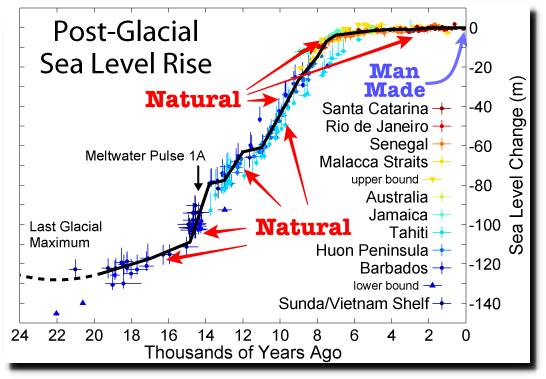
Also, a longer term perspective is informative:

post-glacial_sea_level

Postscript Re. SII v.4

Update: Strange Sea Ice Data July End 2025


via Science Matters

https://ift.tt/9JNnwMX

August 16, 2025 at 09:21AM

Sunday

0 out of 10 based on 0 rating

via JoNova

https://ift.tt/icOSZ6P

August 16, 2025 at 09:08AM

The Folly of Climate Leadership: Britain’s Net Zero Masochism and the China Mirage

From Tilak’s Substack

It is one of the enduring marvels of political hubris that a small, deindustrialising island nation contributing less than 0.8% of the world’s greenhouse gas emissions believes it can “lead the world” into abandoning fossil fuels. This belief – sincerely held by Westminster’s political elites on both the Conservative and Labour benches – has birthed an energy policy that combines moral grandstanding with economic self-harm. The outcome is a textbook case study in how virtue-signalling masquerading as “climate leadership” can hobble an economy while empowering the very geopolitical rivals it purports to outpace.

The latest manifestation of this delusion comes courtesy of Ed Miliband’s “Head of Mission Control for Clean Power by 2030”, Chris Stark. Writing in the Telegraph, Stark urged Britain to emulate China in becoming an “electrostate” – a nation powered entirely by abundant low-carbon electricity – claiming that “we ignore these changes at our peril”. Stark’s premise is as breathtaking in its naivety as it is in its selectivity. China, he tells us, is “laying vast networks of transmission lines, rolling out the world’s biggest fleet of electric vehicles and deploying solar and wind at a scale that dwarfs the rest of the world.”

China’s Net Zero Pledge: Smoke, Mirrors and 2060

It is an attractive picture – if one edits out the inconvenient facts that China remains 60% powered by coal, is permitting two new coal plants a week and is adding annual coal capacity equivalent to the entire UK electricity grid. According to the International Energy Agency (IEA), coal consumption hit another new record last year – 8.77 billion metric tons – due to soaring coal use by China and India. In fact, the International Energy Agency reports that China’s coal consumption has ballooned from 1.3 million tonnes in 2000 to an estimated 4.5 billion tonnes today. That is not a typographical error. It is the energy reality.

To the climate faithful, China’s promise of carbon neutrality by 2060 is an audacious “bid to lead the world”. To seasoned China observers, it is an exercise in diplomatic theatre. Veteran China watcher Patricia Adams writing for the Global Warming Policy Foundation reminds us that the Chinese Communist Party’s highest priority is not the UN’s Framework Convention on Climate Change agenda but its own political survival. That survival depends on sustained economic growth – which in turn requires ever-increasing fossil fuel use. Critical pollution issues such as urban smog and ambient air quality also need to be handled to head off domestic disaffection among China’s vast cities. Global climate change “leadership” does not make the list in China’s political priorities though this is not apparent for naïve Sinophiles like Ed Miliband and Chris Stark.

UNFCCC, Article 3 paragraph 1 [1992] states that “The Parties should protect the climate system for the benefit of present and future generations of humankind, on the basis of equity and in accordance with their common but differentiated responsibilities and respective capabilities. Accordingly, the developed country Parties should take the lead in combating climate change and the adverse effects thereof.” From the earliest climate negotiations, Beijing has positioned itself as champion of the “developing country” bloc, thereby exempting itself from binding emission cuts while demanding vast flows of “climate finance” from the West.

The Paris Agreement of 2015, celebrated in Western capitals as a breakthrough, was in practice a grand bargain in which China promised to go emissions neutral by 2060 – a milestone decades into the future with no commitments on how much emissions will increase and at what rate they decline after a peak. In return, the Obama and Biden administrations imposed costly green mandates and subsidies on the US economy while launching an all-out regulatory onslaught on US coal, oil and natural gas.

In 2010, senior official in the UN’s Intergovernmental Panel on Climate Change Professor Dr Ottmar Edenhofer confessed that climate policy has almost nothing to do any more with environmental protection, and that the then-upcoming world climate summit in Cancun was actually an economic conference in which the redistribution of the world’s resources was the object to be negotiated over.

In 2015, Christiana Figueres, the-then Executive Secretary of UNFCCC, asserted that the goal of environmental activists was to re-define capitalism itself. “This is the first time in the history of mankind that we are setting ourselves the task of intentionally, within a defined period of time, to change the economic development model that has been reigning for at least 150 years, since the Industrial Revolution,” she said. Of the Paris climate change conference which was to be held that year, she added: “This is probably the most difficult task we have ever given ourselves, which is to intentionally transform the economic development model for the first time in human history.”

Since Paris, China’s greenhouse gas emissions have grown, not fallen. Between 2018 and 2023, it approved more new coal capacity than the rest of the world combined. China’s wind and solar installations, while headline-grabbing, produce a modest share of its power, plagued by curtailment rates that are the “worst in the world”. As Patricia Adams documents, generous subsidies created vast unused capacity, with some curtailed wind output sufficient to power Beijing for a year – if only it could reach the grid.

Britain’s Self-Imposed Energy Straitjacket

In contrast, Britain has gone all in. In 2008, under Labour’s Gordon Brown, Parliament passed a legally binding commitment to cut emissions 80% by 2050. In 2019, after an 88-minute Commons debate, that target became 100% – Net Zero – on the advice of the Climate Change Committee, which based its cost projections for offshore wind on a single high-wind year. Boris Johnson, in full booster mode, declared Britain the “Saudi Arabia of wind”.

What makes the Stark–Miliband “lets emulate China” line so astonishing is that it misreads China’s renewables investments as a sign of ideological commitment, when in fact it is a form of state capitalism at work. Beijing’s solar, wind and electric vehicle build-out is not a crusade against fossil fuels but a calculated strategy to dominate the supply chains of technologies that the West has chosen – politically, not economically – to depend on.

By promoting solar panels, wind turbines and EV batteries to Western markets – and ensuring they are produced with cheap, coal-fired electricity at home – China captures the high-value manufacturing and export markets, while leaving its competitors to grapple with the higher costs of integrating intermittent renewables into their grids. Behind the manufacture of wind, solar and EV components and finished products lay entire globe-encompassing supply chains stretching from mining through to refining of minerals and rare earths, dominated singularly by China.

Ed Miliband visited China in March where he pledged closer cooperation with China on green energy. Yet, five months later, the Government has still not revealed the text of the memorandum he signed. According to the Guardian, the UK Secretary of State for Energy Security and Net Zero Ed Miliband “is hoping to shape a new global axis in favour of climate action along with China and developing countries, to counter Donald Trump’s abandonment of green policies in the US.”

This is what makes Miliband’s starry-eyed talk of a “new global axis” with China to lead on climate so laughable to seasoned observers. China is not joining Britain’s green crusade; it is monetising it. It is perfectly content for the UK and EU to legislate themselves into energy poverty while buying Chinese kit to do it.

The public in Britain is told that high bills are a Putin problem, that we are “hostages to volatile gas markets”, and that more wind farms and solar panels will free us from this volatility. Natural gas prices in Europe have declined to almost where they were before the supply crisis brought on by the Ukraine-Russia war. However, estimated electricity bills for an average household in the UK have increased by 35.5%, from £652 in 2021 to £884 in 2024, according to Ofgem data. While increased gas prices (which include an additional carbon tax paid by power companies that generate electricity using natural gas) played a role in this increase, the work by David Turver and Andrew Montford show that the array of subsidies, systems balancing costs (due to intermittency of renewables) and expanding the grid to support increased reliance on solar and wind farms play a far more important role.

Britain once had a thriving industrial base anchored in affordable, secure energy. Today, energy-intensive manufacturing – steel, chemicals, glass – is being priced out. Citing the Office for National Statistics, the Financial Times reported that output in 2025 in the UK’s energy-intensive industries has fallen by a third since 2021 to reach a 35-year low, reflecting their exposure to the highest electricity prices of developed economies. The production of paper, petrochemicals, basic metals and inorganic products such as cement and ceramics was in 2024 at its lowest level in records stretching back to 1990. The figures underline the challenge facing ministers as they seek to shield British industry from high energy costs that put businesses at a severe disadvantage to competitors in the US and China.

The original Climate Change Act in 2008 included no sort of cost-benefit analysis at all. As Paul Homewood notes, “it was passed almost unanimously through Parliament on the basis that when you are saving the planet, costs do not matter.” It was the same story when Theresa May amended the 2008 Act to set the 2019 Net Zero target.

Meanwhile, the Government ploughs ahead with EV mandates, boiler bans and infrastructure upgrades for an all-electric future, at a cost to the UK economy that may run over £1 trillion. The Treasury’s Net Zero Review blithely assumes that “a successful and orderly transition” will yield lower household costs and “wider health co-benefits”. Yet no serious scenario work appears to account for what happens if global fossil fuel demand remains robust – as every credible forecast says it will – and Britain’s self-imposed constraints simply shift production, and emissions, overseas as it has done over the past two decades of economic decline.

Energy Realism Versus ‘Climate Leadership’: Trump Upends the Globalist Climate Agenda

In the developing world, energy realism prevails not just in China. India’s message to the 2023 COP28 annual climate conference was blunt: “It is very clear that India’s energy needs for development, which are substantial, cannot be deferred… India’s reliance on coal is critical to its energy security in the background of the relative paucity of oil and natural gas of domestic origin.”

African leaders are increasingly vocal about the hypocrisy of Western governments that developed on the back of fossil fuels now denying them the same fossil fuel-based energy ladder. Even Germany, after years of climate posturing, reverted to burning lignite when its energy security crumbled post-Ukraine war after having shut down its nuclear plants post-Fukushima at very short notice.

But what was once a united “collective West” climate worldview – represented in the UN via its specialised agencies such as the IPCC – has shattered. President Trump’s energy team led by Energy Secretary Chris Wright, Environmental Protection Agency Administrator Lee Zeldin and Interior Secretary Doug Burgum, is charging full steam ahead, firing off policy and regulatory initiatives at a pace designed to overwhelm the capacity of opponents to respond. It is leaving the administration’s zealous climate adversaries scrambling to oppose the Trumpian counter-revolution.

Under President Trump’s watch, the US has exited the Paris Agreement and ceased financial commitments to the UN climate agenda. Under its “energy dominance” mantra, Trump’s administration is set to continue playing to American strengths in exploiting American coal, oil and natural gas resources and to unleash a “nuclear renaissance”. The Green agenda, championed under the Obama administration and turbocharged by the Biden one, which unleashed the massive Inflation Reduction Act boondoggle for the Democrat Party-favoured renewables sector, is now being dismantled piece by piece.

Britain, meanwhile, clings to “climate leadership”, the idea that moral example will change the world’s energy trajectory. This is the same delusion that informed Barack Obama’s “grand bargain” with Xi Jinping under the Paris Agreement, a deal that tied US hands with costly regulation while asking little of China beyond a vague 2030 peak. If this is leadership, it is leadership of the lead lemming charging over the cliff.

This article was published in The Daily Sceptic https://ift.tt/vpfayHW


Discover more from Watts Up With That?

Subscribe to get the latest posts sent to your email.

via Watts Up With That?

https://ift.tt/D3aAuJM

August 16, 2025 at 08:02AM