Category: Daily News

FERC Must Seize the Supreme Court’s Energy Opportunity

By Dan Brouillette

President Trump’s nomination of attorney Laura Swett to the Federal Energy Regulatory Commission comes at a pivotal moment for American energy and technology. The promise of artificial intelligence presents incredible economic opportunity but also brings new challenges for energy and national security. 

Fortunately, the Supreme Court’s unanimous decision in Seven County Infrastructure Coalition v. Eagle County has tilted the legal landscape in favor of development and away from the endless litigation that has paralyzed critical infrastructure for decades.

Justice Kavanaugh’s opinion clarified what those of us in the energy sector have known for years: the National Environmental Policy Act has been perversely stretched far beyond its original intent. What began as a reasonable procedural step for agencies to take before issuing permits has become what he called a “blunt and haphazard tool employed by project opponents…to try to stop or at least slow down new infrastructure and construction projects.”

Environmental groups have weaponized NEPA reviews to block industrial projects across the board—fossil fuels, nuclear, wind, solar, and battery storage alike—using speculative consequences that stretch far beyond any reasonable connection to the actual proposal. The Court has now told federal judges to stop enabling this abuse.

President Trump’s new AI doctrine – the golden age built by American workers, powered by American energy, run on American technology and AI, making America richer, stronger, and more powerful than ever before – couldn’t be clearer. FERC is an important agency carrying out this vision, as it is  the lead agency authorizing construction of new natural gas pipelines. The deregulatory steps the agency takes hold an important key to U.S. energy and technological dominance.

Yet here’s the reality: FERC’s recent procedural changes on NEPA fail to capitalize on the opportunity created by Seven County. The commission’s minimum two-year review timeline for environmental impact statements delays infrastructure development and adds tens of millions of dollars for major projects, regardless of complexity or impact. None of this equates to greater environmental protection. It’s merely process for the sake of process. In other words, all cost for no benefit. Unless real changes are made, FERC will continue to be a bureaucratic roadblock to success.

Justice Kavanaugh’s opinion has now given FERC the opportunity to change course. The Seven County ruling definitively declared that courts can no longer force agencies to analyze impacts beyond those directly caused by the proposed project itself. Combined with last year’s Loper Bright decision ending Chevron deference, this creates a powerful one-two punch against both judicial overreach and bureaucratic mission creep.

Other federal agencies are already seizing this opportunity. Interior Secretary Doug Burgum shows what’s possible: his department is completing reviews in 28 days—or in one remarkable case, just 11 days for Utah’s uranium mine approval. In contrast, badly needed pipeline projects can take years to win approval.

FERC should immediately implement the streamlined approach for NEPA reviews that Seven County allows. It should establish expedited tracks for projects with minimal new impacts. Eliminate automatic two-year minimum timelines that bear no relationship to project complexity. Fully utilize AI technology to process environmental paperwork. And exercise its authority to dismiss non-substantive protests that seek delay rather than legitimate protection and assert its statutory role as lead agency, ending the regulatory shell game where other agencies exercise effective veto power.

Most importantly, the Commission should recognize that streamlined review doesn’t mean fewer protections for the environment—it means focusing on actual impacts rather than speculative chains of causation that courts can no longer force agencies to chase.

Our competitors understand that resource dominance translates to economic and geopolitical advantage. China expands its infrastructure while we tie ourselves in regulatory knots that bring about neither a better environment nor greater security. The Court has opened the door to more efficient project approval by limiting NEPA’s scope and emphasizing that agencies should act decisively within their proper jurisdiction.

When Laura Swett is confirmed as Chair, she will have the opportunity to seize this historic opportunity to restore American energy dominance through abundant and affordable energy.

For our economy, security, and future, FERC must choose decisive leadership over bureaucratic theater. The Court has provided the legal framework. FERC must provide the will to use it.

The Honorable Dan R. Brouillette is a distinguished leader in energy, finance, and government policy, having served as 15th U.S. Secretary of Energy, 19th Deputy Secretary of Energy, President of Sempra Infrastructure, and CEO of Edison Electric Institute. With a career spanning public service and corporate leadership, he has played a pivotal role in shaping global energy strategy, advancing technological innovation, and managing large-scale infrastructure investments. 

This article was originally published by RealClearEnergy and made available via RealClearWire.


Discover more from Watts Up With That?

Subscribe to get the latest posts sent to your email.

via Watts Up With That?

https://ift.tt/RaNDk9Q

August 14, 2025 at 08:04PM

Looks like man-made global warming mainly applies to airports and industrial areas (8 degrees in 20 years!)

Hot airport runway. Plane. AI image.

By Jo Nova

Who knew, we can solve global warming by moving suburbs, planting trees, limiting immigration?

A new study used satellite data to look at ten cities around the world to see which parts of cities are the warmest, and how that has changed in the last twenty years as they grew.

It looks like man-made global warming mainly applies to airports and industrial areas. We put most of our thermometers at airports which awkwardly turns out to be 2.5 degrees Celsius warmer than surrounding areas, and presumably warmer than they were 120 years ago when there wasn’t 3 square kilometers of concrete runway there sitting in the sun. Industrial zones were even worse, being 2.8°C hotter. Conversely leafy green areas with a lot of vegetation were nearly 4 degrees cooler than the average. So airports are 6 degrees warmer than forests. Places near bodies of water were, not surprisingly, even more than 4 degrees cooler. It’s part of why people pay $5 million for a beachside mansion isn’t it?

The worst climate change in Melbourne is on Boundary Road

One of the ten cities they studied was Melbourne and there […]

via JoNova

https://ift.tt/yWo9sqT

August 14, 2025 at 04:33PM

Why Climate Doomsters Can’t Recant

Ted Nordhaus writes at The EcoModernist Why I Stopped Being a Climate Catastrophist,
And why so many climate pragmatists can’t quit catastrophism.  Excerpts in italics with my bolds and added images.

In the book Break Through, Michael Shellenberger and I argued that if the world kept burning fossil fuels at current rates, catastrophe was virtually assured.  I no longer believe this hyperbole. Yes, the world will continue to warm as long as we keep burning fossil fuels. And sea levels will rise. About 9 inches over the last century, perhaps another 2 or 3 feet over the course of the rest of this century. But the rest of it? Not so much.
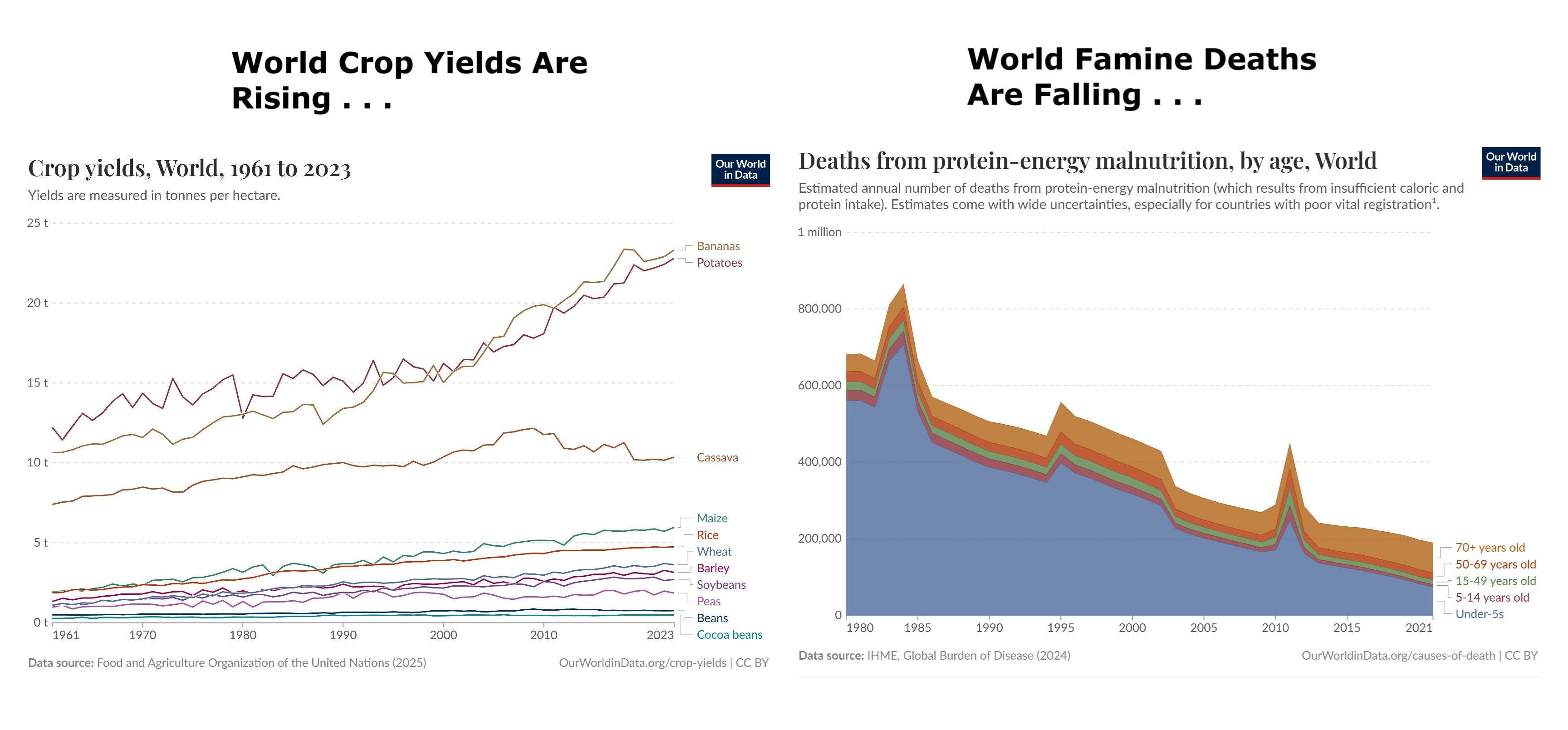
There is little reason to think that the Amazon is at risk of collapsing over the next 50 years. Agricultural yield and output will almost certainly continue to rise, if not necessarily at the same rate as it has over the last 50 years. There has been no observable increase in meteorological drought globally that might trigger the resource wars that the Pentagon was scenario planning back then.
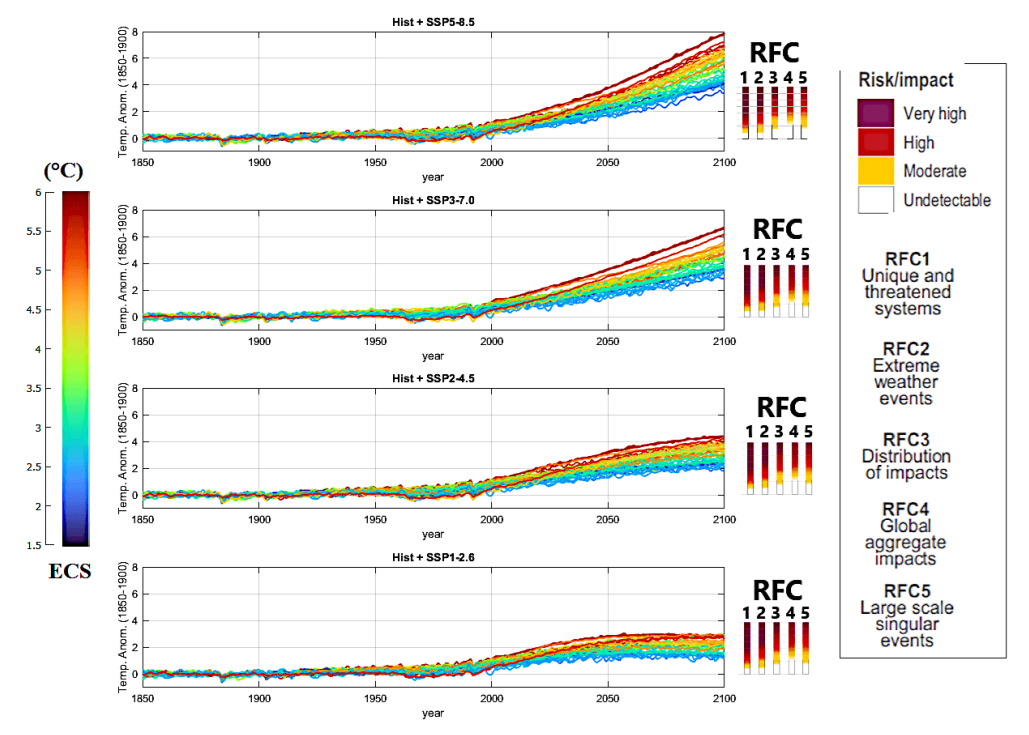
Figure 3: CMIP6 GCM ensemble mean simulations spanning from 1850 to 2100, employing historical effective radiative forcing functions from 1850 to 2014 (see Figure 1C) and the forcing functions based on the SSP scenarios 1-2.6, 2-4.5, 3-7.0, and 5-8.5. Curve colors are scaled according to the equilibrium climate sensitivity (ECS) of the models. The right panels depict the risks and impacts of climate change in relation to various global Reasons for Concern (RFCs) (IPCC, 2023). (Adapted from Scafetta, 2024).

At the time that we published Break Through, I, along with most climate scientists and advocates, believed that business as usual emissions would lead to around five degrees of warming by the end of this century. As Zeke Hausfather, Glen Peters, Roger Pielke Jr, and Justin Richie have demonstrated over the last decade or so, that assumption was never plausible.  The class of scenarios upon which it was based assumed very high population growth, very high economic growth, and slow technological change. None of these trends individually track at all with actual long term global trends.

Fertility rates have been falling, global economic growth slowing,
and the global economy decarbonizing for decades.
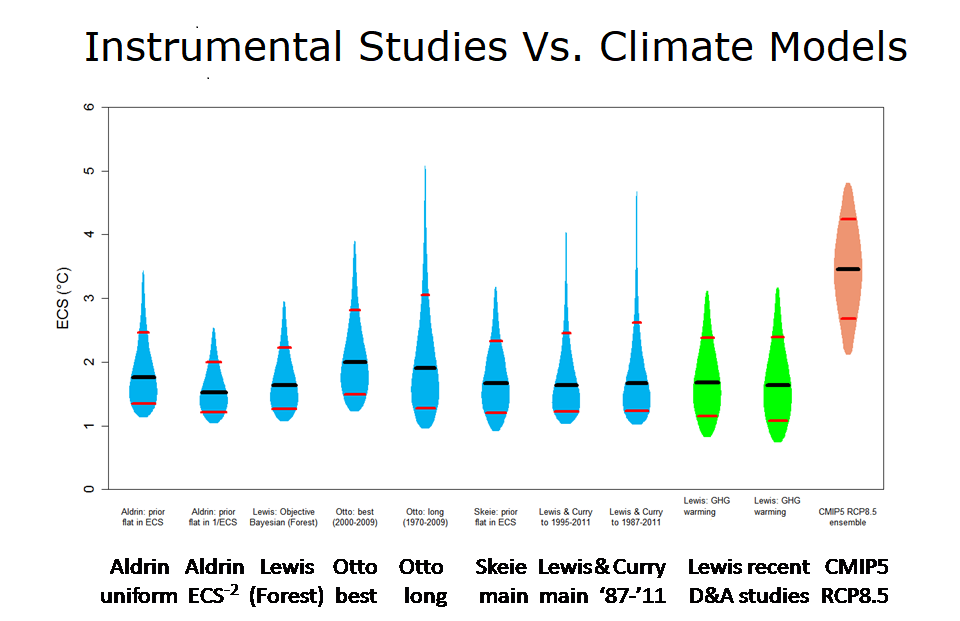
As a result of these dynamics, most estimates of worst case warming by the end of the century now suggest 3 degrees or less. But as consensus around these estimates has shifted, the reaction to this good news among much of the climate science and advocacy community has not been to become less catastrophic. Rather, it has been to simply shift the locus of catastrophe from five to three degrees of warming. Climate advocates have arguably become more catastrophic about climate change in recent years, not less.

When Is Weather Climate Change?

For me, the cognitive dissonance began as I became familiar with Roger Pielke Jr’s work on normalized hurricane losses, in the late 2000s. This was around the time that a lot of messaging from the climate advocacy community had started to focus on extreme weather events, not just as harbingers for the storms of our grandchildren, to borrow the title of James Hansen’s 2009 book, but as being fueled by climate change in the present.

If you want to know why Pielke has been so demonized over the last
15 years by climate activists and activist climate scientists,
it’s because he got in the way of this new narrative.
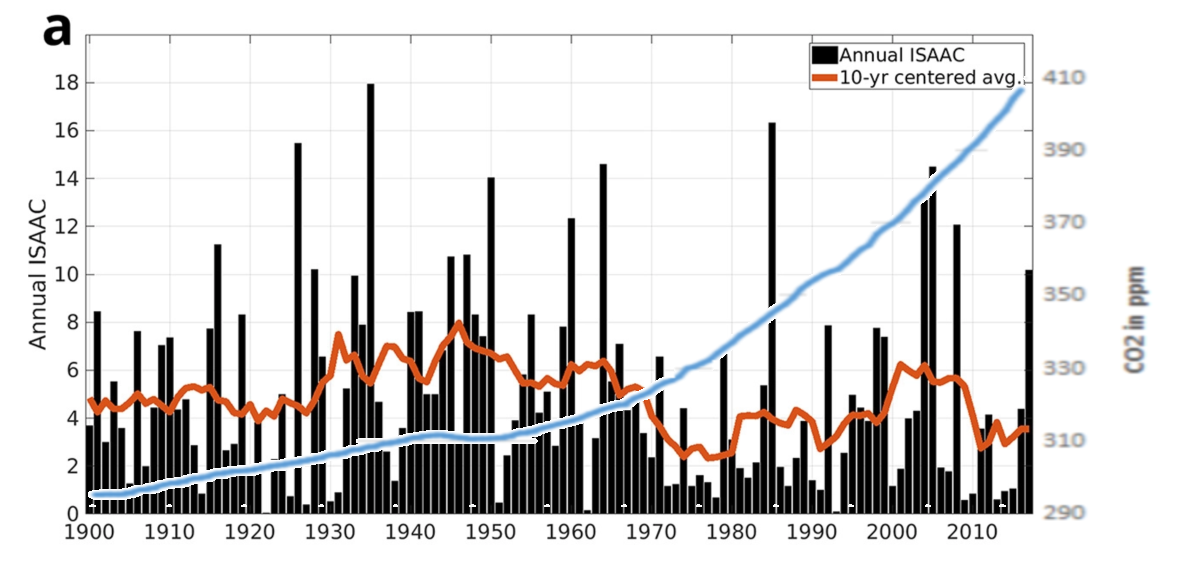
Integrated Storm Activity Annually over the Continental U.S. (ISAAC)

Pielke’s work, going back to the mid-1990s showed, again and again, that the normalized economic costs of climate related disasters weren’t increasing, despite the documented warming of the climate. And unlike a lot of researchers who sometimes produce studies that cut against the climate movement’s chosen narratives, he wasn’t willing to be quiet about it. Pielke got in the way of the advocacy community at the moment that it was determined to argue that present day disasters were driven by climate change and got run over.
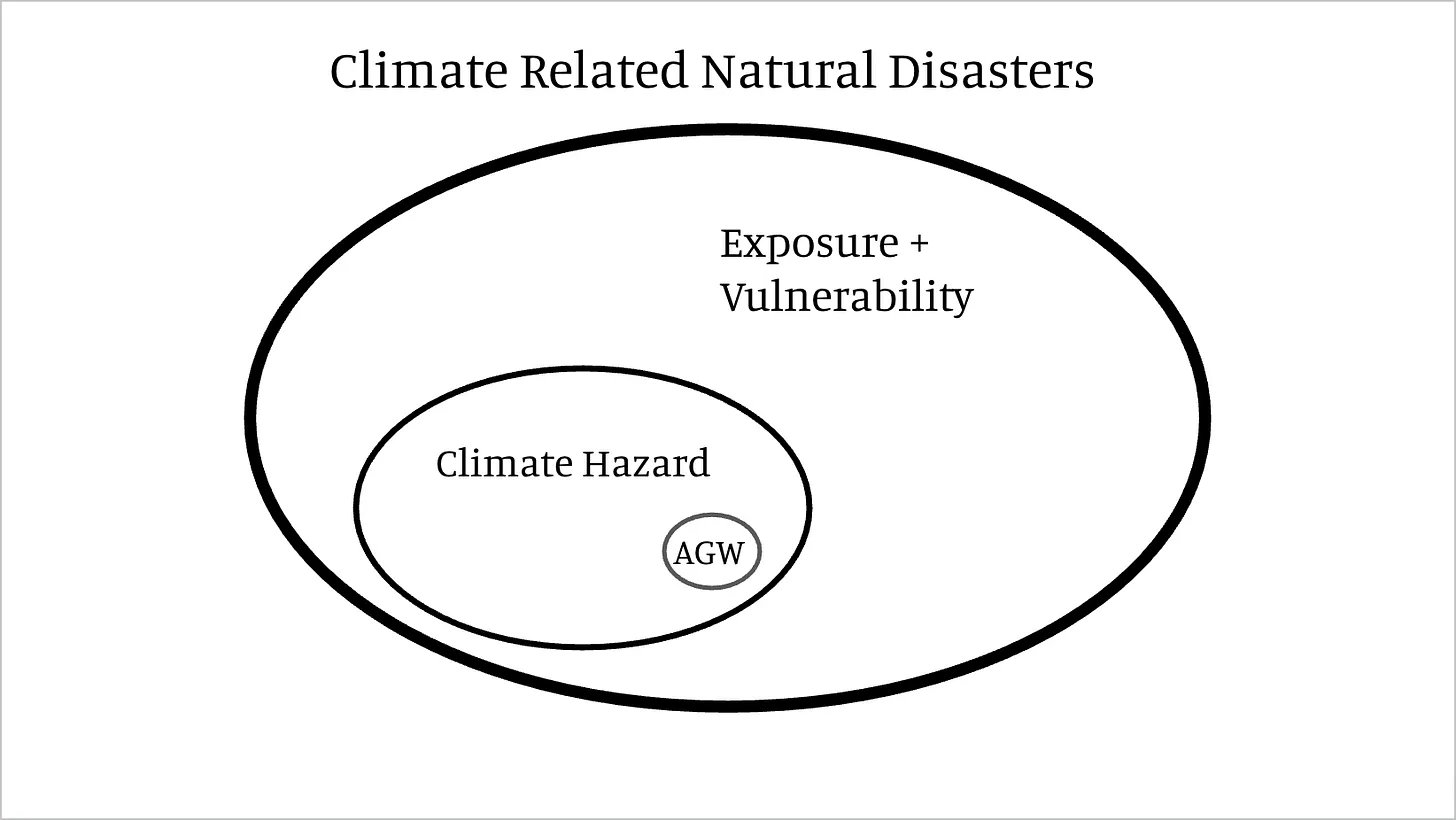
Put these two factors together—the outsized influence that exposure and vulnerability have on the cost of extreme climate and weather phenomena, and the very modest intensification that climate change contributes to these events, when it plays any role at all—and what should be clear is that climate change is contributing very little to present day disasters. It is a relatively small factor in the frequency and intensity of climate hazards that are experienced by human societies, which in turn play a small role in the human and economic costs of climate related disasters compared to non-climate factors.

This also means that the scale of anthropogenic climate change that would be necessary to very dramatically intensify those hazards, such that they overwhelm the non-climate factors in determining the consequences of future climate related events, is implausibly large. 

A Sting in the Tail?

For a long time, even after I had come to terms with the fundamental disconnect between what climate advocates were saying about extreme events and the role that climate change could conceivably be playing, I held on to the possibility of catastrophic climate futures based upon uncertainty. The sting, as they say, is in the tail, meaning so-called fat tails in the climate risk distribution. These are tipping points or similar low probability, high consequence scenarios that aren’t factored into central estimates. The ice sheets could collapse much faster than we understand or the gulf stream might shut down, bringing frigid temperatures to western Europe, or permafrost and methane hydrates frozen in the sea floor might rapidly melt, accelerating warming.

But like the supposed collapse of the Amazon, once you look more closely at these risks they don’t add up to catastrophic outcomes for humanity.  While sensationalist news stories frequently refer to the collapse of the gulf stream, what they are really referring to is the slowing of the Atlantic Meridian Overturning Circulation (AMOC). AMOC helps transport warm water to the North Atlantic and moderates winter temperatures across western Europe. But its collapse, much less its slowing, would not result in a hard freeze across all of Europe. Indeed, under plausible conditions in which it might significantly slow, it would act as a negative feedback, counterbalancing warming, which is happening faster across the European continent than almost any place else in the world.
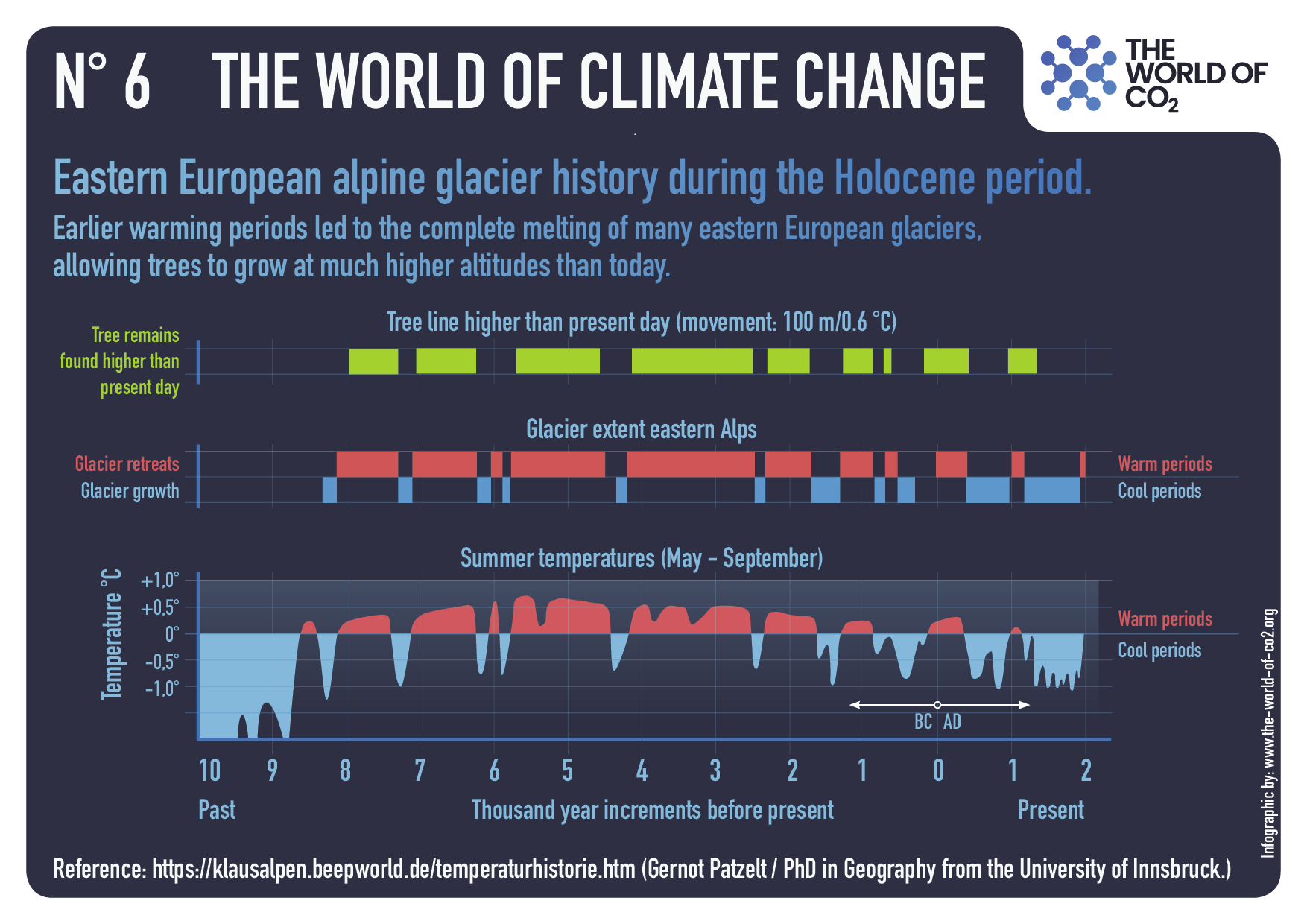
Permafrost and methane hydrate thawing, meanwhile, are slow processes not fast ones. Even irreversible melting would occur over millennial timescales, fast in geological terms but very slow in human terms. The same is true of accelerated melting of ice caps. Even under very high warming scenarios, broadly acknowledged today as improbable, the Greenland and West Antarctic ice sheets contribute around a meter of sea level rise by the end of this century. Those processes would continue far into the future. But even very accelerated scenarios for rapid disintegration of ice sheets unfold over many centuries, not decades.

Moreover, the problem with grounding strong precautionary claims in these known unknowns is that doing so demands strong remedies in the present in response to future risks that are both unquantifiable and unfalsifiable, a problem made even worse by the fact that “fat tail” proponents generally then proceed to ignore the fact that the unknown, unquantifiable, and unfalsifiable risks they are referring to are incredibly low probability and instead set about centering them in the climate discourse.

Clean Energy Without Catastrophism

Why do so many smart people, most trained as scientists, engineers, lawyers, or public policy experts, and all who will tell you, and I say this not ironically, that they “believe in science,” get the science of climate risk so badly wrong?

There are, in my view, several reasons. The first is that highly educated people with high levels of science literacy are no less likely to get basic scientific issues wrong than anyone else when the facts conflict with their social identities and ideological commitments. Yale Law Professor Dan Kahan has shown that people who are highly concerned about climate change actually have less accurate views about climate change overall than climate skeptics and that this remains true even among partisans with high levels of education and general science literacy. Elsewhere, Kahan and others have demonstrated that on many issues, highly educated people are often more likely to stubbornly hold onto erroneous beliefs because they are more expert at defending their political views and ideological commitments.
The second reason is that there are strong social, political, and professional incentives if you make a living doing left of center climate and energy policy to get climate risk wrong. The capture of Democratic and progressive politics by environmentalism over the last generation has been close to total. There is little tolerance on the Left for any expression of materialist politics that challenge foundational claims of the environmental movement.  Meanwhile the climate movement has effectively conflated consensus science about the reality and anthropogenic origins of climate change with catastrophist claims about climate risk for which there is no consensus whatsoever.

Whether you are an academic researcher, a think tank policy wonk, a program officer at an environmental or liberal philanthropy, or a Democratic Congressional staffer, there is simply no benefit and plenty of downside to questioning, much less challenging, the central notion that climate change is an existential threat to the human future. It’s a good way to lose friends or even your job. It won’t help you get your next job or your next grant. And so everyone, mostly falls in line. Better to go along to get along.

Finally, there is a widespread belief that one can’t make a strong case for clean energy and technological innovation absent the catastrophic specter of climate change. “Why bother with nuclear power or clean energy if climate change is not a catastrophic risk,” is a frequent response. And this view simply ignores the entire history of modern energy innovation. Over the last two centuries, the world has moved inexorably from dirtier and more carbon intensive technologies to cleaner ones. Burning coal, despite its significant environmental impacts, is cleaner than burning wood and dung. Burning gas is cleaner than coal. And obviously producing energy with wind, solar, and nuclear is cleaner than doing so with fossil fuels.

There is a view among most climate and clean energy advocates that the risk of climate change both demands and is necessary to justify a much faster transition toward cleaner energy technologies. But as a practical matter, there is no evidence whatsoever that 35 years of increasingly dire rhetoric and claims about climate change have had any impact on the rate at which the global energy system has decarbonized and by some measure, the world decarbonized faster over the 35 years prior to climate change emerging as a global concern than it did in the 35 years since.

Despite some tonal, tactical, and strategic differences, this basic view of climate risk, and corresponding demand for a rapid transformation of the global energy economy is broadly shared by the climate activists and the pragmatists. The impulse is millenarian, not meliorist.
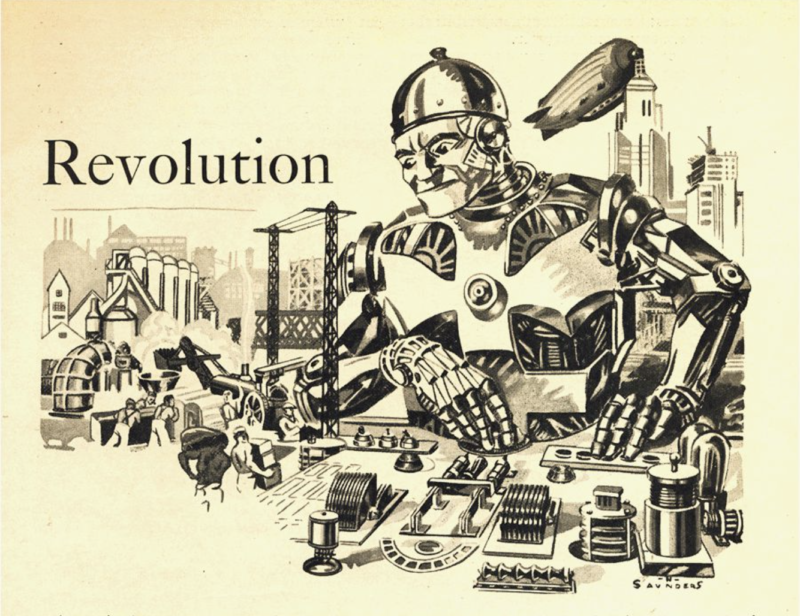
Underneath the real politik, technocratic wonkery, and appeals
to scientific authority is a desire to remake the world.

For all its worldly and learned affect, what that has resulted in is the creation of an insular climate discourse on the Left that may be cleverer by half than right wing dismissals of climate change but is no less prone to making misleading claims about the subject, ignoring countervailing evidence, and demonizing dissent. And it has produced a politics that is simultaneously grandiose and maximalist and, increasingly, deeply out of touch with popular sentiment.
via Science Matters

https://ift.tt/bHNIzVh

August 14, 2025 at 04:31PM

New York’s Official Energy Plan Is No Plan

From THE MANHATTAN CONTRARIAN

Francis Menton

It was in July 2019 that New York State adopted its Climate Leadership and Community Protection Act. Our Legislature and Governor (it was Andrew Cuomo at the time) had officially designated us as the climate “leader,” here to show the unsophisticated rubes and provincials in the rest of the country how a small application of political will could transform our electricity system from majority fossil fuels in 2019 to 70% “renewables” by 2030 and 100% “zero-carbon” by 2040.

Now six years into the eleven available to meet the 2030 mandate, we actually get less of our electricity from zero-carbon sources than we did in 2019. The reason is that the large (2 GW) Indian Point nuclear plant was forced to close under pressure from environmentalists, to be replaced by two natural gas plants of approximately the same total capacity. Meanwhile the vision of massive amounts of power from the wind and sun has barely gotten off the ground; and in particular the vision of vast offshore wind capacity has essentially died with the withdrawal of federal support by the Trump administration.

So what is the plan from here forward? The short answer is that there is no plan, or at least nothing remotely close to a credible plan.

But while we lack any semblance of a credible plan, we do not lack big reports purporting to be a plan. The last couple of months have seen the issuance of two such documents. On July 25, something called the New York State Energy Planning Board issued a document titled the Draft 2025 Energy Plan for the State. Separately, back on June 2, an agency called the New York Independent System Operator (NYISO) issued its own document called 2025 Power Trends. So how can I say that there is no plan?

Well, start with that document from the Energy Planning Board. The EPB is some kind of consortium of the infinitely confusing morass of bureaucracies with their fingers in the New York energy planning pie. Here is a list of members, with some 14 hangers-on ranging from the Commissioner of the Department of Environmental Conservation, to the Chancellor of the State University, to the Commissioner of the Department of Health, to the Chair of the New York State Energy Research and Development Authority. You would think that by this time, with only five years to go to the 2030 deadline, this highfalutin group of muckety-mucks would have, at the minimum: a detailed list of exactly what was going to be built where to meet the mandate, accompanied by an engineering-level feasibility study and detailed cost projections. Well no, no and no.

Instead we get hundreds upon hundreds of pages of fluff. The Summary for Policy Makers alone is 75 pages long. The whole thing is way too voluminous for me to give you anything more than a tiny sampling here. But an excerpt from the introductory paragraphs will give you some of the flavor:

Energy is central to New Yorkers’ lives. It powers the economy, keeps homes and workplaces comfortable, moves people and goods, and runs critical infrastructure. New York is one of the most energy-efficient states in the nation based on energy use per person and state economic output. 1. Additionally, our power grid is becoming cleaner. Roughly half of New York’s in-state electricity generation comes from zero-emission sources,2 and renewable generation projects that are in the pipeline today would double the state’s renewable generation by 2030.3 Yet, like the rest of the country, New Yorkers face volatile energy prices, intensifying extreme weather, and environmental and health impacts associated with reliance on fossil fuels and aging fossil fuel infrastructure. These shared concerns do not affect all communities equally. Low-income households and otherwise disadvantaged communities are disproportionately impacted by energy cost burdens and by community and environmental health concerns like water and air pollution.4 Disadvantaged communities also face significant barriers to accessing clean energy choices.5

Blah, blah, blah, blah, blah.

And then this from a little further down in the introduction:

The Energy Planning Board acknowledges that at the time of developing the Draft Plan, the energy sector faces significant uncertainty, stemming from economic pressures and, more recently, a shift in political priorities and policies at the federal level. These uncertainties impact long-term planning, investment decisions, and possibly the pace of transition to clean energy.

Translation: all of their fantasies about massive amounts of solar and wind power driven by federal subsidies have been wiped out, and they have no idea of what is next. So they’re going to bury you in hundreds of pages of bafflegab about things like “delivering abundant, reliable and resilient clean energy,” or “continuing progress toward de-carbonization and a clean energy economy,” or “delivering abundant energy services for economic competitiveness.” (These are examples of headings from the table of contents.)

Note that this is just the “draft” plan. A multi-month process of public comments and revisions is contemplated. The chance that that process will contribute an actual feasibility study or detailed cost projection is exactly zero.

And then there is the NYISO Power Trends report. This one is a comparatively terse 50 pages. Most is written in the same type of bureaucratese designed to conceal the lack of substance and to keep you from reading further. Example from the President’s introductory letter:

The electric system is the backbone of our economy. It is essential to the health and safety of all New Yorkers. Since the NYISO’s inception in 1999, protecting electric system reliability and evolving competitive markets has been our top priority in the face of great change, whether it be societal, public policy, or extreme weather.

But then NYISO is the one agency here that actually has the responsibility to keep the system up and running. Deeply buried on page 14 as the last paragraph of a section headed “A diverse resource mix supports grid reliability,” we find these two sentences:

Simply put, as New York seeks to retire more fossil fuel units in the coming years it will be essential to deploy new energy resources with the same reliability attributes to maintain grid reliability. Until new, non-emitting alternatives like hydrogen or advanced nuclear generation are developed and commercialized, fossil resources are needed to fill an essential role in preserving reliable grid operations.

Well as of today grid-scale hydrogen and advanced nuclear generation have not been “commercialized.” So the only answer is to keep the fossil fuel generation going. Perhaps they should tell some of their co-bureaucrats, like NYSERDA, or the Energy Planning Board, or maybe even the Legislature or the New York City Council. But as of now NYISO’s strategy seems to be to put a warning somewhere deep in their reports just so they can say “I told you so” when the whole thing falls apart. They owe the New York citizenry much better.


Discover more from Watts Up With That?

Subscribe to get the latest posts sent to your email.

via Watts Up With That?

https://ift.tt/cAyX1ot

August 14, 2025 at 04:03PM