Category: Daily News

East Okement Farm DCNN8825 – A harsh but moderated environment.

50.70349 -3.97754 Met Office CIMO Assessed Class 4 Installed 1/1/1991 Elevation 408 metres amsl.

East Okement Farm is one of the highest in Devon on the edge of Dartmoor. The weather station was installed to replace the original Okehampton weather station site at the nearby military camp and firing range which was closed down in 1990. The former site at 370 metres amsl was a somewhat harsh environment, the new site even more so. It certainly takes dedication to the cause to farm such sites which is amply displayed by the “Commoners” operating this site.

In situations like this I always personally like to distance any criticism of those operating the site from my remarks concerning the Met Office who are the responsible body. I have the greatest respect for the farm owners and observers who fulfil a vital function. My complaints lie with the Met Office who attempt to reconstruct an ongoing national temperature record from sites that were never originally intended for long term climate reporting rather just local conditions.

The issue here is not that the site (if correctly positioned) is unlikely to be representative of a wider area because it certainly could be. The area of Dartmoor National Park is marginally under 1,000 square kilometres (or put another way about 0.8% of the area of England) so it makes perfect sense to measure the climate of such a large area. It is rather the detail of the siting that potentially causes the instrumentation to not accurately reflect the wider area as detailed below.

The farm is obviously going to be located in the most sheltered spot available and will over time have been deliberately sheltered from the worst effects of the harsh weather, most notably almost continuous wind. The farm is located midway between the nearby tor at 480 metres and the East Okement River which breaks the 375 metre contour at this point. A considerable slope but the immediate surroundings of the farm seem acceptably flat for a screen location.

To the north and east, sheltering belts of trees break the worst of winds from those directions. The principal exposure is to the south and west though topography to those largely prevailing wind directions will moderate the wind speed. It is the immediate screen surroundings that dictate this was rated by the Met Office as Class 4 and its attendant inaccuracy. The 3 metre radius circle just makes it within the enclosed area and will be the basis for the Met Office judgment.

this reflects an issue where I feel the Met Office is remarkably inconsistent. Bradford Lister Park is rated as Class 5 with this below what a 30 metre radius looks like. In fact the 3 metre radius does not reach the footpath.

I find it remarkably difficult to understand why the Met Office rates East Okement Farm as significantly superior to the Bradford site. When looked at even deeper the issue gets worse, The Farm location is surrounded by dry stone walling not an open railing fence as at Bradford. Dry stone walling is a very common feature in upland Devon and is built to typical local standards.

“A standard, freestanding wall usually stands 1.4m (4ft 6in) above ground level. Boundary walls (perimeter walls to farms, estates, etc) are more commonly 1.6m (5ft 3in).”

The screen in East okement Farm is surrounded by such walls which in all likelihood will be of the higher 1.6 metre perimeter standard. The image in the “Commoners” link above shows the owners in front of such walls of the greater height. This will mean the screen itself is sitting within a wind sheltered unnatural enclave.

Under most weather conditions, in such otherwise open countryside , this would historically have not posed a major problem. Traditional Liquid in Glass Thermometers are slow to respond especially in the Stevenson screen environment. However, on the 22nd September 2017 in accordance with a nationwide changeover by the Met Office, the maximum reading LIGT (only) was replaced with a fast reacting Platinum Resistance Thermometer (PRT). Despite the notable feature of the electronic PRT and its “data logger” memory recording ALL temperatures by the averaged 60 second period for ALL day making any other air temperature reading instruments unnecessary, the minimum LIGT was always retained at manual sites and used for those recordings in preference to the PRT.

As highlighted in my report on meteorological averaging, the unusual derivation of “means” is solely dependent on points of extreme, small changes in these can cause major end differences. In certain calmer weather conditions this enclosed site will result in stagnant air developing within the screen warming above the outside ambient temperature. Even brief effects will be recorded by the PRT for maximum readings but there will be no compensatory lower minima at any time from the LIGT. A simple recipe for increasing both maxima and more so means.

In conclusion whilst this site is well observed and maintained by its custodians, it is still a poor site which probably should be rated Class 5. It is not suitable for long term climate reporting.

via Tallbloke’s Talkshop

https://ift.tt/5wQKPOB

August 12, 2025 at 04:22AM

Popular Mechanics Unhinged: “Scientists Are Mapping the End of the World”

Essay by Eric Worrall

But we can save the world by reducing meat consumption.

Scientists Are Mapping the End of the World. And Maybe, Just Maybe, a Way Out.

Positive climate action can have cascading effects.

BY DARREN ORF PUBLISHED: AUG 08, 2025 9:30 AM EDT

Here’s what you’ll learn when you read this story:

  • Scientists are aware of planetary boundaries—a series of climate change thresholds that, once crossed, could cause a cascade of negative environmental effects.
  • Now, scientists are developing a methodology to discover “positive tipping points”— a series of actionable green energy goals that could similarly compound in benefit once crossed. 
  • While we’re already well on the way to reaching some of these tipping points—i.e. lowering the cost of wind and solar energy—there’s still lots of work to be done to stay within the two degrees Celsius range stipulate by the 2015 Paris Climate Accords.

To live in an era of anthropogenic climate change is to be constantly reminded of the warming threat to our planet. One way scientists illustrate this threat is by using climate tipping points, also known as planetary boundaries, which showcase around nine critical ecological thresholds that could have devastating effects for life on Earth once crossed. These include things like biosphere integrity, ozone depletion, ocean acidification, and a relative newcomer known as “aquatic deoxygenation.”

Although these thresholds are discussed with deadly seriousness, scientists wonder if the reverse of these doom-and-gloom thresholds—positive tipping points, if you will—could help encourage people, communities, and countries to adopt more aggressive green policies. In a new study, published in the journal Sustainability Science, experts from the University of Exeter in the U.K. explain these positive tipping points would be moments in society’s adoption of green technologies or behaviors that could perpetuate a cascade of positive outcomes.

“Other transformations—such as a major shift away from meat consumption—might also be more likely than they appear,” Steve Smith from the University of Exeter said in a press statement. “In other sectors there is little sign of approaching tipping points and in a few, such as nuclear power and concrete production, we should not expect there to be tipping points at all.”

Read more: https://www.popularmechanics.com/science/green-tech/a65616655/positive-tipping-points/

No mention of the 1.5C target. I guess it’s a bit embarrassing to talk about 1.5C these days, given we hit 1.5C and nothing bad happened.

As for the rest of the claims, there is zero risk global warming will have a major negative impact on oceans, even if several degrees of global warming were to occur, because last time the world experienced 5-8c of global warming, the biosphere and the oceans were fine.

Monkeys also did well during the PETM – which implies humans would also prosper in such conditions.

Stories like this make me seriously question the sanity of the people who write them. I mean, 5 minutes research could have turned up the fact that fish thrived during distant past extreme warm periods, that the entire biosphere thrived. Visiting hot climates to catch big fish is a major tourist industry in places like Florida and Australia’s far North.

Temperatures drop substantially as you move further from the equator. Any species which felt uncomfortable in a warmer climate would just relocate. All species are continuously adjusting their range, seeking out the best possible habitat, probing the edges of their habitable range.

So why write such nonsense? Why would anyone believe such outlandish claims? I wish I knew.


Discover more from Watts Up With That?

Subscribe to get the latest posts sent to your email.

via Watts Up With That?

https://ift.tt/VZAdutE

August 12, 2025 at 04:07AM

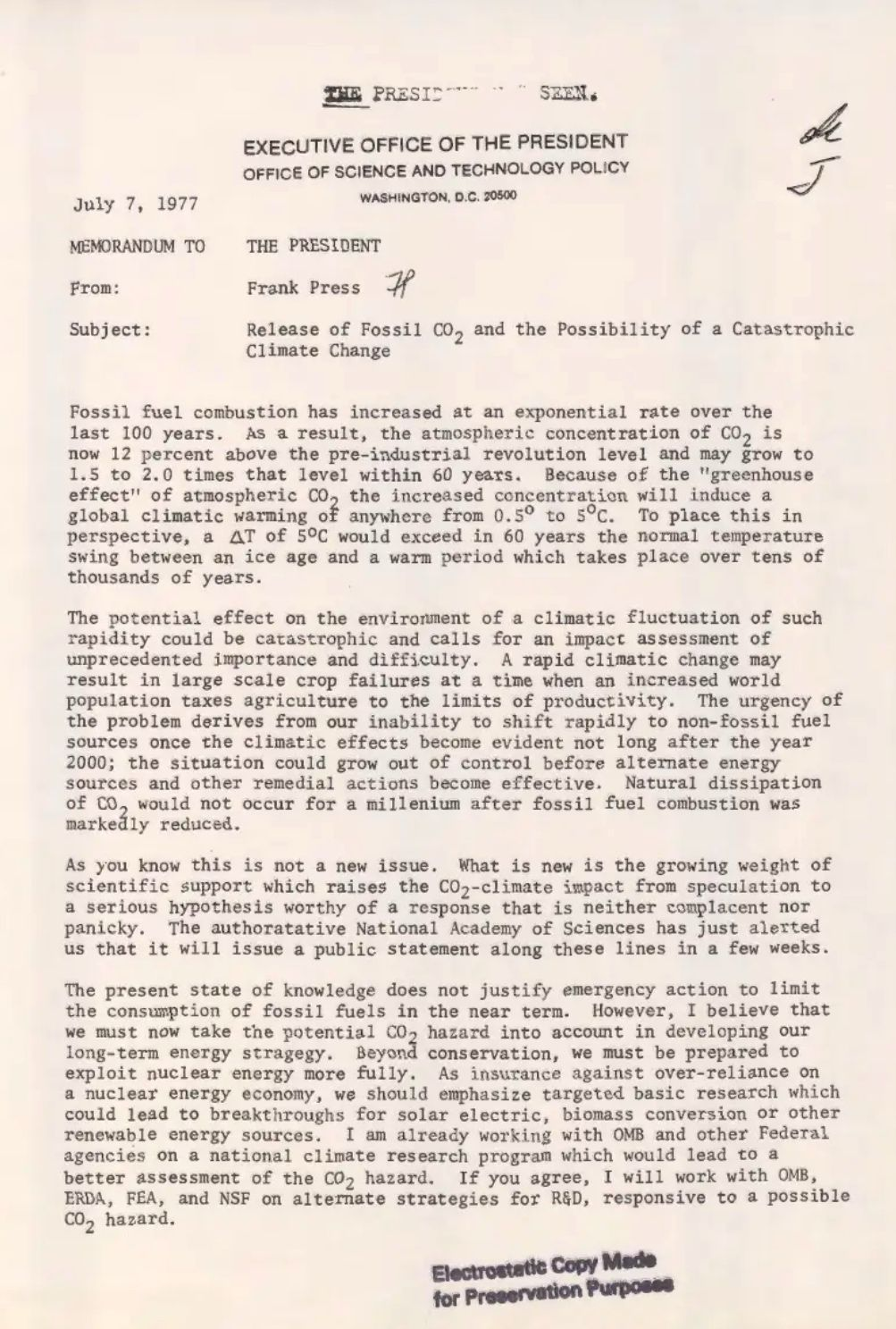
Catastrophic Climate Change? (1977 memo to Carter in retrospect)

“Good thing that Jimmy Carter’s Administration did not act on this to join their other sins, from price control to conservationism to creating the Department of Energy to synthetic fuel.”

Do the math with the 1977 climate memo to Jimmy Carter (below). In the next 60 years (to 2037), the memo predicted that increasing CO2 emissions would increase global average temperatures between 0.5 and 5.0 C (midpoint is 2.75 C).

Warming nearing the 50-year market is about 0.8C. Assume the total warming in the next 12 years brings the total to 1C anthropogenic. That makes a mockery of the high end of the estimate, which is the basis of “the possibility of a Catastrophic Climate Change.” And it is around one-third of the midrange of 2.75C.

It gets worse. Some of the warming in the 60-year period is undoubtedly natural, not anthropogenic. And note that the enhanced greenhouse effect is more oriented toward minimum temperatures going up than maximum temperatures going up–a reduction of the diurnal cycle. Benign-to-positive warming, then.

Good thing that Jimmy Carter’s Administration did not act on this to join their other sins, from price control to conservationism to creating the Department of Energy to synthetic fuels.

The post Catastrophic Climate Change? (1977 memo to Carter in retrospect) appeared first on Master Resource.

via Master Resource

https://ift.tt/AxUoeYE

August 12, 2025 at 01:06AM

Surprise! Study says Late Jurassic CO2 was 1,200 ppm, dipped to 750 ppm in the Cretaceous

Press release from University of Göttingen: T-Rex Dinosaur teeth give glimpse of early Earth’s climate

The study shows that the late Jurassic atmosphere carried about 1,200 ppm of CO₂, about four times the pre industrial 1850 benchmark of 280 ppm. By the late Cretaceous, CO₂ it had dipped to near 750 ppm.

A previously untapped source of data sheds new light on the climate of the early Earth: fossilized dinosaur teeth show that the atmosphere during the Mesozoic era, between 252 and 66 million years ago, contained far more carbon dioxide than it does today. An international research team at the Universities of Göttingen, Mainz and Bochum made this discovery by analysing oxygen isotopes in tooth enamel. They used a newly developed method that opens up opportunities for research into the Earth’s climate history. In addition, the researchers found that total photosynthesis from plants around the world was twice as high as it is today. This probably contributed to the dynamic climate during the time of the dinosaurs. The results were published in the journal PNAS.

The research team analyzed the enamel of dinosaur teeth found in North America, Africa and Europe dating from the late Jurassic and late Cretaceous periods. Enamel is one of the most stable biological materials. It records different isotopes of oxygen that the dinosaurs inhaled with every breath that they took. The ratio of isotopes in oxygen is affected by changes in atmospheric carbon dioxide and photosynthesis by plants. This correlation allows researchers to draw conclusions about the climate and vegetation during the age of the dinosaurs.

Tooth of a Tyrannosaurus rex – like the teeth analyzed in this study – found in Alberta, Canada Photo: Thomas Tütken

In the late Jurassic period, around 150 million years ago, the air contained around four times as much carbon dioxide as it did before industrialization – that is, before humans started emitting large quantities of greenhouse gases into the atmosphere. And in the late Cretaceous period, around 73 to 66 million years ago, the level was three times as high as today. Individual teeth from two dinosaurs – Tyrannosaurus rex and another known as Kaatedocus siberi which is related to Diplodocus – contained a strikingly unusual composition of oxygen isotopes. This points to CO₂ spikes that could be linked to major events such as volcanic eruptions – for example, the massive eruptions of the Deccan Traps in what is now India, which happened at the end of the Cretaceous period. The fact that plants on land and in water around the world were carrying out more photosynthesis at that time was probably associated with CO₂ levels and higher average annual temperatures.

This study marks a milestone for paleoclimatology: until now, carbonates in the soil and “marine proxies” were the main tools used to reconstruct the climate of the past. Marine proxies are indicators, such as fossils or chemical signatures in sediments, that help scientists understand environmental conditions in the sea in the past. However, these methods are subject to uncertainty. By analysing oxygen isotopes in tooth fossils, the researchers have now developed the first method that focuses on vertebrates on land. “Our method gives us a completely new view of the Earth’s past,” explains lead author Dr Dingsu Feng at the University of Göttingen’s Department of Geochemistry. “It opens up the possibility of using fossilized tooth enamel to investigate the composition of the early Earth’s atmosphere and the productivity of plants at that time. This is crucial for understanding long-term climate dynamics.” Dinosaurs could be the new climate scientists, according to Feng: “Long ago their teeth recorded the climate for a period of over 150 million years – finally we are getting the message.”

The study was funded by the German Research Foundation (DFG) and by the VeWA consortium as part of the LOEWE programme of the Hessisches Ministerium für Wissenschaft und Forschung, Kunst und Kultur.

Original publication: Dingsu Feng, Thomas Tütken, Eva Maria Griebeler, Daniel Herwartz & Andreas Pack. Mesozoic atmospheric CO2 concentrations reconstructed from dinosaur tooth enamel. Proceedings of the National Academy of Sciences (PNAS) (2025). DOI: 10.1073/pnas.2504324122


Discover more from Watts Up With That?

Subscribe to get the latest posts sent to your email.

via Watts Up With That?

https://ift.tt/IPpHCkh

August 12, 2025 at 12:03AM