Category: Daily News

Update Aug. 11: Relieving US Grid from Wind and Solar Risks


Update August 11, 2025 Shares of Orsted, the world’s largest offshore wind developer, plummeted today.

Orsted shares crashed more than 25% on Monday morning, after the wind farm developer said it plans a 60 billion Danish kroner ($9.4 billion) rights issue, following a “material adverse development” in the U.S. market.

The company said this turn of events left it unable to raise funds from a planned partial divestment of its Sunrise Wind project off the coast of New York.

Given the market conditions, Orsted’s board of directors decided to end the process of selling a stake in Sunrise Wind, which would have provided the “required strengthening” of its capital structure to support its investment and business development programs. Source: CNBC

Gary Abernathy reports on progress securing the U.S. grid from the load of entanglements from adding wind and solar power supplies.  His Empowering America article is Climate Science is Not the Law in the U.S.  Exerpts in italics with my bolds and added images.

While not everyone is on board with President Trump’s “America First” philosophy, its importance when it comes to energy is brought into sharp focus when considering where the U.S. would be if it capitulated to the whims of global organizations like the United Nations or obeyed the verdicts of world courts.

The frightening attitudes of believers in global rule were recently on display courtesy of a New York Times opinion piece headlined “Climate Science is Now the Law,” penned by three writers who are all part of something called the Center for International Environmental Law. In their article, the authors claim, “The science on climate change has long been settled. Now the law is, too.”  [See post: ICJ Issues Biased Advice on Climate Change]

At about the same time that the International Court of Overstep was issuing its decree for nations to kneel at the feet of the wind and solar gods, the Trump administration took another giant leap in its race to reverse Biden’s disastrous energy policies. On July 7, the Energy Department unveiled its “Report on Evaluating U.S. Grid Reliability and Security,” as required under President Trump’s April executive order to examine the topic.  DOE reported:

“This methodology equips DOE and its partners with a powerful tool to identify at-risk regions and guide federal interventions to prevent power outages, accelerate data center deployment, and ensure the grid keeps pace with explosive load growth driven by artificial intelligence and reindustrialization.”

Rather than follow international directives and judgments to rid itself of energy sources like natural gas, which is necessary to power technology, manufacturing and the coming AI data centers, the DOE is, fortunately, doing the exact opposite. Among the biggest DOE findings:

    • If current plant retirement schedules and incremental additions remain unchanged “most regions will face unacceptable reliability risks within five years.”
    • Radical change is necessary because otherwise, the magnitude of projected demand from AI data centers and other manufacturing “cannot be met with existing approaches to load addition and grid management.
    • The coal and gas plant retirements previously planned by 2030 “could lead to significant outages when weather conditions do not accommodate wind and solar generation.”
    • Even with plans to replace 104 gigawatts of plant retirements with 209 gigawatts of new generation by 2030, “only 22 (gigawatts) come from firm baseload generation sources,” meaning that “the model found outage risk in several regions rises more than 30-fold.” (A gigawatt is equal to 1 billion watts.)

In other words, replacing firm baseload sources like natural gas with alternative sources like wind or solar is not an apples-for-apples proposition, since “renewables” put the grid at greater risk. Establishing arbitrary end dates for our most affordable and reliable energy sources is both illogical and reckless.

On the heels of the international court’s irresponsible and (thankfully) unenforceable decree, and the DOE’s astute recommendation to do the opposite of what the court prescribed, came a story from Reuters declaring that the Trump administration’s actions to end or curtail Biden-era subsidies and credits for “renewables” are, fortunately, having an impact.  Boom fades for US clean energy as Trump guts subsidies

“Singapore-based solar panel manufacturer Bila Solar is suspending plans to double capacity at its new factory in Indianapolis. Canadian rival Heliene’s plans for a solar cell facility in Minnesota are under review. Norwegian solar wafer maker NorSun is evaluating whether to move forward with a planned factory in Tulsa, Oklahoma. And two fully permitted offshore wind farms in the U.S. Northeast may never get built,” the news agency reported.

These are among the major clean energy investments now in question after Republicans agreed earlier this month to quickly end U.S. subsidies for solar and wind power as part of their budget megabill, and as the White House directed agencies to tighten the rules on who can claim the incentives that remain.

The key provision in the new law is the accelerated phase-out of 30% tax credits for wind and solar projects: it requires projects to begin construction within a year or enter service by the end of 2027 to qualify for the credits. Previously the credits were available through 2032.

The policy changes have also injected fresh doubt about the fate of the nation’s pipeline of offshore wind projects, which depend heavily on tax credits to bring down costs. According to Wood Mackenzie, projects that have yet to start construction or make final investment decisions are unlikely to proceed.

Two such projects, which are fully permitted, include a 300-megawatt project by developer US Wind off the coast of Maryland and Iberdrola’s 791 MW New England Wind off the coast of Massachusetts.
Neither company responded to requests for comment.

President Trump is putting America first and leading an energy renaissance that should be in full bloom on our nation’s 250th birthday on July 4, 2026. It’s difficult to imagine a greater Independence Day gift to the American people than freedom from the cold, dark landscape that would result from following the directives of global agencies and the rulings of international courts.

Postscript: Saving U.S. Farmland from Transmission Lines

Robert Bryce adds the canceling of transmission lines dedicated to wind and solar power in his blog article Transmission Unplugged.

From Missouri and Colorado to Germany and Spain,
high-voltage transmission projects are being stopped by
fierce local opposition, soaring costs, and permitting delays.
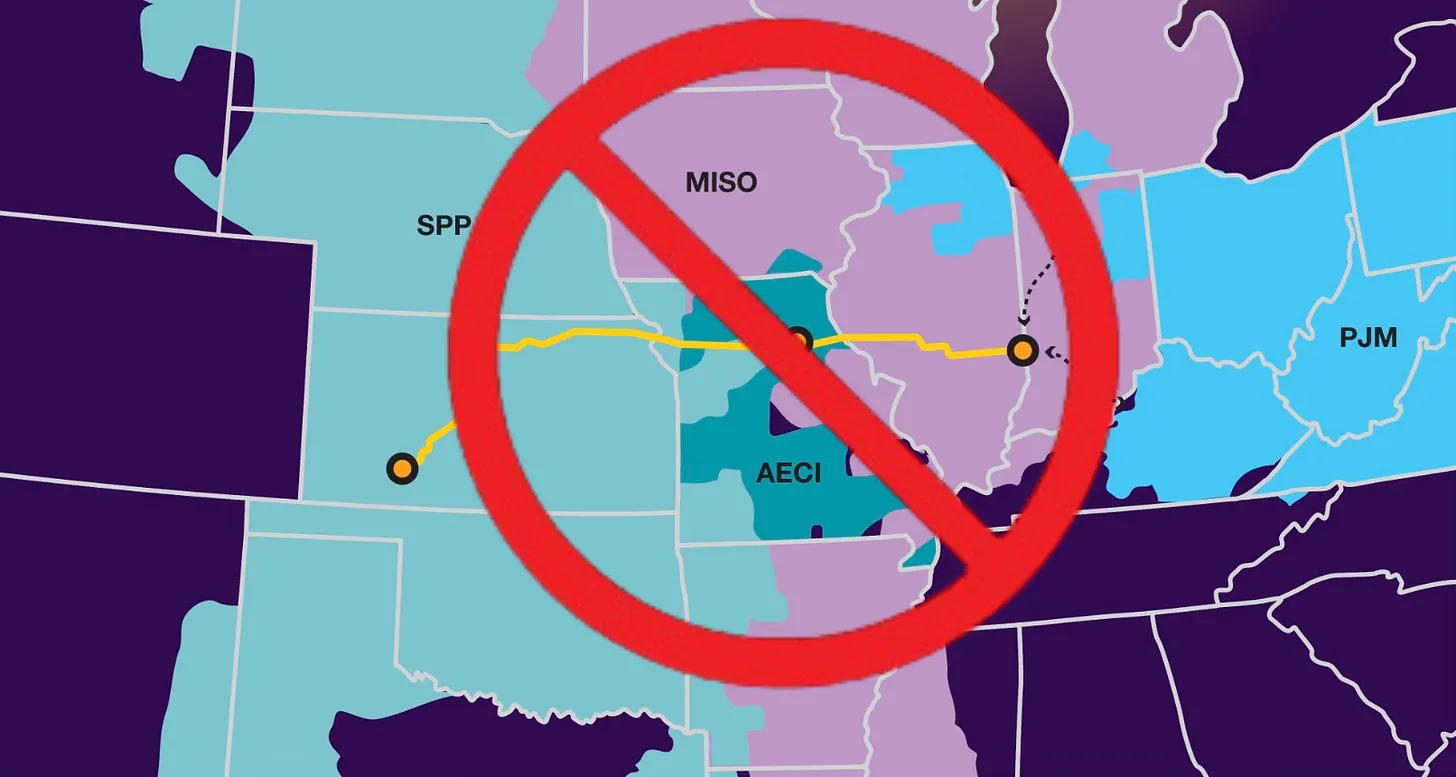
The Grain Belt Express project aimed to carry wind-generated electricity from Kansas to the Indiana-Illinois border. Map credit: grainbeltexpress.com

Invenergy neglected to mention that if the project gets built, it will saddle ratepayers with about $500 million in costs to integrate the power it will be delivering into grids on the eastern end of the line. In other words, Invenergy wants to build a merchant high-voltage transmission line and force its way onto the US electric grid. But it doesn’t want to pay any of the costs that its project will impose on the system. Furthermore, Grain Belt Express has faced fierce opposition in Missouri for more than a decade. Earlier this month, Missouri Attorney General Andrew Bailey announced a civil investigation into Invenergy for its “misleading claims and a track record of dishonesty” about the project.

Last week, the Department of Energy gave Polsky some high-amperage clarity from the Trump administration when it canceled a $4.9 billion loan guarantee for the Grain Belt Express that the agency’s Loan Programs Office made last November in the waning days of the Biden administration.

The DOE said it killed the loan deal “to ensure more responsible stewardship of taxpayer resources.”

via Science Matters

https://ift.tt/ADYslnH

August 11, 2025 at 08:04AM

From Weather to Climate: Why Tribune’s News Service AI Leap is a Logic Fail

The Tribune News Service article, “AI is fast-tracking climate research,” is misleading in its central premise. While AI can speed up certain weather data processing tasks, it does not magically make long-term climate forecasts more accurate. The piece blurs the line between short-term weather model gains and the far more uncertain, decades-scale climate projections — a fundamental error that misleads both policymakers and the public.

The article quotes AZTI marine biologist Ángel Borja saying, “It will allow us to process data and get results much faster, so people that make decisions can act faster, too”. This might be true for fisheries management or local ocean data sets, but when applied to climate, speed does not equal accuracy. Acting “faster” on flawed or incomplete climate projections risks enshrining bad policy based on noise or computer model errors, not signal.

Here is a breakdown of each of the claims in the article.

Claim: “Some AI-powered models are already outperforming conventional forecasting systems.”

Yes — but that’s in weather forecasting, which operates on hours-to-weeks timescales. Even Microsoft’s Aurora and Google DeepMind’s GraphCast, cited in the story, focus on short-term atmospheric prediction. This has almost nothing to do with the 30-year climate averages that define climate science. See Climate at a Glance: Climate Model Fallibility.

Claim: “AI models… can enable climate scientists to explore hundreds of times more scenarios than they can today.”

Quantity isn’t quality. Exploring “hundreds” of flawed scenarios faster doesn’t fix the fact that climate models — AI or not — still have massive uncertainty ranges. Observations show CMIP6 climate models overstate warming trends by nearly double actual measurements as told in Climate Models vs. Measured Data. If your inputs and physics are wrong, multiplying the number of runs just multiplies the wrongness.

Claim: “High-quality weather information is the first step to setting warning systems.”

True — but irrelevant to climate accuracy. Weather quality doesn’t fix deep uncertainties in equilibrium climate sensitivity (ECS), which still ranges from 0.8°C to almost 6°C by 2100. Nor does it solve the known ±4 Watts per square meter radiative cloud forcing error — more than 4,000 times the estimated signal from a year’s worth of CO₂ emissions according to the Hoover Institution.

Claim: “AI is set to turbocharge what the center can offer policymakers… allowing them to make more-informed decisions.”

This is the most dangerous overreach. Climate is by definition a 30-year statistical average. The World Meteorological Organization (WMO) defines climate as “…the average weather conditions for a particular location and over a long period of time. “Fast-tracking” such projections is meaningless — the data horizon can’t be shortened without destroying the definition of climate itself. Worse, rushing policy on the back of still-uncertain models risks trillion-dollar mistakes.

Tribune News Service: please stop confusing flash with substance. AI is not a magical oracle of climate truth — it’s a faster, sometimes cheaper way to crunch the same flawed models that have consistently overshot observed warming. Until climate models can reconcile with reality, narrow their error bars, resolve cloud physics, and stop producing 200% exaggerations of observed warming, your framing of AI as a “climate game-changer” is not journalism — it’s marketing copy. And marketing copy dressed as science is worse than ignorance; it’s an invitation to policy disaster.


Discover more from Watts Up With That?

Subscribe to get the latest posts sent to your email.

via Watts Up With That?

https://ift.tt/ZDAxosW

August 11, 2025 at 08:02AM

Kenley Airfield WMO 03781 – Rarely a star performer in the “Extremes” stakes for a good reason.

51.30394 -09148 Met Office CIMO Assessed Class 3 Installed 1/1/1988 Temperature records from 1/12/1991.

The Met Office produces a list of national daily weather extremes covering temperature rainfall and sunshine. This list is also heavily publicised on their X feed. With almost boring regularity the same culprits regularly appear as national and/or regional hotspots notably the likes of Heathrow, Charlwood (Gatwick) and Hull, East Park. I do not recall Kenley weather station ever appearing on these daily listings despite it being an airfield (partly disused) in Greater London and well within the M25. There is a reason for this.

Tim Channon reviewed the site in 2012 concluding a Class 3 rating and being spot on with the subsequent official view, Tim rarely called them wrong. https://tallbloke.wordpress.com/2012/09/06/wmo03781-kenley-airfield/.

There are some very good historical links in his report of this important airfield that was used in both the First and Second world wars and especially the Battle of Britain. Currently the airfield has only limited use for training purposes and mostly gliders. It is, however, still maintained for operational use as a military airfield should the need ever arise.

A close up view is available as access to the site is often available and there is even a “play park” for occasional community use.

This current weather station site is obviously not the original RAF one being remote from the control tower and only has temperature records from 1/12/1997. Scouring the Met Office records does not produce any earlier dated readings – there definitely would have been a weather station here but no guarantee any records were kept for civilian purposes. This indicates the present location was chosen by the Met Office for synoptic readings hence its relatively recent origin. The obvious compromising feature is the proximity to the perimeter tarmac taxiway/access route. The notably large enclosure (typical of major Met Office sites) ensures the site comfortably meets Class 4. The 10 metre and 30 metre diameter circled areas below show only the tarmac area stopping this being a Class 2 site. A great shame that it was not moved 20 metres further away and a very good site would have been achieved.

The good thing about this site is that it is open enough to rarely experience any artificial wind sheltering (the shrubbery is very low and sparse anyway) as well as the current aviation use being minimal and unlikely to affect readings. Not a perfect site by any means but reasonably acceptable as Class 3 – now compare this to Charlwood and Heathrow which are similarly (but risibly) also rated by the Met Office as Class 3.

Heathrow………Really? Class 3 surrounded by jet blast screens and plastisol cladding to the roadside?

Charlwood (Gatwick) …….Class 3 – “You cannot be serious”

How maximum readings compare between these three aviation sites is a perfectly reasonable question as Kenley is almost equidistant from both sites and in the Greater London area. Rather than cherry pick random dates, I shall use the last 3 national record breaking dates of 10th August 2003 (Faversham 38.5 °C), 25th July 2019 (Cambridge University Botanical Gardens 38.7 °C) and 19th July 2022 (RAF Coningsby 40.3 °C)

Site………………………..10/8/2003…………………..25/7/2019……………………….19/7/2022.

Heathrow………………..37.9 °C……………………….37.9 °C………………………………40.2 °C

Charlwood………………36.5 °C………………………34.9 °C……………………………….39.9 °C

Kenley…………………….34.7  °C………………………33.7 °C………………………………37.1°C

Such consistent large discrepancies need explaining. Should rural Caterham really be recording up to 4.2°C lower than rural Harmondsworth or 2.8°C lower than rural Crawley under natural conditions? Which is most likely to be nearer the “real” temperature – an open largely grassy area or a concrete jungle inhabited by tens of thousands of cars and hundreds of jet airliners?

I feel most reasonable people would consider the Kenley Airfield site, whilst not perfect, would be vastly more likely to represent the wider area real temperature than the others detailed above.

Deploying ultra modern instrumentation in almost ancient casings within areas subject to numerous distorting factors is the absurd unreality that the Met Office is now operating simply to produce wildly inaccurate representations of local conditions. This whole farago needs to be completely dismantled and reconstructed by reputable meteorologists.

A cautionary footnote! I have an inbuilt distrust of “Artificial Intelligence” as I demonstrated in my review of Southampton particularly regarding new generations automatically trusting its answers to questions. I was curious to know for this report what the highest ever temperature recorded at Kenley Airfield was. The exact question in full was:

“What was the highest ever maximum air temperature recorded by the Met Office Kenley Airfield weather station?”

The absurd AI answer was;

I rest my case!

via Tallbloke’s Talkshop

https://ift.tt/QucGvkL

August 11, 2025 at 06:12AM

Electric power fantasies collide out West

They want to pave the prairies with solar panels, line the ridges with wind towers, then ship the juice to far away cities.

via CFACT

https://ift.tt/jWeCYdk

August 11, 2025 at 05:09AM