Category: Daily News

Money No Object

As the UK’s embattled Chancellor of the Exchequer ponders her options ahead of the upcoming autumn budget, including the news that the National Institute of Economic and Social Research believes that the government is on track to miss its self-imposed borrowing rules by £41.2 Billion, might I suggest that she re-visits the Government’s 2025 Spending Review?

This tells us that “Making Britain a clean energy superpower is one of the government’s five missions, as set out in the Plan for Change”. I appreciate that it will be embarrassing to ditch this particular mission, given the noise that the Government has made about it, but does she really have any choice? In any event, it shouldn’t be too difficult to make a dramatic U-turn – our current Labour government has had so much practice that it should be able to manage it with aplomb.

Why might it be necessary? Well, quite apart from the damage that is being caused to the UK’s environment, and the way it is driving up electricity prices, which is undermining the Chancellor’s growth agenda, it is increasingly obvious that is unaffordable. The Spending Review touches on only a few of the costs, and for fuller information I urge the reader to visit The True Cost of Net Zero and particularly the comments below the article, where I have tried to maintain a running commentary of the numerous announcements of increasing volumes of funding the government is throwing at all things Net Zero. However, here are some quick fixes for the Chancellor:

Scrap Great British Energy and the £8.3 Billion it is budgeted to spend during this Parliament,

Scrap the £9.4 Billion included in the Spending Review period that is to be wasted on Carbon Capture, Usage and Storage.

Scrap the £2.6 Billion that is to be wasted on decarbonising transport during the next four financial years (including the “£1.4 billion to support the continued uptake of electric vehicles, including vans and HGVs, and £400 million to support the rollout of charging infrastructure”).

Scrap the money that is to be wasted on funding Sustainable Aviation Fuel (which is said to be £63 million for starters).

Take away Official Development Assistance programming allocations from the Department for Energy Security and Net Zero (scheduled over the next three years to be £247 million, £256 million, and £266 million respectively). When the UK is strapped for cash, it doesn’t need to throw money at the Global Environment Facility and the Green Climate Fund.

Scrap the £80 million to be spent on “supporting” floating offshore wind deployment in Port Talbot.

Scrap the “over £3 billion” of funding “anchoring the supply chain of zero emission vehicles, batteries and ultra-low and zero-carbon emission aircraft”.

Ensure that the 7th Allocation Round (AR7) of the Contracts for Difference scheme strikes contract prices that are below existing prices (after all, aren’t we told that renewable energy is both the cheapest form of energy and that it’s getting cheaper?). There should be no need to offer subsidies to renewable energy companies for the next twenty years if the Government’s claims are correct. We know that things aren’t going well in this respect in Germany, but since our Government wouldn’t lie to us about such things, we should be able to manage quite nicely in this regard in the UK without subsidies.

Prevent any more Hydrogen Allocation Rounds, which are already wasting at least £2 billion of taxpayers’ money.

Start to issue new licences for North Sea oil and gas exploration – if you’re serious about growing the economy, then it makes sense to cease to hamstring those parts of the energy sector that can stand on their own two feet and actually make a contribution to the Exchequer rather than taking lots of money from it.

These are just a few ideas, dear Chancellor. I am sure you have lots of clever people working in the Treasury, and I do hope that they are keeping track of the largesse that is continuing to be bestowed on the Net Zero gravy train. Assuming that they are, then they should be able to identify savings well beyond the few I have identified above. If you once remove Government from the clutches of a cult, then balancing the books should become substantially more straightforward.

via Climate Scepticism

https://ift.tt/TmgjXYi

August 11, 2025 at 01:51AM

TIME TO DOWNGRADE THE “CLIMATE EMERGENCY”

 More on the New Climate Report from the US DOE – Clintel

Below are a few points in the report:

Global climate models generally run “hot” in their description of the climate of the past few decades − too much warming at the surface and too much amplification of warming in the lower- and mid troposphere [Sections 5.2-5.4].

The combination of overly sensitive models and implausible extreme scenarios for future emissions yields exaggerated projections of future warming.

Most extreme weather events in the U.S. do not show long-term trends.

Claims of increased frequency or intensity of hurricanes, tornadoes, floods, and droughts are not supported by U.S. historical data [Sections 6.1-6.7].

Additionally, forest management practices are often overlooked in assessing changes in wildfire activity [Section 6.8].

Global sea level has risen approximately 8 inches since 1900, but there are significant regional variations driven primarily by local land subsidence; U.S. tide gauge measurements in aggregate show no obvious acceleration in sea level rise beyond the historical average rate [Chapter 7].

Attribution of climate change or extreme weather events to human CO2 emissions is challenged by natural climate variability, data limitations, and inherent model deficiencies [Chapter 8].

Moreover, solar activity’s contribution to the late 20th century warming might be underestimated [Section 8.3.1].

Both models and experience suggest that CO2-induced warming might be less damaging economically than commonly believed, and excessively aggressive mitigation policies could prove more detrimental than beneficial [Chapters 9, 10, Section 11.1].

via climate science

https://ift.tt/usJDPxZ

August 11, 2025 at 01:30AM

On the CO2 Fertilization Effect (real science for EPA)

“What would happen if CO2 doubled from the current approximately 400 ppm in the atmosphere to 800 ppm? Crop yields worldwide would increase by about 40%, based on empirical findings of how CO2 concentrations affect crop yields.” (Lindzen and Happer, below)

Greenhouse Gases and Fossil Fuels Climate Science” by Richard Lindzen (MIT) and William Happer (Princeton University) contains many arguments against climate alarmism and thus the U.S. Environmental Protection Agency’s 2009 Endangerment Finding, now subject to reversal. This particular section of the recent Lindzen/Happer study (April 2025) concerns real science, CO2 science, versus non-testable, causality-errant climate models. This testimony in regard to the repeal of the CO2 endangerment finding will be important.

Lindzen/Happer’s general conclusion is (p. 43): “The common belief that CO2 is the main driver of climate change and the EPA Endangerment Finding assertion that ‘elevated concentrations of greenhouse gases in the atmosphere may reasonably be anticipated’ to endanger the public health and welfare are scientifically false.” A key argument concerns the undeniable benefits of CO2, stated as follows.

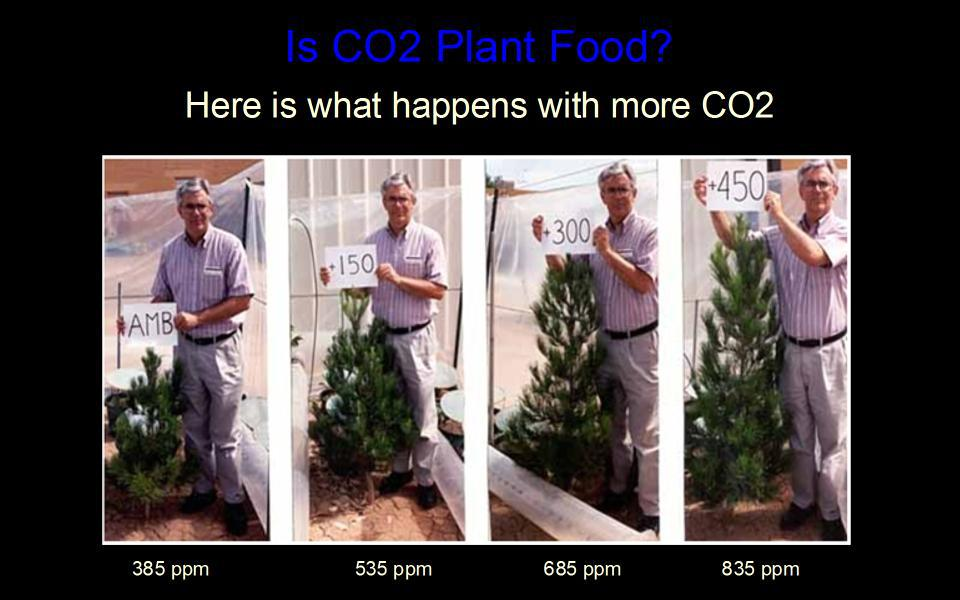
Increasing CO2 in the atmosphere increases the amount of food that plants produce, a phenomenon called “fertilization.” Thousands of experimental results demonstrate that more CO2 usually increases the amount of food that plants produce.46 A graphic illustration of the response of plants to increases in CO2 is shown below. Dr. Sherwood Idso grew Eldarica (Afghan) pine trees with increasing amounts of CO2 in experiments, starting with an ambient CO2 concentration of 385 ppm. He showed what happens when CO2 is increased from 385 ppm to 535 ppm, 685 ppm and 835 ppm over 10 years: 47 (Page 18)

The “fertilization” effect varies significantly by type of plant. Dr. Craig Idso reported, “[s]ince the start of the Industrial Revolution, it can be calculated … that the 120-ppm increase in atmospheric CO2 concentration increased agricultural production per unit land area” for various crops ranging from 28% to 70%, and averaging 46%.48 He also reported “CO2–induced activity productivity increase[d]” one of the varieties of rice by 263%,49 and that a 300 ppm increase in CO2 resulted in an average increase of 46%.50

What would happen if CO2 doubled from the current approximately 400 ppm in the atmosphere to 800 ppm? Crop yields worldwide would increase by about 40%, based on empirical findings of how CO2 concentrations affect crop yields.51

What if the Net Zero Theory went into effect now and CO2 does not double to 800 ppm? There would be 40% less food worldwide. Thus, more CO2 means more food for people worldwide. Reducing CO2 to Net Zero means less food for people worldwide, but with only a negligible effect on temperature.

Sylvan Wittwer, the father of agricultural research on this topic, eloquently emphasized the enormous benefits of providing more food to people worldwide by rising CO2:

“The rising level of atmospheric CO2 could be the one global natural resource that is progressively increasing food production and total biological output … The effects know no boundaries, and both developing and developed countries are, and will be, sharing equally.”52

———————–

46 See, e.g., NIPCC, Climate Change Reconsidered II: Biological Impacts (2014); Craig Idso, “What Rising CO2 Means For Global Food Security” CO2 Coalition (2019); Plant Growth Database, Center for the Study of Carbon Dioxide and Global Change.
47 Craig Idso, Increased Plant Productivity: The First Key Benefit of Atmospheric CO2 Enrichment, Master Resource (Apr. 21, 2022).
48 Nongovernmental International Panel on Climate Change (NIPCC), Climate Change Reconsidered II: Biological Impacts (2014) p. 322.

49 Craig Idso, Estimates of Global Food Production in The Year 2050: Will We Produce Enough to Adequately Feed the World?, p. 31 (2011).
50 Craig Idso, The Positive Externalities of Carbon Dioxide, CO2 COALITION (2013) p. 3 (discussed in Wrightstone, supra, p. 19).
51 One of the authors (Happer) explained that experiments with CO2 fertilization show that many crop yields increase by a factor x with adequate water and other nutrients, where x is the ratio of the current CO2 ppm level to the former level. Doubling from 400 to 800 ppm means x = 800/400 = 2, and √2 = 1.41, implying approximately a 40% increase. (Note it would take more than a century for CO2 to reach 800 ppm).
52 Quoted in NIPCC, Climate Change Reconsidered II: Fossil Fuels (2019), pp. 322–23.

The post On the CO2 Fertilization Effect (real science for EPA) appeared first on Master Resource.

via Master Resource

https://ift.tt/lW5QdIo

August 11, 2025 at 01:12AM

BP Defies Ed Miliband to Reopen North Sea Oil Field

From THE DAILY SCEPTIC

by Richard Eldred

BP is reopening the Murlach North Sea oil field for at least ten more years, despite Ed Miliband’s best efforts to halt new fossil fuel projects. The Telegraph has the details.

The energy giant is reviving the Murlach field, which was declared uneconomic and taken out of use in 2004, has now become viable partly due to new technologies.

BP won agreement to reopen Murlach, 120 miles east of Aberdeen, under the previous government and has since been installing equipment, with production potentially restarting next month.

The milestone comes despite efforts by the Energy Secretary to bring an end to new fossil fuel production in the North Sea. Mr Miliband and his predecessors have almost doubled the taxation rate on oil and gas profits and banned the issuing of licences for new exploration and production.

BP said the Murlach field contained 20 million barrels of recoverable oil and 600 million cubic metres of gas – enough to keep it in production for 11 years. “Murlach is expected to produce around 20,000 barrels of oil and 17 million cubic feet of gas per day,” it said.

It means BP can partially reverse the decline in North Sea output, which has seen oil production fall from 96,000 barrels per day in 2020 to 70,000 last year. Gas production has fallen from 221m square feet a day to 197m. …

BP’s success at Murlach follows a similar story at Shell, which restarted production from its Penguins oil field north of Shetland earlier this year – despite Greenpeace protesters boarding its new production vessel.

The field went into production in 2003 but had to be shut down in 2021 when the Brent Charlie production platform was decommissioned. Production restarted this year with Shell expecting 45,000 barrels a day once in full flow.

Worth reading in full.


Discover more from Watts Up With That?

Subscribe to get the latest posts sent to your email.

via Watts Up With That?

https://ift.tt/G47glnu

August 11, 2025 at 12:05AM