
My latest in the Daily Caller.
via JunkScience.com
August 6, 2025 at 02:16AM
“Underlying most arguments against the free market is a lack of belief in freedom itself.” – Milton Friedman
Even since the Great Texas Blackout of February 2021, I have tried to engage classical liberal scholars with the lost tradition of free market electricity in theory, practice, and public policy. An interesting exchange with economist Steve Postrel on social media some months ago is worth preserving, in this regard.
Postrel is very critical of Lynne Kiesling’s uber technical optimism with governmental chess pieces (wind, solar, batteries, another story). But he rejects a free market in electricity.
I reproduce the exchange and then offer a critical comment. It began with my reference to my AIER primer: Free Market Electricity.
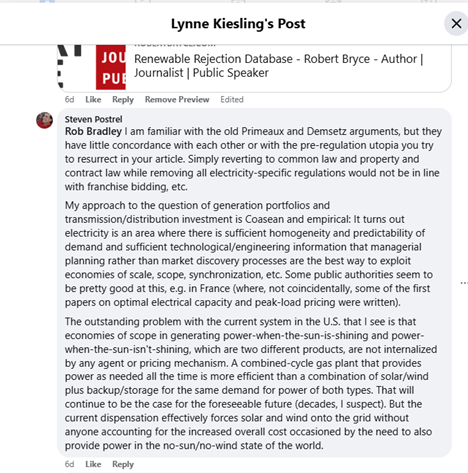
Postrel to Bradley: I am familiar with the old Primeaux and Demsetz [free market] arguments, but they have little concordance with each other or with the pre-regulation utopia you try to resurrect in your article. Simply reverting to common law and property and contract law while removing all electricity-specific regulations would not be in line with franchise bidding, etc.
My approach to the question of generation portfolios and transmission/distribution investment is Coasean and empirical: It turns out electricity is an area where there is sufficient homogeneity and predictability of demand and sufficient technological/engineering information that managerial planning rather than market discovery processes are the best way to exploit economies of scale, scope, synchronization, etc. Some public authorities seem to be pretty good at this, e.g. in France (where, not coincidentally, some of the first papers on optimal electrical capacity and peak-load pricing were written).
The outstanding problem with the current system in the U.S. that I see is that economies of scope in generating power-when-the-sun-is-shining and power-when-the-sun-isn’t-shining, which are two different products, are not internalized by any agent or pricing mechanism. A combined-cycle gas plant that provides power as needed all the time is more efficient than a combination of solar/wind plus backup/storage for the same demand for power of both types. That will continue to be the case for the foreseeable future (decades, I suspect). But the current dispensation effectively forces solar and wind onto the grid without anyone accounting for the increased overall cost occasioned by the need to also provide power in the no-sun/no-wind state of the world.”
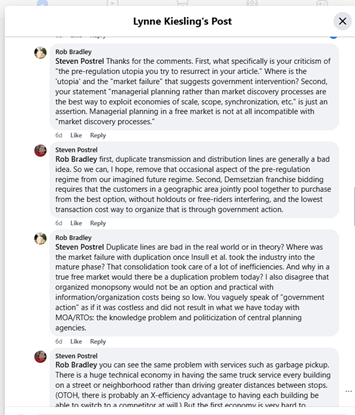
Bradley to Postrel: First, what specifically is your criticism of “the pre-regulation utopia you try to resurrect in your article.” Where is the ‘utopia’ and the “market failure” that suggests government intervention? Second, your statement “managerial planning rather than market discovery processes are the best way to exploit economies of scale, scope, synchronization, etc.” is just an assertion. Managerial planning in a free market is not at all incompatible with “market discovery processes.”
Postrel to Bradley: First, duplicate transmission and distribution lines are generally a bad idea. So we can, I hope, remove that occasional aspect of the pre-regulation regime from our imagined future regime. Second, Demsetzian franchise bidding requires that the customers in a geographic area jointly pool together to purchase from the best option, without holdouts or free-riders interfering, and the lowest transaction cost way to organize that is through government action.
Bradley to Postrel: Duplicate lines are bad in the real world or in theory? Where was the market failure with duplication once Insull et al. took the industry into the mature phase? That consolidation took care of a lot of inefficiencies. And why in a true free market would there be a duplication problem today? I also disagree that organized monopsony would not be an option and practical with information/organization costs being so low. You vaguely speak of “government action” as if it was costless and did not result in what we have today with MOA/RTOs: the knowledge problem and politicization of central planning agencies.
Postrel to Bradley: You can see the same problem with services such as garbage pickup. There is a huge technical economy in having the same truck service every building on a street or neighborhood rather than driving greater distances between stops. (OTOH, there is probably an X-efficiency advantage to having each building be able to switch to a competitor at will.) But the first economy is very hard to achieve without government coercion to pool all the buildings into a single buying group.
Bradley to Postrel: I see the duplication problem with renewables, both in generation and in transmission, but why is this a ‘market failure’ that electricity entrepreneurs cannot handle via alertness and contracts? We are talking about lines and poles and not ‘tearing up the streets’ with natural gas or water or other services. Single provider service over a certain geographical area makes a lot of sense in electricity, and I await a ‘market failure’ argument in theory or history about why vertical and horizontal integration is not efficient and a great way to avoid all the problems of politics/intervention.
Comment
I am not at all convinced that Postrel is giving a true free market in electricity a fair hearing. I challenge his cavalier dismissal of pre-regulation history (in my paper) as being “utopian.” [1] The old duplication/market failure argument does not hold on close inspection, and I challenge him to empirically show otherwise.
He rejects the free market with this argument (emphasis added): “… electricity is an area where there is sufficient homogeneity and predictability of demand and sufficient technological/engineering information that managerial planning rather than market discovery processes are the best way to exploit economies of scale, scope, synchronization, etc.“
Electricity is a unique product, which free market entrepreneurs understood and tamed with vertical integration over some or several control areas. Franchise regulation then locked-in geographical regions, which a market discovery process without public-utility regulation would reveal. Economies of scale and the need for perfect reliability were conquered in a fascinating example of entrepreneurial alertness and necessity-is-the-mother-of-invention.
A market discovery process in a real free market would redefine the industry and the firms within it. Economies of scale and scope would determine vertical and horizontal integration. Utility management would be less political and more entrepreneurial. Investors would demand new things.
Finally, why would a free market provider not be consumer-oriented with politics demoted? Should consumers be dissatisfied, how would investors react? But yes, in our new age of low transaction costs, third party entrepreneurs could well step in to negotiate ‘global settlements’ for large groups of consumers (“ratepayers”). I disagree with Postrel; Demsetz’s bargaining could have more life today than when he wrote in the 1960s.
———————————–
[1] “Rob’s snide reference to my ‘chess pieces’ is a reference to my unwillingness to agree with his Utopian dismissal of ISO/RTO organized wholesale markets.” (- Kiesling to Vernon Smith, here)
The post Postrel vs. Free Market Electricity: Exchange and Comment appeared first on Master Resource.
via Master Resource
August 6, 2025 at 01:07AM
From NOT A LOT OF PEOPLE KNOW THAT
By Paul Homewood
EV sales remain stuck at around 21%, well below the ZEV mandate of 28% for this year:
It is hard to see what carmakers can do now to shift the dial, especially as the target goes up to 33% next year.
The Government still does not seem to have got the message that for the vast majority of drivers, EVs are not fit for purpose. Very few want to buy them now, and there is no reason to think anything will change anytime soon.
Carmakers will doubtless roll their deficits against ZEV targets forward to next year, but this is sillier than taking out a payday loan!
Subscribe to get the latest posts sent to your email.
via Watts Up With That?
August 6, 2025 at 12:05AM
In a just-released report, the International Renewable Energy Agency (IRENA) claims that renewable energy is the most cost-competitive source of new electricity generation worldwide, The report further claims that “91% of new renewable power projects commissioned last year were more cost-effective than any new fossil fuel alternative” based on levelized costs, which can be thought of as the energy equivalent of a fixed mortgage.
If those claims sound too good to be true, it’s because they are. IRENA’s boasts ignore a fundamental reality: the intermittent electricity generated from wind and solar is fundamentally different than electricity generated by traditional generating resources that are not subject to the whims of the weather.
In the U.S., the Energy Information Administration (EIA) makes the same mistake. The EIA claims that wind and solar will account for the lion’s share of new generating capacity for the next decade and will provide electricity at a lower levelized cost than any traditional resource, including new natural gas generators.
But the episodic nature of wind and solar power has critical impacts on both supply adequacy and cost, which, while recognized by some, are nonetheless not incorporated into how bottom-line data. Traditional coal, natural gas, nuclear, and hydroelectric generating plants can be scheduled to run when needed. Some of them, especially nuclear and most coal plants, are designed to operate continuously and are referred to as “baseload” facilities. Others, especially natural gas plants, can quickly be turned on or off (“dispatched”) to match changes in demand. Collectively, traditional generation can be both scheduled and dynamically managed, enabling the operators of electric grids to reliably meet demand at the lowest cost.
The inherent intermittency of wind and solar reduces the physical and economic value of their capacity relative to traditional generating resources, as sufficient reserves or storage must be maintained to meet demand when they are unavailable. Merely reporting total wind and solar capacity misleads because it does not account for the adequacy of the electrical energy generated to meet demand and the actual costs to do so.
Here’s an analogy. Imagine that a city and its citizens are offered two types of buses for commuting. One is with new buses and free fares. However, these run only one-third of the time, are often unpredictable, and are less likely to show up on bad-weather days. If you wait for one of these new free buses but it fails to show up, you must suffer the inconvenience of having to take a relatively expensive Uber ride, which can cost even more on busy or bad-weather days. Meanwhile, the other option is to pay a modest fare (say, one-tenth of an Uber ride) on a conventional bus—but one that’s reliable, regardless of weather. Over a year of commuting, the total costs for the “free” bus service are likely to be much higher and the value much lower than commuting on the conventional bus service.
In the context of electric grids, Uber rides represent the cost of either backup generating capacity or battery storage to compensate for wind and solar unavailability. Adding to these costs is the fact that, when electricity demand is greatest—typically, during the early morning and early evening hours—little, if any, solar power will be available. Similarly, meteorological records show that on the hottest and coldest days, there is often little wind. There can also be multiday periods, often lasting days and even a week, when there is little or no wind (a wind drought) and multiple cloudy days when little solar power is generated. Thus, wind and solar are often most available when the electricity they generate has the least value.
Fundamentally, cost and value are not the same thing. Comparing levelized costs, such as fixed mortgage payments for different homes, provides little insight into actual value. For example, a monthly mortgage payment of $2,000 for one house, versus one of, say, $2,500 for another, provides no information about either house’s value in terms of size, location, condition, and so forth. Similarly, the levelized cost doesn’t reveal power plant attributes, especially intermittency. The lowest levelized cost resources may not be the highest-value ones, or even the cheapest ones, when operated over time in the real world.
For electricity planners and regulators to identify the highest true value, they must compare costs and operational benefits. Just like the commuter bus that doesn’t arrive on a rainy morning, intermittent capacity that is unavailable when it is most needed has far lower economic value.
Promoting misleading claims about wind and solar power distorts policymaking and will only exacerbate the growing inadequacy of electric supplies to meet increased demand in the wake of continued electrification efforts. It will lead to more frequent electricity rationing, as the Netherlands has recently imposed.
That may appeal to hairshirt environmentalists, but it won’t appeal to the broader populace, who are likely to express their displeasure at the ballot box.
Jonathan Lesser is a senior fellow with the National Center for Energy Analytics. This piece is adapted from his recent report, “The U.S. Energy Information Administration Needs to Fix How It Reports Renewable Power Capacity.”
This article was originally published by RealClearEnergy and made available via RealClearWire.
Subscribe to get the latest posts sent to your email.
via Watts Up With That?
August 5, 2025 at 08:04PM
 Iowa Climate Science Education