U.S. Offshore Wind: Politics Giveth, Taketh

Ed. Note: The government-enabled on-grid wind and solar industries are on the downside of a political business cycle. The lesson for sustainable entrepreneurship is to meet underlying consumer demand, not rely on special favor from temporary political majorities.

Last Friday, the Daily Caller News Foundation broke an exclusive story that the U.S. had ordered a halt to construction on the offshore Revolution Wind Farm project. The article, “Trump Admin Kills Massive Offshore Wind Project,” announced the Bureau of Ocean Energy Management (Department of Interior.

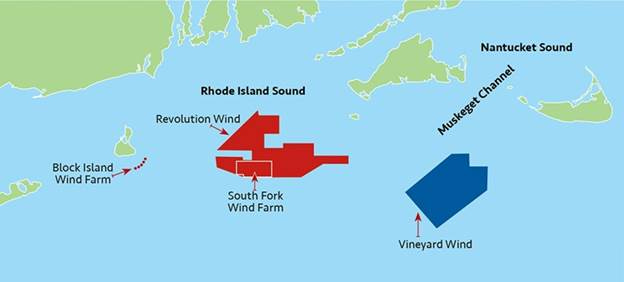
Revolution Wind is a 704-megawatt (MW), 65-turbine wind project located 15 miles south of Rhode Island’s Point Judith port and 32 miles southwest of Martha’s Vineyard. The capacity has been contracted under 20-year power-purchase agreements to utilities in Massachusetts (304 MW) and Rhode Island (400 MW).

A second project (Revolution Wind 2) was rejected by Rhode Island Energy (PPL Corporation) and Rhode Island’s Public Utilities Commission and U.S. Department of Energy staff as too expensive.

The project is located on the federal lease area (OCS-A 0486), which developer Ørsted acquired when it purchased Deepwater Wind LLC, the developer of the Block Island Wind farm and holder of various offshore wind leases, in late 2018 for $510 million.

The locations of significant offshore wind projects.

Construction began on Revolution Wind in 2023, with the installation of the first offshore wind turbine in September 2024. Completion and operation of the project is scheduled in early 2026. Ørsted reported Friday night that the project was 80 percent complete with 45 of 65 wind turbines installed. The project was hailed as the first multi-state offshore wind project in the United States.

The DOI Director’s Order was issued by Matthew Giacona, Acting Director. Compare and contrast his letter with the one issued by Walter Cruickshank on April 16, 2025, ordering stoppage of Empire Wind.

DOI Letters: Empire State vs. Revolution Wind

In the Empire Wind stop-work order, the DOI cited as its reason to freeze work 

to allow time for it to address feedback it has received, including from the National Oceanic and Atmospheric Administration (NOAA), about the environmental analyses for that project. BOEM received this and other feedback regarding Empire Wind as an outgrowth of the review that the Department is engaged in related to offshore wind projects.

In contrast, the Revolution Wind order stated: 

… BOEM is seeking to address concerns related to the protection of national security interests of the United States and prevention of interference with reasonable uses of the exclusive economic zone, the high seas, and the territorial seas, as described in that subsection of OCSLA.

There are two relevant facts and one supposition.

Fact 1: The fact we know about the Empire Wind stop-work order is that, in response to a freedom of information request, the DOI released a 36-page study related to its stop-work decision. The report was titled “Screening Analysis: A Summary of the Record for the Empire Wind Project-NMFS Fisheries Resources.” Twenty-seven of the pages were entirely redacted, a privilege due to the deliberative nature of the report and its role in the review process underway at the time. The public has learned that government agencies are entitled to protect internal studies from public release until final reviews are completed.

Fact 2: With respect to the DOI stop-work order for Revolution Wind, the issue is compliance with Outer Continental Shelf Lands Act (OCSLA) provisions. Consulting firm PLANET A* STRATEGIES℠ studied the compliance of the Bureau of Ocean Energy Management (BOEM) with the provisions of the laws governing the use of our nation’s oceans. The report was titled, Cancelling Offshore Wind Leases with a subheading of “Outer Continental Shelf Lands Act Non-Compliance in Offshore Wind Plant Leasing and Permitting Programs.” Their report was completed in early May, and the findings were presented to the DOI.

Supposition: The supposition relates to the reported agreement between the Trump administration and New York Governor Kathy Hochul for her support in the issuance of previously blocked permits allowing the construction of two natural gas pipelines into the state. That would boost supply to both New York and New England, both of which are short of natural gas supply for generating electricity during the winter months when the gas is diverted to home heating. That shortage causes winter electricity prices in the region to be much higher than during the summer months.

Sunrise Wind Next?

At the time of the Empire Wind stop-work order in April, I predicted the summer would be an interesting period for offshore wind legal activity. So far, so true. Adding to the legal activity, a petition was recently sent to Interior Secretary Doug Burgum requesting a re-examination of the approval of Sunrise Wind, a 924 MW, 84-turbine project. It is located about 19 miles south of Martha’s Vineyard, 30 miles east of Montauk Point, Long Island, and 17 miles from Rhode Island’s Block Island. This is another Ørsted project.

The approval process for Sunrise Wind is being challenged by the former members of the Rhode Island Fishermen’s Advisory Board (FAB), established under legislation regulating the state’s Department of Environmental Management’s review and approval of offshore wind projects that impact the state’s waters.

The complaint demonstrates

… misapplication of section 8(p)(4) of OCSLA and misapplication of NEPA (National Environmental Protection Act), attest to the illegal impacts to the fishing industry that were ignored in permitting the project, attest to the environmental impacts that were ignored in permitting the project, and request that all approvals of the project be rescinded.

Looking Ahead

There is much to come with the above projects given the plight of Ørsted, which is trying to raise $9.4 billion of additional capital to support its ongoing developments.

Offshore wind developers are speaking out about violations of the legal approval process, which have and will continue to harm other legitimate users of the ocean shared with the wind project. As summer winds down, the legal battles over offshore wind are heating up.

The post U.S. Offshore Wind: Politics Giveth, Taketh appeared first on Master Resource.

via Master Resource

https://ift.tt/Ab478Ws

August 25, 2025 at 01:12AM

Britain’s Quixotic Carbon Capture Crusade

From Tilak’s Substack

There is a certain tragicomic quality to Britain’s current climate policy. Having long proclaimed itself a “climate leader” on the world stage, the United Kingdom is now preparing to stake tens of billions of pounds of taxpayers’ money on technologies that have failed everywhere else. At the centre of this quixotic crusade is carbon capture and storage (CCS), with a special emphasis on its most extravagant and least viable variant – direct air capture (DAC). The problem is simple: CCS has an abysmal track record, DAC is even worse and no commercial project anywhere in the world has succeeded in delivering on the promises made with such fanfare.

And yet, here we are.

The Times reports that Energy Secretary Ed Miliband is negotiating with Swiss firm Climeworks to develop Britain’s first DAC plant under the Government’s HyNet cluster. The proposal – code-named Silver Birch – would join a £21.7 billion CCS programme, with £9.4 billion earmarked for just the next four years.

It is worth pausing to consider what Britain is signing up for: paying prohibitive prices per tonne of CO₂ to bury molecules of a trace atmospheric gas essential to photosynthesis under the Irish Sea, with no evidence that the technology can be deployed at scale and with a track record of serial disappointment worldwide.

The Abysmal Record of CCS

CCS has been the subject of countless reports, academic papers and optimistic government pronouncements. Michael Cembalest, Chairman of Market and Investment Strategy for J.P. Morgan Asset & Wealth Management, observed wryly in 2021 that the number of academic papers written on CCS divided by real-life implementation of it yields “the highest ratio in the history of science”.

Despite billions spent in subsidies, tax credits and demonstration projects, the results have been paltry. After two decades of planning and conjecture, by the end of 2020 carbon capture and storage (CCS) facilities stored just 0.1% of global CO2 emissions. Challenges include cost overruns, failure of bellwether projects, the US Department of Energy withdrawing support for demonstration projects, cancellations of projects in Europe, legal uncertainties about liability and a 20%-40% energy cost required to perform CCS in the first place. The UK’s own White Rose project at Drax, intended to capture two million tonnes annually, collapsed when the Cameron government cancelled its £1 billion CCS commercialisation programme in 2015.

Many of the “successes” were not climate mitigation projects at all but simply enhanced oil recovery operations, where CO₂ – typically using CO2 from naturally occurring underground deposits – is pumped into wells to squeeze more hydrocarbons out of the ground. This is pursued as a profitable practice, unrelated to the decarbonisation agenda.

Signature failures in CCS projects abound. The Kemper project in Mississippi, once hailed as a model for “clean coal”, collapsed after costs ballooned past $7 billion. The FutureGen project in Illinois, backed by the US Department of Energy, was cancelled after years of delays and escalating costs. Australia’s Gorgon LNG CCS project, designed to capture up to four million tonnes a year, failed to meet its targets and faced technical challenges and leaks. Even Norway’s Sleipner field, often cited as an exemplar, captures less than a single power station emits and functions primarily because of favourable local geology. Europe’s grand Mongstad CCS plan was abandoned after the Norwegian state auditor called it “an embarrassing failure”.

The most telling statistic: after three decades of effort, no large-scale CCS project exists that operates economically without government subsidy, outside of enhanced oil recovery where profitability drives investment.

Direct Air Capture – Even Worse

If CCS attached to smokestacks has failed, DAC is an exercise in futility. CCS concentrates on capturing emissions at the point of release – power plants, cement factories or steel mills – while DAC aims to pull carbon dioxide directly from the atmosphere. The challenge is obvious. CO₂ in the atmosphere is just 0.04% of the air we breathe. According to a J.P. Morgan report, sequestering 25% of global CO2 through direct air capture would require an astounding 25%–40% of the world’s electricity generation plus 11%–17% of its primary energy.

Climeworks, the world’s leading DAC company and among Fast Company’s “World’s Most Innovative Companies of 2024”, built its Orca plant in Iceland in 2021, designed to capture 4,000 tonnes of CO₂ annually. Its larger Mammoth plant, now under construction, may eventually capture 36,000 tonnes a year – minuscule compared to global emissions of 37 billion tonnes. Even at optimistic estimates of $600 per tonne, the arithmetic collapses. More realistic figures put DAC costs closer to $1,200 per tonne. Compare this with the current EU carbon price of about £60 per tonne – a tenth or even a twentieth of DAC’s cost.

To capture just 1% of global emissions at DAC’s mid-range costs would run to trillions annually and consume an energy budget larger than that of many developed countries.

Britain’s Political Theatre

Why then is the UK pursuing this dead end? The answer lies in the fact that climate-focused virtue signalling and luxury beliefs now dominate elite behaviour. Successive governments, Conservative and Labour alike, have sought to position Britain as a global “climate leader”. Hosting COP26 in Glasgow in 2021, legislating a “Net Zero by 2050” target, and promoting offshore wind as the backbone of green energy were all part of this narrative. Now, CCS and DAC are being folded into the story as evidence that Britain is “doing something” about hard-to-abate sectors such as steel, cement and aviation.

The trouble is that this virtue signalling costs astronomical sums and delivers nothing of value. The HyNet project in Northwest England is projected to capture perhaps 4.5 million tonnes annually by 2030, scaling up to 10 million tonnes. Even if it succeeds – a heroic assumption – that is less than 3% of UK emissions which itself is less than 1% of global emissions. Meanwhile, the cluster will absorb billions in subsidies, increase energy costs for consumers and hand over subsidy-laden contracts to Climeworks or other contenders in the CCS sector.

DAC, the jewel in Miliband’s plan, is worse. Climeworks’ Silver Birch project, if built, would capture at best a few tens of thousands of tonnes per year. That would be the emissions equivalent of taking perhaps 10,000 cars off the road – a rounding error in Britain’s 370-million-tonne carbon footprint. Yet taxpayers are expected to bankroll it at hundreds if not thousands of pounds per tonne, while the EU carbon market (itself a concoction of the climate alarmist establishment in Brussels) says the same ton is worth only £60.

There is something quixotic in all this. Like Cervantes’ knight tilting at windmills, Britain’s leaders are charging headlong at imaginary foes, wasting treasure and deserving ridicule. The pursuit of CCS and DAC is not about rational cost-benefit analysis – it is about symbolism. Britain wants to lead. To lead in what, precisely, is unclear. If the goal is to waste money on technologies with no commercial track record, then yes, Britain is leading.

Interestingly, Dale Vince, Britain’s most high-profile “green” tycoon, has weighed in. Vince, an eco-grifter riding the wave of lavish subsidies for unreliable wind and solar, now dismisses DAC as “ridiculous” and “a million miles off working”. His critique, however, is revealing. Vince does not object to CCS/DAC primarily because it is a costly failure littered with abandoned projects worldwide. Rather, his opposition stems from the fact that CCS and DAC, if they ever worked, would give fossil fuels a longer lease of life — precisely what he most fears. For Vince and his ilk, the goal is not rational energy policy or cost-effectiveness, but the ideological elimination of hydrocarbons altogether, regardless of the consequences.

Europe’s Failures as Warnings

Britain need only look across the Channel to see the folly. Europe has tried and failed at CCS repeatedly. Germany’s Schwarze Pumpe CCS pilot was shut down in 2014 after Vattenfall concluded it was not viable. Norway’s Mongstad project was abandoned after nearly $1 billion spent. Even Northern Lights, Europe’s new CCS flagship, faces serious questions about costs, storage capacity and customer commitments.

These are not teething problems. They are systemic failures rooted in the economics and physics of the technology. CCS is expensive, energy-intensive and operationally fragile. DAC amplifies all these drawbacks. To press ahead regardless, as Britain is doing, is to ignore lessons bought dearly with other people’s money.

Asia Gets in on the Act

Alas, Britain and Europe are not alone in chasing the CCS mirage. East Asia, too, driven by the Japanese and South Korean initiatives in emission mitigation and the Paris Agreement, is joining the fray. Malaysia’s national oil company Petronas has signed MOUs with Japan and South Korea on CCS potential projects using the depleted oil and gas fields offshore peninsular Malaysia, Indonesia and elsewhere in the region.

Singapore has “hub partnership” with ExxonMobil and Shell to collaborate in CCS projects in the Southeast Asian region. Interestingly, these plans have sparked accusations of “carbon colonialism” from climate activists, who see exporting emissions for storage in another country as a “get out of jail free” card for continued fossil fuel use.

To be sure, East Asia is not the EU. While “Net Zero” and the Paris Agreement are real considerations among policymakers in the region, most countries are unapologetically reliant on fossil fuels for their economic growth and energy security needs. Shortly after President Trump assumed office and exited the US (a second time) from the Paris Agreement, Indonesia’s special envoy for climate change and energy Hashim Djojohadikusumo said not unreasonably that he considered the Paris Agreement no longer relevant for Indonesia following the US withdrawal from the deal.

The implementation of CCS projects in East Asia will ultimately depend on the extent to which governments are willing to underwrite them with subsidies, much as what the EU and the US governments did in the past two decades. Given the litany of failures in CCS projects in the West, perhaps the lessons learnt will not go completely to waste in the planning ministries in Tokyo, Seoul and Singapore.

Tilting at Windmills

The UK’s great gamble on CCS and DAC is not leadership but delusion. After decades of global failure, with no commercial project demonstrating viability, a Britain in steep economic decline is prepared to lavish over £20 billion on burying carbon dioxide underground. And all of this is premised on the still-untested dogma that carbon dioxide is the world’s “climate control knob”.

The recently published US Department of Energy report, authored by five eminent scientists, has challenged precisely this orthodoxy, questioning the IPCC’s alarmist literature and highlighting the deep uncertainties in climate sensitivity to CO₂. Meanwhile, NASA’s own satellite data show a greening of the earth over recent decades, with higher atmospheric CO₂ acting as a natural fertiliser for plants. If anything, modest CO₂ increases is likely a net benefit for agricultural productivity and ecosystems.

The US Department of Energy (DOE) under Secretary Wright recently announced the termination of 24 funding awards from its Office of Clean Energy Demonstrations (OCED), totalling over $3.7 billion in taxpayer-funded financial assistance, primarily for carbon capture and sequestration (CCS) and decarbonisation projects.

The Trump administration’s pragmatic stance on “energy dominance” cuts through the fog: CO₂ has economic value if deployed for enhanced oil recovery where it supports greater hydrocarbon output. No subsidies are required. The market dictates the costs and benefits, as it should. Outside of that, in the view of Energy Secretary Chris Wright and EPA Administrator Lee Zeldin, pouring US taxpayers’ money into CCS is little more than virtue signalling dressed up as policy.

Future historians may indeed view this era not as the moment humankind rose to the “climate challenge”, but as one where governments squandered resources tilting at an imaginary enemy, vilifying a trace gas that sustains plant life, while ignoring the real challenges of energy security, economic growth and prosperity.

Britain’s CCS crusade championed by the climate zealot Ed Miliband, far from being a mark of leadership, may ultimately stand as a cautionary tale of how “climate leadership” ambitions and economically-illiteracy can override both science and economics.

The article was first published in The Daily Sceptic https://ift.tt/6z9iufU


Discover more from Watts Up With That?

Subscribe to get the latest posts sent to your email.

via Watts Up With That?

https://ift.tt/PAL0zH5

August 25, 2025 at 12:04AM

No, WCAX 3, Owning a Dog Is NOT a “Wrong Climate Choice”

From ClimateREALISM

By Linnea Lueken

Vermont’s WCAX 3 news station, posted an article from the Associated Press (AP) titled “People often make wrong climate choices, a study says. One surprise is owning a dog,” in which the writers claim that owning a dog is bad for the climate because they are meat eaters. This is completely misguided. Meat eating does not have an inordinate impact on the global climate and studies show that dog ownership can be beneficial to peoples’ mental health – an important consideration in a period where the media coverage of climate change is stoking climate-fear-related anxiety and mental health issues.

The post summarizes points from a recent study from the National Academy of Sciences, which looked at survey participants’ beliefs when it came to the impact of their individual efforts to “fight” climate change. Participants apparently ““weren’t very accurate when assessing how much those actions contributed to climate change, which is caused mostly by the release of greenhouse gases that happen when fuels like gasoline, oil and coal are burned.”

Aside from the point that it is very much not an established fact that most climate change is caused by human use of fossil fuels or is dangerous, it is interesting that the study ranks some very intrusive climate efforts as low-impact. Those included things like using energy efficient appliances and lightbulbs, and recycling. Those individual efforts are things that the U.S. government has pushed for decades, imposing burdensome regulations on consumers and appliance manufacturers alike, as well as hijacking public school classes to promote the merits of recycling.

Associated Press’ writers claim that that the three actions that “help the climate” most are avoiding flying, using renewable electricity, and “choosing not to get a dog.”

These three items were consistently underestimated by study participants as effective mitigating climate change, at least according to the authors. The most offensive is probably the claim that dog ownership is particularly harmful to the planet.

The article claims that because dogs are carnivores, they are a significant contributor to climate change since “farm animals, which will become food, release methane, a greenhouse gas that contributes to climate change.” They claim that beef is a particular problem on that front.

According to the U.S. Environmental Protection Agency (EPA) it is simply false to claim cattle raising is a significant contributor to emissions, let alone global climate change.

The EPA reports that livestock as a whole contribute 3.9 percent of the United States’ greenhouse gas emissions, and cattle by themselves contribute just 2 percent.

Figure 1. Greenhouse gas emissions by sector in the United States. Note that beef production is less than half of the entire livestock sector, at just 2 percent. Source: Data from U.S. Environmental Protection Agency. Graphic by Anthony Watts. Artwork icons in graphic licensed from 123rf.com.

Figuring out what proportion of that beef is then turned into pet food in general and dog food specifically is almost impossible, but it would seem safe to assume it’s very minimal, especially since most commercial dog foods outside of specialty brands are made with animal byproducts that might otherwise go unused. Check the ingredients listed on the label of most dry and canned dog food and you’ll find that even when beef is an ingredient and listed first, it makes up a small portion of the overall content of the food.

Climate Realism has covered discussed methane a lot, but it is worth re-iterating, especially as the media and climate alarm machine target man’s best friend. Methane itself is yet another trace gas, and while it does play a role in the atmosphere’s energy balance, it does not stay in the atmosphere for nearly as long as other gases like carbon dioxide, and much of its ability to trap heat is already covered by water vapor, which plays a much stronger role.

paper written by physicists William Happer, Ph.D., of Princeton University and W. A. van Wijngaarden, Ph.D., of Toronto’s York University, says that “the contribution of methane to the annual increase in forcing is one tenth (30/300) that of carbon dioxide.”

So whatever percentage of cattle emissions result from your dog eating beef-based food, or even all the dogs in the country, they still have such a miniscule impact on any warming, it can hardly be taken seriously as an “underestimated” contributor to climate change.

Besides all of that, climate alarmists probably should think about getting a dog (if they are responsible enough) because having a dog in particular is known to reduce anxiety, which, as Climate Realism has covered, climate alarmists seem to suffer inordinately from. Repeated studies show that pet ownership in general, and dog ownership in particular can reduce stress and anxiety. Thus, a canine companion can help fight the mental illnesses and anxiety that the daily torrent of false stories claiming that human-caused climate change is destroying the planet is generating in some people. Owning a dog can be doubly effective in shoring up mental health, if those alarmed about climate change come to recognize the fact that dog ownership is not hurting the planet.

The AP, WCAX 3, and the study authors are not accurately portraying the true state of the planet. They certainly have no place talking anyone who wants to own dog out of doing so, at least not as a means of preventing climate change.


Discover more from Watts Up With That?

Subscribe to get the latest posts sent to your email.
via Watts Up With That?

https://ift.tt/68nFIBK

August 24, 2025 at 08:03PM

The UN’s Krazy Kangaroo Klimate Kourt

Countries, companies, “deniers” and especially poor families are in the daffy court’s crosshairs

Paul Driessen

Vanuatu and other “climate vulnerable” island nations claim they are threatened by rising seas and worsening typhoons caused by fossil fuel use. In response to an emotional petition from them and law students at the University of the South Pacific, the United Nations General Assembly presented a resolution to the UN’s International Court of Justice (ICJ or World Court), asking two questions:

* What obligations do countries have under the Kyoto and Paris Climate Agreements or other international laws to protect Earth’s climate from carbon dioxide and other greenhouse gas emissions?

* What legal consequences do (developed) countries face if they fail to abide by those laws and thus cause serious harm to the climate system and vulnerable communities?

The ICJ held hearings in December 2024 and (unsurprisingly) in July 2025 ruled formally, or declared in open court, that:

* Greenhouse gas GHG) emissions are “unequivocally caused by human activities,” and are not confined by territorial boundaries” but are distributed throughout the atmosphere, thereby affecting Earth’s entire climate system.

* The “climate crisis” is likewise “unequivocally” serious and caused by human activities. Indeed, manmade climate change is an “existential problem of planetary proportions,” a “universal risk” to all nations, a dire threat to “all forms of life and the very health of our planet.”

* “A clean, healthy and sustainable environment” is a “human right.”

* Member states (excluding China, India and other “emerging economies”) have a “duty” to prevent climate change, and failure of a state to “take appropriate action to protect the climate system … may constitute an internationally wrongful act.”

The Court’s pronouncements of legal and scientific expertise demonstrate yet again that the ICJ offers little more than politicized caricatures of law and justice – this time as a krazy kangaroo klimate kourt.

Americans should be grateful that the ICJ ruling is nonbinding; advisory only, and the United States officially withdrew from the ICJ’s compulsory jurisdiction over UN member nations in 1986.

Climate cultists will nevertheless demand obeisance to ICJ findings and dictates by the USA and other nations, and the ICJ decision and language will undoubtedly be cited in legal actions before their courts.

The lawsuits will almost certainly include demands for billions or trillions of dollars in climate change “prevention” funds, “reparations” for past and ongoing damages, and money for “adaptation measures” that “victimized” countries will have to take to minimize horrific damage from climate changes caused by developed nations. They will also likely demand an end to fossil fuels and petrochemicals, despite our needing them to power vehicles, generators, furnaces and factories, and manufacture 6,000 petrochemical products, including solar panel, wind turbine, transformer, battery and electric vehicle components.

The ICJ rulings raise endless issues and underscore the court’s propensity for vapid, ignorant analysis.

Greenhouse gases (GHGs) certainly arise from human activities and become part of the global atmosphere. However, they are also the product of natural processes, like forest fires and vegetative and animal decay. The most important GHG is water vapor (~1-4% of the atmosphere), though climate activists never mention it. Other GHGs are minuscule components and play minor roles in climate and weather: eg, carbon dioxide (0.04%) and methane 0.0002%).

The only places climate change is a “crisis,” an “existential problem of planetary proportions,” or a “dire threat” to people and planet are in climate cult computer models, fearmongering and press releases.

Actual historic records, empirical data and ongoing measurements show no planet-wide or even national increases in the frequency or intensity of hurricanes, tornadoes, floods, droughts, sea level rise, forest fires or other catastrophes. They do show crops, grasslands and forests growing better, faster and with less water, as atmospheric CO2 levels and global temperatures increased.

A true dire threat to humanity and nature would be another ice age. The Pleistocene Era’s mile-high glaciers bulldozed and buried everything for thousands of miles south of the Arctic, dropped sea levels by hundreds of feet, and replaced countless plant and animal species with new cold-weather varieties. The Little Ice Age (~1300-1850) brought floods, storms, famines and disease to Europe and Asia.

How could Vanuatu have survived the 400-foot rise in sea levels since the last Ice Age, including a foot since 1900, but now is threatened by 1-2 feet more over the next century or two?

The blunt reality is that the World Court cannot decree that a “climate crisis” is being “unequivocally” caused by fossil fuels and other human activities – any more than Spanish Inquisitors could decree that the sun revolves around our planet. Science doesn’t work that way.

Under the scientific method, a theory like catastrophic manmade climate change (nee global warming) must be supported by empirical evidence (not hype or models) – or it must be rejected.

Not only is there no “settled” climate science. What we now know demonstrates that we face no crisis, and the supposed “green” energy cure for this non-crisis would be far more devastating to humanity, wildlife and planet than any climate calamities alleged to be threatening us.

But the UN and Climate Industrial Complex cling so desperately to manmade climate cataclysm claims (and the money and power those claims generate) that they want to criminalize climate “misinformation, disinformation, misrepresentation, denialism and greenwashing” – which the UN, ICJ and nation states would define, prosecute and penalize.  

Any lawsuit claiming a “human right.” to a “clean, healthy, sustainable environment” falsely assumes that developed nations can actually control Earth’s climate and fulfill their “duty” to prevent both natural and human-caused climate change, for whatever climate exists wherever the litigants live.

It must ignore harms from eliminating fossil fuels, reliable coal- or gas-based electricity and 6,000+ products made from petrochemicals. It must dismiss the fact that those life-enhancing products and other modern technologies were created and manufactured by the very countries they now vilify and blame.

The lawsuits must also assume that “clean” wind, solar and battery technologies will magically arrive once the coal-oil-gas era ends – and will not involve mining and processing, toxic pollution, child and slave labor, and ecological destruction from blanketing vast areas with wind, solar and transmission installations. They must ignore the disease and death from the blackouts and reduced living standards and medical services that inevitably come with that unreliable energy.

This “human right” proclamation also presumes that people will have no desire – and no human right – to act and live outside the dictates of UN, ICJ or other ruling elites regarding: what foods they may eat; what homes they may live in, and how warm or cool they may keep them; where, how, how far and how often they may drive or fly; and what they are permitted to read, think and say about any of this, without running afoul of Disinformation Police.

This International Court of Justice is the height of arrogance, tyranny and injustice for the vast majority of the world’s people. They should simply ignore the court and this daft opinion. In fact, the entire UN is well past its “Best by” date.

Paul Driessen is senior policy analyst for the Committee For A Constructive Tomorrow (www.CFACT.org) and author of books and articles on energy, climate change, economic development and human rights.


Discover more from Watts Up With That?

Subscribe to get the latest posts sent to your email.

via Watts Up With That?

https://ift.tt/hNEw9W1

August 24, 2025 at 04:09PM