Assigning Responsibility for the Tragic Los Angeles Fires

By Jim Steele

First understand Southern California is naturally dry. Its Mediterranean climate means it rarely rains in the summer and has a limited winter rainy season. Three deserts in the region attest to its dry climate.

As a result, the vegetation around Los Angeles primarily consists of one-hour fuels that can dry in as little as 60 minutes, including dead grasses, leaves and pine needles, and 10-hour fuels that include dead small branches, 1/4 inch to 1 inch in diameter. Able to retain moisture but briefly, this material is essentially kindling.

While a rainstorm can make the vegetation temporarily fire resistant, as soon as the rains stop, the drying process begins. Dead grasses and twigs can become highly flammable within 12 to 24 hours. Due to natural climate oscillations like El Nino, in contrast to this dry year, the previous year’s above-average rains increased the amounts of combustible 1-hour and 10-hour fuels

Los Angeles’s rainy season runs December through February, but the monthly average is only 6 days with rain. Thus, there are usually about 24 dry days during each winter month when vegetation quickly becomes flammable. The length of the natural summer drought or the timing of the winter’s first rain are immaterial to the fundamental aridity of Southern California.

While climate alarmists like Michael Mann blame the fires on global warming, December dryness is not unusual. In fact, the January 9th fires were preceded by a 30-day trend of increasing rainfall, but that obviously was not a factor.

Furthermore, the winter rainy season coincides with the time of the Santa Ana winds. The winds originate in the cold high deserts and blow down the mountainside to the warmer ocean. As they descend, the winds warm and dry further, typically with a relative humidity below 10% that rapidly dries out the vegetation.

When determining the safety of a prescribed burn, the U.S. Department of Agriculture considers there to be a 100% chance of fires spreading when relative humidity is 25% or less. Little wonder that the National Weather Service warned of dangerous conditions when weather systems lined up to amplify the dry winds. The strongest Santa Anas in a decade were predicted.

The region’s last big fire – the December 2017 Thomas Fire – was ignited when Santa Ana winds caused electrical wires to spark.

Knowing that natural, lethal fire dangers are always looming for the growing population, the question is whether city and state governments could have been better prepared to minimize ignitions and more efficiently contain a fire’s spread through southern California. When fires reach neighborhoods with densely packed houses, one burning structure can radiate enough heat to ignite adjacent buildings causing entire neighborhoods to burn to the ground.

Accordingly, ordinances to create a defensible space around homes were enacted in recent decades to keep the height of grass and native brush less than 3 inches within 200 feet of a building. Roofs on new buildings and replacements must be fireproof. But how well such ordinances have been followed is not clear. Nor is it clear if adequate brush management was maintained in adjacent public lands to slow the spread of fire into populated areas. In any case, the flames reached enough homes to cause entire neighborhoods to be destroyed.

In a surreal landscape, flames dance among towering palm trees, transforming the scene into an apocalyptic vision

The cause of the wildfire ignitions has yet to be determined, but it is absolutely certain it wasn’t due to lightning strikes. During high winds, downed electrical wires are frequent sources of ignitions and likely suspects. However, somewhat unique to large cities like Los Angeles, fires related to homelessness have increased, rising to 13,909 fires in 2023 and doubling since 2020. Those fires sometimes originated with fires that were set to keep warm. But arsonists caused others, such as one of LA’s conflagrations, the Kenneth Fire.

In addition to ineffective policies to address homlessness, many believe government spending priorities have exacerbated the fire threat. For example, LA has increased expenditures on services for the homeless to $1.3 billion.  In contrast, budgets for fire prevention were reduced by LA mayor Karen Bass and Governor Newsome by $18 million and $100 million, respectively.

Finally, water-management policies may have also hurt the ability to contain fires, as several hydrants ran out of water. The Santa Ynez Reservoir in Pacific Palisades was dry and off-line. Could money cut from fire-prevention budgets have been used to install more water storage tanks to offset reduced reservoir supplies? Should governments have increased budgets to build more reservoirs. Could systems using ocean water to stop such devasting fires be investigated?

Climate alarmists like Michael Mann claim it is the increase of CO2 causing drier conditions that correlates with bigger fires. But the data do not support his fearmongering.

An increase in the destruction of property by wildfires better correlates with population growth and the expansion of an electrical grid that is vulnerable to high winds. Increased 1-hour fuels and 10-hour fuels due to land disturbances and poor land management correlate with bigger fires. Increased homeless populations correlates with more ignitions.

Blaming climate change for these disasters only deflects attention away from actual causes. Fabrications linking rising CO2 to wildfires should be ignored. Governments must employ solutions that will truly protect people and their property from the unstoppable, natural conditions enabling devastating fires.

James Steele is a biologist, author and former director of San Francisco State University’s Sierra Nevada Field Campus. He is a member of the CO2 Coalition.


Discover more from Watts Up With That?

Subscribe to get the latest posts sent to your email.

via Watts Up With That?

https://ift.tt/DiZQ1vf

January 14, 2025 at 12:01PM

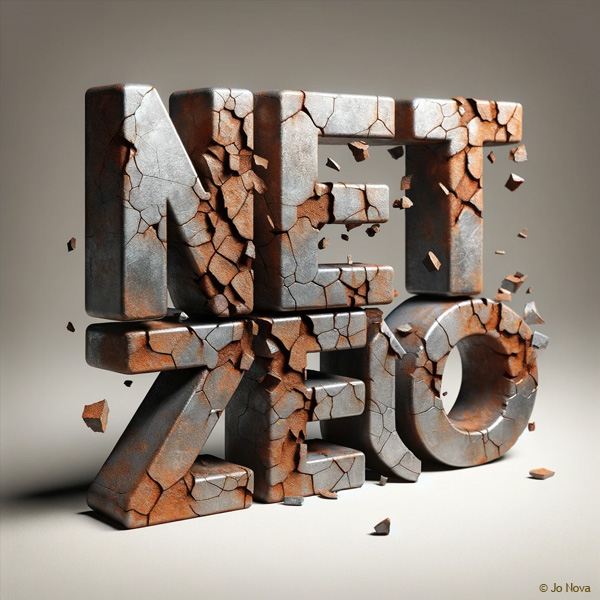
The race to Not Zero: the beginning of the end of the climate delusion picks up speed…

By Jo Nova

Savor the moment. Donald Trump says he wants no wind farms built during his Presidency, and before we can even crack the champagne , the AFD in Germany say if they are elected, they don’t just want to stop people building new wind plants, they want to tear some of the old ones down.

That’s what we like to see, some competition…  Who can get to Not Zero the fastest?

By Bloomberg

Bloomberg) — President-elect Donald Trump said Tuesday he would seek to have a policy of having no wind farms constructed during his second term, threatening billions of dollars in planned wind projects.

“We are going to have a policy where no windmills are being built,” Trump said during a lengthy tirade against wind power during a press conference at his Mar-a-Lago resort in Florida.

Trump, who has vowed a first day executive order targeting wind farms, has long made no secret his disdain for the energy source. But his remarks Tuesday represented the sharpest threat yet from the incoming president.

By MarketWire

Far-right German poltical party Alternative für Deutschland (AfD) wants to tear down all wind turbines, according to the party’s candidate for chancellor, Alice Weidel. “Down with all these windmills of shame,” she said at a party congress on Saturday in the eastern German town of Riesa, according to Bloomberg News.

Germany will hold Bundestag elections on Feb. 23, and AfD is in second place in the latest polls with 20-22% of eligible voters.

This was later clarified by the AfD to say they urgently want to shut down the Reinhardswald turbines. This is the wind park in the 1,000 year old forest of legend in Germany — the sacred greenery that only an money-hungry industrial vandal would want to despoil with giant bird killing towers.

The main question every Western nation needs to get a grip on — is it cheaper to wait for wind turbines to reach the end of life while paying for batteries, flywheels, hydropower, gas storage, interconnectors, plus pandemonium, extra maintenance on your essential infrastructure, and possible blackouts, or to pay out the current wind contracts, and throw a Farewell party?

Obviously, since wind turbines make reliable generators more expensive and inefficient to run and drives the good ones out of business, clearly, the sooner the better. Do it while you still have a grid.

Do it while you still have an economy….


0 out of 10 based on 0 rating

via JoNova

https://ift.tt/Tl6IrCy

January 14, 2025 at 11:01AM

President Trump gets it on wind

The incoming President made clear in a Mar-a-Lago press conference just how thoroughly in sync he is with CFACT’s position on wind turbines.

via CFACT

https://ift.tt/N51ke94

January 14, 2025 at 09:21AM

7000 Year Old Trees Uncovered High Up In The Rockies

By Paul Homewood


A melting patch of ice in the Rockies is uncovering trees that were growing 7000 years ago:


 image

Significance

Recent warming has decreased snow and ice cover and increased the elevation of most subalpine treelines around the world. A mid-Holocene (c. 5,950 to 5,440 cal y BP) whitebark pine forest preserved within a perennial ice patch in the Greater Yellowstone Ecosystem provides insights into the consequences of past climate change and ecosystem dynamics. Mid-Holocene treeline expanded ~180 m above its modern elevation when warm-season temperatures were similar to mid-to-late-20th-century conditions. Treeline elevation was subsequently lowered due to periods of cooling related to increased volcanism, but primarily from declining summer insolation during the late Holocene. As current ice-patch temperatures exceed the warmest mid-Holocene conditions, we expect regional loss of ice patches and possibly renewed upslope treeline expansion.

Abstract

Climate-driven changes in high-elevation forest distribution and reductions in snow and ice cover have major implications for ecosystems and global water security. In the Greater Yellowstone Ecosystem of the Rocky Mountains (United States), recent melting of a high-elevation (3,091 m asl) ice patch exposed a mature stand of whitebark pine (Pinus albicaulis) trees, located ~180 m in elevation above modern treeline, that date to the mid-Holocene (c. 5,950 to 5,440 cal y BP). Here, we used this subfossil wood record to develop tree-ring-based temperature estimates for the upper-elevation climate conditions that resulted in ancient forest establishment and growth and the subsequent regional ice-patch growth and downslope shift of treeline. Results suggest that mid-Holocene forest establishment and growth occurred under warm-season (May-Oct) mean temperatures of 6.2 °C (±0.2 °C), until a multicentury cooling anomaly suppressed temperatures below 5.8 °C, resulting in stand mortality by c. 5,440 y BP. Transient climate model simulations indicate that regional cooling was driven by changes in summer insolation and Northern Hemisphere volcanism. The initial cooling event was followed centuries later (c. 5,100 y BP) by sustained Icelandic volcanic eruptions that forced a centennial-scale 1.0 °C summer cooling anomaly and led to rapid ice-patch growth and preservation of the trees. With recent warming (c. 2000–2020 CE), warm-season temperatures now equal and will soon exceed those of the mid-Holocene period of high treeline. It is likely that perennial ice cover will again disappear from the region, and treeline may expand upslope so long as plant-available moisture and disturbance are not limiting.

https://www.pnas.org/doi/10.1073/pnas.2412162121

The paper incorrectly claims that recent warming is a new phenomenon, but provides no data to back this up.

However many tree line studies have conclusively shown that tree lines in the Rockies were much higher than now as recently as the Middle Ages.

Scan_20250114

HH Lamb : Climate, History and the Modern World

via NOT A LOT OF PEOPLE KNOW THAT

https://ift.tt/Xl2ehoL

January 14, 2025 at 08:44AM