“global climate phenomena, not regional temperature variations”

“Lisa J. Graumlich, who examines the ring patterns of foxtail pine trees and western junipers in the Sierra Nevada, has compiled a detailed record of the year-to-year variation in temperature and precipitation over the last thousand years.

She has seen in the North American trees the feathery but unmistakable signatures of the Medieval Warm Period, a era from 1100 to 1375 A.D. when, according to European writers of the time and other sources, the climate was so balmy that wine grapes flourished in Britain and the Vikings farmed the now-frozen expanse of Greenland; and the Little Ice Age, a stretch of abnormally frigid weather lasting roughly from 1450 to 1850. A Crucial Question

“We can now see that these were global climate phenomena, not regional temperature variations,” she said. “The question is, how did we get those warmer temperatures during pre-industrial times, and what can we learn from those conditions about what is going on today?”

By her analysis, the 20th century has seen more exaggerated swings in moisture than during any comparable period in the last millennium. She and others at the laboratory are particularly concerned because the tree rings clearly declare that in the Western United States, the years 1937 through 1986 have been abnormally wet compared with past centuries — and these are the years of the greatest immigration to the supposedly golden coastal states.”

In Unexpected Places, Clues to Ancient and Future Climate; Warming? Tree Rings Say Not Yet – The New York Times

About Tony Heller

Just having fun

This entry was posted in Uncategorized. Bookmark the permalink.

via Real Climate Science

https://ift.tt/uvi4cbx

January 11, 2025 at 03:53AM

UK’s coldest January night in 15 years


The UK has experienced a “particularly long cold spell” says a Met Office meteorologist, with nights becoming “progressively colder” unlike previous years with a short cold snap. Not exactly what we were led to believe by climate models that the advance of global warming, supposedly due to assorted human activities (industry, transport, power generation, farming etc.), was going to deliver.
– – –
Temperatures in a hamlet in northern Scotland dropped to -18.7C on Friday – the UK’s coldest January night in 15 years, reports BBC News.

The mercury in Altnaharra, which is in the most northern region of the Highlands, plummeted at around 22:00 GMT, the Met Office said.

It is the coldest January overnight temperature since 2010, when temperatures dropped below -15C several times at locations across the UK, including -22.3C on 8 January in Altnaharra.

The average low in northern Scotland for this time of year is about 0.3C, while for England, overnight lows are about 1.5C to 1.6C.
. . .
Meanwhile, the UK Health Security Agency (UKHSA) has extended its cold weather health alert for all of England until Tuesday.

Amber alerts have been extended and will now run until 14 January, meaning a rise in deaths, particularly among those aged 65 and over or with health conditions, is likely, the agency said.
. . .
What is forecast for the weekend?
Much of the UK endured below freezing temperatures into Saturday morning, with -11C recorded in Shap, Cumbria, and Heathrow recording -5C.

Met Office meteorologist Alex Deakin said: “Friday night into Saturday morning may well be the nadir of this current cold spell.”

Saturday is forecast to be cold too, and Met Office meteorologist Zoe Hutin said “it will be mainly eastern parts that see temperatures dropping widely below freezing, so East Anglia, the north-east of England, northern and eastern Scotland as well.”

High pressure is set to build across the UK over the weekend, leading to a significant thaw of snow and ice by Sunday and ushering in a warmer start to the new week.

Temperatures will slowly start to recover across western fringes of the UK, with central and eastern parts still likely to remain cold on Saturday and Sunday.
. . .
The UK has experienced a “particularly long cold spell”, Ms Hutin said, adding: “It has been getting progressively colder each night this week, whereas looking at previous years, we’ve had maybe two or three days where things have been particularly cold.”

Full report here.
– – –
Image: BBC weather forecast

via Tallbloke’s Talkshop

https://ift.tt/fh07exc

January 11, 2025 at 03:48AM

“Western landscapes in presettlement era were very smoky places.”

“In Unexpected Places, Clues to Ancient and Future Climate; Warming? Tree Rings Say Not YetDec. 1, 1992

Fires also leave revealing scars in the tree tissue, and if enough trees in a wide enough region prove to bear fire scars at the same time, researchers can guess the year was extremely dry, for aridity invites a blaze’s spread. Studying fire marks in giant sequoias, Thomas W. Swetnam and co-workers have discovered that major conflagrations sweeping across many mountain ranges in California and the Southwest were a long a common feature, occurring at least twice a decade and apparently linked to oceanic currents much farther south, the so-called La Nina events that often result in droughts.

“Finding this synchronicity in fire events was a big surprise to us,” he said. “It tells me that Western landscapes in presettlement era were very smoky places.”

But by the end of the 19th century, settlers seeking to carve out grazing terrain for their livestock had cleared away much of the forest undergrowth that had served as fodder for the fires, and oscillating fire cycles became a thing of the past. So, too, did the long-term vitality and diversity of many forests, and park and wilderness managers are now seeking Dr. Swetnam’s advice on how to recapitulate, in a controlled manner, the synchronous infernos of the past. “We made the forests safe for cattle,” said Dr. Swetnam, “and now we must make them safe for fires once again.”

In Unexpected Places, Clues to Ancient and Future Climate; Warming? Tree Rings Say Not Yet – The New York Times

Climate Reanalyzer

About Tony Heller

Just having fun

This entry was posted in Uncategorized. Bookmark the permalink.

via Real Climate Science

https://ift.tt/NDjK5vL

January 11, 2025 at 03:38AM

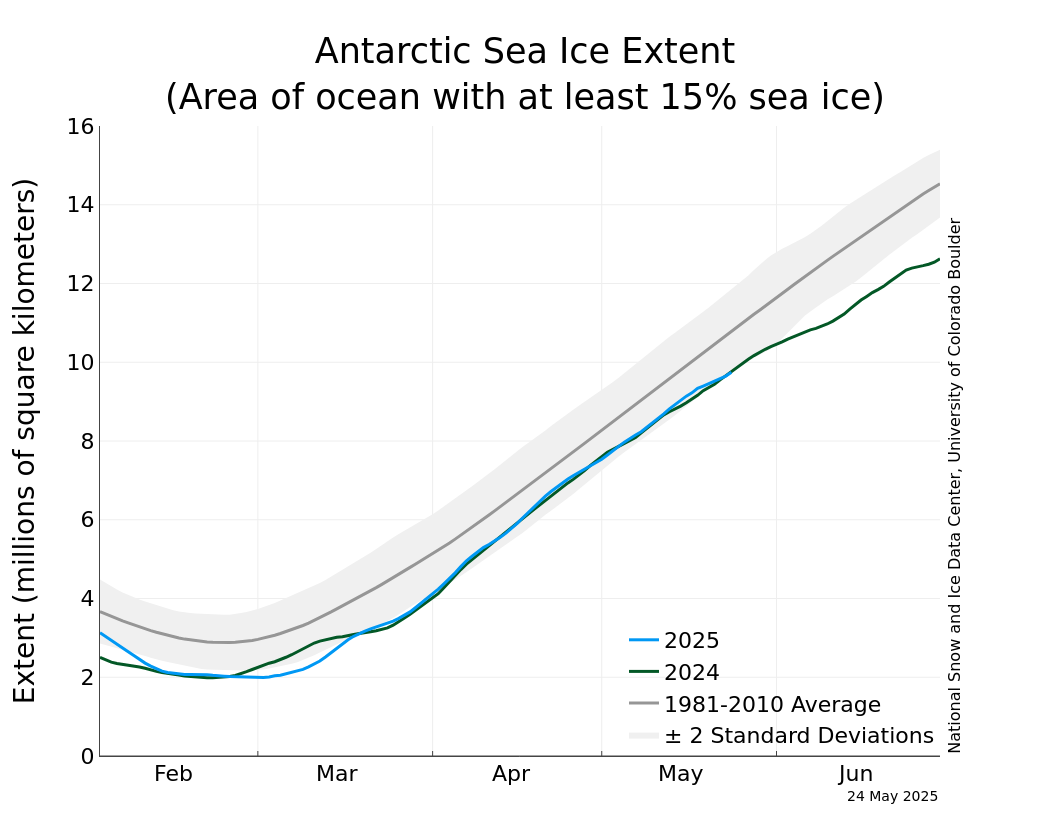
Antarctic Sea Ice Recovery Not Reported In MSM

By Paul Homewood


Chris Morrison unpacks the latest Antarctic sea ice data:


 image

Remember all that alarmist guff about Antarctica sea ice recording lower levels in winter a couple of years ago? Georgina Rannard of the BBC wrote a story headed ‘Antarctic sea ice at “mind-blowing” low alarms experts‘, while Clive Cookson at the Financial Times gave us his suggestion that the area “faces a catastrophic cascade of extreme environmental events… that will affect the climate around the world”. The scare story caravan has moved on to pastures new these days, not unrelated to the fact that at the end of 2024 the extent of sea ice in Antarctica was roughly the same as the 1981 to 2010 average. According to the U.S.-based National Snow and Ice Data Centre (NSIDC), “this provides a sharp illustration of the high variability of Antarctica sea ice extent”. It does indeed, and it also provides us with a classic case study of how a short-term natural variation, well understood by many scientists, is weaponised by activists in science, politics and journalism to induce mass climate psychosis with the aim of promoting the political Net Zero lunacy.

Read the full story here.

And here is the NSIDC confirmation:

https://nsidc.org/data/seaice_index

via NOT A LOT OF PEOPLE KNOW THAT

https://ift.tt/SUtrm6y

January 11, 2025 at 03:00AM