Complacency at the Climate Change Committee

Listening to the PM programme on BBC radio 4 this evening, I was somewhat taken aback by an interview conducted by Evan Davis. His interviewee was Emma Pinchbeck, the recently-appointed Chief Executive of the UK’s Climate Change Committee (CCC). As Cliscep readers will know, the CCC is charged under the Climate Change Act (CCA) with monitoring the UK government’s progress in moving the country to net zero, and it also produces “carbon budgets” on a regular basis, with a view to guiding the government of the day in achieving its legally-binding obligations under the CCA. The seventh carbon budget is due to be published next month, and I have already written about the hell that it is likely to unleash on an unwitting UK public.

This evening the producers of PM, Radio 4’s flagship evening news and current affairs programme, seem to have decided to conduct a gentle interview with Ms Pinchbeck and to allow her to get away with a number of statements which – while not actually untrue – when taken together provided what I consider to be a very misleading impression of the road to net zero. Perhaps as alarmingly, I think the whole interview demonstrated significant complacency on the part of the CCC, or at least on the part of its Chief Executive. I won’t comment, by and large, on what annoyed me, save in one case where the misleading impression is just too significant for me to allow it to pass without comment. See how many statements you can find cause to disagree with. The interview is transcribed below (it starts just after 38 minutes in, here):

Evan Davis (ED): Now, 2024 – the year just gone – was the first year ever that wind power in this country became the single biggest source of electricity, overtaking gas. In fact, it was barely even close: 82,000 Gwh of electric power wind-gnerated – 82,000. 73,000GWh of gas-powered electricity. If you’re interested in where our electricity comes from for 2024, the league table goes – wind, gas, and then some way behind, imports, via connectors overseas, often from France, and then British nuclear. Those four make up the vast bulk of our electricity. Incidentally, that’s all about the generation of electricity. We also had some other figures today, on electric cars, and guess what? Britain overtook Germany last year to become Europe’s biggest market for electric vehicles – 382,000 battery-powered cars. That was up 20% on the year before. Germany had a massive fall, at a 27% fall last year. Let’s just talk about electricity, and wind in particular, with Emma Pinchbeck, the Chief Executive now of the independent [sic] Climate Change Committee, which advises government on climate change plans and net zero. And Emma was also Chief Executive of Energy UK till she got this job. Emma, is wind now always going to be the biggest source of our power now it’s sort of tipped over gas last year? Is that it now, for the foreseeable?

Emma Pinchbeck (EP): That’s a good question, about whether we’ll see the same this year coming. What we do know is wind is going to be the dominant source of power in our electricity system over the next decades, and whilst there’ll be some variation as the system changes, the story in the 2030s and beyond is that wind will be our big dominant source of electricity.

ED: What do we do about the windless days? Now they, I mean, obviously, it’s out in the sea [er, a lot of it isn’t] isn’t it, so I mean, how worried are you by the fact that it’s just not a very reliable supply all year round?

EP: I’m not very worried, but that’s largely because the National Grid aren’t very worried, and they’re the people whose job it is to keep the lights on. And that’s for a few reasons – firstly, wind in the time that I’ve been working has become much more reliable, in the sense that the wind turbines are bigger; as you said they’re out at sea, where there’s a lot more wind; they tip over at the slightest breath of wind, and that means that they can come on in more conditions. Secondly, we’ve got technologies available to complement and now, you mentioned gas, in the long run we’ll have to carbonise [sic] gas from the system to complement wind, but also things like nuclear, storage, other energy technologies. And lastly we’ve got smart technologies on the system now and better ability to predict things like weather patterns, which means we’re more able to run all those technologies together across the system. And all of that combined means that wind isn’t just good for climate change, in my current job, but in my last job, in the energy industry, when we were talking about it, it’s the cheapest, best way of running the energy system overall, so having a clean energy system is now a secure and cheap energy system.

ED: Yup. Tell me about that word “cheap”, because the one thing it doesn’t seem is that electricity, I don’t think you could say electricity is cheap, and I think we’re paying perhaps more for it than most other countries. I think from the tables I’ve seen, and it’s often very difficult to compare with complicated rates and the like, but, I mean, when do we get this so-called cheap, cheap electricity from, you know, home-grown sources, and all the stuff that’s been promised?

EP: Yeah, I’m very aware that when I come on the radio and tell people that electricity is cheap, and that wind is cheap, at a time when the price cap is going up again, it might feel counter-intuitive or that I’m simply making it up, but actually it’s largely the difference between what you’re paying on your bill, and the electricity at source in generation point is to do with policy choices and market design, and what the Committee have advised government to do is our top recommendation over the previous years, is to make electricity cheaper. And our primary recommendation within that is they move some of the policy costs put on electricity, off electricity, so around 20% of the price of electricity on the bill is, are, down to policy costs, and that ultimately is a political regulatory choice we would like to see changed.

ED: And if you burn gas directly – you burn it in your heating, for example – you pay less tax on that, less environmental levy on that gas you burn directly than if a power generator burns gas and puts it into the electricity grid?

EP: Yes. And the energy market is complicated. We could also talk about the fact, for example, that electricity prices still track the gas price, which means that while gas has been at record levels, electricity costs have also gone up. But I suppose the overall message people should take away is these new technologies are cheap, renewable electricity is cheap, passing that on to consumers should be a priority of government, and it’s certainly been a priority recommendation for the Committee.

ED: Do you need subsidies to get people to put wind out into the ocean? I mean, are we still giving guaranteed prices, Contracts for Difference, I mean is it still effectively underpinned by some kind of subsidy?

EP: Yes, we underpin it with a price guarantee from government through the Contract for Difference mechanism. Now, the good news about that is it operates as a sort of price control, in that when prices go above it and generators are making money, more money than expected, they pay back to government; when it goes underneat that, the government tops it up. The reason having a consistent price has helped for when you’re building giant skyscraper-sized wind turbines out at sea, is a lot of the funders of that in construction think that it’s still quite risky, and having a long-term business plan where you can talk to them about what the returns are like over twenty years helps them lock private inward investment. Overall, particularly through the period of the crisis those projects were paying back to the consumer, and of course having wind on the system avoids imported gas, which – particularly through the gas crisis – really helped with bills, and it, in the long run this should be a cheaper way of doing it even with the policy support in place.

ED: All right. Emma Pinchbeck, from the Climate Change Committee, on that fact that wind is the biggest source of our electric power. Thank you for that.

I quite like Evan Davis as an interviewer. He’s polite, clear (always a help when transcribing interviews) and pretty good generally at getting to the heart of an issue. However, I have to say that was a very soft interview, where in my opinion Emma Pinchbeck really should have been pushed a lot harder on many of her claims. I said at the outset that I would take issue only with one particularly egregious part of the interview, so I will – I will leave you, dear reader, if you are so minded, to comment below as to the bits that bothered you.

For me, the spin put on the Contracts for Difference subsidies was the most annoying part of the interview. Emma Pinchbeck said that “[o]verall, particularly through the period of the crisis those projects were paying back to the consumer…”. Now I don’t believe that is true. They paid back only in 2022. Overall, the wind energy companies have received, and continue to receive, massive taxpayer subsidies (by the way, I love the fact that she said projects were “paying back to the consumer”, but that when payments went to the energy companies, they were paid by the government, not the consumer – where does she think the government gets its money from?). Great PR-speak. It’s just like the way costs are never costs, but are always described as investments.

As it happens, Net Zero Watch has today issued a press release about the Contracts for Difference scheme, and they say:

…subsidies paid to renewables under the Contracts for Difference (CfD) scheme hit new highs in 2024. The previous record, of just under £2.3 billion, was set in 2020. That figure was surpassed in the last few weeks of the year, and, by the time the full year’s data is available, the total is likely to hit £2.4 billion…

…The Office for Budget Responsibility is expecting subsidies under several other schemes – the Renewables Obligation Scheme, the Capacity Market, and the Warm Home Discount – to also break records in 2024–25.

The press release is accompanied by a graph, which demonstrates pretty conclusively that only in 2022 did the taxpayer receive a payment from the wind companies under the CfD scheme, and that the refund was less than the payments made to the wind companies in every other year. Worse than that, in most years, the taxpayer has shelled-out substantially more than that single years’ paltry refund and those payments are now reaching record levels.

One last point – at the end, when there was no time to pursue the issue further, the best she could do in answer to the question about why our electricity bills are so high, was to opine that in the long run this should be a cheaper way of doing it. That’s hardly a ringing endorsement.

via Climate Scepticism

https://ift.tt/96hOsZo

January 6, 2025 at 02:04PM

Sorting (Again) Climate and Weather Changes

Brian C. Joondeph asks in his American Thinker Article When Did Changing Weather Become Climate Change? Excerpts in italics with my bolds and added images.

What’s the difference between weather and climate? Let’s ask the expert class, the governmental National Weather Service.

Weather is defined as the state of the atmosphere at a given time and place, with respect to variables such as temperature, moisture, wind speed and direction, and barometric pressure.

Climate is defined as the expected frequency of specific states of the atmosphere, ocean, and land, including variables such as temperature, salinity, soil moisture, wind speed and direction, and current strength and direction. It encompasses the weather over different periods of time and also relates to mutual interactions between the components of the earth system (e.g., atmospheric composition, volcanic eruptions, changes in the earth’s orbit around the sun, and changes in the energy from the sun itself).

That’s a mouthful, a typical governmental explanation. Simply put, weather is short-term, meaning days or a few weeks, while climate is long-term, meaning years, centuries, or longer. [Comment: I prefer a baseball analogy: Weather is like the batter swinging in the box, and climate is the batting statistics, hits, walks, RBIs etc.]

It’s sunny and unseasonably warm where I am today, but a week ago, it was snowy and unseasonably cold. A climate warrior might label the former as global warming, the latter as global cooling, or the composite as climate change. A rational person would call it weather.

The United Nations (UN) defines climate change,

Climate change refers to long-term shifts in temperatures and weather patterns. Such shifts can be natural, due to changes in the sun’s activity or large volcanic eruptions. But since the 1800s, human activities have been the main driver of climate change, primarily due to the burning of fossil fuels like coal, oil and gas.

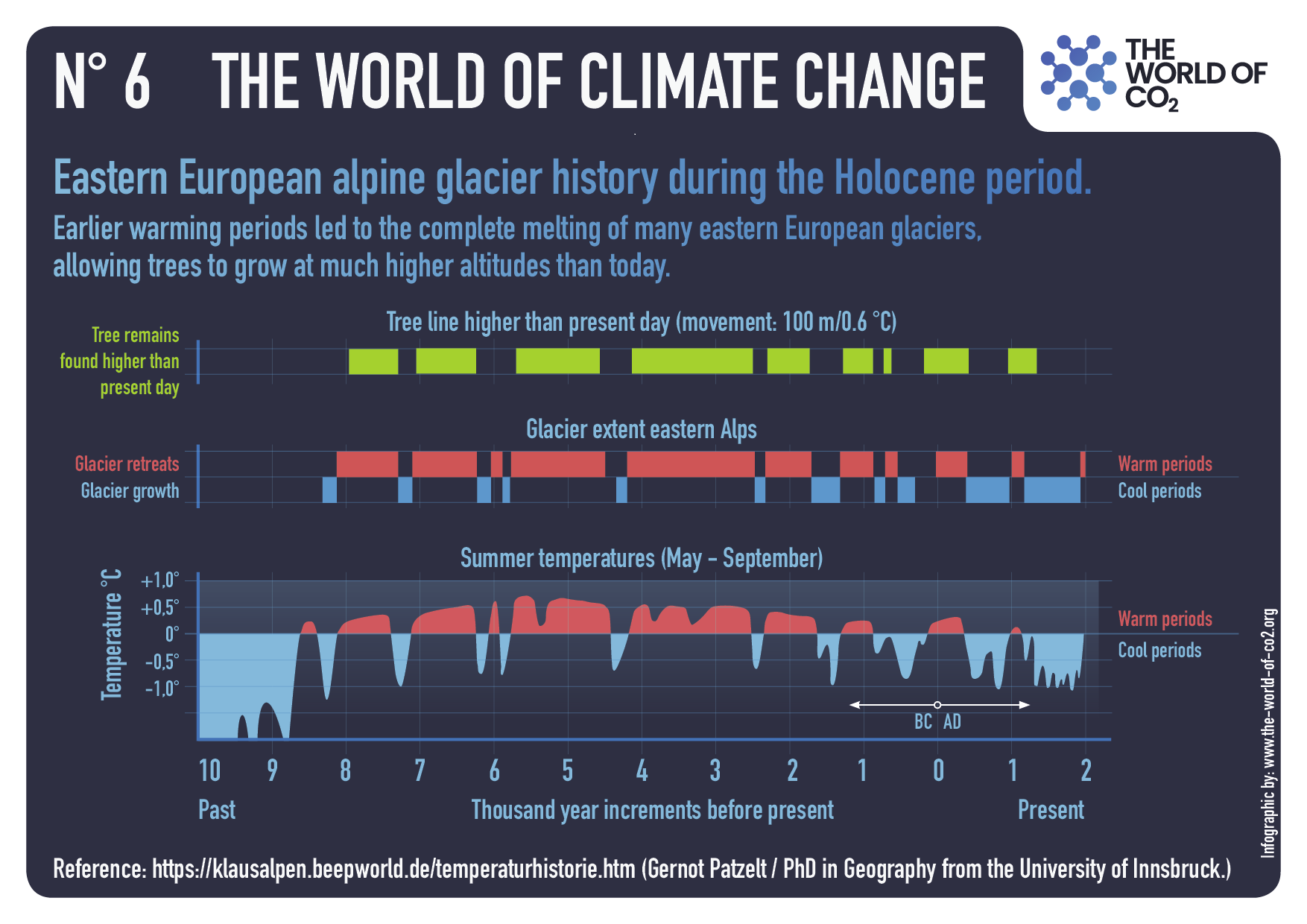
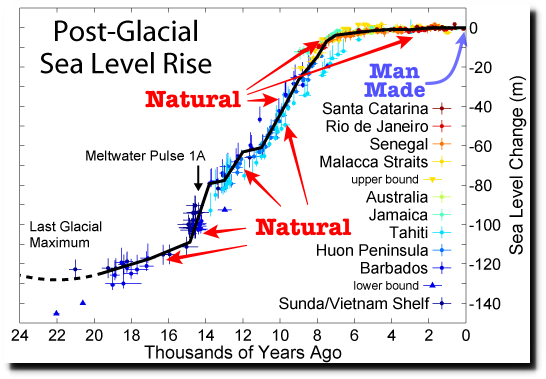
The first sentence is undeniably true. The Great Lakes were once covered by mile-thick ice sheets that disappeared when the glaciers retreated 10,000 years ago. This is not long ago, considering the Earth’s 4.5 billion-year age.

Somehow, the climate cooled and warmed long before any significant human activity existed. And how many additional times did this happen in the past 4.5 billion years?

But the UN believes humans are the “main driver of climate change” since the 1800s, not explaining how climate changed so drastically 10,000 years ago to melt a mile-thick ice sheet during a time of minuscule human activity.

The UN relies on the Intergovernmental Panel on Climate Change (IPCC), that reports in a scary fashion,

Many of the changes observed in the climate are unprecedented in thousands, if not hundreds of thousands of years, and some of the changes already set in motion—such as continued sea level rise—are irreversible over hundreds to thousands of years.

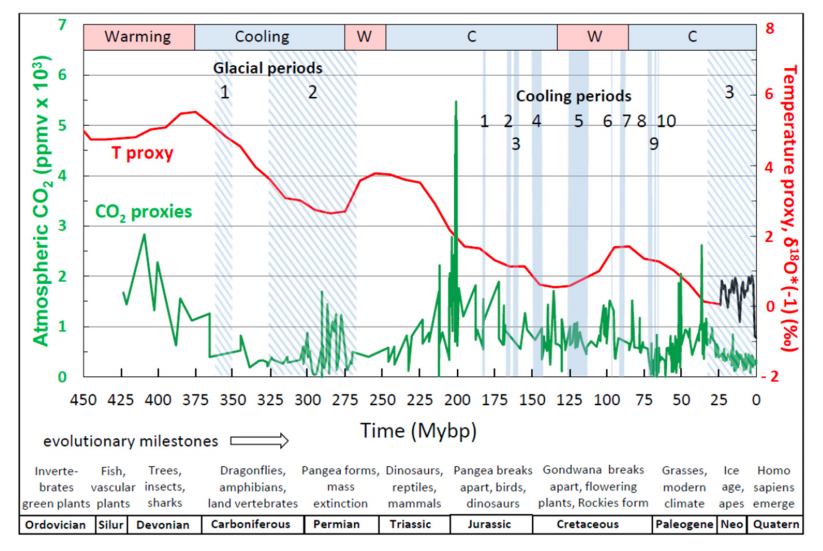
Is today’s climate “unprecedented”? Do they know the temperatures hundreds of thousands of years ago? They should, as this data is readily available, published in the prestigious journal Science.

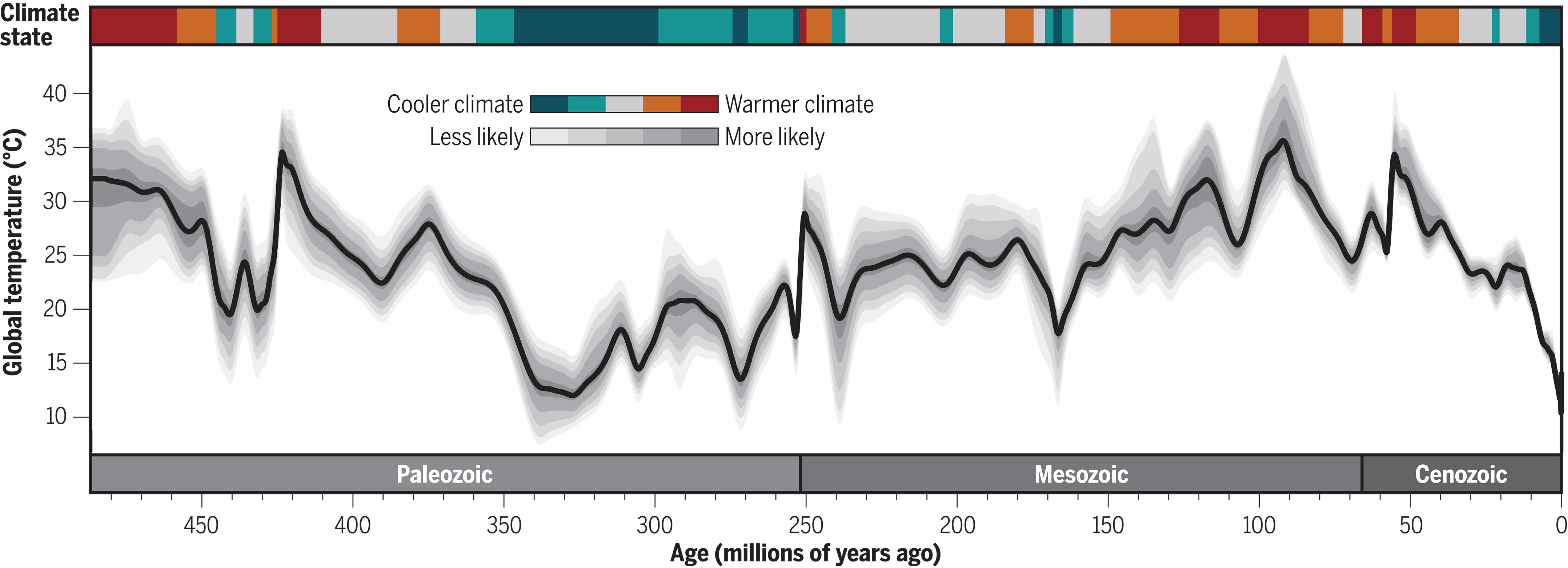
Researchers reconstructed global mean surface temperature using data assimilation, integrating geological data with climate model simulations. They discovered that “the Earth’s temperature has varied more dynamically than previously thought.”

PhanDA global mean surface temperature across the last 485 million years. The gray shading corresponds to different confidence levels, and the black line shows the average solution. The colored bands along the top reflect the climate state, with cooler colors indicating icehouse (coolhouse and coldhouse) climates, warmer colors indicating greenhouse (warmhouse and hothouse) climates, and the gray representing a transitional state. Source: Judd et al 2024

Today’s global temperature is low. It was last this cold 300 million years ago. According to the chart, Planet Earth has been cooling for the past 50 million years. Any man-made warming would be helpful now.

Scientists should know better, as should corporate media.
But obviously, they don’t.

I reference a few articles from this year in The Guardian, a two-hundred-year-old British newspaper considered a “newspaper of record in the UK” (along with the London Times), much like The New York Times in America. As a British newspaper, the Guardian has observed climate change firsthand, reporting on it cooling, then warming, then cooling again.

Another record is the recent (in geological terms) history of the Thames River. Between 1309 and 1814, it froze at least 23 times. There was a “frost fair” in 1608 when the river froze for over six weeks.

What caused this freeze? London’s activity in the 1600s was mainly overcrowding, disease, and crime, not air conditioners, internal combustion engines, and backyard grills.

More recently, the river froze over in 1963 and again partially in 2021. This seems to be normal cyclic climate change, far from the “man-made global warming” the UN and IPCC warn about.

The Guardian ran two stories this year without a bit of irony. In February of this year, their headline was “What will Spain look like when it runs out of water? Barcelona is giving us a glimpse.” In October, the new headline was “Spain floods: number killed passes 150 as scientists say climate change ‘most likely explanation’ – as it happened.”

From running out of water to flooding, all within a few months. It’s dry, then it’s wet. It’s cold, then it’s warm. And vice versa. It’s also normal. But The Guardian wants it both ways. It’s all climate change, in their view.

A month ago, the paper wrote, “Spain’s deadly floods and droughts are two faces of the climate crisis coin.” In other words, all forms of weather are climate change.

CNN wants it both ways, too. In December 2023, it ran a headline, “Winter is here, but it’s losing its cool.” One year later, without a bit of irony or introspection, it reversed itself with this headline, “It’s about to get dangerously cold, even for winter.”

Much like racism, when everything is considered racist, then nothing is. The same is true for climate change. Psychologists call this confirmation bias,

People display this bias when they select information that supports their views, ignoring contrary information, or when they interpret ambiguous evidence as supporting their existing attitudes. The effect is strongest for desired outcomes, for emotionally charged issues, and for deeply entrenched beliefs.

It is also hubris to believe that we can predict, much less control, the climate. The IPCC readily admits, “The climate system is a coupled non-linear chaotic system, and therefore, the long-term prediction of future climate states is impossible.”

Yet Al Gore, Greta Thunberg, John Kerry, and other “climate experts” claim to know exactly how many years it will be until the Earth is uninhabitable.

Speaking of Al Gore, I recommend Joel Gilbert’s new film, “The Climate According to AI Al Gore,” where Joel interviews an AI Gore, debunking Gore’s conviction, expertise, and the entire climate emergency of the left.

To the fearmongering, climate-catastrophizing left, it’s all humans’ fault, and with ever-increasing command-and-control diktats, rules, regulations, and taxes, we can affect forces beyond our comprehension and control.

The climate is indeed changing—it always has and always will. Temperatures will likely rise from their current 500 million-year low regardless of what the so-called experts, activists, or any world government agencies say or do.

In their attempts to regulate and tinker with Mother Nature, they may inadvertently destroy everything they are attempting to save—unless that’s the plan.

Previous Post: Corrupting Climate and Weather

An article at The Spectator raises the question Do alarmists know the difference between weather and climate?  The author Charles Moore may also be a man for all seasons like Sir Thomas More.  Excerpts in italics with my bolds and images.

A lot of clever people are putting the ‘green’ into ‘greenbacks’

Until recently, those expressing skepticism about climate change catastrophe have been hauled over the coals (or the renewables equivalent) for not understanding the difference between ‘climate’ and ‘weather’. The lack of global warming at the beginning of the 21st century was not to be taken, chided the warmists, as evidence that climate change was not happening. Weather was the passing phenomenon of each day: climate was the real, deep thing.

Now, however, the alarmists themselves have elided the two concepts, using the Australian bush fires as their cue. As Sir David Attenborough puts it: ‘The moment of crisis has come’. They could be right, of course, but how could they really know? In this sense, President Trump is surely justified in warning, at Davos, against the ‘Prophets of Doom’. Prophecy is a different skill from an exact understanding of the here and now.

Mr Trump might usefully have talked about the Profits of Doom too. If the movement can persuade western society that the climate emergency is upon us, there are enormous sums to be made by people who claim to be able to remedy it. Hence the patter now coming out of companies such as Blackrock, BP or Microsoft, fanned by Mammon’s public intellectuals, such as Mark Carney. A lot of clever people are putting the ‘green’ into ‘greenbacks’. A lot of less clever investors are going to get their fingers burnt.

See Also Stoking Big Climate Business

Footnote:  Case in Point:  Green Fraudsters Plead Guilty

Jeff Carpoff, 49, of Martinez, pleaded guilty today to conspiracy to commit wire fraud and money laundering. His wife, Paulette Carpoff, 46, pleaded guilty today to conspiracy to commit an offense against the United States and money laundering. According to court documents, between 2011 and 2018, DC Solar manufactured mobile solar generator units (MSG), solar generators that were mounted on trailers that were promoted as able to provide emergency power to cellphone towers and lighting at sporting events. A significant incentive for investors were generous federal tax credits due to the solar nature of the MSGs.

The conspirators pulled off their scheme by selling solar generators that did not exist to investors, making it appear that solar generators existed in locations that they did not, creating false financial statements, and obtaining false lease contracts, among other efforts to conceal the fraud. In reality, at least half of the approximately 17,000 solar generators claimed to have been manufactured by DC Solar did not exist.

“By all outer appearances this was a legitimate and successful company,” said Kareem Carter, Special Agent in Charge IRS Criminal Investigation. “But in reality it was all just smoke and mirrors — a Ponzi scheme touting tax benefits to the tune of over $900 million. IRS CI is committed to investigating those who take advantage and impact the financial well-being of others for their own personal gain.”

“The Federal Deposit Insurance Corporation, Office of Inspector General (FDIC-OIG) is pleased to join our law enforcement colleagues in announcing these guilty pleas,” stated Special Agent in Charge Wade Walters for the FDIC OIG San Francisco Regional Office. “The defendants conspired with others to create a fraudulent business venture that duped unsuspecting entities, including banks, to invest approximately $1 billion, which the two later used to support a lavish lifestyle.

Source:  https://wattsupwiththat.com/2020/01/27/dc-solar-owners-plead-guilty-to-largest-ponzi-scheme-in-eastern-california-history/

via Science Matters

https://ift.tt/qUyF2om

January 6, 2025 at 12:34PM

The Little Fish That Could

Opinion by Kip Hansen — 7 January 2025 – 750 words/3 minutes

“Swim Swim Swim.  Blub Blub Blub. The little fish swam along the river.  He was a happy little fish.”

And this little fish was very proud.  All by itself, just by swimming along in the Little Tennessee River, the happy little fish stopped the creation of the Tellico Reservoir – for six long years. 

This is one of the seminal stories of the great Environmental Movement of the 1970s .    And one of the many stories of the destructive overreach of the United States’ Environmental Protection Agency.

The Snail Darter, then Percina tanasi  was claimed by the EPA to be an Endangered Species.   It was listed on October 9, 1975 for the specific purpose of preventing the completion of the Tellico Dam which was claimed to present a threat to the continued existence of the Snail Darter —  if the dam was built the Snail Darter would go extinct. 

Years of legal challenges, all the way to the Supreme Court,  delayed the completion of the dam.  Finally,   legislative efforts resulted in President Jimmy Carter signing  a bill that exempted the Tellico Dam from the Endangered Species Act on September 25, 1979.   The bill, proposed by Senator Howard Baker, exempted the Snail Darter from the provisions of the Endangered Species Act (ESA).  

The episode is discussed in a Wiki article Snail darter controversy – I have no idea how accurate the article is or if it is biased in any particular direction.   Only now, fifty years later, do the real facts become known.

It was suspected at the time that the listing of the snail darter under the ESA was a political move to placate the growing Environmental Movement in the United States.  Many activists left without a cause with the ending of the U.S. involvement in Viet Nam had quickly realigned themselves with environmentalism, within a few years following Earth Day in 1970.  Challenging the building of a major new dam in Tennessee gave them something to fight against.

Fast forward to earlier this week, to January 03, 2025,  and the publication of Comparative species delimitation of a biological conservation icon;  Otto et al. 2025.

As explained in the New York Times:

“On Friday, a team of researchers argued that the fish was a phantom all along.”

“There is, technically, no snail darter,” said Thomas Near, curator of ichthyology at the Yale Peabody Museum.”

“Dr. Near, also a professor who leads a fish biology lab at Yale, and his colleagues report in the journal Current Biology that the snail darter, Percina tanasi, is neither a distinct species nor a subspecies. Rather, it is an eastern population of Percina uranidea, known also as the stargazing darter, which is not considered endangered.”

Dr. Near, bless his heart, gets a little more honest when he says:

“Dr. Near contends that early researchers “squinted their eyes a bit” when describing the fish, because it represented a way to fight the Tennessee Valley Authority’s plan to build the Tellico Dam on the Little Tennessee River, about 20 miles southwest of Knoxville.”“I feel it was the first and probably the most famous example of what I would call the ‘conservation species concept,’ where people are going to decide a species should be distinct because it will have a downstream conservation implication,” Dr. Near said.”

The environmental movement points to a book “The Snail Darter and the Dam” by Zygmunt J. B. Plater:

“The untold story of a notorious environmental case and the citizen crusade that carried a little fish through Washington politics and the Supreme Court

Even today, thirty years after the legal battles to save the endangered snail darter, the little fish that blocked completion of a TVA dam is still invoked as an icon of leftist extremism and governmental foolishness. In this eye-opening book, the lawyer who with his students fought and won the Supreme Court case—known officially as Tennessee Valley Authority v. Hill—tells the hidden story behind one of the nation’s most significant environmental law battles.”

It tells the story of brave “the little fish that could”. 

But you see, just like The Little Train That Could, the Little Fish was, all along,  a fiction.

# # # # #

Author’s Comment:

A cautionary tale – perk your ears up, turn your Critical Thinking knob up to full, whenever you hear of some species or other being declared a new species or a new subspecies – such as is being done with the giraffes.  Some of these decisions may be being made to bolster conservation claims leading to declarations of Endangered Species status.

The are far more species that are unknown to mankind than have been ‘discovered’ , described and assigned names. How many may be disappearing every year and how many are coming into existence as new species is unknown.

I have my doubts about the whole species thing.

Thanks for reading.

# # # # #


Discover more from Watts Up With That?

Subscribe to get the latest posts sent to your email.

via Watts Up With That?

https://ift.tt/VvWcJI4

January 6, 2025 at 12:01PM

Insane Queues For Tesla Chargers

By Paul Homewood


MGUY highlights a very real problem with public EV chargers:


OK, this situation was an exceptional one, with tourists all rushing to get back home.

But it is exactly the same as we get several times every summer on Bank Holiday weekends and the like.

via NOT A LOT OF PEOPLE KNOW THAT

https://ift.tt/7eXKR0A

January 6, 2025 at 11:18AM