Climate Anxiety: Manufactured Hysteria Masquerading as Science

Sometimes you stumble across a piece of “research” so self-serving, so packed with assumptions, and so nakedly designed to push a particular agenda that you almost have to admire the brazenness. The Lancet Planetary Health recently published an article titled “Climate emotions, thoughts, and plans among US adolescents and young adults.” On the surface, it purports to be a large-scale survey analyzing the mental health impact of climate change on U.S. youth. Beneath the veneer of academic rigor, however, lies little more than a thinly veiled manifesto for aggressive climate policies, rooted in the hyperventilating world of climate alarmism.

The authors claim that the emotional burden of climate change is creating widespread despair, anxiety, and life-altering fear among adolescents and young adults. Their evidence? Self-reported feelings and a whole lot of presumptive correlations between weather events, climate narratives, and mental health.

The Methodological House of Cards

We evaluated survey responses from 15 793 individuals (weighted proportions: 80·5% aged 18–25 years and 19·5% aged 16–17 years; 48·8% female and 51·2% male). Overall, 85·0% of respondents endorsed being at least moderately worried, and 57·9% very or extremely worried, about climate change and its impacts on people and the planet. 42·8% indicated an impact of climate change on self-reported mental health, and 38·3% indicated that their feelings about climate change negatively affect their daily life. Respondents reported negative thoughts about the future due to climate change and actions planned in response, including being likely to vote for political candidates who support aggressive climate policy (72·8%). In regression models, self-reported exposure to more types of severe weather events was significantly associated with stronger endorsement of climate-related distress and desire and plans for action. Political party identification as Democrat or as Independent or Other (vs Republican) was also significantly associated with stronger endorsement of distress and desire and plans for action, although a majority of self-identified Republicans reported at least moderate distress. For all survey outcomes assessed in the models, the effect of experiencing more types of severe weather events did not significantly differ by political party identification.

https://www.thelancet.com/journals/lanplh/article/PIIS2542-5196(24)00229-8/fulltext

The study surveyed 15,793 young Americans between the ages of 16 and 25 through the Cint digital marketplace, a glorified Craigslist for survey participants. It’s a convenience sample, not a probability sample, meaning that it’s inherently biased toward people who actively choose to participate. Despite this glaring issue, the authors confidently declare their findings representative of the nation’s youth, with only a brief hand-wave acknowledging the obvious flaw.

Weighting the responses by census demographics (age, race, and sex) doesn’t make up for this selection bias. The study does break down responses by political affiliation—Democrat, Republican, and Independent—but it doesn’t appear to ensure that the sample reflects the actual distribution of political ideologies within the U.S. population. In other words, while they analyze responses by party, they don’t adjust the sample itself to align with real-world proportions of Democrats, Republicans, and Independents.

Then there’s the issue of self-reporting. Respondents were asked to recall their exposure to “severe weather events” like heatwaves, floods, and wildfires. Unsurprisingly, 93.2% reported living in an area affected by at least one such event in the past year. Did the study verify this exposure through weather data? Of course not. The authors took these claims at face value, assuming that perception equals reality.

This raises an important issue: If the survey disproportionately included Democrats (who are statistically more likely to express climate distress), the results will skew toward progressive attitudes. For example, a Gen Z activist in California is naturally going to report more climate anxiety than a rural Midwesterner who doesn’t spend their evenings doom-scrolling Twitter. Without proper weighting to account for ideological representation, the findings risk amplifying the views of one political cohort while marginalizing others, making the overall conclusions less credible.

Climate Distress: A Manufactured Crisis

The headline finding? 85% of respondents are at least moderately worried about climate change, with 57.9% feeling “very” or “extremely” worried. Around 42.8% claim that their mental health is negatively affected by climate change, and 38.3% say it disrupts their daily lives. These numbers are then waved around as proof of an impending mental health crisis among young people caused by climate change itself.

But let’s pause and ask: Are these feelings a product of actual climate phenomena, or of a relentless barrage of fear-driven messaging? The study completely sidesteps the role of media narratives, education systems, and social media in amplifying these fears. When you spend years telling kids the world is ending because they used a plastic straw, don’t be surprised when they start crying into their oat milk lattes.

And speaking of emotional manipulation, the survey questions themselves practically begged for dramatic responses. For example rating belief in the following statements:

  • “ Climate change will threaten my life”
  • “Do you believe the US government is betraying you and/or future generations?”

Subtle, right? Asking questions like these doesn’t yield meaningful data—it validates the authors’ predetermined narrative.

The Agenda Beneath the Data

Make no mistake: this study isn’t about understanding youth mental health. It’s a tool to advance radical climate policies.

  • The authors repeatedly emphasize respondents’ desire for “aggressive climate policies” and their tendency to vote for candidates who support such policies (72.8%). They interpret this as evidence of a groundswell of youth demand for systemic change.
  • Corporations and governments are predictably cast as villains, with 82% blaming corporate greed for their distress and 81.8% declaring the U.S. government is “failing young Americans.”

These findings don’t reflect reality so much as they mirror the talking points of climate activists. And surprise, surprise—the study was funded by the Avaaz Foundation, a group known for climate advocacy. This is akin to Big Tobacco funding research that concludes smoking relieves stress.

Feelings Are Not Facts

The paper’s reliance on self-reported data leads to absurd leaps of logic. For instance:

  • Exposure to severe weather events: Self-reported experience with events like heatwaves or floods is treated as evidence that climate change is driving distress. No effort is made to distinguish between ordinary weather variability and long-term climate trends.
  • Mental health impacts: The authors conflate ordinary anxiety—stoked by relentless media fearmongering—with clinically significant mental health issues. Reporting sadness about the future isn’t the same as being clinically depressed, but the study makes no effort to separate the two.

The most egregious assumption is that these feelings represent a call to action. The authors argue that youth distress will only subside when corporations and governments “act at the necessary scale” to address climate change. Translation: More regulations, higher taxes, and more power handed to unelected bureaucrats.

Weaponizing Guilt

What’s truly alarming is how this study weaponizes guilt to push its agenda. It paints young people as helpless victims, paralyzed by fear and betrayed by previous generations. Parents and grandparents are accused of not doing enough, corporations are evil, and governments are apathetic.

The result? A generation that believes it’s doomed unless sweeping, authoritarian policies are enacted immediately. This isn’t science; it’s a roadmap for political manipulation.

Take the finding that 52.3% of respondents are hesitant to have children because of climate change. This isn’t a reflection of reality—it’s evidence of a successful propaganda campaign. It’s easier to control a population that believes the future is hopeless and the only solution lies in surrendering more power to the state.

Alarmism Sells

Ultimately, this paper isn’t a scientific analysis of climate change’s tangible effects—it’s a study in the effectiveness of climate alarmism. It demonstrates how fear can be cultivated, monetized, and weaponized to achieve political ends.

Its conclusions are better interpreted as a reflection of the efficacy of scare tactics than as a meaningful assessment of reality. The authors have crafted a study that validates their preconceived notions and serves as a rallying cry for “systems-level change.”

But here’s the truth they won’t admit: The greatest driver of youth anxiety isn’t climate change—it’s the relentless messaging that they are powerless victims of an imminent apocalypse.

Young people don’t need more fear. They need the courage to question these narratives, to separate facts from propaganda, and to reject the idea that the only solution to their worries is to hand over their freedom to those selling the panic.

It’s time to tell the alarmists, and their so-called research, to take a hike. The world isn’t ending. The kids are alright—they just need to turn off the noise.


Discover more from Watts Up With That?

Subscribe to get the latest posts sent to your email.

via Watts Up With That?

https://ift.tt/0ASfCH7

December 30, 2024 at 08:06PM

RGGI Investment Proceed Performance in New York

Roger Caiazza

I recently submitted comments based on my analysis of the New York State Research & Development Authority’s auction proceed investments from the Regional Greenhouse Gas Initiative (RGGI) and my findings could be of interest to many.  Cap-and-invest programs like RGGI are frequently touted as a program that will kill two birds with one stone.  “It simultaneously puts a limit on the tons of pollution companies can emit — ‘cap’ — while making them pay for each ton, funding projects to help move the jurisdiction away from polluting energy sources — ‘invest.’”  Advocates praise RGGI as a successful model for cap-and-invest programs citing observed emission reductions and the quantity of funds raised.   It is always good to remember that past results offer no guarantee of future performance. In this case, however it is even worse, closer examination indicates that past results were not as successful as commonly believed.

Background

I am not going to provide detailed backup for the numbers in this article but at the end I have provided sources for the information presented as well as links to the comments submitted for a couple of New York proceedings.  The RGGI webpage and my RGGI page have background information on the program itself.

Proponents claim that RGGI has been successful for three reasons.  The program has successfully raised funds for transition efforts because New York’s share of proceeds since 2009 is more than $2 billion.  New York electric utility reductions have come down nearly 50% since 2000 while RGGI has been in place.  Finally, they claim that funding has prompted effective investments for the energy transition.  My analysis shows that RGGI is batting only one for three. Moreover, there are unacknowledged risks for RGGI and future cap-and-dividend programs.

Success – RGGI Raises Funds

Fifteen years ago, when RGGI was started, no jurisdiction in the US had a cap-and-trade program that relied on auctions to distribute allowances.  RGGI successfully set up the infrastructure to auction the allowances, track the purchases, and ensure compliance.  Currently cumulative proceeds exceed $8.6 billion for all RGGI states and $2 billion just for New York.  This is an unquestioned success.

Failure – RGGI Affects Emissions

However, the implicit claim that RGGI had something to do with the observed emission reductions is wrong.  In a classic bait and switch deception, proponents accurately state that electric utility emissions have come down 50% since 2000 but don’t acknowledge RGGI’s role.  For starters, RGGI did not begin until 2009.  As shown in the Figure 1, reductions were primarily due to fuel switching from coal and oil firing to natural gas.  I believe that the fuel price differential for natural gas was much greater than the added cost of RGGI allowances and thus the main driver of the observed reductions.

Figure 1: New York State Electric Generating Unit Annual CO2 Emissions by Fuel Type

Emissions are from EPA Clean Air Markets Program Data

Failure – Effective RGGI Investments

There also are issues with the effectiveness of RGGI investments for the net-zero emission transition.  The observed cost effectiveness of emission reductions is poor. 

NYSERDA program funding status reports estimate the emission savings from their program investments.  According to the latest report, the total cumulative annual emission savings due to NYSERDA program investments through the end of 2023 that directly or indirectly affect electric generating source emissions  is 1,405,513 tons.  That means that emissions from RGGI sources in New York would have been only 3% higher if the NYSERDA program investments did not occur.  According to the funding status report, cumulative combined costs for those programs was $801 million which means that the cost per ton reduced is $818. 

The Semi-Annual Status Report through December 2023  describes the NYSERDA funding priorities for the auction proceeds: “The State invests RGGI proceeds to support comprehensive strategies that best achieve the RGGI CO2 emission reduction goals” and goes on say: “These strategies aim to reduce global climate change and pollution through energy efficiency, renewable energy, and carbon abatement technology.”  In the latest report the total emissions savings was 2,084,317 tons at a cumulative cost of $1,150 million which means that the cost per ton reduced is $552. 

My most recent work has concentrated on New York’s auction proceed investments.  Lest you think that New York’s dismal reduction effectiveness is an outlier, I evaluated the investments and savings in the 2022 investment proceeds report for all the RGGI states last summer.  Table 1 shows that the New York estimates are consistent.

Table 1: Summary of RGGI Investments in Categories that Provided Emission Reductions

These results indicate that the estimated cost per ton reduced is not cost-effective.  The New York State Value of Carbon guidance “establishes a value of carbon that can be used by State entities to aid decision-making and used as a tool for the State to demonstrate the global societal value of actions to reduce greenhouse gas emissions.”  In 2024 the social cost of carbon dioxide is $57.25 at 3% discount rate, $132.09 at the central value 2% discount rate, and $430.75 at 1% discount rate. The observed $552 per ton cost effectiveness of the NYSERDA RGGI auction proceeds is well above the social cost of carbon estimates so when using this metric NYSERDA investments are not cost effective.  RGGI effectiveness estimates are similar.

Risk– RGGI Compliance

There is another program success metric – compliance with the emissions cap.  NYSERDA has not acknowledged that RGGI has a compliance mandate and is risking the ability of affected sources to comply with the cap.  NYSERDA does not prioritize programs that affect electric sector emissions either directly funding development of zero-emission resources that displace generation or indirectly by funding energy efficiency and energy conservation programs that reduce the generation required.  Historically, one third of the proceeds invested go to programs that increase electric sector emissions by increasing load with investments in things like electric vehicle infrastructure.  The latest operating plan proposes investing only 22% to programs that directly, indirectly, or could potentially decrease RGGI-affected source emissions.  Programs that will add load that could potentially increase RGGI source emissions total 37% of the investments.  Programs that do not affect emissions are funded with 29% of the proceeds and administrative costs total another 8%. 

The unacknowledged ramification of NYSERDA’s program funding priorities is illustrated in Figure 1.  There are no more opportunities to switch fuels.  Future reductions must come from effective investments in programs that reduce emissions at the electric generating units.  If there are insufficient investments, there will be compliance problems because the only remaining way for the affected sources to comply with RGGI is to reduce operating or shut down.  The risk is an artificial energy shortage affecting electric system reliability.  I do not think that is appropriate.  It is a perfect example of transition policies doing more harm than good.

Discussion

Danny Cullenward and David Victor’s book Making Climate Policy Work describe one aspect of cap and invest programs that no advocates acknowledge.    They note that the level of expenditures needed to implement the net-zero transition vastly exceeds the “funds that can be readily appropriated from market mechanisms”.  The inefficient observed cost per ton reduced exacerbates this problem.  

In a rational world, Cullenward and Victor’s conclusion and the observed poor performance would prompt New York to make electric system emission reduction investments a priority for RGGI revenues.  It gets worse because New York’s net-zero emissions transition program is really a Green New Deal that includes a mandate that 35%, with a goal of 40% ,of all benefits will be directed to disadvantaged communities.  If that were the only distraction from the need to focus on electric sector emission reductions that might be overcome.  However, the latest NYSERDA operating plan proposes allocating more money to programs that do not affect emissions (29%) than to programs that affect electric sector emissions (22%).  The programs that don’t affect emissions include $18.5 million for the “Climate Action Consumer Awareness & Education” that proposes to fund “increased awareness and understanding of the critical need for and benefits of climate action in New York State”.  In other words, overt propaganda to convince people that they should care about a problem New York cannot solve on its own and be grateful to convert to more expensive, less reliable, and more environmentally impactful energy sources.  New York is not in a rational world.

Conclusion

Anyone who thinks that a market-based program that caps GHG emissions and invests proceeds from a poorly disguised tax will work as advertised is going to be disappointed.  The RGGI model has successfully raised funds.  That is the easy part.  The observed reductions to date have not been the result of RGGI.  The effectiveness of auction proceed investments is poor and there is no reason to expect that will change enough to provide sufficient future emission reduction targets achievable. Moreover, the compliance obligation carries significant potential reliability risks if the program sets a compliance reduction trajectory based on political goals instead of a rational assessment of what can be achieved.

I see no way that this approach will end well.

*************************************************************************************

Documentation

Documentation is available in the comments I submitted to NYSERDA on its Regional Greenhouse Gas Initiative (RGGI) Operating Plan Amendment for 2025 and in my public statement and documentation to the  New York Assembly Committee on Energy as part of its public hearing on NYSERDA spending and program review.  The data presented are available in a spreadsheet.

Relevant blog posts at Pragmatic Environmentalist of New York

Comments on RGGI Performance and Implications for NYCI summarized the submittals and other articles.

New York NYSERDA RGGI Funding Status Report Status Through 2023  described the observed emission reduction trend.

Implications of NYSERDA RGGI Funding Status Report Status Results described data from Semi-Annual Status Report through December 2023  including the cumulative annual costs of investment programs and annual tons of carbon dioxide equivalent (CO2e) saved by the investments..

Implications of NYSERDA RGGI Operating Plan Investments described data from the 2025 Draft RGGI Operating Plan Amendment including the proposed funding for future NYSERDA programs.


Roger Caiazza blogs on New York energy and environmental issues at Pragmatic Environmentalist of New York.  This represents his opinion and not the opinion of any of his previous employers or any other organization with which he has been associated.


Discover more from Watts Up With That?

Subscribe to get the latest posts sent to your email.

via Watts Up With That?

https://ift.tt/ugR6vwB

December 30, 2024 at 04:03PM

The Glen Sannox Clown Show

By Paul Homewood


Further to the story about the new eco Arran ferry, Glen Sannox, one reader has sent me some relevant local knowledge:


The normal Arran route was Brodick to Ardrossan, journey time 55 minutes. They built the new Glen Sannox knowing that she was to big to enter Ardrossan harbour without major works being carried out. At a cost which has risen from £49 million to possibly £90 million. Because of this the Glen Sannox will have to sail Brodick to Troon with a journey time of one hour 20 minutes. With the extra sailing time she will emit far more emissions than the old diesel powered Caledonian Isles. With the extra sailing time it will mean one fewer crossing each day.

Ardrossan has a railhead on the pier which Troon lacks which means foot passengers have to bused into town for the rail station or service bus stops adding more time to the journey.

In short the whole thing is a total disaster. This obsession with CO2 and Net Zero is going to ruin this country.

What a farce!!

via NOT A LOT OF PEOPLE KNOW THAT

https://ift.tt/Mhy3vVR

December 30, 2024 at 03:22PM

Since the industrial revolution China has burnt more coal than any nation on Earth

Since the industrial revolution China has burnt more coal than any nation on Earth

By Jo Nova

The whole guilt trip about how the rich nations have ruined the world and need to pay reparations to the poor is rapidly losing currency.

The British may have started mining coal in third century, invented coal fired steam engines and made the first coal fired power plants, but by 1998 China had already burned more coal than Great Britain. In terms of cumulative coal burning, by 2018 China overtook the EU, and by 2020 it surpassed the US. China has now burnt more coal than any nation on Earth.

China has become the world’s coal furnace and no one gives a toss. Everyone in the West pretends to save carbon dioxide while they ship their factories to China, and buy the same things back from them. When will China have to pay reparations? Answer — Never. Because it was never really about CO2.

Cumulative CO₂ emissions from coal:

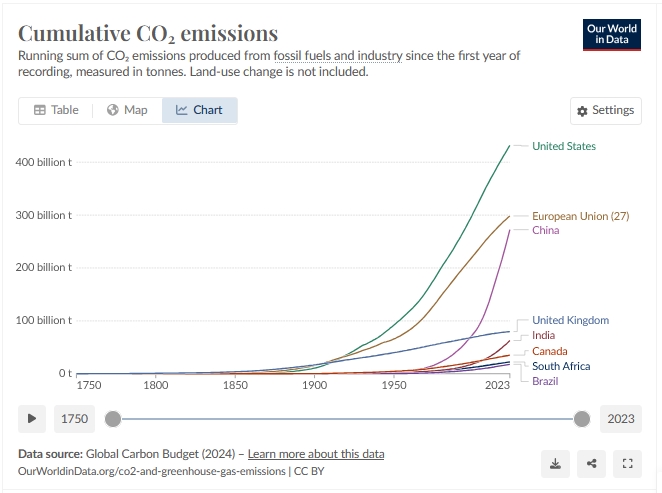
Coal is the largest single source of human CO2 emissions. In terms of the cumulative human emissions of CO2 from all sources, the USA is still the world leader. China almost certainly overtook Europe in the last twelve months, and it’s just a matter of time before China could theoretically take the blame for “man made global warming”. (If that title meant anything).


The point of this post, is to highlight how absurd the situation is. The white guilt for “climate change” is the point — not the gigatons of CO2. No one really gives a damn about carbon dioxide or they would be trying to solve “the China problem” as if life on Earth depended on solving it.

The whole planet and every koala will die, but no one has the time to add up a few sums and start talking about trade embargos, or boycotts, or even writing a strong letter to President Xi…


10 out of 10 based on 1 rating

via JoNova

https://ift.tt/oXxYNy7

December 30, 2024 at 02:30PM