Scientists Report A ‘Striking Global Greening Trend’ Over The Last 42 Years

The greening of the Earth’s vegetated areas is “attributed to CO2 fertilization, climate change, and land use changes.”

New remote sensing research (Gutiérrez-Hernández and García, 2025) uses robust statistical methods to eliminate false positives and spurious correlations in establishing vegetation trends in the satellite era.

The scientists find 38% of the Earth’s land surface has undergone statistically significant greening or browning trends over the last 42 years (1982-2023). Conventional methods (i.e., Mann-Kendall test) that had previously found 51% of the Earth’s surface experienced statistically significant vegetation trends in the satellite era may overlook crucial factors that produce less accurate, inflated results.

With this new analytical method, the True Significant Trends (TCT) test, the authors have robustly determined there has been a “striking global greening trend” attributed to CO2 fertilization and climate change.

“Applying a new proposed workflow methodology (True Significant Trends, TST) we reveal a striking global greening trend, with a significant portion of the Earth’s terrestrial land surface showing increases in vegetation cover over the past four decades, particularly in Eurasia.”

Specifically, 76.1% to 85.4% of statistically significant vegetation trends indicate greening, whereas browning trends account for 14.7 to 23.9%

“Among these significant trends identified using the TST workflow, 76.07% indicated greening, while 23.93% indicated browning. Notably, considering areas (pixels) with NDVI values above 0.15, greening accounted for 85.43% of the significant trends, with browning making up the remaining 14.57%. These findings strongly validate the ongoing global greening of vegetation.”

In other words, greening trends dominate over browning trends at a ratio of about 4:1, or 80% to 20%.

Image Source: Gutiérrez-Hernández and García, 2025

via NoTricksZone

https://ift.tt/hdkmsA4

December 30, 2024 at 10:30AM

Happy New Years Eve

Happy New Years Eve

10 out of 10 based on 1 rating

via JoNova

https://ift.tt/41NqeRh

December 30, 2024 at 08:05AM

MasterResource Turns 17

From MasterResource

By Robert Bradley Jr. — December 26, 2024

On this day in 2008, I launched MasterResource. The inaugural post, A New Energy Blog, read:

We are just getting started here, but some of us veterans of the energy debate from a private property, free-market perspective have teamed together to offer our thoughts on late breaking energy items. When I read my newspapers each day, I have some thoughts that I wish I could share with folks from a historical, worldview perspective. I think we all have something to add–and thus the inspiration for this endeavor.

We have a good core group of principal (and principled) bloggers, as well as a growing list of guest bloggers. We aim to post new material most every day. What we have to provide to the reader is frequent insight so that you visit us regularly.

There will be some trial and error, but this is the time to launch. President-elect Obama and his team have little concept of history in the energy debate–what W.S. Jevons said about renewable energies in the 1860s or the perils of U.S. energy regulation learned from wartime planning and the 1970s. Some of us will dwell on this to add some unique perspective to the debate.

By the way, our blog name is inspired by the late Julian Simon (1932–1998). He labeled energy “the master resource” because it is the resource needed to bring other resources from a state of nature to one of human usefulness. Simon also used the term “the ultimate resource” to describe human ingenuity. As the institutional economist Erich Zimmermann once said, resources come from the mind, not the ground.

Finally, I do hope mainstream journalists and many other open-minded individuals will come our way in the great energy and climate debates. The Obama march to energy statism needs a lot of debate. Big Government Democrats are not the cure to Big Government Republicanism. Oil, natural gas, and coal are middle class, working class energies. Wind and solar are for the rich. Wind power, in particular, as my friend Robert Bryce has put it, is the ethanol of electricity. Maybe, just maybe, these parasitic, inefficient energies will get the scrutiny they deserve from all sides of the political spectrum.

Peak Oil. Peak Gas. Climate Emergency. Worsening Pollution. Green Energy. The fallacies of old remain in the debate today, although the intellectual case against has only grown. Market failure has been swamped by both analytical failure and government failure.

New issues have arisen with the weak sister of the U.S. energy market, electricity. Mandatory Open Access. Independent System Operators. Regional Transmission Organizations. Old vinegar in new bottles with central governmental planning and dilute, intermittent, fragile wind and solar requiring battery backup. Much to discuss and debate in 2025!


Discover more from Watts Up With That?

Subscribe to get the latest posts sent to your email.

via Watts Up With That?

https://ift.tt/sFAyaIo

December 30, 2024 at 08:05AM

Telegraph Cereal Harvest Lies

By Paul Homewood


h/t Ian Magness


Meanwhile climate change is also being blamed for the poor cereal harvest in the UK this year, which the useless Telegraph headline calls the “second-worst on record”.

Needless to say it is nothing of the sort, it is only the lowest since 2020:

image

https://www.fao.org/faostat/en/#compare

https://www.gov.uk/government/statistics/cereal-and-oilseed-rape-production/cereal-and-oilseed-production-in-the-united-kingdom-2024

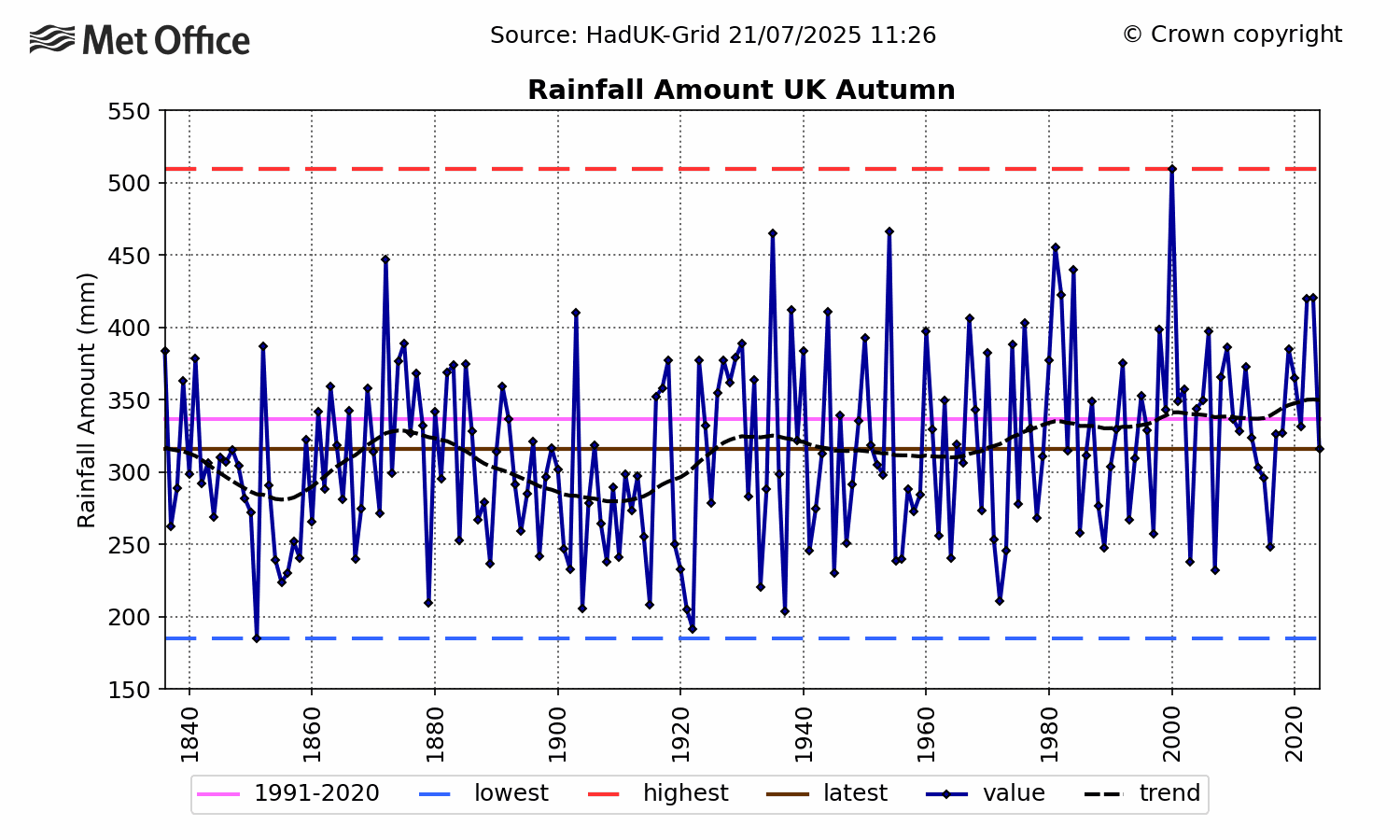
Cereal production was obviously badly hit by the wet autumn last year, which made seeding difficult in many places.

But poor harvests do happen in the UK from time to time because of bad weather. The drought in 1976, for instance, or the wet summers in 2007 and 2012.

There was also another extremely low harvest in 2001, which as this year’s was caused by the wet autumn the year before.

There is of course no evidence that autumns have been getting wetter:

The Telegraph also report claims by Tom Lancaster of the ECIU that:

“This year’s harvest was a shocker, and climate change is to blame. “

No, Tom, climate change is not to blame, as you must know.

And the chart of cereal output is proof that cereal output has been extremely stable since the 1980s, despite occasional blips. Your scaremongering about climate change is baseless.

via NOT A LOT OF PEOPLE KNOW THAT

https://ift.tt/xsmveAo

December 30, 2024 at 05:15AM