Arctic Siberia summers were up to 10°C warmer than today during the Last Interglacial, study finds


Now we’re supposed to believe much less warming than that is something to fear, is mostly human-caused, and is somehow to be avoided at all costs? Climate science today often seems content to ignore or downplay natural variation that is known to play a big part in Earth’s past, and therefore future.
– – –
Interglacials are, as the name suggests, warm periods between planetary glaciations when the expanse of ice on Earth shrinks, says Phys.org.

Currently, we are in an 11,000 year-long interglacial period known as the Holocene. Prior to this, the Last Interglacial occurred between 115,000 and 130,000 years ago.

During this time, Earth experienced summers that were almost completely ice-free and there was significant vegetation growth in polar regions, changing the ecosystems for life to flourish.

Scientists can look to this Last Interglacial as a potential analog for future global warming.

Indeed, new research, currently under review for publication in the Climate of the Past journal, has turned to the geological record of the Arctic to understand how terrestrial environments responded to the warmer world.

Here, warming was amplified compared to the rest of the northern hemisphere due to ice albedo feedbacks, whereby solar insolation melted ice sheets, reducing the amount of radiation reflected back out to space and causing further warming, creating a positive feedback loop [Talkshop comment – which self-evidently wasn’t permanent].
. . .
The researchers ultimately identified up to 10°C more summer warming in northern Siberia during the Last Interglacial compared to summers today, with fossilized plant material suggesting that mean temperatures of the warmest month could have reached 15°C, while fossil beetles indicate the coldest temperature may have been -38°C. Today, the respective mean temperatures are approximately 3°C and -34°C.

Having said this, in June 2020, the town of Verkhoyansk in Russia measured the highest temperature ever recorded above the Arctic Circle at 38°C, while the lowest temperature recorded is -69°C in Greenland. While these were anomalous, the continued changing climate highlights the need to look to the past to inform the future, when such conditions could become more common.

Dr. Schirrmeister notes that while the Last Interglacial warming mostly impacted summer temperatures, future climate change is expected to more broadly impact winter months due to anthropogenic activity.

Nevertheless, ice sheet retreat, loss of sea ice and melting permafrost are all observed in the Arctic today, highlighting the importance of continued research into the sensitivity of Earth to rising temperatures during the Last Interglacial.

Full article here.
– – –
Image credit: grida.no / NOAA

via Tallbloke’s Talkshop

https://ift.tt/83o4adB

December 19, 2024 at 09:57AM

International and state interference in US energy policy must end

Trump and the Supreme Court should restore our national energy and climate sovereignty

Paul Driessen

America has long considered Europe an exemplar and leader in cultural and political thought. We’ve frequently cited European laws, policies and viewpoints as guidance for how the United States should change or behave on multiple issues.

Even after the USA eclipsed the Euro continent economically, militarily and (some say) culturally this past century, we have generally continued to do this. In recent years, we’ve even done so on energy policy, in response to claims that Earth’s climate is changing dangerously due to man’s activities.

We’ve done it despite witnessing how German, British and European electricity prices have skyrocketed, industries have lost millions of jobs, and people cannot afford to heat their homes properly, because of those climate and energy policies.

President Obama unilaterally followed Europe in signing the Paris climate treaty, obligating America to stop using abundant, reliable, affordable fossil fuels; switch to expensive, unreliable, weather-dependent wind and solar power for electricity generation, transportation, manufacturing and defense; pay “developing countries” tens of billions a year in “reparations” for climate change; and let UN and foreign politicians and bureaucrats exert control over America’s future.

Trump45 withdrew the USA from the pact. President Biden re-subjugated us. Trump47 plans to pull us out again – but should also send the treaty to the Senate for prompt attention, debate and likely rejection under our Constitution’s “treaty clause” (Article II, Section 2), as should have been done years ago.

That would be a major step in meeting his pledge for renewed commonsense regulation, energy dominance and resurgent economic vitality. 

Meanwhile, a week after Mr. Trump’s reelection as President, a legal ruling at The Hague shows European views on energy policy may likewise be moving back toward common sense.

On November 12, The Hague’s Appeals Court judges overturned a May 2021 District Court order requiring that Shell Oil Company accelerate its greenhouse gas (GHG) emissions reduction levels to 45% by 2030, using the company’s 2019 GHG emissions as a benchmark.

The 45% ruling reflected Paris Agreement goals and would have applied to Shell’s direct and indirect operational emissions (drilling, production, refining and pipelines), as well as emissions by its oil and natural gas customers worldwide. If the lower court opinion had stood, Shell would have been compelled to more than double its “net carbon intensity” reductions beyond its existing pledge.

The appellate judges refused to impose any specific reduction targets for Shell, citing the company’s substantial emissions reduction efforts, plus insufficient scientific consensus around GHG reduction percentages needed by individual energy companies.

Unfortunately, they still held that Shell had a general legal duty to curb the effects of climate change. How that might happen – amid rapidly growing GHG emissions by China, India, Indonesia, Vietnam and other rapidly developing countries – the judges did not say.

Other than “red counties” and the new Trump Administration, is America moving toward common sense? The jury is still out, as 30-plus U.S. state and local climate lawsuits are still pending. However, there is at least one bright spot among all that litigation.

In July, a circuit court in Maryland dismissed the City of Baltimore’s lawsuit alleging violations of Maryland’s nuisance, trespass and deceptive marketing laws by multiple energy companies. Judge Videtta Brown ruled that emissions produced outside Maryland were beyond the authority of state law.

She also called the city’s efforts to hold energy companies accountable for supposed misinformation an attempt “to get in the back door what they cannot get in the front door.”

This was the third climate lawsuit against energy companies dismissed (New York City’s in 2021) or narrowed in scope (Delaware’s earlier this year), with claims deemed largely preempted by federal law.

Judge Brown’s analysis reflects pro-industry arguments presented by 19 state attorneys general, alleging before the Supreme Court that lawsuits spearheaded by Connecticut, California, New Jersey, Minnesota and Rhode Island attempt to regulate energy and commerce across all 50 states.

It’s noteworthy that states with the greatest focus on climate change and wind, solar and battery power already have the most expensive residential electricity in America’s Lower 48. At 13.9¢ per kilowatt-hour, Maryland is well behind California (19.9¢), Massachusetts (21.1¢) and Connecticut (21.6¢), but pricier than Louisiana (9.4¢), Tennessee (10.8¢) and 32 others.

Despite Maryland’s legal bright spot, however, the other 30-plus cases are charging ahead – because green activists have rigged court systems in their favor.

Activists at the Environmental Law Institute’s Climate Judiciary Project (CJP) have helped “educate” more than 3,000 judges on how to understand the “facts” of climate change as related to legal issues. Even more disturbing, CJP’s materials were crafted by activists who advise state attorneys general and municipalities in these cases and/or support their claims through legal briefs.

It’s all part of a coordinated “think global, sue local” strategy – except no thought is given to global GHG emissions from China, India or other developing countries. It also hampers efforts to develop reliable,  affordable, accessible coal, oil and gas; and easier for state and local governments to mandate and subsidize expensive, intermittent, environmentally destructive wind, solar and battery electricity.

These cases permeate liberal state politics and affect American consumers nationwide.

Liberal state politicians want “green, renewable” electricity but know it’s expensive. To make it seem cheaper, they support tax-funded and deficit-increasing subsidies – and states and municipalities that drag energy companies into $5-trillion tobacco-style legal settlements, to help pay for an ultimately $100-trillion pseudo-renewable energy infrastructure. 

Of course, consumers across America will eventually foot this bill via rate hikes and higher taxes – along with lost jobs, lower living standards and blackouts – to support alarmist policies and the “privilege” of having unreliable “green” power for an all-electricity society.

Climate fearmongers think voters and consumers are powerless to stop this, since the process is playing out in state courts, where climate realist views and votes don’t count.

However, President-elect Trump has numerous energy and climate options at his disposal. Perhaps more important, the US Supreme Court has signaled an interest in hearing two climate cases: City & County of Honolulu v. Sunoco and Alabama v. California.

The court could rule that energy companies are not legitimate lawsuit targets for the “climate crime” of producing what America and humanity need to survive and thrive. It may also say federal courts have jurisdiction in these cases, and are the proper venue, because fossil fuel use, greenhouse gas emissions and climate change are interstate, regional, national and international in nature – and no state, much less any municipality, has jurisdiction or authority to impose narrow, provincial interpretations of law, science and commerce on the rest of the country and world.

Hopefully, the Supreme Court will follow the Hague’s common sense in hearing these cases and ruling in favor of fossil fuel energy that truly is the foundation of health, welfare, prosperity and security.

Paul Driessen is senior policy analyst for the Committee For A Constructive Tomorrow (www.CFACT.org) and author of books and articles on energy, environment, climate and human rights issues.


Discover more from Watts Up With That?

Subscribe to get the latest posts sent to your email.

via Watts Up With That?

https://ift.tt/h7BVMsa

December 19, 2024 at 08:07AM

Achiltibuie No 2 DCNN 0419 – A remote outpost where bananas were grown.

58.01481 -5.33643 Met Office CIMO Assessed Class 5 Installed 1/5/2013 (replacement site)

Achiltibuie is a small and somewhat remote village in Ross and Cromarty. It has the most charming name in Scottish Gaelic of “Achd Ille Bhuidhe” which apparently translates to “Field of the yellow-haired boy”. Life in such locations is very different to that enjoyed by the rest of the mostly urbanised UK population and not easily understood by many. The weather station is in the grounds of the local primary school who likely earn a small income from it and they also engage their young pupils in taking readings as part of their overall learning process.

It seems almost churlish to criticise this site in such a beautiful location and I would certainly prefer not to. Unfortunately, for whatever reason, this choice of site was not particularly good. I often find these situations frustrating as a very modest amount of additional investment could ensure both a good weather station and a genuine community asset. The street view image below indicates rapid encroachment on the unenclosed site by newly planted conifers.

When originally installed (as a relocation) the site was not perfect being on a slope but considerably better with no shading trees. The image below predates the installation by a few months and prior to the playing field being excavated at the top of the headline image and is indicative of the level of natural slope.

It would appear that to improve conditions on the new playing field the trees were understandably planted to act as wind breaks. Although possibly not entirely natural, perhaps a less shaded location could have been found on the new playing field area to improve the readings validity. Interestingly there is a caption to a posted image montage made on the schools X (Twitter) page that tells an enlightening story. This is not necessarily a cold place, although describing the day’s high of 25.2°C as “extreme” is probably a relative term.

“Sports day this afternoon, great effort in extreme heat. Well done everyone.”

Quite surprisingly the weather station was relocated from its previous location when the locals were unable to buy out its former site at a local exotic fruit and veg “Hydroponicum” that actually grew bananas.

https://www.bbc.co.uk/news/uk-scotland-highlands-islands-15820481

The article goes on to describe the locals attempts to get affordable housing built on the site – a major problem in the area as their difficulty in recruiting a new Head Master subsequently showed. A great pity.

Despite all this it cannot be avoided that the principle purposes of supplementary small sites like Achtilibuie cannot be met.

It is hard to justify the readings (from however a delightful spot it may be set in) as meeting an adequate standard for inclusion in the long term climate record.

via Tallbloke’s Talkshop

https://ift.tt/2WFuH78

December 19, 2024 at 06:15AM

More Polar Bear Propaganda From The BBC

By Paul Homewood

The BBC has been running its annual “Polar Bears Are All Going To Die” propaganda again:

https://www.bbc.co.uk/news/articles/c5yg344zz1ro

Having been forced to apologise  for lying that overall  polar bear populations have been declining, the BBC have now turned their attention to the West Hudson Bay area around Churchill.

According to a so-called polar bear expert, Alysa McCall, who is ferrying the BBC team around, half of the bears in the region have disappeared since 1980, due (you guessed it) to global warming.

Unfortunately Alysa is not a reliable source of information, because she works for Polar Bear International, (PBI), a lobbyist organisation. Their own website says they are a “conservation organisation”, and they are constantly appealing for donations, and publicity stunts like this one are crucial for their funding.

And her claims have claims have been demolished by the polar bear expert, Dr Susan Crockford. In her peer reviewed State of the Polar Bear Report 2023, she inconveniently pointed out that there has been no statistically significant change in West Hudson Bay bear numbers since 2004.

The issue, she pointed out, is that there has never been any consistent approach to counting bears in any of the surveys beginning in 1987. There have been aerial surveys, and very limited catch and release ones. Consequently the margin of error is huge, and the amount of guesswork is enormous.

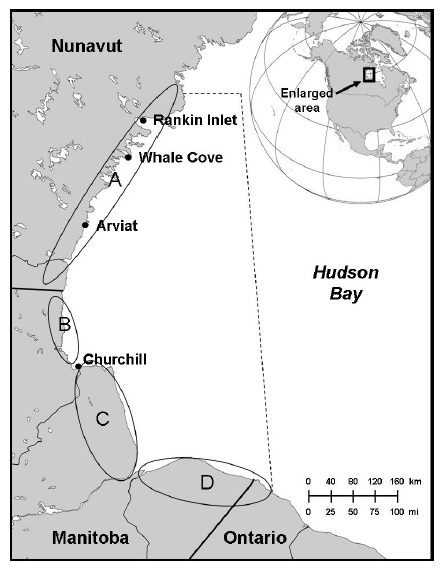
One of the major problems is that most surveys have centred on the Churchill area – ( C ) on the map below.

Little is known about the areas further to the north – B and A. Yet, as Crockford shows, it is known that polar bears frequently migrate to find the best conditions. If sea ice conditions are not suitable in Churchill, bears would likely simply head further north, thus returning to the ice earlier in autumn.

None of the surveys made have attempted to take this migration into account.

As Crockford summarises:

“Journalists go to Churchill and PBI provides the talking points. It’s all just PBI propaganda, it’s what they do every fall to generate donations and the BBC go along”

via NOT A LOT OF PEOPLE KNOW THAT

https://ift.tt/5KZdCnS

December 19, 2024 at 04:34AM