h/t Greg L; Despite claims of progress, genuine emissions cuts have stalled since 2020.
These six charts tell the story of Australia’s (slow) progress on climate change
By national science and environment reporter Michael Slezak Mon 9 Dec
Climate Change and Energy Minister Chris Bowen recently declared that Australia was “on track” to meet its climate change targets. Shortly after making this announcement, new data challenged that optimism.
As a reminder of what Australia’s targets are — we have pledged to bring emissions 43 per cent below 2005 levels by 2030, and reach net zero emissions by 2050.
And in the past few weeks the federal government has released four reports on Australia’s greenhouse gas pollution that highlight just how far away we are from meeting those targets.
Also pouring cold water on Mr Bowen’s parade was Matt Kean, chair of the government’s independent Climate Change Authority, who said: “Emissions need to fall faster to reach Australia’s 2030 target.”
…
The only really big cuts so far have happened in the land sector — by felling fewer trees, and planting more. (In the jargon of carbon reporting, that’s called Land Use, or more formally Land Use, Land Use Change and Forestry (LULUCF)).
…
Those numbers are actually unreliable. So much so that the government changes its mind about those emissions every single year.
Annual revisions to the methodology, government sponsored ABC reporters questioning the narrative. Is it possible the government is just making the emissions cuts numbers up to suit their political narrative?
Surely not, after all they are a group of green politicians who are committed to climate action.
Legal Insurrection readers may recall my previous report on the Biden administration warning Beijing of its plans to update rules that curb shipments of AI chips and chipmaking tools to China.
Now, a day after Team Biden tightened Chinese access to advanced American technology, Chinese officials have ordered a halt to exporting several rare minerals to this country.
The ban signals Beijing’s willingness to engage in supply chain warfare by blocking the export of important components used to make valuable products, like weaponry and semiconductors.
Sales of gallium, germanium, antimony and so-called superhard materials to the United States would be halted immediately on the grounds that they have dual military and civilian uses, China’s Ministry of Commerce said. The export of graphite would also be subject to stricter review.
China is central to many global supply chains, but it generally refrained from clamping down on its own exports during the first Trump administration, preferring instead to take more limited actions like buying soybeans from Brazil instead of the United States. But senior Chinese officials are worried that President-elect Donald J. Trump plans more stringent policies during his coming term in office.
As Legal Insurrection readers know from my previous post, these minerals are key components of technologies and equipment we use regularly. China has already begun curbing exports through regulations and restrictions in the past few years.
China said in July 2023 it would require exporters to apply for licenses to send to the U.S. the strategically important materials such as gallium and germanium. In August, the Chinese Commerce Ministry said it would restrict exports of antimony, which is used in a wide range of products from batteries to weapons, and impose tighter controls on exports of graphite.
Such minerals are considered critical for national security. China is a major producer of antimony, which is used in flame retardants, batteries, night-vision goggles and nuclear weapon production, according to a 2021 U.S. International Trade Commission report.
The limits announced by Beijing on Tuesday also include exports of super-hard materials, such as diamonds and other synthetic materials that are not compressible and extremely dense. They are used in many industrial areas such as cutting tools, disc brakes and protective coatings. The licensing requirements that China announced in August also covered smelting and separation technology and machinery and other items related to such super-hard materials.
China is the biggest global source of gallium and germanium, which are produced in small amounts but are needed to make computer chips for mobile phones, cars and other products, as well as solar panels and military technology.
Of course, it would be on-brand for Team Biden to heat up a war just before President-Elect Donald Trump returns to office, albeit a trade one.
China issued the new ban just two days after the U.S. curbed exports to 140 companies in China’s semiconductor industry. The U.S. crackdown — the third in three years — was aimed at stymieing China’s ability to advance artificial intelligence technologies for military applications.
The escalating tit-for-tat economic measures by Washington and Beijing come weeks before the swearing in of President-elect Donald Trump for his second term. During his first term, Trump launched a trade war with China, and he’s threatened to escalate the standoff once again with a new 10% blanket tariff on all Chinese imports once he returns to office.
“It comes as no surprise that China has responded to the increasing restrictions by American authorities, current and imminent, with its own restrictions on the supply of these strategic minerals,” Peter Arkell, chairman of the Global Mining Association of China, told Reuters. “It’s a trade war that has no winners.”
I am consoled by two facts:
1) Over 2 Billion Metric Tons of Rare Earth Minerals Discovered in Wyoming. 2) Native American racialist and eco-activist Deb Haaland will no longer be in charge of the Department of the Interior starting January 2025. Therefore, Americans will have access to their own supply of rare earth minerals.
Who knows? Trump may be able to sweeten the deal and get Denmark to sell us Greenland, which would alleviate our need for China even father.
Not only is the new RSV vaccine not safe and effective, early results suggest it makes the disease worse
Bear in mind, they are experimenting on the youngest of the young: babies from 5 months to 2 years of age, and we are dealing with a disease that 90% of babies will catch in their first two years. Some of these babies will get a severe life threatening disease, but as I reported last month, the ones who are deficient in vitamin D are 5 to 10 times more likely to end up in intensive care. We can already do a lot to protect these babies, more cheaply and with far less risk than testing immature and complex therapies.
Maryanne Demasi reports that things are looking bad for the new RSV vaccine:
The latest trial data demonstrates the dangerous speed of innovation.
This week, the Food and Drug Administration (FDA) disclosed that vaccinated children in the trial experienced higher rates of severe RSV compared to those in the placebo group.
The data was striking: 12.5% of vaccinated children developed severe or very severe RSV disease, compared to just 5% in the placebo group.
Moreover, among those who developed symptomatic RSV, 26.3% of vaccinated participants progressed to severe illness, sharply contrasting with the 8.3% in the placebo group.
The trials were stopped in July after five babies aged 5 to 8 months developed severe cases of RSV. The FDA has since put the experiment on hold.
With uncanny timing, Moderna’s massive new vaccine factory opened in Victoria two weeks ago. It will “have the capacity to produce up to 100 million vaccine doses each year for respiratory diseases including influenza, Respiratory Syncytial Virus (RSV), and COVID-19.” As Demasi points out the Australian Federal government signed a $2 billion agreement, committing to the purchase of Moderna’s locally produced vaccines for at least a decade. (Damn.)
History rhymes — in the long, unfortunate quest for vaccine development for RSV
A classic antibody diagram
Back in 1966, researchers tried killing the virus and then injecting it into twenty-five children. The results were disastrous — about 80% of the children caught RSV regardless of the vaccination, and worse, 80% who caught the illness went on to have a severe form of the disease. Sadly, two children died. People were still publishing papers on why that happened forty years later.
Years later researchers figured out that the formalin used to kill the virus chemically changed the shape of the key markers, meaning that the children developed immunity to the dead form of the virus which was different from the live form. We trained their bodies to make antibodies that were not at all effective. This was not just a major drain on resources (all those expensive proteins get used to make the wrong weapons), but worse, these antibodies helped the virus gain entry to cells. It was the first instance of vaccine induced antibody-dependent enhancement (ADE).
The message here is that there are far better cheaper ways of dealing with infections than with rapid vaccine development. Vaccines can be very useful, but their are a hundred ways they can go wrong, and changes to our immune system are potentially permanent or at least long term. If we weren’t embedded in a deep dark cav, dripping with patent and profit incentives we would spend a few dollars fixing natural deficiencies, get a little bit of sunlight, and then seek antivirals that we’ve safety tested on millions of people for thirty years.
The FDA will meet urgently to discuss the situation.
__________________________
PS: In great news today Dr William Bay won his case today in the Supreme Court against the Australian medical police who suspended him two years ago for speaking out against vaccination — at one point he yelled at a conference “”stop forcing these vaccines on the people of Australia who are getting killed by them”.”
The regulators argued they had to stop him damaging confidence in vaccines etc, but Justice Bradley said “None of these measures extended the board’s regulatory role to include protection of government and regulatory agencies from political criticism.”
We hope this is truly a free speech win, rather than a technical victory over some fine print. Doctor Mark Hobart (who has also been suspended) seems to think it is — “The house of cards is now falling down. Doctors can now tell the truth. This will be unstoppable. This will spread throughout the world and create a revolution. A revolution of truth.”
Me, I want a free market. I want to be able to visit any doctor I want. I want their honest opinion, not their “permitted one”.
The notion that CO2 from human activities causes global warming has multiple flaws, many of which have been dissected and rebutted here and elsewhere. But The Big Lie is to fundamentally misrepresent how Earth’s climate system works. Richard Lindzen explains in the above interview with Jordan Peterson. For those who prefer reading I provide a transcript from the closed captions in italics with my bolds and added images.
JP: When you started to object to the narrative, back say in ‘92, To what narrative were you objecting and on what grounds were you objecting?
RL: You’re touching on something that took me a while to understand. You know Goebbels famously said: If you tell a big enough lie and repeat it often enough, it’ll become the truth. there’s been a lot of that in this. But there are aspects of establishing the narrative, that is, what makes something the truth that I hadn’t appreciated.
So the narrative was the climate is determined by a greenhouse effect
and adding CO2 to it increases warming. And moreover besides CO2
the natural greenhouse substances–water vapor, clouds, upper level clouds–
will amplify whatever man does.
Now that immediately goes against Le Chatelier’s principle which says: If you perturb a system and it is capable internally of counteracting that, it will. And our system is so capable.
So that was a little bit odd. You began wondering, where did these feedbacks come from? Immediately people including myself started looking into the feedbacks, and seeing whether there were any negative ones, and how did it all work?
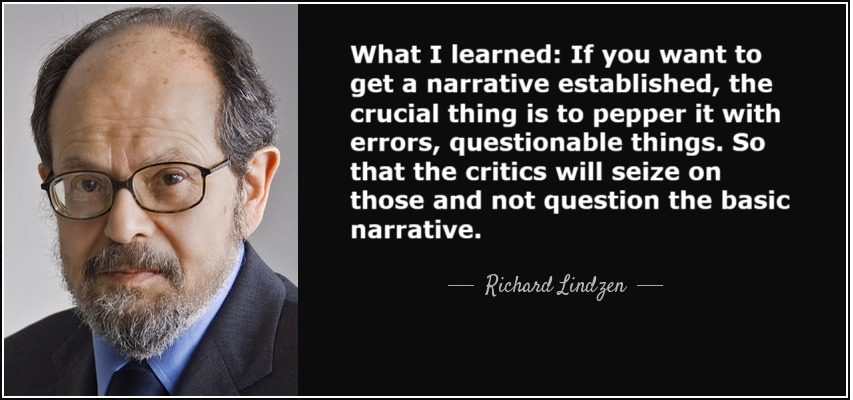
But underlying it, and this is what I learned: if you want to get a narrative established, the crucial thing is to pepper it with errors, questionable things. So that the critics will seize on those and not question the basic narrative.
The basic narrative was that climate is controlled by the greenhouse effect. In point of fact the earth’s climate system has many regions, but two distinctly different regions. There are the tropics roughly minus 30 to plus 30 degrees latitude, and the extra Tropics outside of plus or minus 30 degrees.
They have very different dynamics, and this is the crucial thing for the Earth by the way. And this is a technicality and much harder to convey than saying that greenhouse gases are a blanket or that 97 percent of scientists agree.
This is actually a technical issue. The Earth rotates. Now people are aware that we have day and night, but there is something called the Coriolis effect. When you’re on a rotating system it gives rise to the appearance of forces that change the winds relative to the rotation. So at the pole the rotation vector is perpendicular to the surface, while at the equator it’s parallel to the surface: it’s zero.
And this gives you phenomenally different Dynamics. So where you don’t have a vertical component to the rotation, vector motions do what they do in the laboratory in small scales. If you have a temperature difference, it acts to wipe it out.
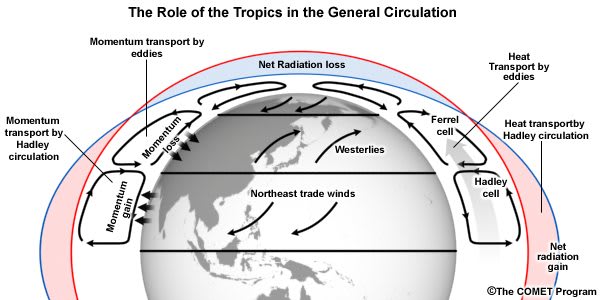
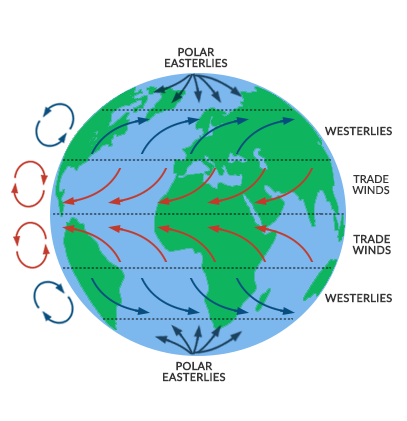
Figure 11. Most sunlight is absorbed in the tropics, and some of the heat energy is carried by air currents to the polar regions to be released back into space as thermal radiation. Along with energy, angular momentum — imparted to the air from the rotating Earth’s surface near the equator — is transported to higher northern and southern latitudes, where it is reabsorbed by the Earth’s surface. The Hadley circulation near the equator is largely driven by buoyant forces on warm, solar-heated air, but for mid latitudes the “Coriolis force” due to the rotation of the earth leads to transport of energy and angular momentum through slanted “baroclinic eddies.” Among other consequences of the conservation of angular momentum are the easterly trade winds near the equator and the westerly winds at mid latitudes.
And so if you look at the tropics the temperatures at any surface are relatively flat: they don’t vary much with latitude. On the other hand you go to the mid Latitudes, in the extra Tropics the temperature varies a lot between the tropics and the pole. We know that about how temperatures are cold at high Latitudes. And if you look at changes in climate in the Earth’s history, what they show is a Tropics that stays relatively constant, and what changes is the temperature difference between the tropics and the pole.
During the Ice Age it was about 60 degrees Centigrade, today it’s about 40. During 50 million years ago something called the eocene the difference was about 20. So that’s all a function of what’s going on outside the tropics. Within the tropics the greenhouse effect is significant but what determines the temperature change between the tropics and the pole has very little to do with the greenhouse effect.
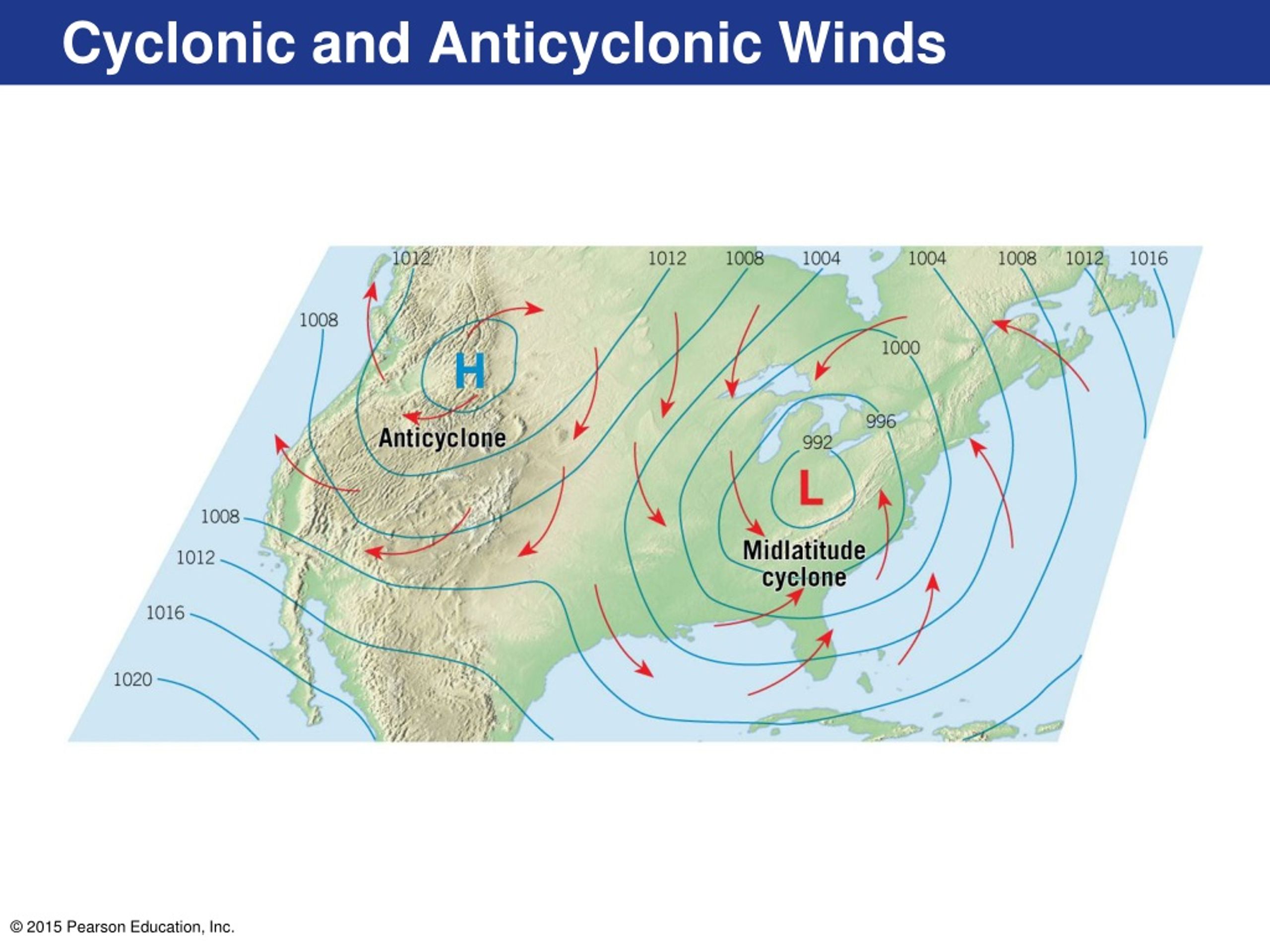
It is a dynamic phenomenon based on the fact that a temperature difference with latitude generates instabilities. These instabilities take the form of the cyclonic and anticyclonic patterns that you see on the weather map. You can see the tropics are very different from even a casual look at a weather map. The systems that bring us weather travel from west to east at latitudes outside the tropics. Within the tropics they travel from east to west. The prevailing winds are opposite in the two sections.
Sometimes people say that changes due to the greenhouse effect are amplified at the poles. That is not true: there’s no physical basis for that Statement. All they do is determine the starting point for where the temperature changes in mid-latitudes and that’s determined mainly by Hydrodynamics.
Okay that’s complicated to explain to someone and yet it’s the basis for those claims of seemingly large significance of these small numbers. You know they’re saying if Global mean temperature goes up one and a half degrees it’s the end. That’s based on it getting much bigger at high latitudes and determining that. But all one and a half degrees at the equator would do or in the greenhouse part of the Earth is change the temperature everywhere by one and a half degrees, which for most of us is less than the temperature change between breakfast and lunch.



 And this gives you phenomenally different Dynamics. So where you don’t have a vertical component to the rotation, vector motions do what they do in the laboratory in small scales. If you have a temperature difference, it acts to wipe it out.