
Get an insider’s view into the latest COP UN Climate Summit from CFACT President Craig Rucker and Cliamte Depot publisher Marc Morano on the podcast this week.
via CFACT
December 4, 2024 at 12:31PM
Get an insider’s view into the latest COP UN Climate Summit from CFACT President Craig Rucker and Cliamte Depot publisher Marc Morano on the podcast this week.
via CFACT
December 4, 2024 at 12:31PM
by David Wojick
BOEM is taking comments on a draft Programmatic Environmental Impact Statement (PEIS) for its five floating wind offshore leases off the California coast. I am doing research prior to commenting and this is my first report which other commenters might find useful.
The comment deadline is February 12 so the final EIS will be under the Trump Administration. This may make comments opposing the Program more important than they have been previously when they were mostly ignored.
For the PEIS and how to comment see https://www.boem.gov/renewable-energy/state-activities/california-offshore-wind-programmatic-environmental-impact
This is BOEM’s second offshore wind PEIS. The first was for a set of leases off New York and it was atrocious. This one is still bad but it has some useful features that are worth pointing out.
Note that this is the first one for floating wind turbines which is very different from the fixed turbines being built along the Atlantic coast. Floating wind is still an immature technology with a large number of proposed designs none of which has been tested at commercial utility scale. There are just a handful of small demonstration scale projects in the world.
There are at least two good things about this PEIS. First is a pretty good tutorial on floating wind with a focus on the California case. This is Appendix A and done by the National Renewable Energy Laboratory. They rule out a number of design options including the most popular that has been demonstrated. The huge range of options they present shows the immaturity of the technology.
Second the PEIS includes an encyclopedic discussion of numerous potential adverse impacts of a huge floating wind project. This is just what is contemplated for each of the five leases so there is already a lot not to like about this Program.
Here is a quick list of some of the biggest flaws found to date.
By far the biggest is that there is no cumulative multi-lease impact assessment. The whole point of a PEIS is to do such an assessment. Cumulative impact can be much greater than the sum of individual project impacts especially where two or more projects are closely clustered as in this case.
In many cases an adverse impact is merely mentioned with no assessment of the potential harm.
The systematic harassment of large numbers of endangered and protected species of whales and other animals is not discussed. In fact the term “harassment” only occurs twice in the entire main report. Death due to noise harassment is one of the top adverse impacts of offshore wind.
Moreover floating wind introduces a major non-acoustic form of harassment. This is the 3D web of potentially thousands of mooring cables each of which could be up to a mile long. We may be talking about hundreds of square miles of deep ocean literally filled with webs of cables. Harassment is defined as causing behavioral change on a protected animal’s part and these monstrous webs will certainly do that.
The PEIS does briefly mention the threat of “secondary entanglement” in the nets, lines and other debris that are caught on the cables over time. The potential adverse effects of this deadly accumulation needs to be assessed in detail.
Lastly there is an extensive economics section but no mention of cost. Development of these five leases will likely cost ratepayers and taxpayers tens of billions of dollars, possibly hundreds of billions, but these staggering sums are never quantified. Job creation is treated in detail as a benefit when jobs are in fact a cost.
This is just a quick look but it is already clear that this PEIS is woefully inadequate. In fact it specifically avoids those issues that justify cancelling the Program. Stay tuned for more findings.
via Watts Up With That?
December 4, 2024 at 12:05PM
Everyone John?… This is a guy who was caught in Iceland flying a private jet to get an environmental award. WATCH NOW
via CFACT
December 4, 2024 at 11:55AM
Many of us are blogging to draw attention to knowledge and information dismissed or suppressed by legacy and social media as “misinformation”, simply because the thoughts and ideas are rational and reasonable rather than alarmist. Tom Harris reminded me in his recent comment that we have many many colleagues speaking out in the public square sharing our concerns. So let this post introduce a valuable resource in this fight for reasonable climate understandings and policies, namely CANADIANS FOR SENSIBLE CLIMATE POLICY Join the Movement for Responsible and Sensible Climate Policy.
The home page summarizes why this mission is important and what is at stake and the path forward.
That is 62% of the total federal tax revenue.

According to public data, in Canada alone these organizations control billions in funds, raise and spend millions on PR campaigns and employ hundreds of staff to achieve these objectives. Globally, the climate activism industry controls trillions of dollars and has armies of advocates. This politicisation of public policy impacts every Canadian.

Even when done with the best intentions, power without oversight isn’t peace, order or good government. To advocate for the best policy, we encourage a range of views, even the controversial ones. We dare to question, to be wrong and to explore all sides of complex issues.

Carbon dioxide gets a lot of attention compared to the many other environmental concerns. Every bad weather event gets assigned to it. The main player in the greenhouse effect remains water and clouds. A changing climate may be unpredictable but that does not mean abnormal.
With prosperity comes costs which must be balanced against the benefits. Strange does not mean unexplainable. Proclamations of doom and crisis are always suspicious.

Big Oil, corporate interests, corrupt politicians, conspiracy theorists, corporate PR firms and paid skeptics. These are all boogeymen for why, despite general popularity and political backing, there remains a dire crisis with minimal progress.
What if the crisis is exactly because the incentives are designed to perpetuate a cycle? What if the problem isn’t bad intentions or ethics but a social mission over funded to irreverence which needs to be called out as ineffective?

Motivated reasoning is choosing only the good parts of a story well ignoring the rest because it is what we want to believe. It is quite common in everyday life. When it comes to climate change, calm, pragmatic discussions are rare with many complex and passionate explanations and perspectives.
Those complex explanations may well be accurate, but any analysis of climate change must acknowledge the issue has emotional and personal implications for many Canadians.

When speaking unpopular opinions, one’s intelligence, integrity and ethics will almost always come under fire. When speaking popular opinions rarely is there such scrutiny. It’s human to deeply care for our environment. Why don’t we see the mass implementation of responsible governance, moderation & sustainability? Why so much green washing? Why are 9/10 solutions just shifting our problems into other people’s lands.
Transporting environmental destruction from Canada to Qatar, China or Nigeria is not ethical or effective. If being sustainable was easy or obvious someone would have done it long ago.
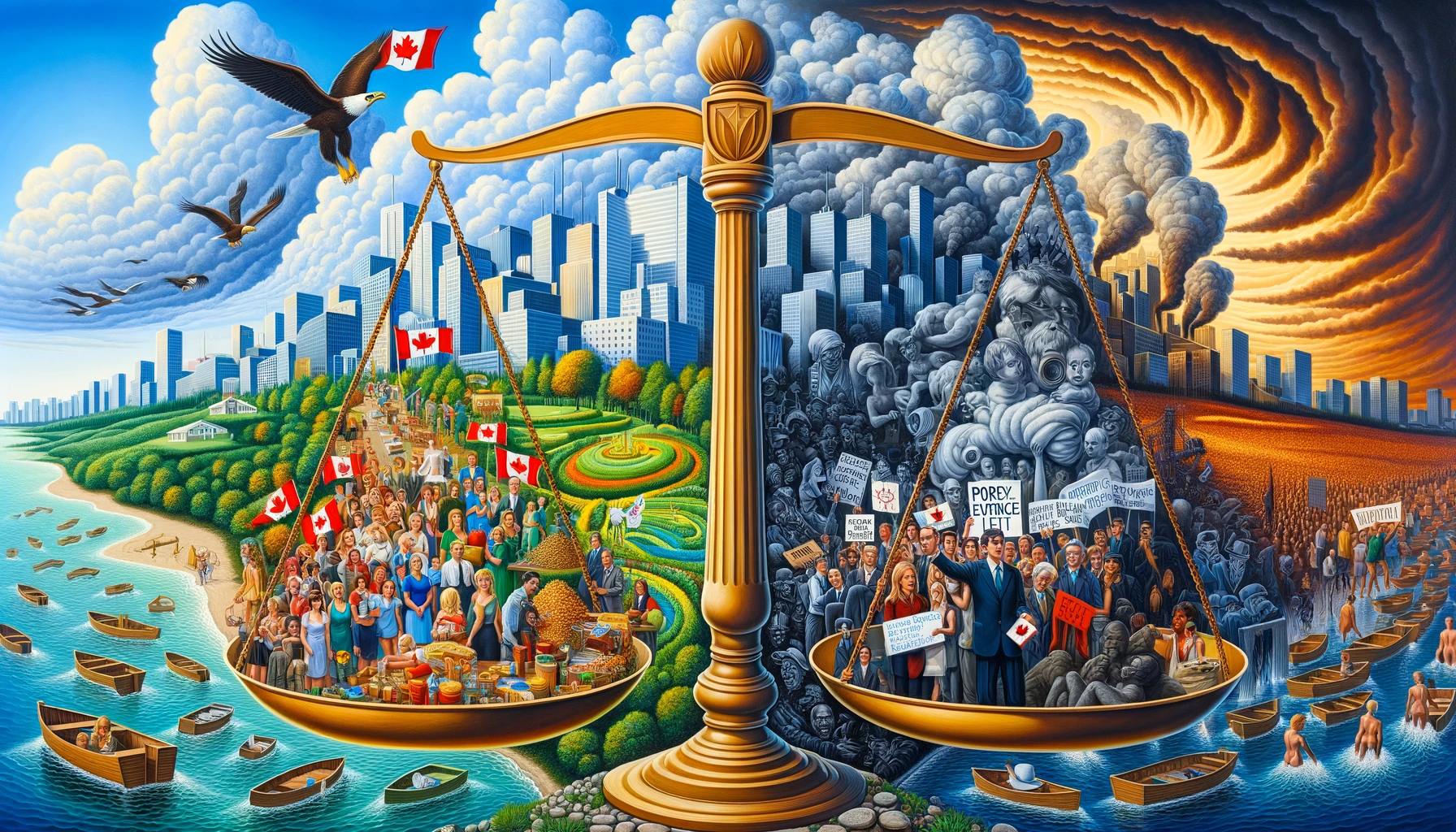
Spending must be within context. Canada is estimated to produce about 2% of the worlds total CO2 emissions with our higher emissions per capita being within expectations for an oil producing nation. Alberta accounts for much of this higher status. The Federal government revenue was $447 billion. A provincial government like Ontario was $179 billion.
A hundred billion or trillion dollar public effort to reduce a rounding error in emissions isn’t just another project, it’s a significant financial commitment with long lasting implications.

Your generation has enjoyed a splendid life because of the sacrifices made by your parents during and after WW2. Post war, jobs were easy to find, economies expanded throughout the developed world and Boomers “Never-had-it-so-good.” In retirement your lifestyle was far better than any previous generation enjoyed.
Now, you have a choice, you can either watch economic hardship unfold while passing on huge debts to the next generations or speak up and blow the whistle on the biggest waste of capital the world has ever seen.

You are inheritors of a huge debt by the leadership of today. Do you want to spend your life in bad economic times? Do you want your children to live through the same hardships as you stand to inherit? How much time have you invested in thinking about what the Net Zero at 2050 policies cost? Can humans in fact control climate? Is the financial sector pushing that agenda biased? Are the alternative energy jobs long-term or busy-work?
Decide for yourself. Make your thoughts known.

Alberta and Saskatchewan’s embrace of lower-regulation, pro-petroleum and chemical development is a source of concern to many Canadians. Yet, this comes with benefits to those same groups including massive subsidies to public spending, foreign investment, increased buying power and lowered cost of living in all provinces.
A sensible climate policy transcends politicisation, it works for those who are pro-petroleum or anti-petroleum, left or right wing, those who see increased carbon as beneficial or those seeking net-zero. Sober energy policy improves lives by balancing concerns and offering pragmatic decisions which achieve universal objectives.

The journalists spread the word and the activists too, the science becomes “settled” and 97% of climate scientists agree. Your life could get a little easier, just don’t listen to skeptics, realists, opponents, the scientists not surveyed, friends, brothers, sisters, cousins, or uncles. An agency will sort the details and inform you of the correct and proper truth.
Never, a sensible climate policy comes from open inquiry, where facts and data are the observations in agreement and the debate is about the meaning and impacts of that data. Experts will breakdown confusion, answer questions and offer clarity.

Climate change policies and activism have a track record of growing budgets, increased powers, and increased access to new technologies and insights. Show us the benefits. Show us the increases in quality of life. Show the practical applications and decreased risks and dangers.
A sensible climate policy is measurable, and though perhaps driven by fear and concern, increased attention and effort means more tangible results.

In cost-benefit analysis, choices are made between conflicting values. Energy and climate policy can be framed as altruists against economics. It can be framed as common good against special interests. It can be framed as differing scientific views.
A sensible climate policy will be driven by maximizing well-being and benefit to society.

Climate policy is often ignored except by special interests. The tale of energy companies against the activists is contradicted by the funding patterns which see energy companies actively funding, hiring and promoting climate change activists. In the energy business “green energy” is just another opportunity.
A sensible climate policy must have checks and balances. Lobbying can benefit everyone in a marketplace of ideas but as a monopoly, everyday Canadians will never be served.
via Science Matters
December 4, 2024 at 11:24AM

