The Oppressed Scientist: When Emotions Replace Objectivity in Climate Research

It’s time we asked an important question: who needs cold, unfeeling objectivity when you’re saving the world from a climate apocalypse? Apparently not climate scientists, according to the recently published article in Nature Climate Change by Schipper, Maharaj, and Pecl. This manifesto—masquerading as a scientific commentary—argues that emotions, anxieties, and grievances belong in the laboratory, right next to the Bunsen burners and climate models. Because, why not?

The piece begins with a bold premise: “The dominant paradigm holding that science is always objective needs to be challenged.” And challenged it is! Objectivity, the bedrock of scientific inquiry, is brushed aside as an oppressive relic of a bygone era. Why? Because, they claim, suppressing emotions weakens climate science. How, exactly? They don’t explain that, but their assertions are thick with the aroma of self-righteous victimhood.

A Sob Story in a Lab Coat

The authors tell us that climate scientists are just regular folks, cycling between despair and hope, burdened by their special “curse of foresight.” Apparently, only these enlightened individuals can see the inevitable doom awaiting us, making their despair not just understandable but noble. And if the rest of us dare question their emotional outbursts or point out their activist leanings? That’s just more proof of how society marginalizes their feelings.

They even invoke the specter of “Climategate,” the 2009 scandal that revealed dubious practices within the climate research community. Rather than reflect on why public trust eroded after those revelations, the authors bemoan how unfair it was for scientists to face scrutiny. Being held accountable? How dare anyone suggest that transparency matters more than their fragile egos!

When Victimhood Becomes Virtue

Of course, this isn’t just about emotions. No modern narrative is complete without the obligatory nod to systemic oppression. The article laments the lack of equity, inclusion, and diversity in climate science, pointing fingers at dominant “Global North male voices.” Apparently, marginalized groups within the field don’t just need a seat at the table; they also need their “perspectives and worries” amplified because their emotional experiences are inherently more valuable than mere data.

The authors don’t stop at demanding emotional inclusion—they want a full-on reimagining of how science operates. “Science requires emotion too,” they declare, as though this is some groundbreaking revelation rather than the kind of sentiment you’d find on a motivational poster. But they’re not just talking about letting scientists feel feelings. They argue that emotions should influence research directions and communication strategies. If you’re skeptical, that’s because you’re stuck in the “reductionist, positivist” mindset they’re trying to dismantle.

Science or Therapy Session?

The article makes an impassioned plea for “safe spaces” where scientists can express their anxiety, grief, and burnout. It’s hard not to chuckle at the idea of converting research institutions into group therapy centers. What’s next? Emotional support animals at IPCC conferences?

There is a need for a safe space to share feelings of anxiety, grief and burnout among climate scientists11. It is likely that most scientists do not currently recognize how much they might need such an outlet. Let’s get started by talking to each other and acknowledging that science requires emotion too.

More hilariously, the authors suggest that feelings of despair can actually enhance scientific inquiry. They point to polar bear population declines and heatwave fatalities as issues that should inspire distress, conveniently ignoring that sensationalizing these topics often leads to public disengagement. Why? Because no one wants to be lectured by Chicken Little in a lab coat.

Dividing the Faithful: Doomists vs. Hopeists

In what can only be described as a theological schism, the authors acknowledge a divide among climate scientists between “doomists” and “hopeists.” Doomists are charged with spreading apocalyptic fear, while hopeists preach the gospel of technological salvation. Both camps, they argue, are unfairly maligned. Why? Because apparently, being called out for alarmism or blind techno-optimism is the real problem—not the questionable science or policy prescriptions these labels often describe.

This framing reveals the underlying absurdity of their argument. They want us to trust scientists as impartial experts while simultaneously advocating that their personal emotions and ideologies take center stage. It’s like asking someone to take a fortune-teller seriously because she cries when reading your palm.

The Real Agenda: Ideology Dressed as Science

At its core, this article is less about improving climate science and more about reshaping it into a tool for ideological warfare. By elevating subjective emotions above objective analysis, the authors undermine the very credibility they claim to seek. They dismiss concerns about bias as “gatekeeping” and accuse anyone who values neutrality of perpetuating harm.

But here’s the rub: science isn’t supposed to make you feel good. It’s not here to validate your worldview or comfort your anxieties. Its purpose is to uncover truths, no matter how inconvenient or indifferent to human emotions they may be. When scientists abandon objectivity in favor of activism, they cease to be scientists and become little more than political operatives with PhDs.

Conclusion: Woke Science is Not Science

The article in Nature Climate Change is a case study in what happens when grievance culture infects academia. It replaces rigor with rhetoric, evidence with emotion, and facts with feelings. This isn’t progress—It’s the intellectual equivalent of swapping out a pilot’s controls for a karaoke machine and expecting a smooth landing.

If climate scientists want to be taken seriously, they need to stop whining about how hard their job is and start focusing on doing it well. Until then, they’re not saviors of the planet—they’re just glorified activists cloaked in lab coats, preaching a gospel of despair and self-pity.

via Watts Up With That?

https://ift.tt/1kt3Ffl

November 29, 2024 at 08:02PM

British Government Climate Advisors Demand Everyone Live like Poor People

Essay by Eric Worrall

“… fly less, eat less meat and use public transport more often …”

Now Keir Starmer’s climate advisers say we will need to change diets and fly less – after PM insisted climate goals wouldn’t hit Britons

By COLIN FERNANDEZ 
PUBLISHED: 09:30 AEDT, 28 November 2024 | UPDATED: 10:09 AEDT, 28 November 2024

Britons will have to fly less, eat less meat and use public transport more often to hit Net Zero goals, the Government’s main climate-change advisers have insisted.

The stipulations outlined to MPs today directly contradict promises by Sir Keir Starmer earlier this month that reducing greenhouse gas emissions would not involve people in Britain having to change their lifestyles.

New targets mean the UK’s emissions should be cut to 81 per cent of 1990 levels by 2035.

Speaking at the Cop29 summit in Azerbaijan a fortnight ago, the Prime Minister said he would not be ‘telling people how to live their lives’ by reducing air travel or changing their diets.

But today leading members of the Climate Change Committee (CCC) spelled out that hitting the target would involve widespread ‘behaviour change’.

…

Read more: https://www.dailymail.co.uk/news/article-14134341/Keir-Starmers-climate-advisers-PM-climate-goals.html

Is anyone else getting fed up with this wartime austerity nonsense greens keep trying to impose on us?

Of course, none of this stops them from claiming renewable energy is the cheapest option. In which case, why the need for rationing and austerity?

via Watts Up With That?

https://ift.tt/kj0zOc5

November 29, 2024 at 04:06PM

High Energy Costs Continue to Plague European Industry

By Paul Homewood


From OilPrice.com


 image

Europe is losing and will continue to lose competitiveness and jobs if it doesn’t tackle its high energy costs compared to other regions, Morten Wierod, chief executive of Switzerland-based engineering giant ABB, told Bloomberg.

“The cost for energy intense industries like chemical, steel production, cement is a challenge, and investments will go elsewhere than Europe if this continues,” Wierod told Bloomberg in an interview published on Tuesday.

This predicament would hinder job creation in Europe, which, the executive said, “is a clear concern.” Bureaucracy is also weighing on the industry and job creation, Wierod said.

Major European companies are already moving to cut costs and retain their competitive edge.

For example, Thyssenkrupp, Germany’s largest steelmaker, said on Monday it would slash 11,000 jobs in its steel division by 2030, in a major corporate reshuffle.

“Urgent measures are needed to improve Thyssenkrupp Steel’s own productivity and operating efficiency, and to achieve a competitive cost level,” the German industrial giant said.

As Europe is bracing for the winter, wholesale electricity prices have jumped in November to the highest level in 20 months, additionally burdening the key industries in major economies that had just started to recover from the 2022 energy crisis.

The highest spot-based electricity prices in Europe since February 2023 threaten industrial production in key economies and loom large over business sentiment.

Earlier this month, falling wind power generation tightened power markets in Europe, with electricity prices in Germany hitting their highest since the peak of the energy crisis in 2022.

The rising energy costs threaten major European economies, just as Germany, the biggest economy in Europe, narrowly avoided a recession in the third quarter of the year. Eurozone GDP grew by 0.4% in the third quarter, Eurostat’s flash estimate showed earlier this month. That was higher than expected as the two top economies, those of Germany and France, outperformed forecasts.

https://oilprice.com/Latest-Energy-News/World-News/High-Energy-Costs-Continue-to-Plague-European-Industry.html

via NOT A LOT OF PEOPLE KNOW THAT

https://ift.tt/QFagUJL

November 29, 2024 at 03:40PM

11 US states sue BlackRock, StateStreet and Vanguard for working as a cartel to reduce coal and increase electricity prices

BlackRock, Vanguard, State Street.

By Jo Nova

A strike at the heart of the Blob

Texas and 10 other US States have pressed the radioactive Antitrust legal button and filed against BlackRock, Vanguard and State Street. The states claim the money managers bought up large stakes in coal companies and then colluded to promote ESG and DEI (diversity, equity and inclusion) goals that reduced coal output. The decreased supply of coal, in turn increased the cost of electricity to consumers. It was fundamentally anti-competitive behaviour. These three companies together have $26 Trillion dollars of assets under management. That’s only one trillion smaller than the entire US GDP.

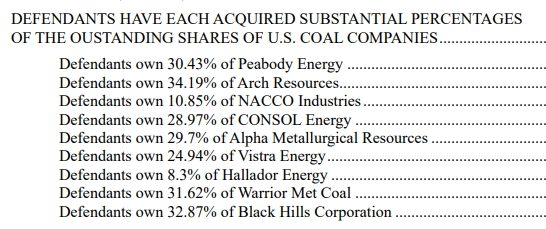
In this case, some of the collusion was all out in the open. The three money managers said they were trying to save the world and protect the people, and they joined groups like the GFANZ and Net Zero alliances like Climate Action 100+. But in the end, these three financial giants had collectively acquired close to 30% of most US Coal companies, and even though they claimed to have good intentions, the 11 State Attorney Generals argue that any supposed social benefits are irrelevant. These three companies have profited immensely while customers have been denied access to a free and open market, and have paid higher electricity bills.

In a democracy, the people are supposed to decide the policies, not the Oligarchs.

Look at the grip the three supermassive money managers had on the coal industry:

US Anti-trust suit.

No wonder coal companies were so pathetic at fighting back against the climate propaganda.

The defendants were accused of exploiting their market power and involvement in climate advocacy groups to pressure coal companies to slash output and reduce carbon emissions from coal by more than 50% by 2030, driving up consumers’ utility bills.

“Competitive markets — not the dictates of far-flung asset managers — should determine the price Americans pay for electricity,” the states said in the complaint.

Texas Attorney General Ken Paxton, whose office filed the lawsuit, in a statement accused the defendants of promoting an “illegal weaponization of the financial industry in service of a destructive, politicized ‘environmental’ agenda.”

The lawsuit aims to stop these companies from voting on shareholder resolutions or acting in a way to undermine coal output and competition. The Attorney Generals also want money — calling for fines to be paid for the antitrust violation.

The free market has been destroyed:

For the past four years, America’s coal producers have been responding not to the price signals of the free market, but to the commands of Larry Fink, BlackRock’s Chairman and CEO, and his fellow asset managers. As demand for the electricity Americans need to heat their homes and power their businesses has gone up, the supply of the coal used to generate that electricity has been artificially depressed—and the price has skyrocketed. Defendants have reaped the rewards of higher returns, higher fees, and higher profits, while American consumers have paid the price in higher utility bills and higher costs.

The three financial giants have violated the Clayton Act (Antitrust legislation)

Defendants are three of the largest institutional investors in the world. Each Defendant has individually acquired substantial stockholdings in every significant publicly held coal producer in the United States. Each has thereby acquired the power to influence the policies of these competing companies and bring about a substantial lessening of competition in the markets for coal. And each has used its power to affect a substantial reduction in competition in coal markets. Considered alone and in isolation, each Defendant’s acquisition and use of  producers has violated Section 7 of the Clayton Act.

… Defendants have immense influence over these companies on their own, but collectively Defendants possess a power to coerce management that is all but irresistible.

They have made their goals public

But Defendants have not just acted alone and in isolation. In 2021, they went further. In that year, Defendants each publicly announced their commitment to use their shares to pressure the management of all the portfolio companies in which they held assets to align with netzero goals. Those goals included reducing carbon emissions from coal by over 50%. Rather than individually wield their shareholdings to reduce coal output, therefore, Defendants effectively formed a syndicate and agreed to use their collective holdings of publicly traded coal companies to induce industry-wide output reductions.

And even though they have pulled out of these Net zero alliances, that doesn’t change the fact that they did engage in anticompetitive behaviour and continue to threaten the free market.

Pretending to save the world while profiting from collusion is not OK

Defendants have publicly defended their anticompetitive scheme with appeals to environmental stewardship. But acquiring shares of common stock, “the effect of which ‘may be substantially to lessen competition’ is not saved because, on some ultimate reckoning of social or economic debits and credits, it may be deemed beneficial.” … The nation’s antitrust laws “reflect a legislative judgment that ultimately competition will produce not only lower prices, but also better goods and services.” … Defendants’ belief that concern for the climate confers a license to suppress competition is “mistaken.

The antitrust laws don’t permit [the enforcers of America’s antitrust laws] to turn a blind eye to an illegal deal just because the parties commit to some unrelated social benefit.”1 Under the antitrust laws, full and open competition must dictate domestic coal production.

BlackRock has also deceived its own shareholders

In addition to joining with the other two major institutional asset managers to bring about a reduction in the output of coal, Defendant BlackRock went further—actively deceiving investors about the nature of its funds. Rather than inform investors that it would use their shareholdings to advance climate goals, BlackRock consistently and uniformly represented its non-ESG funds would be dedicated solely to enhancing shareholder value. But as detailed below, BlackRock routinely violated its pledge to investors, using all its holdings to advance its climate goals and—as most relevant here—promote the objectives of its output-reduction syndicate.

The States that may save us all are Texas, Alabama, Arkansas, Indiana, Iowa, Kansas, Missouri, Montana, Nebraska, West Virginia, and Wyoming.

Other countries should be following suit, and looking hard at their own competition laws. We may not have antitrust laws, but most of the West have some kind of competition laws against cartels who misuse their market power.


0 out of 10 based on 0 rating

via JoNova

https://ift.tt/jMirJDx

November 29, 2024 at 03:32PM