
By Paul Homewood
If they were so marvellous, we’d all be buying them!
via NOT A LOT OF PEOPLE KNOW THAT
November 27, 2024 at 03:23PM
By Paul Homewood
If they were so marvellous, we’d all be buying them!
via NOT A LOT OF PEOPLE KNOW THAT
November 27, 2024 at 03:23PM
I think it’s fair to say that things got off to a pretty poor start in Baku. None of the main world leaders bothered to attend – not President Biden from the USA, not President Xi from China, no Von der Leyen from the EU, no Modi from India, no Scholtz from Germany, and certainly no Putin from Russia. Even some of those who did attend were recalled by their President amid rumours that Argentina will withdraw from the Paris climate agreement. President-elect Trump almost certainly will do just that, and his recent election cast a long shadow over a jamboree that seemed much more sombre than usual, even if 66,778 people still attended.
The BBC reported that the chief executive of Azerbaijan’s COP29 team, Elnur Soltanov, discussed “investment opportunities” in the state oil and gas company with a man posing as a potential investor.
“We have a lot of gas fields that are to be developed,” he says.
Which shouldn’t really surprise anyone, given that the President of host country Azerbaijan described oil and gas as a gift from God, and the Guardian reported that over 1,700 coal, gas and oil lobbyists were granted access to COP29; furthermore that over 100 fossil fuel bosses got the red carpet treatment.
Before the conference even started, the Guardian reported that the host country was arresting journalists and climate activists in readiness for the summit which, somewhat amusingly, the Guardian then seemed to think would take place in September. The actual event (in November) brought a report from the BBC that Azerbaijan is accused of “detaining climate defenders”.
To top it all, the BBC (as well as many others) also reported that:
The United Nations’ COP climate talks are “no longer fit for purpose” and need an urgent overhaul, key experts including a former UN secretary general and former UN climate chief have said.
So much for the background. What actually happened? According to the BBC a huge deal was done (though, in fairness, that article does contain – as it should – quite a few caveats). According to the Guardian, it was a case of “Backroom deals and betrayal: how Cop29’s late $300bn deal left nobody happy. While an agreement on climate finance was eventually reached in Baku, many poorer countries were outraged”. And according to the United Nations press release: “COP29 UN Climate Conference Agrees to Triple Finance to Developing Countries, Protecting Lives and Livelihoods”, which rather implies a tremendous success. For those who are interested, the press release makes reference to some of the subsidiary topics also covered at Baku, such as carbon markets; transparent climate reporting; adaptation; gender and climate change; and civil society participation, children and youth.
However, the big deal was with regard to money. And as we know, press releases (and especially their headlines) can be misleading by perhaps seeking to put an unduly positive spin on things. Consequently, it always pays to look behind the press release to see what actually happened. Given that this COP, possibly more than ever before, was all about money (developing countries want it – lots of it – and developed countries are increasingly loath to part with it), we should look at the text (still in draft form at this stage) relating to the “agreement” relating to the “New collective quantified goal on climate finance”.
Previous COPs have produced agreements of copious length, but not the one held in Baku, despite the by now traditional dramatic end, with wailing and gnashing of teeth, walk-outs and time over-runs. This one runs to just 38 numbered paragraphs, including the ones setting the scene by referring back to earlier agreements.
After the usually introductory blurb, recalling what has gone before, particularly the Paris agreement, it starts (paragraph 1) by affirming that the new collective quantified goal on climate finance is aimed at “holding the increase in the global average temperature to well below 2 °C above pre-industrial levels and pursuing efforts to limit the temperature increase to 1.5 °C above pre-industrial levels”. This is so as to reduce the risks and impact of climate change; to increase the ability to adapt to it; and to foster climate resilience and low greenhouse gas emission development in a manner that does not threaten food production (my emphasis – is this the first recognition that climate mitigation and/or adaptation measures might threaten food production?
Where paragraph 1 affirmed things, paragraph 2 re-affirms the outcome of the first global stocktake and stresses the urgency of action “to address the gaps in the implementation of the goals of the Paris Agreement” in this “critical decade”. So much for the “binding” Paris Agreement – there are, we are here told, gaps in the implementation of its goals.
Paragraph 3 highlights the importance of money. The needs reported in nationally determined contributions of developing country Parties are estimated at USD 5.1–6.8 trillion up until 2030 or USD 455–584 billion per year and adaptation finance needs are estimated at USD 215–387 billion annually up until 2030. It notes with concern the gap between “finance flows and needs”.
Paragraph 4 notes the findings of IPCC AR6, and that governments are key to closing the global investment gap by both public funding and clear signals to investors.
Paragraph 5 actually makes a decision. It runs to eight lines, but the gist is that the “new collective quantified goal on climate finance” will support developing countries, whether it be for adaptation, increasing ambition, or reflecting their special needs. Of course, it may be a decision, but – as is the way of COP agreements – it doesn’t actually commit anybody to anything.
Paragraph 6 is wonderful – lots of words recognising the problems developing countries face in raising money, without saying that anyone will do anything to solve them. It:
Reiterates the importance of reforming the multilateral financial architecture and underscores the need to remove barriers and address disenablers faced by developing country Parties in financing climate action, including high costs of capital, limited fiscal space, unsustainable debt levels, high transaction costs and conditionalities for accessing climate finance.
Robin Guenier’s comments on another thread, can’t be bettered by me, so I’ll slot them in here, regarding paragraphs 7, 8 and 9. These are in many ways, the nub of the agreement, if it can be said to have a nub. Paragraph 7 issues a call for “all actors” to to work together to increase climate financing from public and private sources to developing countries, so that it reaches at least USD 1.3 trillion per annum by 2035. Robin’s comment:
…‘actors’ working together, is almost completely meaningless: who are these ‘actors’? And the USD 1.3 trillion p.a. they’re supposed to find is to come ‘from all public and private sources’ – i.e. there’s no need for it to come from developed countries and certainly not from their governments. This is hugely significant: where might it come from? And then there’s the extraordinary provision that nothing has to happen until 2035 – a decade from now!
Paragraph 8 is so ineffectual as to be almost meaningless. It reaffirms Article 9 of the Paris Agreement and decides to set an additional goal, with developing countries taking the lead, of at least an extra USD 300 billion by 2035 for developing countries. The money is (a) to come from a wide variety of sources, is to be (b) in the context of meaningful and ambitious ,mitigation and adaptation and transparency in implementation [which I take as a nod to complaints that some money might otherwise be misappropriated] and (c) [this is a brilliant underminer of everything that goes before] “[r]ecognizing the voluntary intention of Parties to count all climate-related outflows from and climate-related finance mobilized by multilateral development banks towards achievement of the goal set forth in this paragraph”. As Robin says, it:
merely sets a ‘goal’ – in no sense a commitment. And the goal is that USD 300 billion a year is to be paid to developing countries (no definition of which such countries) ‘for climate action’, whatever that means. And as above nothing has to happen until 2035. Note that developed countries merely have to take a lead: what does that mean – and who is supposed to follow? Then note:
8 (a) that the funds can come from almost any source – governments need not pay a penny. (As Miliband has said.)
8 (b) that any funds will it seems only have to be paid in return for evidenced ‘ambitious’ mitigation and adaptation. That’s most significant and doesn’t seem to have been mentioned elsewhere.
8 (c) I’ve no idea what this is supposed to mean except that it seems to be another qualification of the ‘goal’.
Paragraph 9 (possibly aimed at China and others) encourages developing countries to make contributions – on a voluntary basis, of course. Robin seems to share my guess as to what this is about and suggests that it:
seems to be an answer to my who is supposed to follow question above. I think the intention is to answer criticisms that big developing emitters don’t have to contribute. If so, it’s not much of an answer.
If it’s possible, things go downhill after that. Paragraph 10 merely affirms that nothing in paragraphs 8 and 9 affects the development or recipient status of any parties (Heaven forfend!). Paragraph 11 underscores the importance of using bilateral channels, while paragraph 12 encourages parties who are shareholders in multilateral development banks to “continue advancing efforts…”. Paragraph 13 recognises the importance of various multilateral climate funds in supporting developing countries and encourages parties to work through their governing bodies to enhance climate finance. Paragraph 14 acknowledges fiscal constraints and increasing costs of adaptation and acknowledges the need for concessional finance for developing countries that are worst-affected by climate change.
Paragraph 15 “underscores the critical importance” of significantly reducing the cost of capital by 2030 and using innovative financial instruments and encourages the scaling-up of innovative sources and instruments of finance.
Paragraph 16 purports to make a decision. Not that it means anybody has to do anything to implement it. It decides that a significant increase in public resources through various mechanisms and funds and to endeavour to triple outflows from those funds from 2022 levels by 2030 at the latest. Paragraph 17 says that these scaled-up resources should aim to achieve a balance between mitigation and adaptation. Yet paragraph 18 recognises the need to dramatically scale-up adaptation finance. Is this a sign that it’s beginning to dawn on them that mitigation isn’t going to happen?
Paragraph 19 acknowledges significant gaps in responding to [alleged] increasing scale and frequency of loss and damage, and the need to avert or minimise this. Paragraph 20 recognises the importance of “just transitions” and paragraph 21 sounds like a repetition of some of the stuff earlier in the document – the need to reduce constraints etc to accessing climate finance and urging “all climate finance actors” to strengthen their efforts in this regard.
Paragraph 22 ups the ante by urging bilateral climate finance providers to apply access enhancements; but paragraph 23 reverts to type by inviting international financial institutions to carry on doing pretty much what they are currently doing. Paragraph 24 calls on multilateral climate funds to strengthen their efforts, and paragraph 25 calls on “Parties to enhance their enabling environments, in a nationally determined manner, with a view to increasing climate financing”.
By paragraph 26 we know we’re nearing the end, because it makes its usual nod to “women and girls, children and youth, persons with disabilities, Indigenous Peoples, local communities, migrants and refugees, climate-vulnerable communities and people in vulnerable situations.”
Paragraph 27 decides to launch a roadmap to try to deliver on the limited aims set out above; paragraph 28 reminds developed countries that the Paris agreement requires them to provide consistent and transparent information regarding their support for developing countries and paragraph 29 recalls the way in this information should be supplied. Paragraph 30 requests the Standing Committee on Finance to prepare a report biennially [but only commencing in 2028 – there’s no rush].
Paragraph 31 invites submissions on the information on financial support, and paragraph 32 requests that the Standing Committee on Finance take such submissions into account in assessing progress towards its belated report. Paragraph 33 recognises the importance of transparency in measuring progress, and paragraph 34 decides to undertake a special assessment of access to climate finance in 2030. Paragraph 35 invites the Standing Committee on Finance to consider in its report the regional balance in efforts to increase finance in line with paragraphs 7 and 8. Paragraph 36 decides to take stock periodically of the implementation of the decision. As Robin Guenier observes, this:
…simply emphasises the absurdity of having a 2035 goal – the only certainty about that is that the world will be an utterly different place by then.
As I noted at the outset, the whole thing is completely absurd and essentially meaningless: there’s no call for any payment before 2035 nor is anyone responsible for paying anything anyway.
Paragraph 37 takes note of the budgetary implications of all this for the secretariat. It ends with paragraph 38 requesting the secretariat to undertake the necessary actions “subject to the availability of financial resources.
In my title to this piece I described all this as a fudge, but perhaps it would be better described as desperately thin gruel. It’s time this expensive and greenhouse gas-emitting farce was put out of its misery. But of course that isn’t going to happen. Developing countries still have hopes of shaming developed countries into handing over lots of dosh (climate justice, and all that), and anyway, it’s going to be in Brazil next year. Much better than Azerbaijan, after all. What’s not to like?
(With thanks to Robin for kindly allowing me to cite his comments in full).
via Climate Scepticism
November 27, 2024 at 02:07PM
By Jo Nova

…
Just to be clear, yet again, the 29th United Nations Conference of Parties was a smashing success, 70,000 people got a free trip to Azerbaijan, millions of dollars were siphoned from taxpayers, nobody was asked any hard questions, and everyone gets to schmooze it all again next year.
In a big win, nothing at all was achieved in solving “The CrisisTM” which means The Gravy Train rides again.
Last year the UN was excited because of the “historic” move to use the phrase “transition away from fossil fuels” for the absolute, first time ever in a global document. It marked the “beginning of the end of fossil fuels” according to the UN. But one year later, and the phrase was quietly dropped. Nevermind. This time, Saudi Arabia and the petrostate allies were able to nix that promise — possibly because the world still needs their oil. Where were the honest headlines: “UN backslides from key historic transition away from fossil fuels?”
The new $300 billion “goal” replaces the last $100 billion target, which achieved almost nothing, and wasn’t reached, except with accounting games, like relabeling foreign aid and rebadging loans. Seven years after the last target was set, Kiribati had received nothing except a half a million dollars to help them write a new application.
The $300 billion goal is just a Grifter Target to aim for in ten years. It’s part of the Psy-Op to gaslight the citizens of the rich world to keep paying billions to unaccountable foreign committees.
The WEF puts the best spin possible on the pork, and it isn’t that big:
A broad target of $1.3 trillion in annual funds by 2035 was adopted, yet only $300 billion annually was designated for grants and low-interest loans .
The deal has tripled finance to developing countries up from the previous goal of $100 billion annually.
The deal has done nothing of the sort. “Has tripled” makes it sound like a done-deal, but the only thing that tripled was the language. It’s just another acronym of a distant promise:
… crucially agreeing on how much money developing countries will get to tackle and prepare for climate change in what is known as the ‘New Collective Quantified Goal on Climate Finance’ or simply ‘NCQG’.
Tony Thomas found the event has become a kind of “Hunger Games” — where businesses in the host nation charge extortionate fees to soak the rich world taxpayers, while third world delegates can’t even afford a meal. The UN was sponsoring some delegates for $291 USD a day, but almost all that was going on accommodation. The top hotel in Azerbaijan was charging $12,000 a night, while delegates from Africa were living off sample cheese crackers and free coffee. A “dinner date” was part of the menu…
Tony Thomas, Quadrant
Nation’s reporter, Leon Lidigu, cited many accounts from famished Third World delegates, including “Isabella” our Brazilian food seductress. She told him, “I’ve been low-key surviving off lunch and dinner date invites from my male global north friends who can afford it here. To be honest, it feels like they are ‘living’ around here while we merely exist.”
Calorie-scrounging was so common that one COP smarty created a WhatsApp group listing all events involving coffee urns and free biscuits and cheese. “The document has spread like wildfire,” said Isabella to Lidigu.
…a delegate from Tanzania told Nation he had been obliged to skip a session, Making Climate Finance Work for Climate Action in Agriculture and Food Security, “because I have to go to a local market that I am told is quite far, to see if I can get affordable food to eat. The cost of food at COP is just too much for me.”
Baku’s hunger games put a new perspective on COP’s hordes. Kenya, for instance, had 288 delegates, Uganda 412 and Tanzania 353. Few, I’d say none, paid their own way: [4] it was all sponsored by First World grants, delegates’ own long-suffering national treasuries, or diverted from charities’ funds meant to conquer poverty.[5]
How many grants does it take to send 288 Kenyans to Azerbeijan, and why did the climate need a planeful of people from Uganda and Tanzania?
Most of the money in “climate change” is not spent changing the climate, it just rains cash in the Believer Tent.
10 out of 10 based on 2 ratings
via JoNova
November 27, 2024 at 01:41PM

“Mistake” definition (American Heritage Dictionary)
Noun
 Surface stations records have warmed mostly from urban heat sources, not IR-active gases.
Solar climate forcing varies more than IPCC admits.
Experiments show more CO2 does not make air warmer.
On all time scales temperature changes lead and CO2 changes follow.
IPCC climate models exclude natural climate factors to blame all warming on GHGs.
The first two misconceptions are described in a recent paper by CERES (Center for Environmental Research and Earth Sciences). My post below provides the details.
Our review suggests that the IPCC reports have inadequately accounted for two major scientific concerns when they were evaluating the causes of global warming since the 1850s:
1. The global temperature estimates used in the IPCC reports are contaminated by urban warming biases.
2. The estimates of solar activity changes since the 1850s considered by the IPCC substantially downplayed a possible large role for the Sun.
We conclude that it is not scientifically valid for the IPCC to rule out the possibility that global warming might be mostly natural.

By way of John Ray comes this Spectator Australia article A basic flaw in IPCC science. Excerpts in italics with my bolds and added images.
Detailed research is underway that threatens to undermine the foundations of the climate science promoted by the IPCC since its First Assessment Report in 1992. The research is re-examining the rural and urban temperature records in the Northern Hemisphere that are the foundation for the IPCC’s estimates of global warming since 1850. The research team has been led by Dr Willie Soon (a Malaysian solar astrophysicist associated with the Smithsonian Institute for many years) and two highly qualified Irish academics – Dr Michael Connolly and his son Dr Ronan Connolly. They have formed a climate research group CERES-SCIENCE. Their detailed research will be a challenge for the IPCC 7th Assessment Report due to be released in 2029 as their research results challenge the very foundations of IPCC science.
The climate warming trend published by the IPCC is a continually updated graph based on the temperature records of Northern Hemisphere land surface temperature stations dating from the mid 19th Century. The latest IPCC 2021 report uses data for the period 1850-2018. The IPCC’s selection of Northern Hemisphere land surface temperature records is not in question and is justifiable. The Northern Hemisphere records provide the best database for this period. The Southern Hemisphere land temperature records are not that extensive and are sparse for the 19th and early 20th Century. It is generally agreed that the urban temperature data is significantly warmer than the rural data in the same region because of an urban warming bias. This bias is due to night-time surface radiation of the daytime solar radiation absorbed by concrete and bitumen. Such radiation leads to higher urban night-time temperatures than say in the nearby countryside. The IPCC acknowledges such a warming bias but alleges the increased effect is only 10 per cent and therefore does not significantly distort its published global warming trend lines.

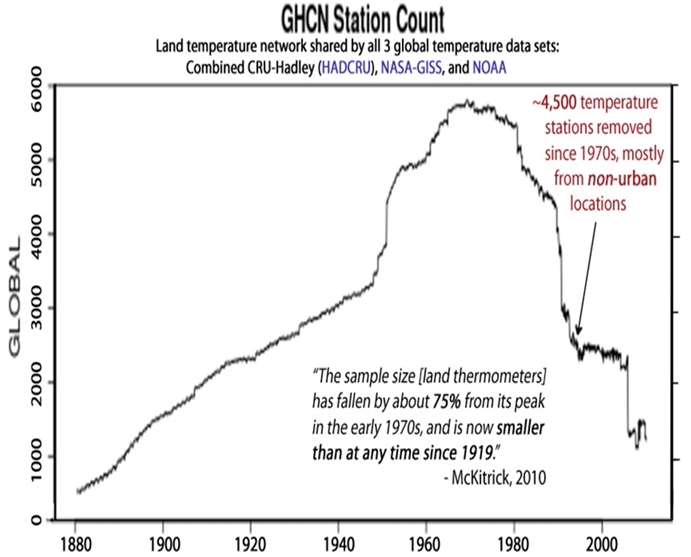
Since 2018, Dr Soon and his partners have analysed the data from rural and urban temperature recording stations in China, the USA, the Arctic, and Ireland. The number of stations with reliable temperature records in these areas increased from very few in the mid-19th Century to around 4,000 in the 1970s before decreasing to around 2,000 by the 1990s. The rural temperature recording stations with good records peaked at 400 and are presently around 200.
Their analysis of individual stations needs to account for any variation in their exposure to the Sun due to changes in their location, OR shadowing due to the construction of nearby buildings, OR nearby vegetation growth. The analysis of rural temperature stations is further complicated as over time many are encroached by nearby cities. Consequently, the data from such stations needs to be shifted at certain dates from the rural temperature database to either an intermediate database or to a full urban database. Consequently, an accurate analysis of the temperature records of each recording station is a time-consuming task.
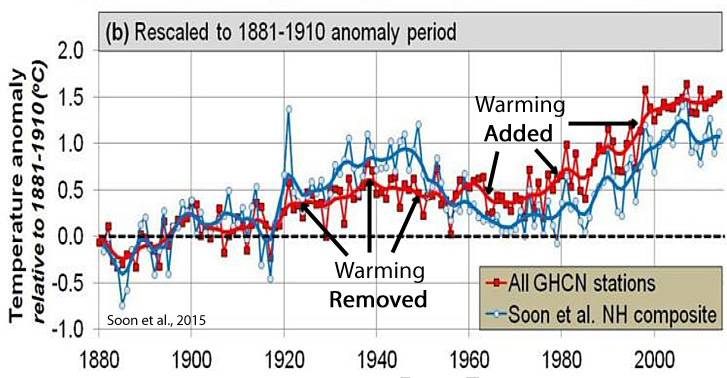
This new analysis of 4,000 temperature recording stations in China, the USA, the Arctic, and Ireland shows a warming trend of 0.89ºC per century in the urban stations that is 1.61 times higher that a warming trend of 0.55ºC per century in the rural stations. This difference is far more significant than the 10 per cent divergence between urban and rural stations alleged in the IPCC reports; a divergence explained by a potential flaw in the IPCC’s methodology. The IPCC uses a technique called homogenisation that averages the rural and urban temperatures in a particular region. This method distorts the rural temperature records as over 75 per cent of the temperature records used in this homogenisation methodology are urban stations. So, a methodology that attempts to statistically identify and correct some biases that may be in the raw data, in effect, leads to an urban blending of the rural dataset. This result is biased as it downgrades the actual values of each rural temperature station. In contrast, Dr Soon and his coworkers avoided homogenisation so the temperature trends they identify for each rural region are accurate as the rural data are not distorted by the readings from nearby urban stations.
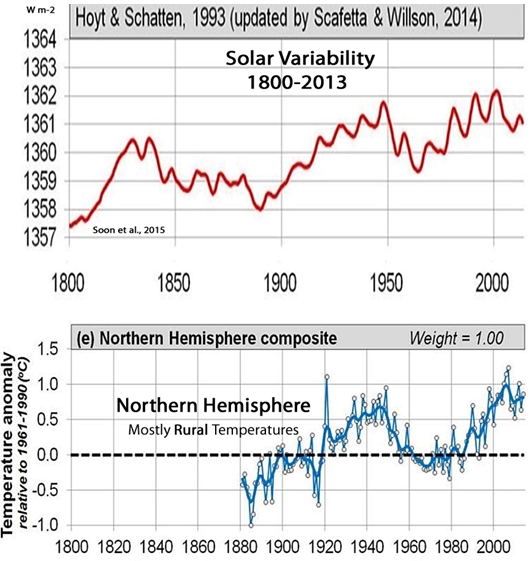
The rural temperature trend measured by this new research is 0.55ºC per century and it indicates the Earth has warmed 0.9ºC since 1850. In contrast, the urban temperature trend measured by this new research is 0.89ºC per century and indicates a much higher warming of 1.5ºC since 1850. Consequently, a distorted urban warming trend has been used by the IPCC to quantify the warming of the whole of the Earth since 1850. The exaggeration is significant as the urban temperature record database used by the IPCC only represents the temperatures on 3-4 per cent of the Earth’s land surface area; an area less than 2 per cent of the Earth’s total surface area. During the next few years, Dr Willie Soon and his research team are currently analysing the meta-history of 800 European temperature recording stations. When this is done their research will be based on very significant database of Northern Hemisphere rural and urban temperature records from China, the USA, the Arctic, Ireland, and Europe.

This new research has unveiled another flaw in the IPCC‘s temperature narrative as trend lines in its revised temperature datasets are different from those published by the IPCC. For example, the rural records now show a marked warming trend in the 1930s and 1940s while there is only a slight warming trend in the IPCC dataset. The most significant difference is the existence of a marked cooling period in the rural dataset for the 1960s and 1970s that is almost absent in the IPCC’s urban dataset. This later divergence upsets the common narrative that rising carbon dioxide levels control modern warming trends. For, if carbon dioxide levels are the driver of modern warming, how can a higher rate of increasing carbon dioxide levels exist within a cooling period in the 1960s and 1970s while a lower increasing rate of carbon dioxide levels coincides with an earlier warming interval in the 1930s and 1940s? Or, in other words, how can carbon dioxide levels increasing at 1.7 parts per million per decade cause a distinct warming period in the 1930s and 1940s while a larger increasing rate of 10.63 parts per million per decade is associated with a distinct cooling period in the 1960s and 1970s! Consequently, the research of Willie Soon and his coworkers is discrediting, not only the higher rate of global warming trends specified in IPCC Reports, but also the theory that rising carbon dioxide levels explain modern warming trends; a lynchpin of IPCC science for the last 25 years.
Willie Soon and his coworkers maintain that climate scientists need to consider other possible explanations for recent global warming. Willie Soon and his coworkers point to the Sun, but the IPCC maintains that variations in Total Solar Irradiance (TSI) are over eons and not over shorter periods such as the last few centuries. For that reason, the IPCC point to changes in greenhouse gases as the most obvious explanation for global warming since 1850. In contrast, Willie Soon and his coworkers maintain there can be short-term changes in solar activity and, for example, refer to a period of no sunspot activity that coincided with the Little Ice Age in the 17th Century. They also point out there is still no agreed average figure for Total Solar Irradiance (TSI) despite 30 years of measurements taken by various satellites. Consequently, they contend research in this area is not settled.
The CERES-SCIENCE research project pioneered by Dr Willie Soon and the father-son Connolly team has questioned the validity of the high global warming trends for the 1850-present period that have been published by the IPCC since its first report in 1992. The research also queries the IPCC narrative that rising greenhouse gas concentrations, particularly carbon dioxide, are the primary driver of global warming since 1850. That narrative has been the foundation of IPCC climate science for the last 40 years. It will be interesting to see how the IPCC’s 7th Assessment Report in 2029 treats this new research that questions the very basis of IPCC’s climate science.
Abstract
A statistical analysis was applied to Northern Hemisphere land surface temperatures (1850–2018) to try to identify the main drivers of the observed warming since the mid-19th century. Two different temperature estimates were considered—a rural and urban blend (that matches almost exactly with most current estimates) and a rural-only estimate. The rural and urban blend indicates a long-term warming of 0.89 °C/century since 1850, while the rural-only indicates 0.55 °C/century. This contradicts a common assumption that current thermometer-based global temperature indices are relatively unaffected by urban warming biases.
Three main climatic drivers were considered, following the approaches adopted by the Intergovernmental Panel on Climate Change (IPCC)’s recent 6th Assessment Report (AR6): two natural forcings (solar and volcanic) and the composite “all anthropogenic forcings combined” time series recommended by IPCC AR6. The volcanic time series was that recommended by IPCC AR6. Two alternative solar forcing datasets were contrasted. One was the Total Solar Irradiance (TSI) time series that was recommended by IPCC AR6. The other TSI time series was apparently overlooked by IPCC AR6. It was found that altering the temperature estimate and/or the choice of solar forcing dataset resulted in very different conclusions as to the primary drivers of the observed warming.
Our analysis focused on the Northern Hemispheric land component of global surface temperatures since this is the most data-rich component. It reveals that important challenges remain for the broader detection and attribution problem of global warming: (1) urbanization bias remains a substantial problem for the global land temperature data; (2) it is still unclear which (if any) of the many TSI time series in the literature are accurate estimates of past TSI; (3) the scientific community is not yet in a position to confidently establish whether the warming since 1850 is mostly human-caused, mostly natural, or some combination. Suggestions for how these scientific challenges might be resolved are offered.
Thomas Allmendinger is a Swiss physicist educated at Zurich ETH whose practical experience is in the fields of radiology and elemental particles physics. His complete biography is here.
His independent research and experimental analyses of greenhouse gas (GHG) theory over the last decade led to several published studies, including the latest summation The Real Origin of Climate Change and the Feasibilities of Its Mitigation, 2023, at Atmospheric and Climate Sciences journal. The paper is a thorough and detailed discussion of which I provide here the abstract and the excerpt describing the experiment. Excerpts are in italics with my bolds and added images. Full post is Experimental Proof Nil Warming from GHGs.
The actual treatise represents a synopsis of six important previous contributions of the author, concerning atmospheric physics and climate change. Since this issue is influenced by politics like no other, and since the greenhouse-doctrine with CO2 as the culprit in climate change is predominant, the respective theory has to be outlined, revealing its flaws and inconsistencies.
But beyond that, the author’s own contributions are focused and deeply discussed. The most eminent one concerns the discovery of the absorption of thermal radiation by gases, leading to warming-up, and implying a thermal radiation of gases which depends on their pressure. This delivers the final evidence that trace gases such as CO2 don’t have any influence on the behaviour of the atmosphere, and thus on climate.
But the most useful contribution concerns the method which enables to determine the solar absorption coefficient βs of coloured opaque plates. It delivers the foundations for modifying materials with respect to their capability of climate mitigation. Thereby, the main influence is due to the colouring, in particular of roofs which should be painted, preferably light-brown (not white, from aesthetic reasons).
It must be clear that such a drive for brightening-up the World would be the only chance of mitigating the climate, whereas the greenhouse doctrine, related to CO2, has to be abandoned. However, a global climate model with forecasts cannot be aspired to since this problem is too complex, and since several climate zones exist.
If the warming-up behaviour of gases has to be determined by temperature measurements, interference by the walls of the gas vessel should be regarded since they exhibit a significantly higher heat capacity than the gas does, which implicates a slower warming-up rate. Since solid materials absorb thermal radiation stronger than gases do, the risk exists that the walls of the vessel are directly warmed up by the radiation, and that they subsequently transfer the heat to the gas. And finally, even the thin glass-walls of the thermometers may disturb the measurements by absorbing thermal radiation.
By these reasons, quadratic tubes with a relatively large profile (20 cm) were used which consisted of 3 cm thick plates from Styrofoam, and which were covered at the ends by thin plastic foils. In order to measure the temperature course along the tube, mercury-thermometers were mounted at three positions (beneath, in the middle, and atop) whose tips were covered with aluminum foils. The test gases were supplied from steel cylinders being equipped with reducing valves. They were introduced by a connecter during approx. one hour, because the tube was not gastight and not enough consistent for an evacuation. The filling process was monitored by means of a hygrometer since the air, which had to be replaced, was slightly humid. Afterwards, the tube was optimized by attaching adhesive foils and thin aluminum foils (see Figure 13). The equipment and the results are reported in [21].

Figure 13. Solar-tube, adjustable to the sun [21].
The initial measurements were made outdoor with twin-tubes in the presence of solar light. One tube was filled with air, and the other one with carbon-dioxide. Thereby, the temperature increased within a few minutes by approx. ten degrees till constant limiting temperatures were attained, namely simultaneously at all positions. Surprisingly, this was the case in both tubes, thus also in the tube which was filled with ambient air. Already this result delivered the proof that the greenhouse theory cannot be true. Moreover, it gave rise to investigate the phenomenon more thoroughly by means of artificial, better defined light.

Figure 14. Heat-radiation tube with IR-spot [21].
Accordingly, the subsequent experiments were made using IR-spots with wattages of 50 W, 100 W and 150W which are normally employed for terraria (Figure 14). Particularly the IR-spot with 150 W lead to a considerably higher temperature increase of the included gas than it was the case when sunlight was applied, since its ratio of thermal radiation was higher. Thereby, variable impacts such as the nature of the gas could be evaluated.
Due to the results with IR-spots at different gases (air, carbon-dioxide, the noble gases argon, neon and helium), essential knowledge could be gained. In each case, the irradiated gas warmed up until a stable limiting temperature was attained. Analogously to the case of irradiated coloured solid plates, the temperature increased until the equilibrium state was attained where the heat absorption rate was identically equal with the heat emission rate.

Figure 15. Time/temperature-curves for different gases [21] (150 W-spot, medium thermometer-position).
As evident from the diagram in Figure 15, the initial observation made with sunlight was approved that pure carbon-dioxide was warmed up almost to the same degree as air does (whereby ambient air only scarcely differed from a 4:1 mixture between nitrogen and oxygen). Moreover, noble gases absorb thermal radiation, too. As subsequently outlined, a theoretical explanation could be found thereto.
Conclusion
Finally, the theoretically suggested dependency of the atmospheric thermal radiation intensity on the atmospheric pressure could be empirically verified by measurements at different altitudes, namely in Glattbrugg (430 m above sea level and on the top of the Furka-pass (2430 m above sea level), both in Switzerland, delivering a so-called atmospheric emission constant A ≈ 22 W·m−2•bar−1•K−0.5. It explained the altitude-paradox of the atmospheric temperature and delivered the definitive evidence that the atmospheric behavior, and thus the climate, does not depend on trace gases such as CO2. However, the atmosphere thermally reradiates indeed, leading to something similar to a Greenhouse effect. But this effect is solely due to the atmospheric pressure.
Changes in CO2 follow changes in global temperatures on all time scales, from last month’s observations to ice core datasets spanning millennia. Since CO2 is the lagging variable, it cannot logically be the cause of temperature, the leading variable. It is folly to imagine that by reducing human emissions of CO2, we can change global temperatures, which are obviously driven by other factors. Most recent post on this:

Figure 1. Anthropic and natural contributions. (a) Locked scaling factors, weak Pre Industrial Climate Anomalies (PCA). (b) Free scaling, strong PCA
In 2009, the iconic email from the Climategate leak included a comment by Phil Jones about the “trick” used by Michael Mann to “hide the decline,” in his Hockey Stick graph, referring to tree proxy temperatures cooling rather than warming in modern times. Now we have an important paper demonstrating that climate models insist on man-made global warming only by hiding the incline of natural warming in Pre-Industrial times. The paper is From Behavioral Climate Models and Millennial Data to AGW Reassessment by Philippe de Larminat. H/T No Tricks Zone. Excerpts in italics with my bolds.
Context. The so called AGW (Anthropogenic Global Warming), is based on thousands of climate simulations indicating that human activity is virtually solely responsible for the recent global warming. The climate models used are derived from the meteorological models used for short-term predictions. They are based on the fundamental and empirical physical laws that govern the myriad of atmospheric and oceanic cells integrated by the finite element technique. Numerical approximations, empiricism and the inherent chaos in fluid circulations make these models questionable for validating the anthropogenic principle, given the accuracy required (better than one per thousand) in determining the Earth energy balance.
Aims and methods. The purpose is to quantify and simulate behavioral models of weak complexity, without referring to predefined parameters of the underlying physical laws, but relying exclusively on generally accepted historical and paleoclimate series.
Results. These models perform global temperature simulations that are consistent with those from the more complex physical models. However, the repartition of contributions in the present warming depends strongly on the retained temperature reconstructions, in particular the magnitudes of the Medieval Warm Period and the Little Ice Age. It also depends on the level of the solar activity series. It results from these observations and climate reconstructions that the anthropogenic principle only holds for climate profiles assuming almost no PCA neither significant variations in solar activity. Otherwise, it reduces to a weak principle where global warming is not only the result of human activity, but is largely due to solar activity. Full post is here:
via Science Matters
November 27, 2024 at 12:11PM

