Return Funding for Reliable Energy to the World’s Poorest

By Brenda Shaffer

A centerpiece of President Biden’s agenda was a government led effort to greatly reduce production and consumption of fossil fuels. One of the key policies Biden enacted to pursue this goal was ending of public finance for fossil fuel projects.  This policy  attracted little public attention or scrutiny, since it had little impact on Americans. The policy mainly impacted the global poor, especially in Africa, which lost access to funding to develop electricity capacity. While ending public finance for fossil fuels provided a feel good moment for the Biden administration and governing elites in  other wealthy countries, it hurt the world’s poorest, did not impact climate change and created an opportunity for China to increase its geopolitical influence in Africa and beyond. Cancellation of  these restrictions on public finance for fossil fuels should be on the day one list of the incoming Trump administration.

States in the developing world have difficulty attracting commercial investments in their domestic energy sectors, especially for electricity provision. While rich countries that pay high prices for electricity can rely on the private market to develop power capacity, developing  countries  rely on loans and grants from public finance institutions, like the World Bank and regional development banks, and foreign aid to develop electricity for their populations. 

In 2021, the United States together with the G-7, ended finance and loans for fossil fuel based energy projects, leaving the developing world with few finance options for electricity development, which is key to economic growth and poverty reduction. As part of Washington’s climate policies, in August 2021, the U.S. Department of the Treasury announced guidelines to Multilateral Development Banks stating that the “United States will promote ending international financing of carbon-intensive fossil fuel-based energy.” The U.S. has top influence at the multilateral banks, as the main donor thus frequently the World Bank adopts U.S. led policies.  In 2019, the  World Bank had already stopped funding for fossil fuel production. In December   2021, the G-7  member countries formally ended public finance for fossil fuel projects, including natural gas. At the UK sponsored COP26 in Glasgow, the signatories declared: “we will end new direct public support for the international unabated fossil fuel energy sector within one year of signing this statement.

Through cutting finance to fossil fuels, the Biden administration and the G-7 states believed they could force the developing world to establish renewable projects instead of fossil fuel based electricity. However, most countries rejected this offer. Their energy professionals understood better than the bureaucrats sitting in Washington or Brussels, that today’s renewable energy cannot provide the stable and affordable power that will allow their publics to move up out of poverty. Moreover, wind and solar require baseload power from fossil fuels to provide constant power. Thus, even renewable projects require funding for fossil fuels.

Reducing access to fossil fuels does not mean that pollution and emissions will decrease. In fact, lack of access to stable and affordable electricity produced from fossil fuels, will likely lead to an increase in pollution, emissions and threats to public health. Humans need energy for basic functions, such as heating, cooking and purifying water. If energy is not available, humans will burn dung, lump coal, wood  and other biomass. This generates greater pollution, carbon emissions and health threats, than production of electricity from fossil fuels, especially natural gas.

There are several  geopolitical implications of the West’s halting of public finance. One, China can reap geopolitical influence through its role as the main funder for energy projects in the developing world.  Second, the West’s retreat from finance for fossil fuel projects  can generate antagonism in the developing world against the West, as indifferent to the suffering caused by energy poverty. Third,  lack of reliable power in the developing world contributes to increased instability in many affected parts of the globe. Fourth, the cessation of public finance for fossil fuels can lead to a  slowdown in expanding electricity access in the developing world. For the first time in close to a  century, global electricity access declined in 2022 and in 2023 it remained close to flat.  Today,  one in ten people on the globe do not have access to regular electricity.

The new administration  should overturn this prohibition and encourage the G-7 to do the same. The new administration should clarify to the World Bank its support for funding for natural gas and other fossil fuel projects that would benefit the world’s poor. Luckily, Trump’s nominee for Secretary of Energy, Chris Wright is passionate about extending energy access to the world’s poor and has been involved in philanthropy that enables clean cooking for many years.

Reversing this policy and many other Biden era energy policies will not be simple. While some energy policies can be eliminated through Congressional legislation  and executive orders, the ban on public finance for fossil fuels was adopted by multi-lateral frameworks, including the G-7, and international agencies, such as the World Bank. The Trump administration will encounter headwinds in attempt to change the policies. It is important to clarify widely that these policies have hurt the world’s poor and need to be reversed. Washington should consider withholding funding to agencies it funds that deny the world’s poor access to funding for electricity.

Prof. Brenda Shaffer is a faculty member of the U.S. Naval Postgraduate School, Senior Advisor for Energy at the Foundation for Defense of Democracies, and a Senior Fellow at the Atlantic Council’s Global Energy Center.

This article was originally published by RealClearEnergy and made available via RealClearWire.

via Watts Up With That?

https://ift.tt/4HIvDlE

November 26, 2024 at 04:03PM

Biden’s Existential Threat

Democrats say a one part per ten thousand increase in CO2 over the past century is an existential threat to the human race, but they seem to be unconcerned about the effects of a nuclear war.

About Tony Heller

Just having fun

This entry was posted in Uncategorized. Bookmark the permalink.

via Real Climate Science

https://ift.tt/oFm8bd2

November 26, 2024 at 03:44PM

Labour has just revealed the full cost of net zero

By Paul Homewood


h/t Paul Kolk


 image

Les jeux sont faits, Ed Miliband. The chips are down, the game is up. We knew Labour was no closer to solving the energy trilemma than scientists are to explaining dark matter. That, for now, we cannot have net-zero emissions, security of supply and affordability. We knew that using public money to import gas to manufacture CO2 was less a display of moral leadership on climate change than it was brazen hypocrisy.

Perhaps most importantly, we knew that the pursuit of net-zero policies, regardless of cost, would impact our lives in ways the gentleman in Whitehall could not possibly foresee. It already is, as anyone who has driven into a clean air zone can attest. Yet the ruling class insisted on living in some alternate reality where there were no trade-offs; just cheap, abundant, secure renewables.

So we should thank Bill Esterson, Labour chair of the Commons Energy Security and Net Zero Committee, for letting the cat out of the bag. “We will all have to change our lives” if we are to decarbonise the grid by 2030, he has just admitted. Keir Starmer is offering no such candour; at Cop29, the climate jamboree many world leaders had the good sense to snub, the Prime Minister not only set us another target (an 81 per cent reduction in emissions by 2035), but peddled the line that he “won’t be telling people how to behave”.

This will surely only be true in the most literal sense. Impose congestion charges in British cities, and people might be forced to travel by other means, or not at all. Foist mandates on car manufacturers to sell a certain number of EVs on penalty of hefty fines, and they may be forced to cut sales of petrol vehicles, pushing prices up and consumers out. Introduce green levies on energy bills – they now make up 16 per cent of electricity bills – and households will have to cut spending elsewhere. Did the Government “tell” us to change our behaviour? No, it just left us with no alternative.

And we are only in the foothills of the transition. Yes, the UK last year became the first country to halve its emissions since 1990 – a milestone about which the eco-zealots remained surprisingly quiet. But this was achieved by accelerating existing trends, such as abandoning much domestic production, and we could rely on renewables because fossil fuels were there to provide baseload power. The next half will be far more painful – though the climate cult will likely dismiss such concerns, insisting that clean energy sources are “cheap” and jobs will be provided aplenty.

Clearly, when wind turbines are running the marginal cost of energy produced is close to zero, whilst energy produced by gas has a positive marginal cost because we have to purchase the fuel. But gas-fired power stations are easy to build and link to the grid. Wind turbines, on the other hand, are costly to install and maintain, especially offshore. They don’t have a long life, are in places far from population centres, and are expensive to link to the grid. They also need backup when the wind doesn’t blow, or if it blows too hard. But these issues are hidden by government subsidy and delusional eco-hype.

Yet the Tories are hardly in a position to challenge it – assuming they want to. The timetable they set for the transition to clean energy was excessively ambitious. They did nothing about the 2008 Climate Change Act, failed to dismantle the supposedly independent Climate Change Committee, and enshrined the Net Zero by 2050 target in law. As a result, the country that birthed the industrial revolution and created the oil refineries and steelworks that transformed people’s lives, now has the world’s highest electricity prices – and only the ghost of an industrial sector.

Some 199 years ago, the first steam locomotive carried passengers in the North East. Why did this breakthrough happen on our small island? For the same reason we pioneered large factories, mass electrification and gas for cooking: because we had cheap coal. No country in the world has ever prospered without affordable and abundant energy. That Labour fails to accept this is as alarming as its belief you can grow an economy by lavishing money on the public sector. It is making us poorer by the day, telling us we’re imagining it – and then giving an exasperated sigh when we complain.

“The clean energy transition is unstoppable,” said the fanatical Miliband yesterday, as Vauxhall announced the closure of its Luton factory. “Unstoppable because clean energy is the route to energy security. Unstoppable because it is the economic opportunity of our time.” A noble lie is still a lie.

https://www.telegraph.co.uk/news/2024/11/26/ed-miliband-hammering-final-nail-in-britains-coffin-labour/

via NOT A LOT OF PEOPLE KNOW THAT

https://ift.tt/xaU8pFv

November 26, 2024 at 03:16PM

Why Mars? Because the first trillionaires might be mining $100 Quadrillion dollar asteroids

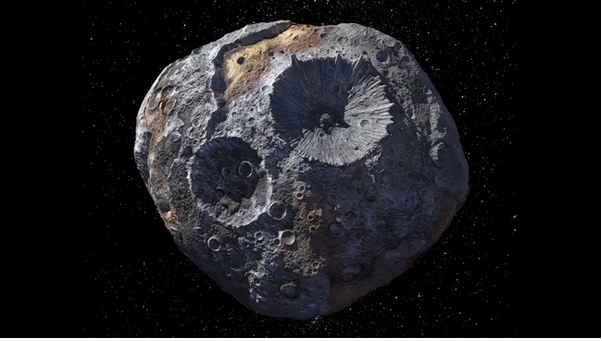
Psyche Asteroid

16-Psyche asteroid, theoretically (possibly) a mine worth $100 Quadrillion dollars (Image: NASA/JPL-Caltech/ASU)

By Jo Nova

Thanks to Elon, many people are wondering “Why Mars?” and the answer might be “mining the asteroids”

Devon Eriksen compares the race to space with the industrial revolution. Just as wood, coal and oil set us free of lives of  manual labor, a whole new set of materials beckon… if minerals that are rare and expensive on Earth can be mined in the asteroid belt, and processed on Mars, all kinds of new tools and toys may follow the boom.

The Earth, Eriksen says, is like a jar that’s been shaken until most of the heavy stuff settles to the bottom. The heavy metals mostly end up in the Earths core, with the lighter stuff on top. But apart from the distance, asteroids have easy access goods, and are split already into handy size chunks, conveniently parked out in the open, far from gravity wells and not hidden under crustal plates, oceans and magma. The rocks underfoot are technically closer but it might be a lot cheaper to get the rare metals we need on asteroids than out of our core.

The 16-Psyche asteroid is one of the bigger ones, at 279 km across, or 173 miles, and spectroscopic analysis and radar indicates it’s mostly metal.  Judging by other bits of meteorites that fall on Earth, speculation is rife that Psyche contains nickel, iron, and things like palladium and platinum, but of course, no one knows.

Humanity has collected so far all of 255 grams of asteroid space rock (5g from a Japanese launch and 250g from NASA). But China plans to launch Tianwen-2 next year and collect samples from the near-Earth asteroid 469219 Kamoʻoalewa.

The race is on:

By Devon Eriksen, Substack

The first entity to establish a Mars colony will be the universe’s first trillionaire

Earth is a metal-poor, heavy-element-poor environment.

We just don’t think of it that way because it’s what we are used to. And it’s a major bottleneck holding our industrial development back. Not because these elements will run out, but because the expense of extracting them limits availability, and drives costs up.

Well, the mass of the asteroid belt is roughly 0.05% of Earth’s mass. But, unlike the Earth, the asteroid belt isn’t a big lump of material, sitting in its own steep gravity well. It’s a powder. A spray of fine dust orbiting the sun. The largest asteroid is only about the size of Texas, and most are much smaller.

One single asteroid, 16 Psyche, some 140 miles across, has an estimated value at today’s market prices of 100 quadrillion dollars. You read that right. That’s roughly 900 times the value of the entire world economy.

On Earth we live at the bottom of a deep gravity well, and all the hard part of a journey to the asteroids is just getting out of the driveway accelerating at 10 meters per second per second. But Mars has a much smaller gravity well, and suddenly so much more interaction with space is possible:

… Mars’s gravity acceleration is about a third of Earth’s. A little over 3.5 m/s². Rocket science is not so difficult on Mars. [Closed caption for the hard-of-thinking: Devon is speaking comparatively. Rocket engineering is still difficult.]

So if you think SpaceX can move stuff to Earth orbit cheaply now, with their fancy reusable rocket boosters, and all their lightyears-ahead-of-NASA space tech, and their $2 million dollar Starship launches, you ain’t seen nothing yet.

On Mars, with its ⅓ gravity, and thin atmosphere, you wouldn’t even need a rocket to achieve escape velocity.

It’s the fact that here you have a planet, where people can live in sealed habitats (above or below the surface), and it’s really, really easy to throw things into space, and get them to and from the asteroid belt.

In other words, if Earth is the suburbs, and the Belt is the mine, Mars is your industrial zone.

Hell, you don’t even need to mine asteroids in place.

Depending on the delta-v cost, you can just attach boosters to your smaller rocks and push them right into Mars orbit. It’s called a Hohmann transfer. But whether you are moving metal from a mobile refinery, raw ore, or entire rocks, cargo is cheap to move in space, at least compared to space launch from Earth’s surface.

Space isn’t an ocean, you see. There are no waves, your cargo can’t sink, and there’s no air to slow it down. So you don’t load it up into a ship, and sail the ship somewhere.

There’s no place like space for those self-driving vehicles.

h/t to David E


0 out of 10 based on 0 rating

via JoNova

https://ift.tt/hNmJQ0C

November 26, 2024 at 01:02PM