Direct air capture (DAC) of CO2 looks like a non-starter at any serious scale. MiT says: ‘For example, one recently proposed design for capturing 1 million metric tons of CO2 per year would require an “air contactor” equivalent in size to a structure about three stories high and three miles long.’ Major problems are also found with energy use, siting/storage and high costs. Although MiT believes in greenhouse gas ’emissions’ removal as an idea, current practicalities tend to undermine it even for such believers. Not wishing to sound too negative, the researchers suggest DAC might somehow become more viable with (unknown) future technical developments, but that won’t impress climate alarmists much.
– – –
In 2015, 195 nations plus the European Union signed the Paris Agreement and pledged to undertake plans designed to limit the global temperature increase to 1.5°C, says MiT research (via Phys.org).
Yet in 2023, the world exceeded that target for most, if not all of, the year—calling into question the long-term feasibility of achieving that target.
To do so, the world must [Talkshop comment – says who?] reduce the levels of greenhouse gases in the atmosphere, and strategies for achieving levels that will “stabilize the climate” have been both proposed and adopted.
Many of those strategies combine dramatic cuts in carbon dioxide (CO2) emissions with the use of direct air capture (DAC), a technology that removes CO2 from the ambient air.
As a reality check, a team of researchers in the MIT Energy Initiative (MITEI) examined those strategies, and what they found was alarming: The strategies rely on overly optimistic—indeed, unrealistic—assumptions about how much CO2 could be removed by DAC.
As a result, the strategies won’t perform as predicted.
. . . The bottom line
In their paper, the MITEI team calls DAC a “very seductive concept.” Using DAC to suck CO2 out of the air and generate high-quality carbon-removal credits can offset reduction requirements for industries that have hard-to-abate emissions. By doing so, DAC would minimize disruptions to key parts of the world’s economy, including air travel, certain carbon-intensive industries, and agriculture.
However, the world would need to generate billions of tons of CO2 credits at an affordable price. That prospect doesn’t look likely. The largest DAC plant in operation today removes just 4,000 tons of CO2 per year, and the price to buy the company’s carbon-removal credits on the market today is $1,500 per metric ton.
BY DARRIN FIFE: Repowering Palisades Nuclear Power Plant is a good thing for the community of western Michigan as it will help provide reliable, clean, and safe energy for the coming decades.
That is the future of electricity production. It would seem that, belatedly, our leaders have realised that renewables simply won’t do the job of producing reliable electricity, according to this piece:
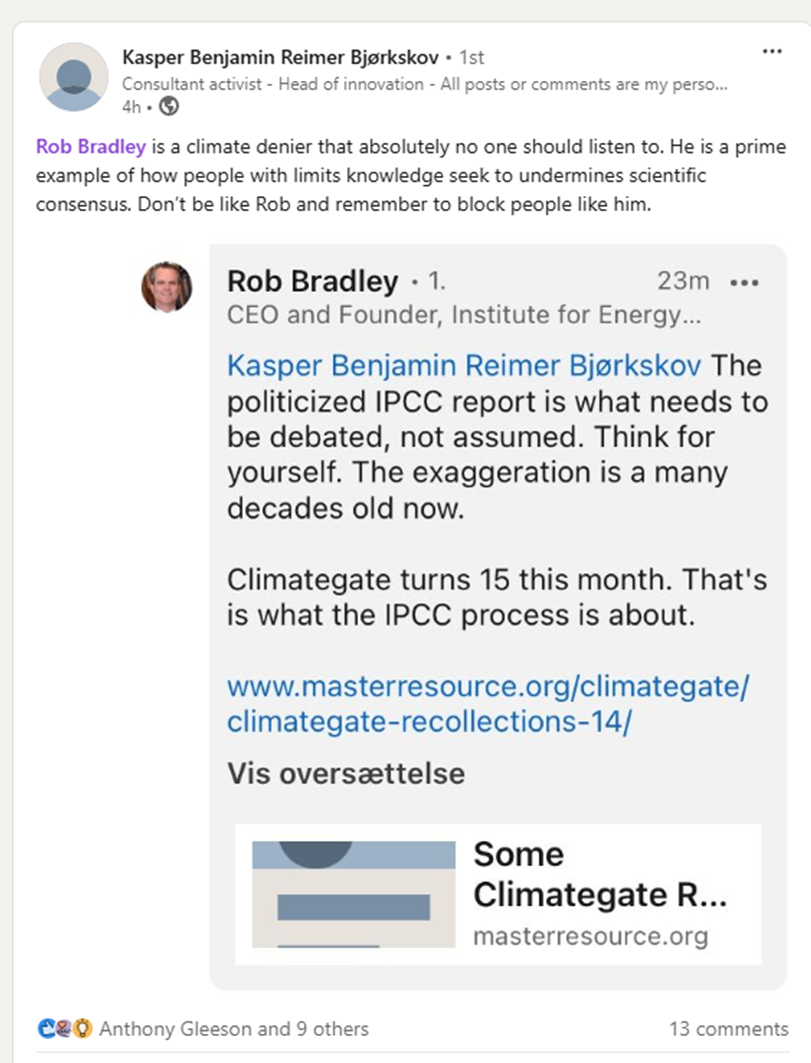
Ed. Note: The links below have been blocked against Bradley. They might work for you. If so, feel free to bring up this debate and post with the principals.
I responded: “Ad hominem? Let’s debate. I’ve worked with dozens of mainstream scientists over the decades to reach my conclusions, which can be found in this 2003 primer for the IEA of London.”
Why should we block him? Debate him with facts. That would expose him.
Or ignore him. Blocking him is a sign of weakness unless he poses a security issue for you. It will just add fuel to his cause.
Social media is the modern day Collosseum. Where we can debate in front of an international audience. And where the best debater will win. Blocking is akin to running away from the battle.
Bjørkskov will have none of it: “the only way to ensure they don’t get more reach is to stop engaging, that not an opinion that’s a fact….” He added in another comment: “… he is using it as a way to undermine the dangerous of Climate Change and is actively talking about expanding fossil fuels”
nope. European, North American, Australian and Kiwi climate change activists are failing the planet by not openly and transparently debating the subject, citing uncomfortable questions. Are we better off than yesterday? The answer is no. And when people do their own research, the facts are not as clear as claimed to be. I am not talking about whether climate change is real or not. But how to resolve the problem. The moment someone challenges the thinking of someone from the Global North, the debate is shut down. This is not a healthy approach. Only an inclusive movement will move the needle!
Bjørkskovresponded: “there is not point in debating people being payed to spread misinformation the last 30 years of media coverage proved this. So no it’s not a sign of weakness to ensure that deniers are not given a seat at the table it’s a sign of a the opposite.”
we can agree to disagree. And I will not comment again, not to spoil your post. But every inch of space we give, is an advantage we let slip. They have more resources and more people at their disposal. The only way is assymetrical warfare. Keep snapping at their heels with facts. It upsets their rhythm. If you block them, you effectively lose your chance to check them. When we transparently present facts and repeatedly countering every manuevre they put out, then the gloves will come off. The truth cannot be hidden. It can only be suppressed through force. When they do that, we know that we have hit bulls eye. I am not comfortable with many activists like Just stop oil, but they do great service, by disrupting the normal business of things and focus attention on the issues. We have to be relentless, till all defences are overcome.
I would use your very words to argue my position, not yours. Facts is where I start. Climate models with fudge factors are not science because of many things.
Bjørkskov Becomes unhinged toward his critics with further comments:
Bradley Urias joined in: “I have responded to that comment of his with 6 logical fallacies that he made in those short few words and article.”
Bradley Urias: stated his first three points: “This comment contains several logical fallacies. Here’s an analysis of the fallacies in each part:
1. Ad Hominem: Labeling the IPCC report as “politicized” suggests that it cannot be trusted without addressing the scientific content or findings within the report itself. This approach dismisses the IPCC’s conclusions without engaging with the evidence, implying bias rather than providing specific critiques of the science presented. 2. Appeal to Tradition: The claim that “the exaggeration is many decades old” implies that because climate change concerns have been raised for a long time, they must be exaggerated or incorrect. This fallacy assumes that longstanding claims are inherently flawed or overblown without providing evidence against the current scientific consensus. 3. Red Herring: Mentioning “Climategate” shifts the focus from the validity of climate science to a past controversy that has since been investigated and largely discredited. Independent investigations found that “Climategate” did not undermine the scientific evidence for climate change. Bringing it up distracts from the core issues in the climate debate today.
1. The IPCC report is very politicized from the Executive Summary cherry picking alarmism and not mentioning its science against alarmism. A whole new ES could be constructed from the Skeptic side.
Importantly, climate models are relied upon that do not have known (unknown) physics in them. This is a whole debate that gets to cloud feedbacks, the SO2 offset, etc. Data on weather extremes trumps high-sensitivity climate models any day, Data, data ….
2. The exaggeration of climate models and climate activists are legion (John Holdren, Al Gore, James Hansen, etc.). And don’t forget the Malthusian global cooling scare led by Steve Schneider and picked up in the mainstream press.
3. No, Climategate was not “a past controversy that has since been investigated and largely discredited.” The sentences, quotations, and context speak for themselves. Michael Mann cheated and was called out by his colleagues in real time. Fred Pearce provided a fair analysis in his book.
4. Guilt by Association: Referring to “Climategate” as what “the IPCC process is about” implies that because a few scientists were accused of misconduct, the entire IPCC process is flawed. This fallacy unfairly extends accusations from individuals to an entire institution, disregarding the IPCC’s rigorous review processes and thousands of contributing scientists.
5. Appeal to Skepticism: Statements like “Think for yourself” imply that questioning climate science is inherently more valid than trusting scientific consensus. While critical thinking is important, this approach often disregards the value of expert analysis and peer-reviewed research. It suggests that personal intuition is more reliable than scientific evidence, undermining the scientific method.
6. Appeal to Authority (of an Unreliable Source): The commenter links to an article from a site known for promoting climate change skepticism rather than peer-reviewed scientific sources. This appeal to an unreliable authority detracts from a balanced discussion, as it draws on biased sources instead of credible scientific evidence.
These fallacies misdirect from a genuine examination of climate science to generalized distrust and unsupported skepticism.
4. Climategate was mainstream IPCC leadership. And they promised to pervert the peer review process also. The ‘skeptic’ side has long disengaged from the IPCC process. The alarmists (governments too) also pervert the Summary leave a lot of good science in the main document.
5. The Malthusian consensus has been wrong since the 1960s. Mainstream and exaggerated. One has to vigorously examine the arguments from the other side to defuse the alarmism. I have tried to do that for most of this time. Also, the scientific method does not apply to climate models but applies to CO2 science under laboratory conditions. Good news for CO2 there.
6. Arguments above. And there is peer-reviewed science questioning climate alarmism in its parts that maybe will get a fair hearing in the climate press with the political turn. Data over climate models. Time series data refutes a lot of weather extreme alarmism. Begin with data, not model predictions.