
0 out of 10 based on 0 rating
via JoNova
November 19, 2024 at 09:13AM

52.61189 -0.46793 Met Office Assessed CIMO Class 1 Installed 1/1/1955
This is a typical UK military airfield site – there are surprisingly over 120 such locations. The above circle delineates a 100 metre radius from the Stevenson Screen. If it comes down to pernickety measurements this possibly should be more correctly defined as Class 2. However, it would still be accurate enough for good quality data recording and the site, as with all military sites, is impeccably maintained. The historic data record from such a site should be equally impeccable, however………
Tim Channon reviewed the site back in 2012 arriving at a completely different assessment

Obviously Tim was reviewing a different site so the question is had he misidentified the location? That seems highly unlikely as he would have used the Met Office location co-ordinates given at the time and the image above is certainly a weather station site.
What has now become apparent is that there are two separately WMO numbered sites and both of them still seem to be operational in one way or another. WMO03461 appears to have been superseded for historic temperature recording but understandably continued for immediate aviation purposes. The footpath to it is well worn indicating continued regular use.
The headlined Class 1 (2?) WMO03462 is providing recordings to the historic record though this only appears to be from around 1994/5/6 as indicated in the CEDA archived data.

Prior to this archives suggest WMO03461 (different location & different elevation) was the primary source of data.

But there was a not entirely explained relocation in the 1970s

20th Century Met Office protocol regarding identification numbering of sites was stipulated as follows:
“Over time certain instruments, or the whole enclosure, may be relocated some distance away from the original site. Where the distance moved is small, the observations obtained from the new site may have exactly the same climatological characteristics as previously and it makes sense to regard them as coming from the same source or station distinguished by certain identifiers. Where the distance moved is large, or, where the exposure at the new site is sufficiently different that a detectable impact on the measured climatology is judged likely, it is appropriate that observations from the new site are labelled by a different set of identifiers.”
Conclusions that can be drawn from this site review are:
1. The current recording is now from a good quality site.
2. Unfortunately this good site does not have a particularly long term record with its comparative data record under 30 years i.e. less than a climate averaging period.
3. Longer term comparison would not be reliable due to significant location/elevation differences sufficient to require re-identification numbering of sites where ” a detectable impact on the measured climatology is judged likely”.
I would hope these above conclusions were similarly accepted by the current Met Office regime from their own historic guidance though, sadly, I suspect not.
via Tallbloke’s Talkshop
November 19, 2024 at 08:47AM
A recent article posted at a Jacksonville news affiliate website, “News4Jax,” suggests that kids TV shows should push more climate propaganda and environmentalist content in order to “empower” them to act on those issues. This is just advocating for yet more activist content, of which there is already plenty. Young people are already largely afraid of the future, and this will not help.
The article, “Toddlers and TV: Making screentime matter for children concerned about climate change,” quickly introduces the idea that a majority of kids are scared about their futures because of climate change. News4Jax writes that a recent survey found “54% of children are fearful about what climate change will mean for their future,” and goes on to say that television shows “can be a powerful tool for fostering environmental awareness.” The post quotes an educational scientist from the University of Rhode Island who explains how kids’ shows can be used as vehicles for a particular message, and can even make kids “feel like collectively they can do things to help our earth,” or in other words, encourage them to engage in climate activism.
If the goal is to assuage kids’ fears about the future, however, hitting them with yet more climate alarm propaganda is not going to help.
Climate Realism has covered how the media is largely to blame for anxiety and fear surrounding climate change, in posts here, here, and here, among others. The media and educators already are constantly telling kids that the planet is facing an existential threat in climate change, and that their futures are uncertain unless massive world-spanning action occurs to stop it. When that action does not happen, kids become understandably despondent. What makes this so sinister is the fact that the Earth is not, in fact, in existential danger because of the modest warming of the past century or so. Nor is it in danger of becoming unlivable, as the media likes to claim.
Kids are already bombarded with this kind of alarmist language. The news their parents watch and the news that gets pushed to feeds on social media are all constantly filled with climate change related content, tying every bit of less-than-pleasant weather to climate change, as this website constantly covers and refutes. In schools, climate alarmism can be promoted in every single class—including even physical education or gym class—as was the case in certain schools in New Jersey. This kind of bombardment starts on kids as young as elementary school, which the media lauds. Multiple generations of kids have now grown up being told that their future is doomed.
Further, a recently released U.S. Department of Homeland Security report on existential risks finds that climate change does not fall into that category and explains that activists and media enablers making such claims are expressing worldviews, not science.
In reality, climate related deaths are down 99 percent over the past hundred years, world undernourishment is dropping, and the earth is actually becoming more lush with plant life. Extreme weather is not getting worse, either, and neither are wildfires.
Kids do not need yet another source of climate misinformation and alarm in their lives, they already have far too much exposure to it. News4Jax should be more skeptical about this kind of cheerleading for climate content, especially since as a media outlet, they are themselves a major source for kids’ and adults’ unreasonable anxiety about climate change.
via Watts Up With That?
November 19, 2024 at 08:05AM
The Australian Institute of Marine Science (AIMS) put out a media release earlier today claiming to have scientifically documented changes in coral cover for the northern section of the Great Barrier Reef, particularly in the vicinity of Lizard Island. Claims include that:
The losses of coral we’ve recorded so far are significant. Despite these losses, coral cover on most reefs is at moderate levels of between 10 and 30%.
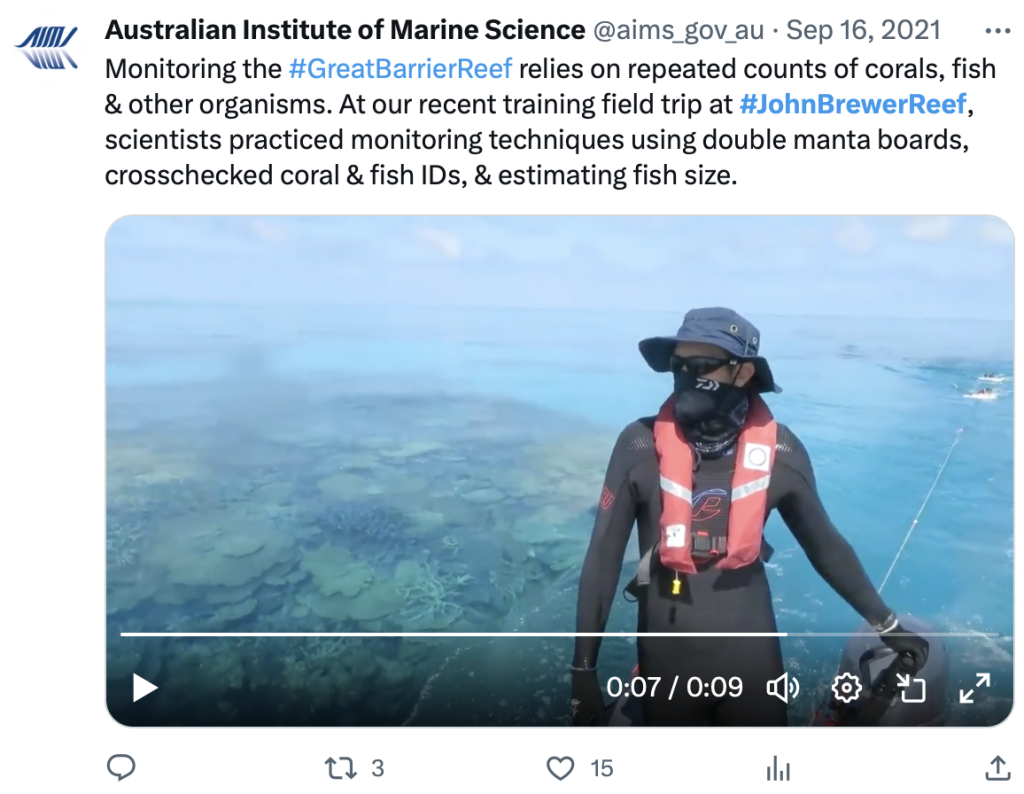
In fact, the method used to survey the corals makes it impossible to determine whether the loss is statistically significance or not, and the surveys were only of the reef perimeters, specifically avoiding habitats with higher levels of coral cover including the reef crest. So, claims that coral cover is between 10 and 30% really needs to be qualified.
Many textbooks have been written about the type of survey needed to know if there is a statistically significant change in some aspect of the distribution and abundance of an organism. This could be the population of a city, or even the extent of coral at the Great Barrier Reef. Knowing the distribution and abundance of organisms and how this might change over time is fundamental to understanding the world around us. It is fundamental to the biological sciences.
Rarely is it possible to count every person or every coral. Instead, scientists rely on samples that must be representative of the entire population of interest, and samples must be large enough to generate meaningful data that gives unbiased results.
A population will always include some natural variability and knowing how this is distributed in space and time is important before any conclusions are drawn about the significance of a perceived increase or deterioration, for example, in the corals.
Importantly, in order to be able to quantify statistical significance the data needs to be gathered as an actual count. By which I mean the number of corals needs to be counted per unit area, and given the extent to which coral cover changes naturally with habitat it is important that the survey method distinguishes between the different habitats at a reef.
Of concern, the long-term monitoring being undertaken by the Australian Institute of Marine Science (AIMS) of coral cover is by way of perimeter surveys that do not include, for example, the reef crest that is often the habitat with the highest coral cover. This is the equivalent of claiming to know how the population of a city has changed but never actually going into the central business district (CBD) or even the inner-city suburbs or industrial area. The AIMS surveys that have been reported upon in the media today are surveys of only the reef perimeter, which is the equivalent of skirting around the outer suburbs of a city and from this limited information having an opinion about how the population of a city might have changed.
It is also very important to note that the data is not collected as an actual count. Rather AIMS coral cover data is categorical data, with the survey collected by towing a person behind a boat and noting whether the extent of the coral cover falls into one of the following categories: 0-10%, 10-30%, 30-50%, 50-75%, 75-100%.
These categories have a very large range, up to 25%. It doesn’t matter how many surveys are undertaken, given the way the data is collected it is impossible to calculate average coral cover. It follows that it will be impossible to know how average coral cover changes.
Because the AIMS coral cover data is categorical data it is not possible to calculate a standard error or any other such statistic. Calculating an uncertainty value, for example a standard error, depends on knowing the sample mean. The method used by AIMS precludes this, it is therefore not possible to draw any conclusions about the statistical significance of the recent survey results.
via Jennifer Marohasy
November 19, 2024 at 05:08AM

