The climate case of the century

by Lucas Bergkamp

On the 12th of November, the Hague Court of Appeal ruled in the “climate case of the century” that Milieudefensie (“FoE”) filed against Shell in 2019. FoE demands that Shell reduce emissions throughout the entire chain by at least 45% by 2030. The foundation “Man & Environment” (M&E) joined the case to represent the interests of Dutch citizens.

The Court of Appeal was not impressed by FoE’s “go green or go extinct” rhetoric and rejected its claims.  Nevertheless, the Court of Appeal’s ruling leaves much to be desired and did not eliminate the threat of activist NGOs launching climate cases to effect “system change,” i.e., set aside democracy, subordinate citizens and destroy the economy.

Climate science

Although M&M had offered strong rebuttals with expert reports, the Court of Appeal uncritically adopted many of FoE’s factual statements about the urgency and seriousness of the climate problem.  In doing so, the Court relied on the authority of the IPCC and the alleged “consensus” that would emerge from their reports, in particular the SPMs.

The Court not only took the IPCC reports as irrebuttable proof, but also attributed normative force to them. For example, the Court ruled that climate scientists have determined that the average temperature on earth may not rise by more than 1.5 degrees. In doing so, the Court, like the Dutch Supreme Court, ignored that science cannot set norms and that scientists are not authorized to set social standards. The Dutch judiciary’s scientistic tendency is extremely worrisome and does not bode well for future climate-related judgments.

Dangerous climate change

A case in point, the Court arrives at the alarmist conclusion that “the climate problem is the biggest problem of our time” and that the danger of climate change is great and even “life-threatening”. Based on the non-factual findings of fact and obligatory references to the Paris climate agreement, the Urgenda judgment and the Klimaseniorinnen ruling of the European Court of Human Rights, the Court confirmed a right to protection against “dangerous climate change.”

“Protection against dangerous climate change,” the Court says, “is a human right,” without any caveats or qualifications. Obviously, realizing this human right will be at the expense of all kinds of other human rights and interests, such as the right to (or interest in) reliable and affordable energy. Inevitably, the right to protection against “dangerous climate change” will harm the realization of other “sustainable development goals.” Although M&E had flagged these kinds of trade-offs extensively, the judges did not bother to deal with these implications of climate morality.

Dog whistle

This new human right must be respected not only by states, but also by large corporations, the Court found.  In civil liability law, this right translates into a duty of care for companies. According to the Court, the Paris goals require measures to reduce the demand for fossil fuels and to limit the supply of fossil fuels. Oil and gas companies should therefore consider “the negative impact on the energy transition when investing in the production of fossil fuels.”

With this line of reasoning, the judgment suggests that “saving the climate” legitimizes creeping expropriation of oil and gas companies. This dog whistle did not escape the attention of FoE’s lawyer, who has hinted at further legal proceedings to prevent the development, expansion and financing of oil and gas production, referring to forthcoming climate finance case against ING, the largest Dutch bank.

Reduction Percentage

FoE lost the case based on two lucid moments of the judges. FoE had demanded that Shell reduce scope 1, 2 and 3 emissions. With regard to scope 1 and 2, the Court of Appeal ruled that Shell had committed itself to this objective and is on track to achieve it, so that claim was rejected.

With regard to scope 3 emissions, the Court of Appeal concluded that neither the law nor climate science sets specific reduction standards for a company such as Shell. The 45% invoked by FoE, the Court found, is only an “average global reduction in all sectors” that does not apply to each country and each business sector individually. Indeed, this point had been well explained in M&E’s submissions to the Court.

In this regard, the judgment serves as a dialogue between the courts and the climate movement. Climate science therefore knows what is expected of it: set reduction standards for the oil and gas sector and the courts (at least, the Dutch courts) will enforce them.

Effectiveness

The Court of Appeal also undermined FoE’s lawsuit by finding that the reduction order sought by FoE would be ineffective. This too had been explained in detail in M&E’s expert opinions. As the Court confirmed, there is no reason to believe that a reduction obligation imposed on a specific company will have any positive effect: if Shell sells less oil and gas, other suppliers will simply take its place and any “climate gain” will be illusory.

Progressive realization

In line with the human rights theory of ‘progressive realization’, the court-made right to protection against ‘dangerous climate change’ is slowly but surely being realized. Two steps forward, one step back: first governments, then companies, then a specific reduction percentage, and then no such percentage.

This week, it was a step back, but the District Court’s verdict in first instance has already had its effect. With that verdict in hand, many other lawsuits have been launched and the climate movement has been able to persuade the European Union to oblige companies to implement a “climate transition plan” in accordance with 1.5 degrees. Judges have learned rapidly how to play the political climate game.

Threat remains

This is the first climate ruling in the Netherlands that is favourable to citizens who are suffering under the ever-rising prices of energy and other products. M&E’s intervention has had its effect, as it demonstrated for the Court that there are other interests affected by these kinds of cases and that other valid perspectives on the issues generate dramatically different conclusions. Moreover, as the main reasons for denying FoE’s claims are rather factual in nature, it will be difficult to find a good angle to appeal the ruling to the Supreme Court, which review only points of law.

A battle has been won, but the climate war will rage on. Activist NGOs will be able to derive new legal bases from the Court’s ruling for further climate cases.

NGOs for the people

To prevent that democracy is set aside and the people are subordinated to climate activists supported by the judiciary, interventions by NGOs that are sympathetic to the interests of citizens will continue to be essential. There is much enthusiasm around this idea, but the financing of the activities continues to be the biggest challenge.

All in all, the ruling of the Hague Court of Appeal is an important first step towards restoring rationality and balance in judicial decision-making in climate cases.  The rejection of the case against Shell will have ripple effects on many other climate cases throughout the world, and should cause the EU to rethink the obligation for companies to implement a climate transition plan consistent with 1.5C.

In all things climate, to use a Chinese proverb, “the journey of a thousand miles begins with one step.”

via Climate Etc.

https://ift.tt/9UiC7Ap

November 13, 2024 at 12:28PM

President Trump: The Final Nail in the Coffin of the Global Environmental Agenda?

From the DAILY SCEPTIC

by Tilak Doshi

Another year, and another ‘Conference of the Parties’ (COP) to the United Nations Framework Convention on Climate Change (UNFCCC) will convene. The 29th COP is meeting in Baku, Azerbaijan. It started yesterday and will last for 11 days.

My view of the previous year’s UN climate jamboree, attended by a record-breaking 86,000 delegates, was realistically downbeat (some would say cynical):

It is likely that apart from grand-sounding communiques, more breast-beating by the climate NGOs and alarmist headlines by the legacy media, nothing much of practical significance will come out of the 28th Conference of the Parties in Dubai.

But the seismic change brought on by the election of  Donald “drill baby drill” Trump on Tuesday as U.S. president-elect – an avowed ‘climate denier’ and whose campaign has already promised to withdraw from the Paris Agreement a second time – must leave the West’s faithful devotees of the Church of Climate aghast. A second Trump presidency together with a Republican senate majority will bring about what finance and energy consultant Doomberg calls a “whirlwind that is about to befall the progressive environmental Left [that] will reverberate for decades”.

Pragmatists vs. Alarmists at COP28

As important as Mr. Trump’s triumphant election win is to the outlook for the globalist climate change agenda, let’s step back a bit for context.

It will come as no surprise that over the past year since COP28, large developing countries such as China, India, Indonesia and Vietnam carried on with their ambitious schedules for growing coal mining capacity and building new fossil-fueled power plants needed by their growing economies.

Just as unsurprisingly, the Biden administration and the left-of-centre European and U.K. governments zealously continued their quest for ‘Net Zero (emissions) by 2050’, the mantra that has entranced Western governments since the 2015 Paris Agreement.

Many governments in the Global South struggle to have access to affordable fossil fuels. Meanwhile, with the relentless climate alarmist propaganda going on for three decades, Western policymakers continue to demonise fossil fuels and nurture (with taxpayers’ money) their favoured green technologies, such as electric vehicles, solar and wind power, “green” hydrogen, carbon capture and storage, many of which have yet to be proven commercially viable.

With their control over leading financial institutions such as the World Bank and the International Monetary Fund, Western governments veto the development and use of fossil fuels in developing countries in the name of the “climate crisis”. Carbon colonialism hypocritically denies developing countries the means to scale the energy ladder that the now-developed West has exploited to obtain their industrial prosperity and high standards of living.

Last year’s COP28 served as a crossroad when the contradictions between the ‘energy pragmatist’ and the ‘climate alarmist’ camps – roughly matching the ‘Global South’ and the ‘collective West’ – broke out into the open. Dr. Sultan Al Jaber, the president of the COP28 climate summit and CEO of Abu Dhabi National Oil Company, said in an interview: “You’re asking for a phase-out of fossil fuels… Please, help me, show me the roadmap for a phase-out of fossil fuel that will allow for sustainable socio-economic development, unless you want to take the world back into caves.”

Al Jaber’s remarks were amplified by Saudi Energy Minister Prince Abdulaziz bin Salman who told Bloomberg that the world’s biggest oil exporter would not agree with Western demands to phase out fossil fuels. “Absolutely not,” he said in an interview in Riyadh. “And I assure you not a single person – I’m talking about governments – believes in that… If they believe that this is the highest moral ground issue, fantastic. Let them do that themselves. And we will see how much they can deliver.”

Enter President-elect Trump

Ah, what a difference a year – and an American presidential election – makes! Expectedly, the hyperventilating headlines of the mainstream media were out in full force within 48 hours of the election results being announced:

Bloomberg: “Trump Stranglehold Adds to Growing Doubts at Climate Talks”

Euronews: “Trump victory casts shadow over upcoming COP global climate talks”

Politico: “No leaders remain to check Trump’s climate wreckage”

MSN News: “Trump’s climate denial and green rollbacks poised to fuel warming”

BBC News: “Trump victory is a major setback for climate action, experts say”

Activist-journalists fulminating in the legacy media over what the Trump win means for the globalist climate agenda are among the less interesting aspects of this year’s UN climate fest in Baku.

The COP29 summit, in the shadow of Mr. Trump’s return as the 47th U.S. President, will be noteworthy for other, more durable reasons. When the U.S. first pulled out of the Paris Agreement with a formal notice in 2017 during President Trump’s first term, it was only three years later – as it happened, the day after the 2020 election – that the decision took effect under UN rules. Upon taking office, President Joe Biden promptly re-instituted U.S. participation in the UN agreement. This time around, it will take a year for a withdrawal to take effect under the terms of the pact once the Trump administration files its exit notice to the U.N. upon assuming office on January 20th 2025.

But more importantly than the formal details of UN bureaucratic rules, the expected second pullout by the incoming Trump administration next year from the (non-binding) Paris Agreement will happen at a time when other Western countries leading the global environmental agenda are themselves exhausted economically and politically.

Hours after the announcement of the results of the U.S. elections, the German three-party ruling coalition government collapsed after Chancellor Olaf Scholz announced the sacking of Finance Minister Christian Lindner over deadlocks on spending and economic reforms. The fiscal constraints brought on by years of irrational energy policies that de-industrialised and immiserated EU economies have come home to roost.

The imposition of sanctions on supplies of cheap Russian energy imports in the wake of the Russian invasion of Ukraine in February 2022, which boomeranged on Europe, effectively put paid to Europe’s climate leadership. Its farmers have revolted. Its working and middle classes, owing no allegiance to the luxury beliefs of Brussel bureaucrats and political elites in Berlin, Paris and London, have begun to support the populist right as a force in the European political order.

It’s all about the money

The U.N. climate summit in Baku has been dubbed the “climate finance COP” for its central goal: to agree on how much money should go each year to helping developing countries cope with “climate-related costs”. From the current climate finance commitment of $100 billion annually by wealthy nations (not achieved in most years), some negotiators hope to transfer $1 trillion a year for “climate mitigation and adaptation goals” to the developing countries.

But in the U.S., the UN’s biggest climate finance contributor, ‘Bidenomics’ and the duplicitously termed Inflation Reduction Act which promise massive subsidies for ‘green’ energy were comprehensively rejected at the ballot box last week.

Mr. Trump’s climate scepticism will once again encourage U.S. oil and gas dominance in global markets, continuing a strong theme of his first term in office. One would think that even the climate-obsessed European elites will be under no illusion about what a Trump administration would make of the U.N.’s push for transfers of vast financial resources to poor countries for what is essentially bad weather. As they might say in Main Street U.S.A., “that ain’t going to happen” on Mr. Trump’s watch.

Indeed, among Mr. Trump’s most enthusiastic supporters will likely be the host of COP29, Azeri President Ilham Aliyev, who described his country’s oil and gas resources as “a gift from God”. Trump’s election victory could not have been more nicely timed to put a nail in the coffin of the globalist environmental agenda.

Dr. Tilak K. Doshi is an economist, a former contributor to Forbes, and a member of the CO2 Coalition. Follow him at Substack and X.

Stop Press: Heather Mac Donald has written a wonderfully vituperative piece about COP29 for City Journal: “Any doubt regarding the wisdom of the next Trump administration’s likely pullout from such meetings should be dispelled by the conference photos alone.”

via Watts Up With That?

https://ift.tt/NWxJH5d

November 13, 2024 at 12:03PM

Ocean Cools Further October 2024

The best context for understanding decadal temperature changes comes from the world’s sea surface temperatures (SST), for several reasons:

  • The ocean covers 71% of the globe and drives average temperatures;
  • SSTs have a constant water content, (unlike air temperatures), so give a better reading of heat content variations;
  • Major El Ninos have been the dominant climate feature in recent years.

HadSST is generally regarded as the best of the global SST data sets, and so the temperature story here comes from that source. Previously I used HadSST3 for these reports, but Hadley Centre has made HadSST4 the priority, and v.3 will no longer be updated.  HadSST4 is the same as v.3, except that the older data from ship water intake was re-estimated to be generally lower temperatures than shown in v.3.  The effect is that v.4 has lower average anomalies for the baseline period 1961-1990, thereby showing higher current anomalies than v.3. This analysis concerns more recent time periods and depends on very similar differentials as those from v.3 despite higher absolute anomaly values in v.4.  More on what distinguishes HadSST3 and 4 from other SST products at the end. The user guide for HadSST4 is here.

The Current Context

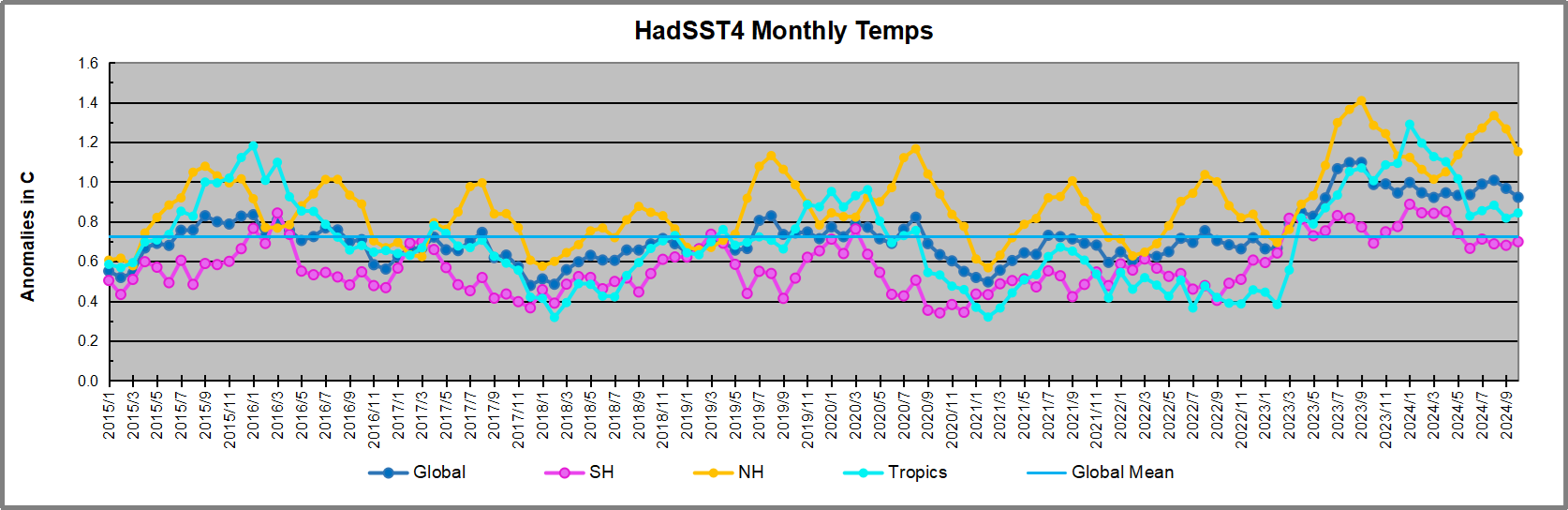
The chart below shows SST monthly anomalies as reported in HadSST4 starting in 2015 through October 2024.  A global cooling pattern is seen clearly in the Tropics since its peak in 2016, joined by NH and SH cycling downward since 2016, followed by rising temperatures in 2023 and 2024.

Note that in 2015-2016 the Tropics and SH peaked in between two summer NH spikes.  That pattern repeated in 2019-2020 with a lesser Tropics peak and SH bump, but with higher NH spikes. By end of 2020, cooler SSTs in all regions took the Global anomaly well below the mean for this period.  A small warming was driven by NH summer peaks in 2021-22, but offset by cooling in SH and the tropics, By January 2023 the global anomaly was again below the mean.

Now in 2023-24 came an event resembling 2015-16 with a Tropical spike and two NH spikes alongside, all higher than 2015-16. There was also a coinciding rise in SH, and the Global anomaly was pulled up to 1.1°C last year, ~0.3° higher than the 2015 peak.  Then NH started down autumn 2023, followed by Tropics and SH descending 2024 to the present. After 10 months of cooling in SH and the Tropics, the Global anomaly is back down, after a small bump from NH summer warming.

Comment:

The climatists have seized on this unusual warming as proof their Zero Carbon agenda is needed, without addressing how impossible it would be for CO2 warming the air to raise ocean temperatures.  It is the ocean that warms the air, not the other way around.  Recently Steven Koonin had this to say about the phonomenon confirmed in the graph above:

El Nino is a phenomenon in the climate system that happens once every four or five years.  Heat builds up in the equatorial Pacific to the west of Indonesia and so on.  Then when enough of it builds up it surges across the Pacific and changes the currents and the winds.  As it surges toward South America it was discovered and named in the 19th century  It iswell understood at this point that the phenomenon has nothing to do with CO2.

Now people talk about changes in that phenomena as a result of CO2 but it’s there in the climate system already and when it happens it influences weather all over the world.   We feel it when it gets rainier in Southern California for example.  So for the last 3 years we have been in the opposite of an El Nino, a La Nina, part of the reason people think the West Coast has been in drought.

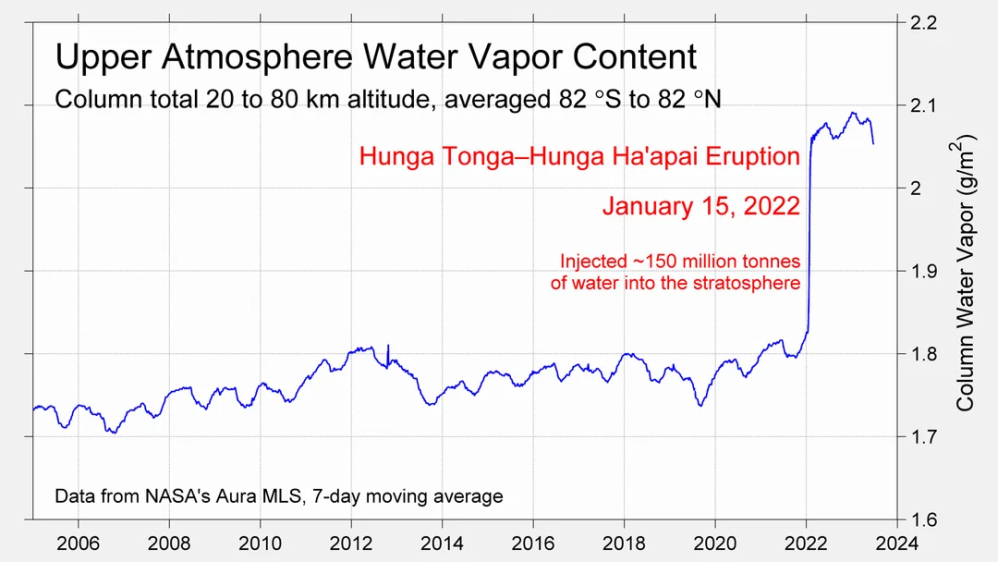
It has now shifted in the last months to an El Nino condition that warms the globe and is thought to contribute to this Spike we have seen. But there are other contributions as well.  One of the most surprising ones is that back in January of 2022 an enormous underwater volcano went off in Tonga and it put up a lot of water vapor into the upper atmosphere. It increased the upper atmosphere of water vapor by about 10 percent, and that’s a warming effect, and it may be that is contributing to why the spike is so high.

A longer view of SSTs

Open image in new tab to enlarge.

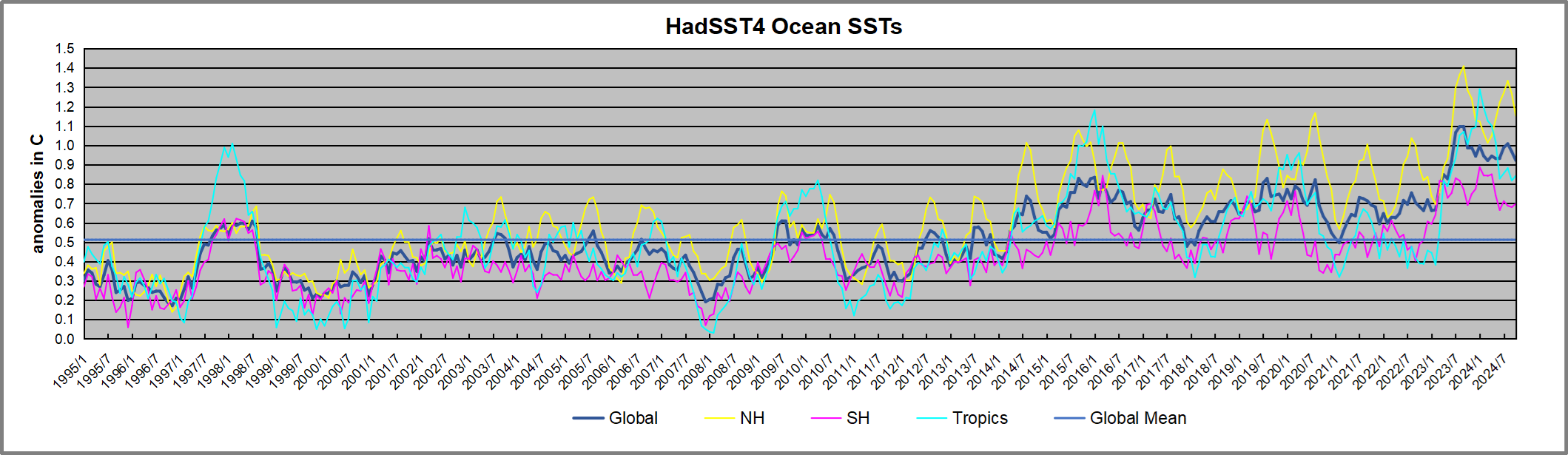
The graph above is noisy, but the density is needed to see the seasonal patterns in the oceanic fluctuations.  Previous posts focused on the rise and fall of the last El Nino starting in 2015.  This post adds a longer view, encompassing the significant 1998 El Nino and since.  The color schemes are retained for Global, Tropics, NH and SH anomalies.  Despite the longer time frame, I have kept the monthly data (rather than yearly averages) because of interesting shifts between January and July. 1995 is a reasonable (ENSO neutral) starting point prior to the first El Nino. 

The sharp Tropical rise peaking in 1998 is dominant in the record, starting Jan. ’97 to pull up SSTs uniformly before returning to the same level Jan. ’99. There were strong cool periods before and after the 1998 El Nino event. Then SSTs in all regions returned to the mean in 2001-2. 

SSTS fluctuate around the mean until 2007, when another, smaller ENSO event occurs. There is cooling 2007-8,  a lower peak warming in 2009-10, following by cooling in 2011-12.  Again SSTs are average 2013-14.

Now a different pattern appears.  The Tropics cooled sharply to Jan 11, then rise steadily for 4 years to Jan 15, at which point the most recent major El Nino takes off.  But this time in contrast to ’97-’99, the Northern Hemisphere produces peaks every summer pulling up the Global average.  In fact, these NH peaks appear every July starting in 2003, growing stronger to produce 3 massive highs in 2014, 15 and 16.  NH July 2017 was only slightly lower, and a fifth NH peak still lower in Sept. 2018.

The highest summer NH peaks came in 2019 and 2020, only this time the Tropics and SH were offsetting rather adding to the warming. (Note: these are high anomalies on top of the highest absolute temps in the NH.)  Since 2014 SH has played a moderating role, offsetting the NH warming pulses. After September 2020 temps dropped off down until February 2021.  In 2021-22 there were again summer NH spikes, but in 2022 moderated first by cooling Tropics and SH SSTs, then in October to January 2023 by deeper cooling in NH and Tropics.  

Then in 2023 the Tropics flipped from below to well above average, while NH produced a summer peak extending into September higher than any previous year.  Despite El Nino driving the Tropics January 2024 anomaly higher than 1998 and 2016 peaks, following months cooled in all regions, and the Tropics continued cooling in April, May and June along with SH dropping.  After July and August NH warming again pulled the global anomaly higher, September resumed cooling in all regions.

What to make of all this? The patterns suggest that in addition to El Ninos in the Pacific driving the Tropic SSTs, something else is going on in the NH.  The obvious culprit is the North Atlantic, since I have seen this sort of pulsing before.  After reading some papers by David Dilley, I confirmed his observation of Atlantic pulses into the Arctic every 8 to 10 years.

Contemporary AMO Observations

Through January 2023 I depended on the Kaplan AMO Index (not smoothed, not detrended) for N. Atlantic observations. But it is no longer being updated, and NOAA says they don’t know its future.  So I find that ERSSTv5 AMO dataset has current data.  It differs from Kaplan, which reported average absolute temps measured in N. Atlantic.  “ERSST5 AMO  follows Trenberth and Shea (2006) proposal to use the NA region EQ-60°N, 0°-80°W and subtract the global rise of SST 60°S-60°N to obtain a measure of the internal variability, arguing that the effect of external forcing on the North Atlantic should be similar to the effect on the other oceans.”  So the values represent sst anomaly differences between the N. Atlantic and the Global ocean.

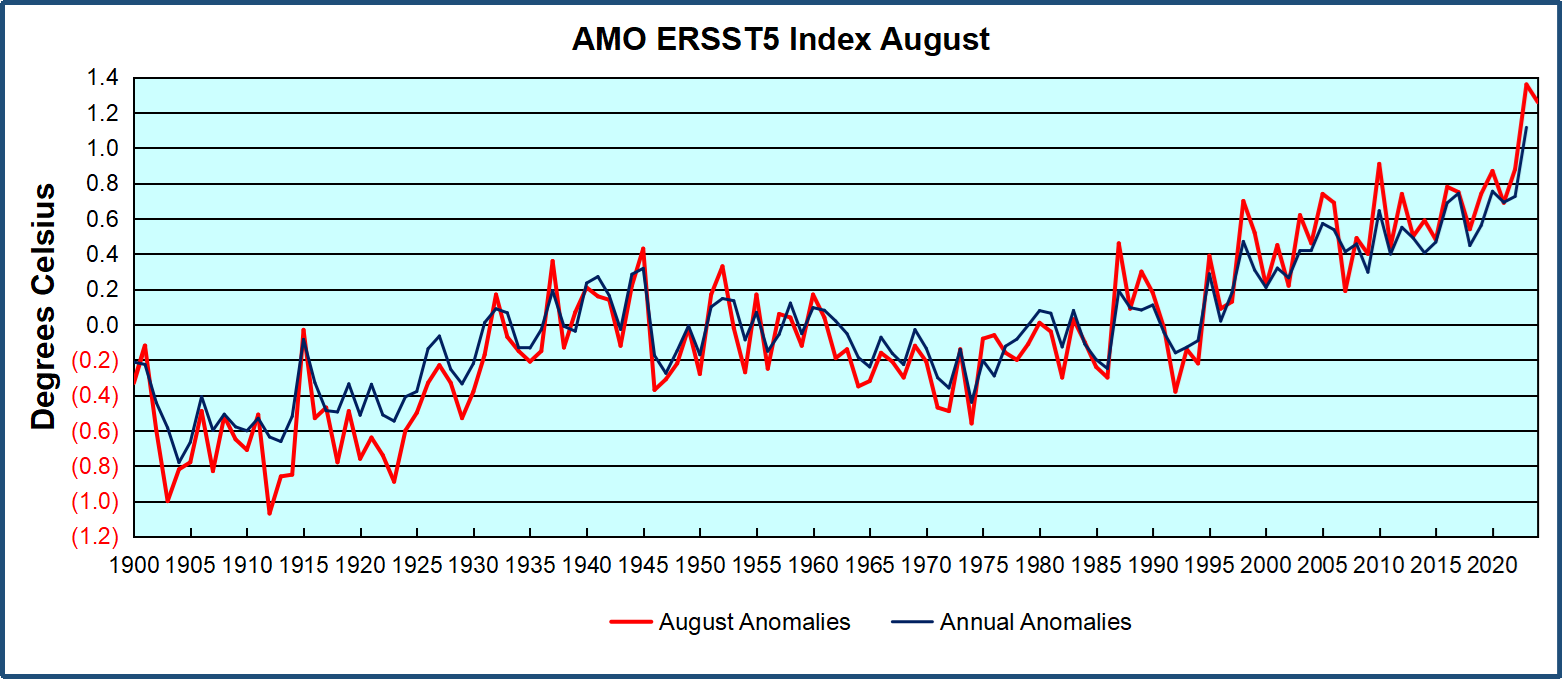
The chart above confirms what Kaplan also showed.  As August is the hottest month for the N. Atlantic, its variability, high and low, drives the annual results for this basin.  Note also the peaks in 2010, lows after 2014, and a rise in 2021. Then in 2023 the peak was holding at 1.4C before declining.  An annual chart below is informative:

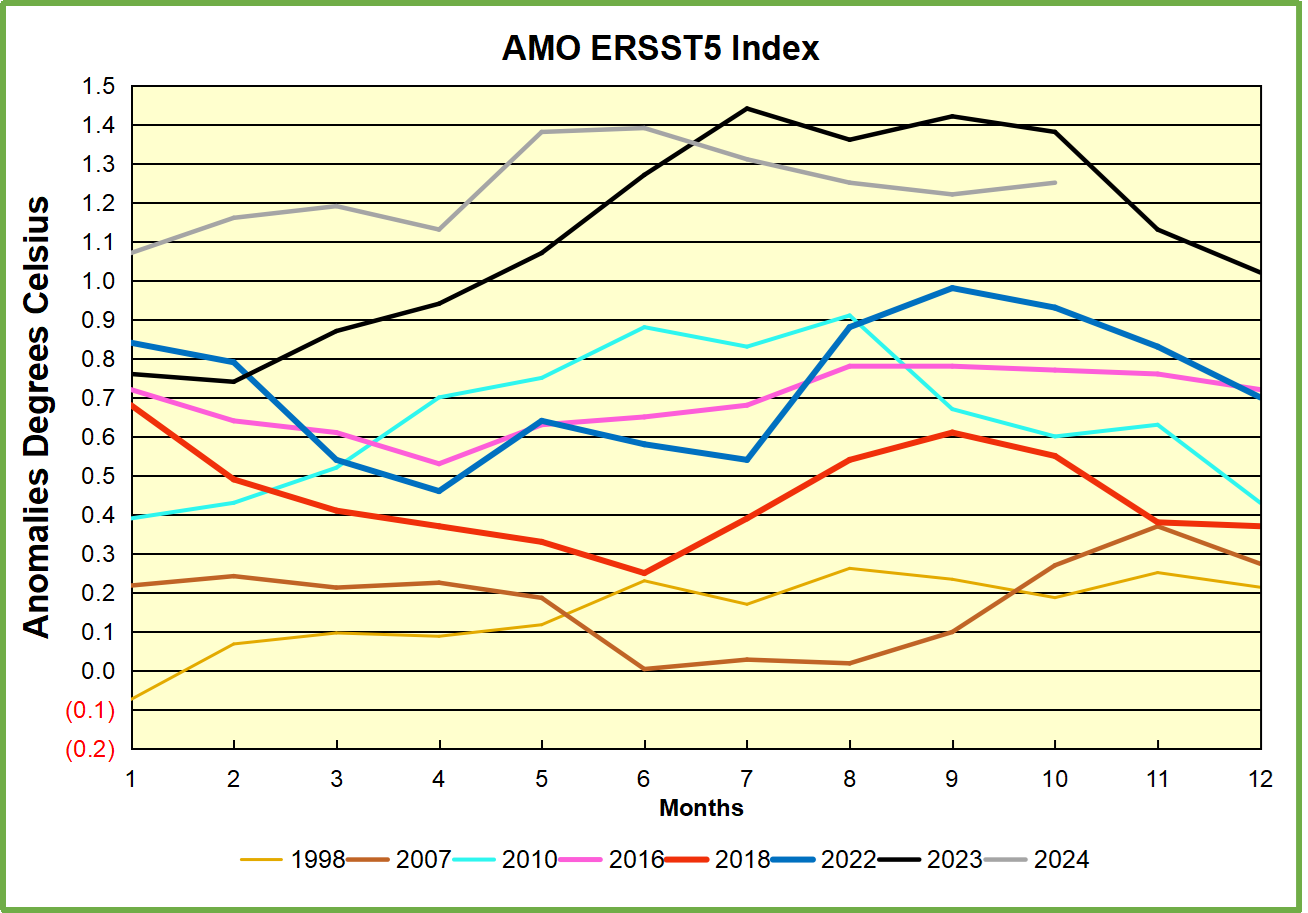
Note the difference between blue/green years, beige/brown, and purple/red years.  2010, 2021, 2022 all peaked strongly in August or September.  1998 and 2007 were mildly warm.  2016 and 2018 were matching or cooler than the global average.  2023 started out slightly warm, then rose steadily to an  extraordinary peak in July.  August to October were only slightly lower, but by December cooled by ~0.4C.

Then in 2024 the AMO anomaly started higher than any previous year, then leveled off for two months declining slightly into April.  Remarkably, May showed an upward leap putting this on a higher track than 2023, and rising slightly higher in June.  In July, August and September 2024 the anomaly declined, and despite a small rise in October, is now lower than the peak reached in 2023.

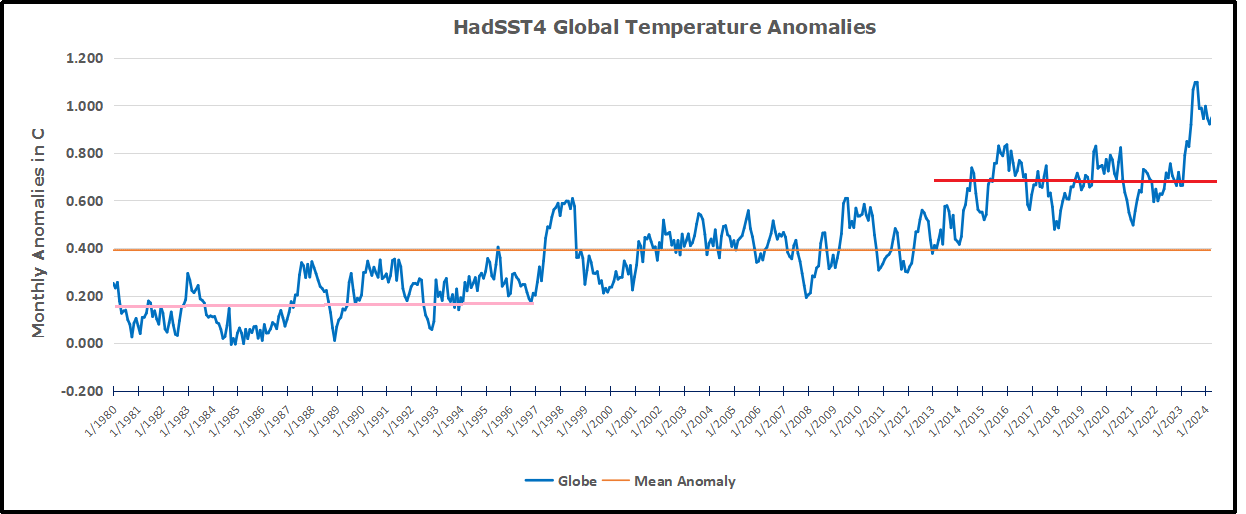
The pattern suggests the ocean may be demonstrating a stairstep pattern like that we have also seen in HadCRUT4. 

The purple line is the average anomaly 1980-1996 inclusive, value 0.18.  The orange line the average 1980-202404, value 0.39, also for the period 1997-2012. The red line is 2013-202409, value 0.69. As noted above, these rising stages are driven by the combined warming in the Tropics and NH, including both Pacific and Atlantic basins.

See Also:

2024 El Nino Collapsing

Curiosity:  Solar Coincidence?

The news about our current solar cycle 25 is that the solar activity is hitting peak numbers now and higher  than expected 1-2 years in the future.  As livescience put it:  Solar maximum could hit us harder and sooner than we thought. How dangerous will the sun’s chaotic peak be?  Some charts from spaceweatherlive look familar to these sea surface temperature charts.

Summary

The oceans are driving the warming this century.  SSTs took a step up with the 1998 El Nino and have stayed there with help from the North Atlantic, and more recently the Pacific northern “Blob.”  The ocean surfaces are releasing a lot of energy, warming the air, but eventually will have a cooling effect.  The decline after 1937 was rapid by comparison, so one wonders: How long can the oceans keep this up? And is the sun adding forcing to this process?

Space weather impacts the ionosphere in this animation. Credits: NASA/GSFC/CIL/Krystofer Kim

Footnote: Why Rely on HadSST4

HadSST is distinguished from other SST products because HadCRU (Hadley Climatic Research Unit) does not engage in SST interpolation, i.e. infilling estimated anomalies into grid cells lacking sufficient sampling in a given month. From reading the documentation and from queries to Met Office, this is their procedure.

HadSST4 imports data from gridcells containing ocean, excluding land cells. From past records, they have calculated daily and monthly average readings for each grid cell for the period 1961 to 1990. Those temperatures form the baseline from which anomalies are calculated.

In a given month, each gridcell with sufficient sampling is averaged for the month and then the baseline value for that cell and that month is subtracted, resulting in the monthly anomaly for that cell. All cells with monthly anomalies are averaged to produce global, hemispheric and tropical anomalies for the month, based on the cells in those locations. For example, Tropics averages include ocean grid cells lying between latitudes 20N and 20S.

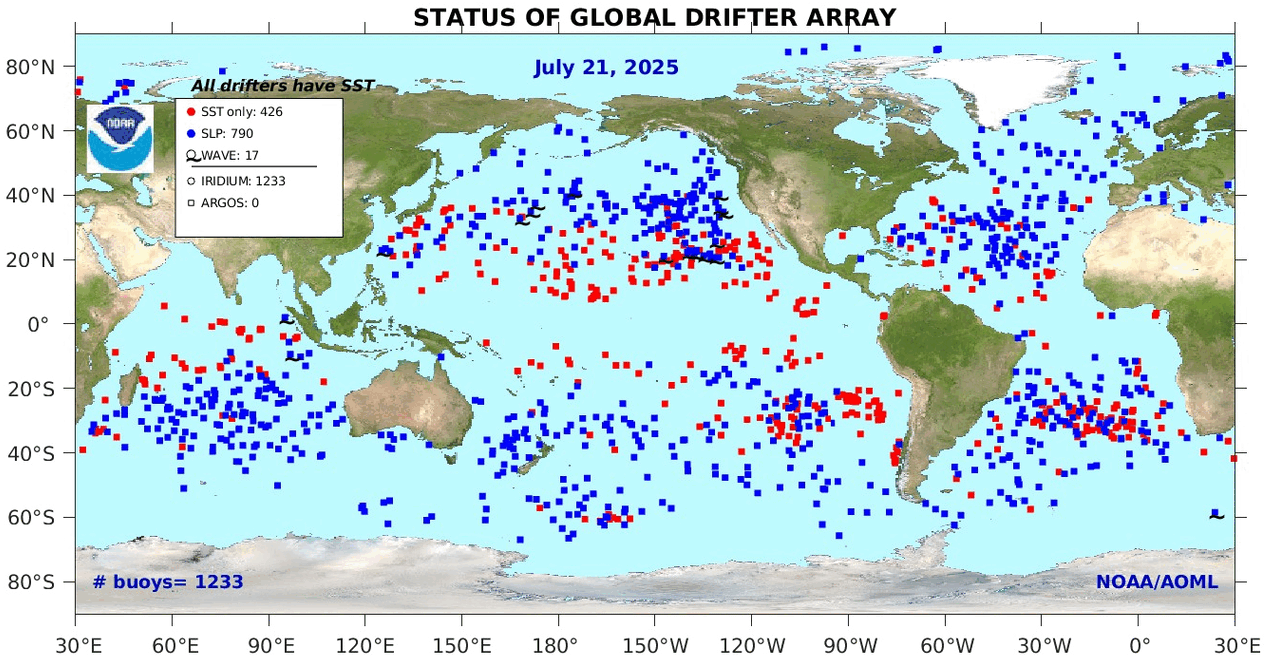
Gridcells lacking sufficient sampling that month are left out of the averaging, and the uncertainty from such missing data is estimated. IMO that is more reasonable than inventing data to infill. And it seems that the Global Drifter Array displayed in the top image is providing more uniform coverage of the oceans than in the past.

uss-pearl-harbor-deploys-global-drifter-buoys-in-pacific-ocean

USS Pearl Harbor deploys Global Drifter Buoys in Pacific Ocean


via Science Matters

https://ift.tt/qbkeCN3

November 13, 2024 at 10:27AM

Thursday

0 out of 10 based on 0 rating

via JoNova

https://ift.tt/SCnGfOY

November 13, 2024 at 09:08AM