
0 out of 10 based on 0 rating
via JoNova
November 2, 2024 at 09:16AM

Gas stoves are the thin edge of the wedge.
Megan K. Jacobson explains the fight and what’s at stake at msn A Washington State Revolt Against the Gas-Stove Grabbers. Excerpts in italics with my bolds and added images.
Environmentalists have waged a campaign against natural gas, but users of this efficient, low-emission fuel are fighting back. A wide range of industry groups are backing Washington state’s Initiative 2066 to protect the right to choose natural gas.
By 2030, Washington is supposed to reduce carbon emissions to 45% below 1990 levels—one of its many overlapping climate goals. The state’s most recent energy plan declares that the cheapest route to meeting Olympia’s climate targets is to switch many uses of oil and gas to electric sources. Last year the Building Code Council amended the state energy code to make it prohibitively costly to install gas appliances in new buildings. In March the Legislature passed a law allowing the state’s largest natural-gas and electricity utility, Puget Sound Energy, to pass the costs of going green onto consumers and mandating the utility files a plan “to achieve all cost-effective electrification of end uses currently served by natural gas.”
To the Washington Hospitality Association and the Building
Industry Association of Washington, Initiative 2066’s cosponsors,
this sounded like an economic wrecking ball.
Anthony Anton, CEO of the hospitality association, says 84% of the restaurateurs he represents rely on natural gas. Remodeling to go electric is a “massive cost at a time where operators just can’t afford it,” he says. Some say the quality of their product would suffer, as some cooking methods, such as stir-frying, are difficult to perform on lower-heat electrical stoves. Most of the association’s members are very small businesses with substantial debt from Covid lockdowns.
The building association worries the new energy code will raise the state’s already high housing costs, locking out potential buyers. The code requires that new buildings meet a certain environmental “score.” Without the points from an electric heat pump, a builder will have to make up the difference with other green measures that run between $15,000 and $20,000 in a single-family home. “Every time they raise the price $1,000, it prices out another 500 Washington families,” says Greg Lane, the association’s executive vice president.
Dozens of varied industry groups support Initiative 2066. Each has its own reasons. The Washington Denturist Association worries about the expense of switching from propane- or gas-based equipment and a lack of reliable power. Most members are small businesses and it’s a good path for immigrant dentists whose credentials don’t carry over to the U.S.

The Washington State Tree Fruit Association (of which my paternal grandfather’s company, Apple King, is a member) is concerned about rising costs of refrigeration to keep produce fresh. A sudden power outage could be catastrophic for the state’s apple industry. Trade regulations for its top two export markets require that fruit be constantly refrigerated at a specific temperature for as long as 90 days.
The state’s cheapest energy plan would almost double electricity demand in Washington by 2050, putting an unprecedented strain on the grid. The only real option is to increase wind and solar generation, since the state’s plentiful hydroelectric capacity can’t do more without potentially threatening salmon. Wind and solar tend to falter in Washington in the winter, when energy demand peaks.
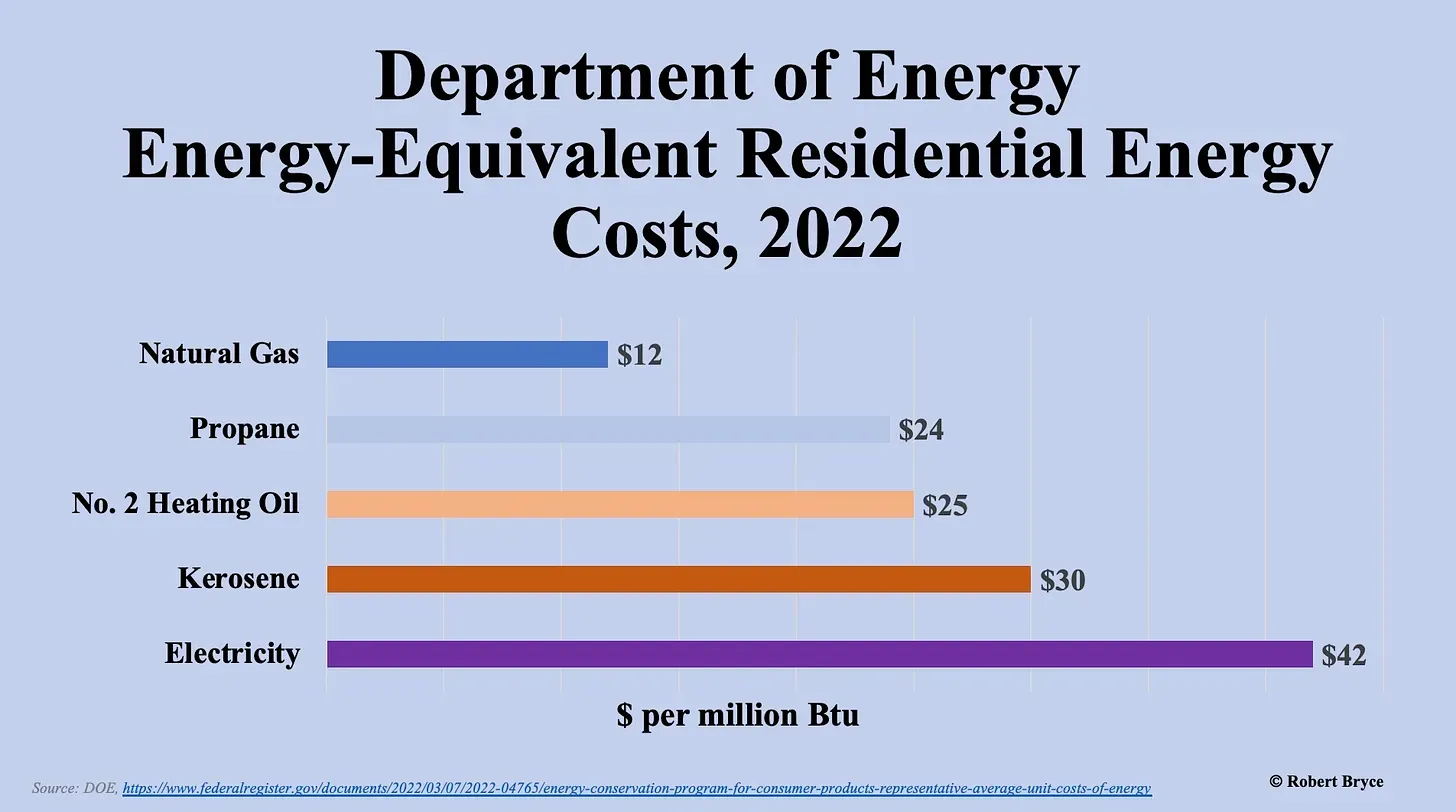
Consumers would also suffer in Washington’s green utopia. Everything from a haircut to a ballgame would become more expensive as the price of electricity rises. Climate advocates argue that Washingtonians will recoup their costs over time thanks to efficiency gains. But a 2021 report from Home Innovation Labs estimates that recovering the cost of a heat-pump installation could take 47 to 49 years. It’s worse for existing gas customers. The Building Industry Association of Washington estimates that switching from natural gas to electricity in a single-family home would cost as much as $70,000. Heat pumps also tend to fail in the sort of frigid weather that hits rural Washington in winter.
Proponents of electrification insist that technology will improve over time. But if they’re really confident that green energy will be the best option for consumers and businesses, then Initiative 2066 is no threat. Washington voters should ask why climate advocates still see it as one.

via Science Matters
November 2, 2024 at 08:32AM
NASA uncovers 50 ‘areas of concern’ including leaks and cracks on the 25-year-old space station.
Posted by Leslie Eastman
Recent reports indicate that the National Aeronautics and Space Administration (NASA) and its Russian counterpart Roscosmos are facing serious safety concerns on the International Space Station (ISS), potentially leading to preparations for an emergency evacuation.
NASA’s astronauts aboard the International Space Station have been told to prepare for an urgent evacuation amid growing safety concerns.
The US space agency and its Russian counterpart, Roscomos, are tracking 50 ‘areas of concern’ related to a growing leak aboard the station.
NASA is now calling the cracks in a Russian service module a ‘top safety risk’ – escalating the threat rating to five out of five.
Astronauts have been warned to stay in the American section when the module is open so they can be close to their spacecraft in case of an emergency evacuation.
The most pressing issue is an ongoing air leak in the Zvezda Service Module in the Russian portion of the station, which has been tracked for the past five years.
The leaks’ exact cause is not known, nor is it clear exactly where the air is leaving the space station. Both space agencies have narrowed their focus to internal and external welds that may have deteriorated, according to the inspector general.
The U.S. space agency has been working closely with Roscosmos to identify the source of the leaks and ensure crew safety, Free said. Since the last round of patches over the summer, “the leakage rate has gone down,” he said.
“We’ve asked them to minimize how long that hatch is open, and they are minimizing it,” Free said. “We’ve come to a compromise that they close it in the evening.”
NASA has determined the station remains safe enough for the 11 people aboard. Still, the agency decided its astronauts need more options in the event that a rapid departure from the space station becomes necessary.
The developments currently indicate the space agencies are preparing for a worst-case scenario, hoping the station lasts until its slated 2030 decommissioning. The US and Russia are having troubles reaching an agreement as to the conditions in which evacuation of the station would be deemed necessary.
NASA and Roscomos are collaborating to monitor the leak and try to identify the source of the issue.
However, the two agencies are yet to agree on when the leak rate would be considered ‘untenable’.
In the same OIG report, NASA also raised the concern that the space station could be seriously damaged by tiny pieces of material in orbit – escalating the risk rating to the highest level.
The agency wrote: ‘NASA considers the threat of micrometeoroids and orbital debris (MMOD) a top risk to crew safety, the ISS structure, visiting vehicles, and sustained ISS operations.’
Over the past two decades, the ISS has been a hub for groundbreaking scientific research. The microgravity environment has enabled significant advancements in studying diseases like Alzheimer’s, Parkinson’s, cancer, asthma, and heart disease. The unique conditions allow researchers to observe cellular and molecular changes impossible on Earth.
Without the interference of Earth’s gravity, Alzheimer’s researchers have studied protein clusters that can cause neurodegenerative diseases. Cancer researchers studied the growth of endothelial cells on the space station.
Endothelial cells help supply blood in the body, and tumors need that blood to form. Space station-grown cells grow better than those on Earth and can help test new cancer treatments.
Why do this in space? Studying cells, organoids, and protein clusters without the influence of gravity – or even the forces of container walls – can help researchers get a clearer understanding of their properties, behaviors, and responses to treatments.
The ISS website lists 19 other important research contributions and discoveries made aboard the station. Hopefully, the precautions will not be needed, and all the astronauts and researchers can return home safely and complete their important work.
via Watts Up With That?
November 2, 2024 at 08:01AM
The world’s deadliest cyclone occurred in 1970 around the same time the New York Times and Washington Post were warning about “ominously” thickening Arctic ice and a new ice age. World: Highest Mortality, Tropical Cyclone | World Meteorological Organization’s World … Continue reading →
via Real Climate Science
November 2, 2024 at 07:20AM

