Hmm? The historic archive of the Internet is hacked out of action in these critical weeks

By Jo Nova

Four weeks before the biggest election in history, the The Wayback Machine, was hacked in a major DDOS attack. The site was restored partially, but for the moment operates as “read only”. It is not possible to ask the archive to save a page. In a strange coincidence, Google caching stopped earlier this year and officially ended in September. So there is suddenly no recognised source of common shared truth about the history of the internet at the moment. Officially, supposedly, they will be back in action, sometime, one day…

Imagine how convenient that might be if someone were planning to lie, cheat, or change their story after the election?

So please, everyone, keep a copy, and tell your friends to keep copies too. Capture the screenshots. Save the page. Download the youtubes and save them. You never know when an election promise, a counting tally, a prediction, or a gaffe might disappear down a memory hole.

Is it just a coincidence or was this the deep state blob? As Jeffrey Tucker says, the timing is perfect, but we just do not know.

Deleting history helps people who want to cheat:

By Jeffrey Tucker, Brownstone Institute

Incredibly, the service Archive.org which has been around since 1994 has stopped taking images of content on all platforms. For the first time in 30 years, we have gone a long swath of time – since October 8-10 – since this service has chronicled the life of the Internet in real time.

As of this writing, we have no way to verify content that has been posted for three weeks of October leading to the days of the most contentious and consequential election of our lifetimes.

Crucially, this is not about partisanship or ideological discrimination. No websites on the Internet are being archived in ways that are available to users. In effect, the whole memory of our main information system is just a big black hole right now.

What this means is the following: Any website can post anything today and take it down tomorrow and leave no record of what they posted unless some user somewhere happened to take a screenshot. Even then there is no way to verify its authenticity. The standard approach to know who said what and when is now gone. That is to say that the whole Internet is already being censored in real time so that during these crucial weeks, when vast swaths of the public fully expect foul play, anyone in the information industry can get away with anything and not get caught.

Without the Wayback Machine Chris Gillham couldn’t have shown how the second round of adjustments in our national climate database wiped out even more historic hot days. (See the graph changes below).
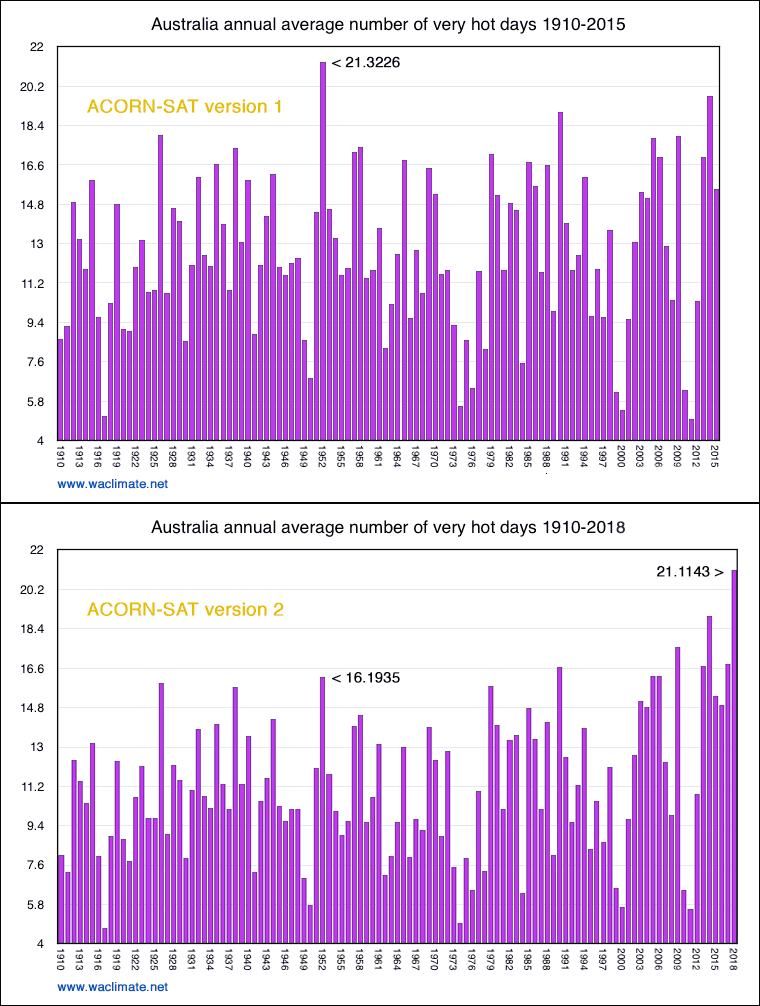
The animated graphic below shows very hot days from 1910 to 2015 in the ACORN 1 dataset source archived bureau pages within the WayBack Machine when compared to very hot days from 1910 to 2018 within the ACORN 2 dataset sourced to current readings at the BoM website.

Sweeping changes in record hot days? The Bureau of Meteorology adjusted raw data to make ACORN 1 and has adjusted that further to make ACORN 2!

Without the Wayback Machine we might not have a copy of the Victorian Government paper pushing for offshore wind power which accidentally admitted that all the onshore wind and solar plants they needed would require up to 70% of all agricultural land in the state.

Without the Wayback Machine we wouldn’t have a link to the original government report that listed the climate models biggest prediction and the results that showed it was a complete failure. The missing hot spot is probably the most important feedback within the climate models. All the models predicted the most rapid heating would happen 10km over the tropics, but 28 million weather balloons hunted for that signal and found it never happened. This shows water vapor doesn’t amplify the warming, and there was no catastrophe coming. After skeptics pointed out the failure, the large 6 Chapter Report from 2005 quietly disappeared. All my links to references broke, but there was a full copy on the WaybackMachine so I could update that post.

Every time government agencies screw up they want to hide the evidence. That’s why we need the Wayback Machine, and it’s why they need to shut it down.

h/t Bally, Skepticynic, and Simon Thompson.


10 out of 10 based on 1 rating

via JoNova

https://ift.tt/UmXLKo5

November 1, 2024 at 04:17PM

Electric Vehicles: A Tale of Woe in the Absence of the Market Process

By Timothy G. NashJason HayesTom Rastin

Introduction

You don’t need a government agent to tell you what you want or when you want it.

Milton Friedman explained that “market processes” allow individuals to interact and exchange goods and services voluntarily. The prices they charge in these exchanges guide production and consumption decisions, ultimately leading to the most efficient resource allocations, maximized customer satisfaction, and increased purchasing power, and this all occurs with minimal need for government interference.

When it comes to electric vehicles, the absence of a “market process” has ignored consumers’ wants and needs and allowed consumer demand to be misinterpreted. Demand exists only when a consumer needs and/or wants a product and can afford it. However, when government mandates and subsidies push EVs instead of more desirable vehicles, we can’t tell if manufacturers are producing the optimal number of electric vehicles.

With the national debt ready to exceed $36 trillion, we know the federal government cannot continue spending recklessly. Whoever occupies the White House next will need to cut spending dramatically. We suggest they start by eliminating electric vehicle subsidies for producers and consumers.

Markets are sending strong negative signals on electric vehicles as American consumers are increasingly hesitant to purchase them. Government policies are, therefore, wasting tens of billions of dollars—soon, hundreds of billions or more—forcing this immature technology into a market where consumers are not ready to purchase.

 Americans have many reasons to pause before purchasing an electric vehicle.

  1. Consumer Confidence

A recent Gallup survey showed that only 7% of Americans owned an EV. A further 9% were seriously considering a purchase, 35% reported they would consider buying an EV, and 49% were not interested in an EV (this includes 1% who had no opinion). This survey revealed an 11% decline in customer demand for EVs since 2023. The Gallup polling compounded the fact that most EV owners own at least one additional internal combustion engine vehicle. According to Edmunds, 40% of all electric vehicle trade-ins were used as down payments to purchase an ICE vehicle in the second quarter of 2024.

  1. Purchase Costs

Edmunds also reported that, in the first quarter of 2024, there was still a 42% gap between the average price of an electric and gasoline-powered car. That gap expands to 58.5% in the popular and relatively crowded SUV category. A compact electric SUV costs $53,048, while the equivalent ICE competitor’s manufacturers-suggested retail pricing is $35,722. The smallest gap in MSRP was 18% in the large pick-up truck sector, where EV pick-ups average $76,475.

  1. Range Anxiety

Range Anxiety is the fear of running out of battery power before reaching a destination due to limited battery range or insufficient charging infrastructure. Other factors influencing range anxiety include knowledge of charging locations, charging times, battery degradation, and changes in performance relative to weather conditions.

  1. Grid Capacity

EVs will strain an already overworked grid. Fleet charging requirements for larger batteries in delivery trucks and public transportation will compound this strain. Utilities will need to manage the complex timing and location of new EV charging infrastructure. Those complexities will be compounded by rushed transition timelines, like the Biden administration’s goal of EVs making up 67% of all new automobile sales in America by 2032. That burden will be compounded by the demand for electric power to supply AI, Bitcoin exchanges, and data centers.

  1. Safety concerns and weather conditions

Major safety concerns for EVs orbit around the potential for increased damages during crashes caused by the increased weight of EVs over ICE vehicles. Additional concerns exist over the changing nature of vehicle fires associated with lithium-ion batteries. Fires can be sparked by defects in the battery system, causing flammable and toxic gases to be released, damage to the battery system from a crash, or exposure to salt water due to floods or hurricanes. Electric vehicles tend to perform inconsistently, especially in climates with a wide range of temperatures (extreme heat or cold).

  1. Resale and/or trade-in value of EVs

The average American automobile, light truck or SUV, is 12.6 years old and rising, meaning the business for the U.S. aftermarket looks rosy. But, the prospect of purchasing a used EV causes concerns for many consumers. In 2024, electric vehicles are depreciating faster than ICE vehicles, and the ability to find a good service center to handle the list of growing maintenance needs is becoming more evident and costly. Finally, the realization that at trade-in, or the end of the useful life of an electric vehicle, its value could be negative. The notion of owning something that may have negative value is not endearing when considering a purchase.

  1. Rental car companies around the world are sending a signal on EVs

Over the past few years, many rental car users have pushed back on driving an EV, forcing European and U.S. companies to reduce their EV fleets. These companies report high repair costs, poor resale value, lack of customer charging centers, and the learning curve it takes to educate first-time users.

Conclusion

This list of reasons why consumers are hesitant about EVs is not exhaustive, but it does provide some clear reasons that companies and government regulators are moderating strategies to transition. Without government mandates and subsidies, it is highly unlikely that even 50% of consumers would choose an EV by the government’s arbitrary date of 2032.

There is a market for electric vehicles, but government mandates and subsidies—regulators predicting winners and losers—cause more harm than good. By forcing technology into widespread use before it is ready for primetime, governments are causing consumers to resist EVs. Instead, government regulators should allow consumer demand, competition, and the “market process” to guide EV adoption.

Dr. Timothy G. Nash is director of the McNair Center at Northwood University. 

Mr. Jason Hayes is director of Environmental Policy at the Mackinac Center.

Dr. Tom Rastin is a retired business executive from Ohio.

This article was originally published by RealClearEnergy and made available via RealClearWire.

via Watts Up With That?

https://ift.tt/ZlqxUSA

November 1, 2024 at 04:05PM

Indigenous burning practices once reduced the shrub cover that now fuels megafires in Australia, say researchers

Indigenous burning practices once reduced the shrub cover that now fuels megafires in Australia, say researchers

Posted: November 2, 2024 | Author: | Filed under: Bushfires, Climate Change | Tags: , , , , , , , , |

In this case the supposed human causation problem is not the one alarmists like to put forward. Since colonisation ‘shrub cover has surged to an …

Indigenous burning practices once reduced the shrub cover that now fuels megafires in Australia, say researchers


via Climatism

https://ift.tt/6uLG2jA

November 1, 2024 at 03:04PM

Indigenous burning practices once reduced the shrub cover that now fuels megafires in Australia, say researchers

Australian bushfire
In this case the supposed human causation problem is not the one alarmists like to put forward. Since colonisation ‘shrub cover has surged to an unprecedented 35%’. Many generations of indigenous experience in managing known wildfire risks by targeted precautionary burning were ignored by settlers, even up to the present day, sometimes with disastrous results – which are now used to promote claims of human-caused climate change.
– – –
Indigenous burning practices in Australia once halved shrub cover, reducing available fuels and limiting wildfire intensity for thousands of years, but the removal of these practices following European colonization has led to an increase in the tinder that has fueled today’s catastrophic megafires, researchers report.

The findings suggest that reintroducing cultural burning practices could provide a strategy to curb future fires, says the AAAS (via EurekAlert).

“Through detailed histories of Indigenous burning regimes across the world and Indigenous-led collaborations in contemporary wildfire management projects, we can inform sustainable and healthy solutions that ‘tame the flames’ threatening global socioenvironmental systems,” write the authors.

Climate change is increasing the frequency and intensity of wildfires in many regions, particularly the forests of western North America and southeastern Australia.

In addition to anthropogenic climate change [Talkshop comment – the usual assertion], human forest management and fire suppression have led to a build-up of shrubby vegetation that fuels more intense fires. This dense shrub layer allows ground fires to spread to the forest canopy above, resulting in destructive and difficult-to-control crown fires.

For millennia, humans have used fire as a tool, with Indigenous groups worldwide practicing ‘cultural burning’ to promote biodiversity, improve hunting, and reduce fuel loads through frequent, low-intensity burns. This approach creates spatial diversity in vegetation and helps to prevent severe wildfires.

In fire-prone regions like southeastern Australia, colonial suppression of Indigenous burning practices has caused fuel loads to increase, resulting in more frequent high-intensity fires.
. . .
Mariani et al. found that Indigenous population expansion and cultural burning practices during the mid-late Holocene (6,000 to 1,000 years ago) coincided with a roughly 50% reduction in shrub cover (from ~30% from the early to mid-Holocene to 15% during the late to mid-Holocene).

However, since British colonization in the 18th century, shrub cover has surged to an unprecedented 35% – surpassing levels seen even before human presence on the continent – contributing to modern megafires.

Full article here.
– – –
Image: Blue Mountains bushfire [credit: Meganesia @ Wikipedia]

via Tallbloke’s Talkshop

https://ift.tt/xC0yedQ

November 1, 2024 at 02:09PM