
ABC News has reported final results in next week’s election.

About Tony Heller
Just having fun
This entry was posted in Uncategorized. Bookmark the permalink.
via Real Climate Science
October 30, 2024 at 12:25PM
ABC News has reported final results in next week’s election.
Just having fun
This entry was posted in Uncategorized. Bookmark the permalink.
via Real Climate Science
October 30, 2024 at 12:25PM
Electricity is needed for all infrastructures, starting with water filtration and sanitation.
Ronald Stein, P.E. is an engineer, columnist on energy literacy at America Out Loud NEWS, and advisor on energy literacy for the Heartland Institute and CFACT, and co-author of the Pulitzer Prize nominated book “Clean Energy Exploitations.”
Oliver Hemmers has aDoctorate in Physics from the Institute of Radiation and Nuclear Physics at the Technical University of Berlin, Germany. He was a Researcher in Physics, the Executive Director of UNLV’s Harry Reid Center and C- level executive.
Steve Curtis has a Master’s degree in Health Physics from UNLV. He has spent decades studying spent fuel issues in Nevada and worked as a technical field team leader for nuclear search and characterization missions for the Department of Energy. He is currently engaged in education, speaking, and writing in favor of nuclear power returning to the United States, especially from recycling spent nuclear fuel in fast reactors.
Co-authored by Ronald Stein, Oliver Hemmers, andSteve Curtis
Published October 29, 2024, in America Out Loud NEWS
https://www.americaoutloud.news/affordable-electricity-can-resolve-worldwide-poverty/
The poorest American is richer than 75 percent of humanity, and about 4.56 billion people on this planet are living on less than $10 a day, and billions are living with little to no access to electricity.
Most everyone in the United States has access to electric power that is required by water filtration, sanitation, airports, hospitals, medical equipment, appliances, electronics, communications systems, heating and ventilating, space programs, and militaries.
However, several billion people in the rest of the world do not have any access to the infrastructures being enjoyed in wealthier developed countries. This is something most Americans find hard to believe.
Yet, the solution is simple. Getting Government to quit “helping”, as it is the job of the American people and free enterprise to innovate products people like, not the Government. Again, the basic solution is anchored in the basic economic principle of free enterprise, unencumbered by Government “help”.
The most pronounced factor in poverty, or basic quality of life, is affordable electricity in our modern world. We find it difficult to operate any of our machines without it. Yet 120 years ago, almost nobody had electricity. Such is the magic of modern innovation. Access, however, is not enough. Electricity must be dirt cheap or almost free. Don’t laugh. Thanks to free enterprise, we can now make all the long-distance phone calls we want for one low monthly cell phone fee.
The solution to affordable electricity is within the grasp of “we the people” more than you think. Technology exists, now all we need is political will. Two factors have accentuated the need for more clean electricity in the last few years: More concern about clean air, and a massive increase in electricity demand projected to double or triple in the coming decades, driven by the sudden popularity of Artificial Intelligence, Datacenters, and EV charging.
Sitting on the sites of all our nuclear power plants are already-mined, already formed pellets, for future affordable electricity. There are 90,000 tons of energy worth its weight in gold (at 1 cent/kWh) just sitting there. Some call this “nuclear waste” and are trying to spend tax dollars to bury it forever. Fortunately, the anti-nuclear lobbying has prevented this from happening. It turns out that recycling this material in fast reactors can extract all the hidden energy in uranium, not just 3% of it as is common in today’s reactors.
The major impediment, ironically, is that the United States has not defined a disposition plan for this “waste” material and a great many people, with good reason, regard this as detrimental to placing trust in a nuclear power industry. If this problem cannot be solved, how can nuclear power be good? It turns out that the nuclear power industry had the solution decades ago and, through the “magic” of Government “help”, that solution was legally stopped.
So, the Slightly Used Nuclear Fuel (SUNF) piled up. Being called “waste” has poisoned the public perception. However, with the new name, SUNF, there may be a way to see a bright new world ahead in plentiful, safe, clean, reliable, robust, and, best of all, cheap electricity. All we must do is get the Government to stop regulating it out of affordability.
To put this so-called “waste” into perspective, the amount of electricity contained in just the so-called “waste” material, we have is the equivalent of 270 years of our current electricity consumption in the US by itself, and we are creating 2,000 tons of additional SUNF per year. There is enough to power for our ramping demands for Artificial Intelligence, datacenters, and EV chargers and still have enough to export to those in adjoining states who do not have sufficient electricity.
If we could see our way of transitioning this production of electricity to private enterprise and allow companies to compete for your electricity business, it is not difficult to see the possibilities. Consider that, if disposition of this material is, indeed, a top priority, then the faster we dispose of it, the better, right? So, people would be encouraged to use electricity as fast as they can.
With affordable electricity, unlimited clean water, unlimited hydrogen, unlimited electricity for billions around the world would be realized. In fact, using proven nuclear generated electricity technology, power at one cent per kWh (it is well more than ten cents now) would be profitable. So, one low monthly price for electricity could not be far behind.
In fact, the US military is looking to power their bases with their own individual nuclear power plants as “micro-grids”, all owned by the individual base and not needing any power from external sources. As the competition ramps up for better and better reactors and the availability of power skyrockets, the American people finally get the advantage in the marketplace. Best of all, technology exists today to make all this possible. So, what are we waiting for?
It looks like we will need a Governor of a state to see the vision and develop this idea for their own state. The lucky state that seizes this opportunity could be the nucleus of the next electricity production revolution. Leveraging the existing Congressional Nuclear Waste fund for start-up costs in return for reduced regulations and some initial facilities, the state would benefit, the US Government would benefit, and, best of all, electricity customers would benefit. However, the overwhelming support of the public is needed for this to happen. Our US Government works for you, so you can make your desires known to a State Governor who can make the proposal to the US Government.
Since the nuclear power industry has proven to be the safest industry in the world for over 7 decades, regulations could easily be reduced to allow such a beneficial industry to thrive in free enterprise nirvana.
It would not take a lot of imagination to see free enterprise vs. government regulations spreading to the world. Running water, sanitation, and modern appliances would find their way into the poverty centers in South Asia, Africa, and the Pacific and East Asia. It just takes leadership.
Please share this information with teachers, students, and friends to encourage Energy Literacy conversations at the family dinner table.
Click this Link to Sign up for Energy Literacy from Ronald Stein
via Watts Up With That?
October 30, 2024 at 12:09PM
After its politically driven foray into electric vehicles, Volkswagen is facing significant financial challenges…plans to close at least three of its German factories…unprecedented move in the company’s history…. tens of thousands of jobs will be lost!
The news for VW is real bad, and now the powerful IG Metall engineering and metal workers’ union is already hinting at strikes to prevent the cuts. Additionally, the company is looking to cut more than $4.3 billion in costs
Hat-tip: Aktienmitkopf.
Misguided foray into electric vehicles
But don’t start feeling sorry for VW. The problems are largely self-made by incompetent managers and politicians.
Firstly, the German state of Lower Saxony, where VW is headquartered in Wolfsburg, owns approximately 20% of Volkswagen. Then, secondly, in the late 2010s, VW began its earnest push into electric vehicle production with the introduction of its ID family of electric cars. The increased focus on electric vehicles was largely politically driven by factors like increasingly stringent emissions standards and massively optimistic future demand for electric vehicles.
EV car sales stall
However, VW electric vehicle sales have since taken a turn for the worst. EVs aren’t popular in Germany. Their sales in the he first half of 2024 were approximately 317,200 units worldwide, lower than the same period in 2023 (321,600 EVs). The future of EV sales now looks bleak: Volkswagen just announced the closure of its Audi Brussels plant in Belgium, which primarily produces electric vehicles. This decision comes due to lower-than-expected demand for electric vehicles and is expected to take effect in February 2025.
Green Party anti-auto activist, college dropout on VW supervisory board!
And if you think VW being owned by a green-leaning state is already problematic for the management of the company, take a look at who sits on the company’s supervisory board: Julia Willie Hamburg, a German politician from Alliance 90/The Greens, Ms. Hamburg also serves as the Deputy Minister-President of Lower Saxony and the State Minister for Education and Culture.
Now let’s look at her qualifications: According to her resume, Ms Hamburg was educated in Hanover, studied political science, German philology and philosophy at the University of Göttingen.
She dropped out of her studies without a degree. Moreover, she’s an anti-car activist and travels by bicycle. She has neither industrial management experience, financial expertise nor an inkling of automotive engineering. That folks, is one of the top executives at VW. No joke!
Expect VW to get its clock cleaned by the competition over the next few years.
Donate – choose an amount
via NoTricksZone
October 30, 2024 at 11:33AM

, Dr. Kevin E. Trenberth, a distinguished scholar at the National Center for Atmospheric Research, commented on this movie: “I don’t recall a lot except that the whole science was incredibly wrong,”, “one does not get an ice age out of global warming.”
Likely you’ve heard the recent and previous warnings from Mann and friends about the ocean conveyor belt (including the Gulf Stream) slowing down and freezing us all. With the COP gathering next month, something scary must be proclaimed, and Global Freezing is it, replacing Global Boiling earlier this year. The declaration signed by Mann and 23 other scientists was Open Letter by Climate Scientists
to the Nordic Council of Ministers, Reykjavik, October 2024. Preface:
“We, the undersigned, are scientists working in the field of climate research and feel it is
urgent to draw the attention of the Nordic Council of Ministers to the serious risk of a
major ocean circulation change in the Atlantic. A string of scientific studies in the past few
years suggests that this risk has so far been greatly underestimated. Such an ocean
circulation change would have devastating and irreversible impacts especially for Nordic
countries, but also for other parts of the world.”“Given the increasing evidence for a higher risk of an AMOC collapse, we believe it is of critical importance that Arctic tipping point risks, in particular the AMOC risk, are taken seriously in governance and policy. Even with a medium likelihood of occurrence, given that the outcome would be catastrophic and impacting the entire world for centuries to come, we believe more needs to be done to minimize this risk.”
Florida Current transport observations reveal four decades of steady state Volkov et al 2024
Abstract
The potential weakening of the Atlantic Meridional Overturning Circulation (AMOC) in response to anthropogenic forcing, suggested by climate models, is at the forefront of scientific debate. A key AMOC component, the Florida Current (FC), has been measured using submarine cables between Florida and the Bahamas at 27°N nearly continuously since 1982. A decrease in the FC strength could be indicative of the AMOC weakening. Here, we reassess motion-induced voltages measured on a submarine cable and reevaluate the overall trend in the inferred FC transport. We find that the cable record beginning in 2000 requires a correction for the secular change in the geomagnetic field. This correction removes a spurious trend in the record, revealing that the FC has remained remarkably stable. The recomputed AMOC estimates at ~26.5°N result in a significantly weaker negative trend than that which is apparent in the AMOC time series obtained with the uncorrected FC transports.
Fig. 1: The Western Boundary Time Series
observing network in the Straits of Florida.
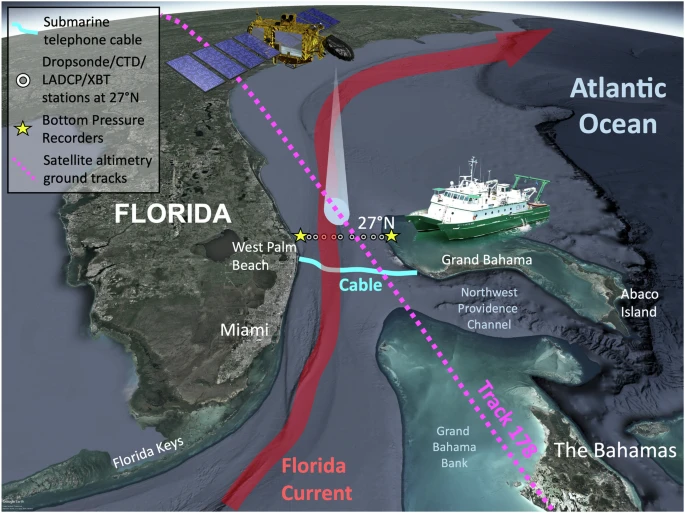
The network consists of the submarine telecommunications cable between West Palm Beach and Grand Bahama Island (cyan curve), ship sections across the Florida Current (FC) at 27°N with in situ measurements at nine stations (white circles), two bottom pressure gauges on both sides of the FC at 27°N (yellow stars), and along-track satellite altimetry measurements (magenta dotted line). CTD Conductivity-Temperature-Depth, LADCP Lowered Acoustic Doppler Current Profiler, XBT expendable bathythermograph.
Fig. 6: Florida Current (FC) volume transports corrected for
the secular change in the Earth’s Magnetic Field (EMF).
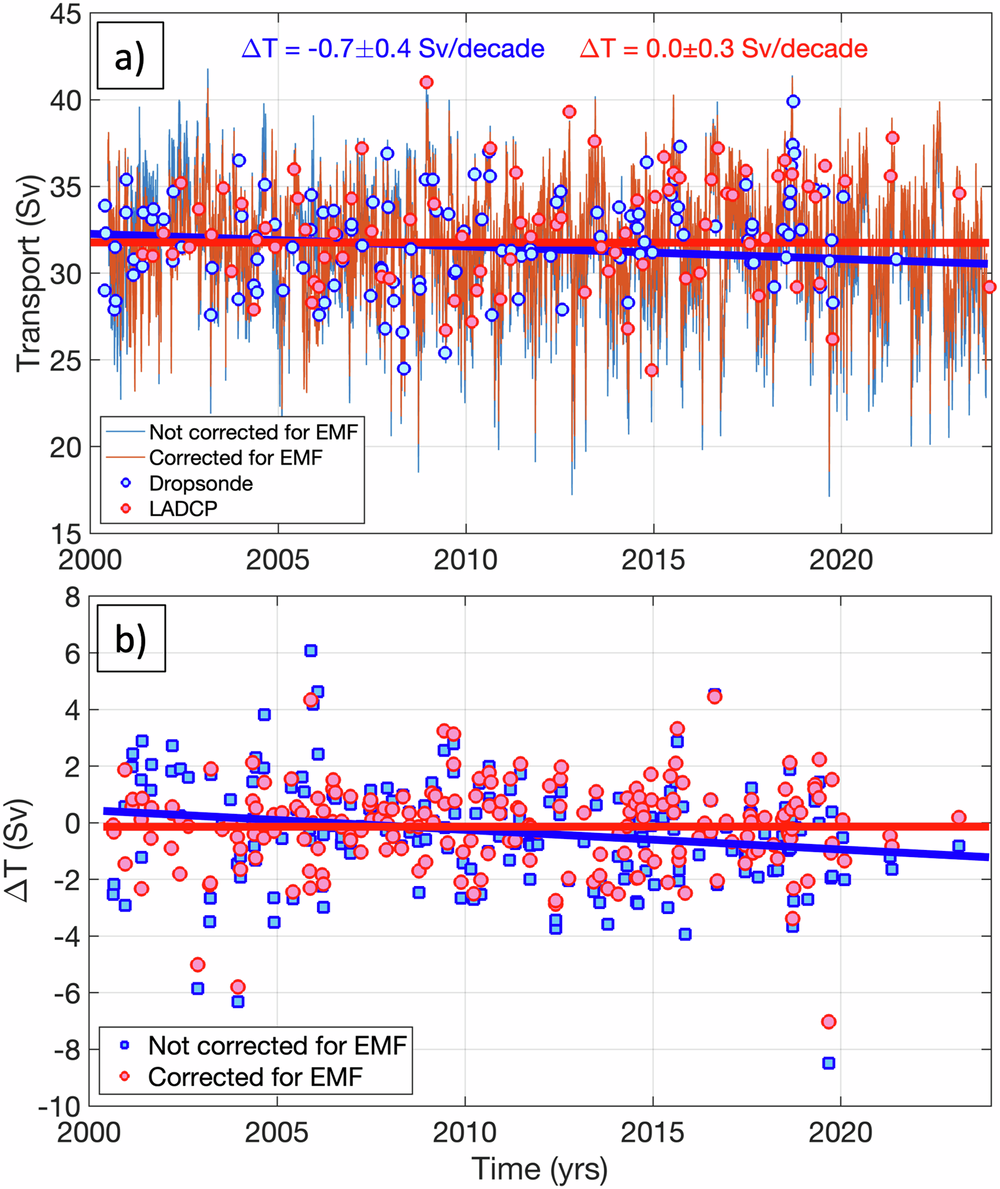
a The time series of the daily FC volume transport: (blue) not corrected for the secular change in the EMF, (red) corrected for the secular change in the EMF. The linear trends of the FC transport not corrected and corrected for the EMF are shown by the blue and red lines, respectively. b The differences between the cable and ship section transport for the cable data (blue squares) not corrected for the EMF and (red circles) corrected for the EMF. The linear trends of the differences (ΔT) not corrected and corrected for the EMF are shown by the blue and red lines, respectively.
Fig. 2: The Florida Current volume transport.
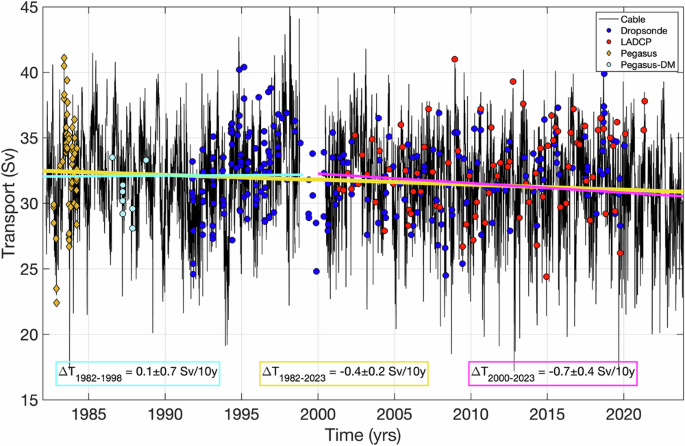
Daily transport estimates from the cable record (black; prior to corrections applied in this study); estimates from the Pegasus (orange diamonds) and Pegasus in dropsonde mode (Pegasus-DM; light blue circles) sections; estimates from the dropsonde sections (blue circles); and estimates from the Lowered Acoustic Doppler Current Profiler (LADCP) sections (red circles). The linear trends for 1982–2023, 1982–1998, and 2000–2023 periods are shown by the orange, cyan, and magenta lines, respectively.
Controlling factors for the global meridional overturning circulation: A lesson from the Paleozoic, Yuan et al. 2024.
Abstract
The global meridional overturning circulation (GMOC) is important for redistributing heat and, thus, determining global climate, but what determines its strength over Earth’s history remains unclear. On the basis of two sets of climate simulations for the Paleozoic characterized by a stable GMOC direction, our research reveals that GMOC strength primarily depends on continental configuration while climate variations have a minor impact. In the mid- to high latitudes, the volume of continents largely dictates the speed of westerly winds, which in turn controls upwelling and the strength of the GMOC. At low latitudes, open seaways also play an important role in the strength of the GMOC. An open seaway in one hemisphere allows stronger westward ocean currents, which support higher sea surface heights (SSH) in this hemisphere than that in the other. The meridional SSH gradient drives a stronger cross-equatorial flow in the upper ocean, resulting in a stronger GMOC. This latter finding enriches the current theory for GMOC.
On the basis of a series of simulations for the Paleozoic, we find that the GMOC is primarily controlled by:
The latter two factors are especially important for the strength of the GMOC and are highly related to continental configuration. Our major conclusions find validation through Paleozoic climate simulations using the HadCM3 model by Valdes et al. (53, 67) and a non-IPCC class model, FOAM, by Pohl et al. (52) (figs. S17 and S18). This last study by Pohl et al. (52) also pointed out the unfortunate absence of proxy data for validating the direction and magnitude of the Paleozoic GMOC.
Controlling factors for the global
meridional overturning circulation

Fig. 5. Schematic of controlling factors for the GMOC during the Paleozoic. The schematic is based on the situation for 400 Ma. Three main factors are shown, the less net precipitation in the south SH; the strong westerlies, ocean surface current, and Ekman upwelling in the midlatitude region in NH; the SSH anomaly and associated pressure anomaly in the low-latitude region.
Although there has been tremendous interest in understanding the mechanisms that govern the MOC, surface topography in the westerlies region and the presence of an open seaway in the low-latitude region were previously largely overlooked. Our study thus draws attention to how the evolution of continents in these two regions affects the strength of MOC. Our study indicates that the traditional theory for MOC misses an important element, that is, the influence of a low-latitude seaway. Previous studies either did not have such a seaway (1, 34, 43) or had a partial seaway that connected the present-day Atlantic Ocean and Pacific Ocean only (32–34). Their focus was mostly on the strength of the AMOC and mechanism invoked generally involved freshwater and salinity only (32, 33, 68), while as demonstrated above, a fully open low-latitude seaway affects the MOC in a fundamentally different way.
Activist scientists claim the Arctic is warming up to five times faster than lower latitudes. This is based on models projecting scarce temperature records great distances over the Arctic ocean drift sea ice. There are three flaws in the arctic warming claim (from Arctic “Amplification” Not What You Think)
a, Arctic Amplification is an artifact of Temperature Anomalies

Clive Best provides this animation of recent monthly temperature anomalies which demonstrates how most variability in anomalies occur over northern continents.
b. Arctic Surface Stations Records Show Ordinary Warming
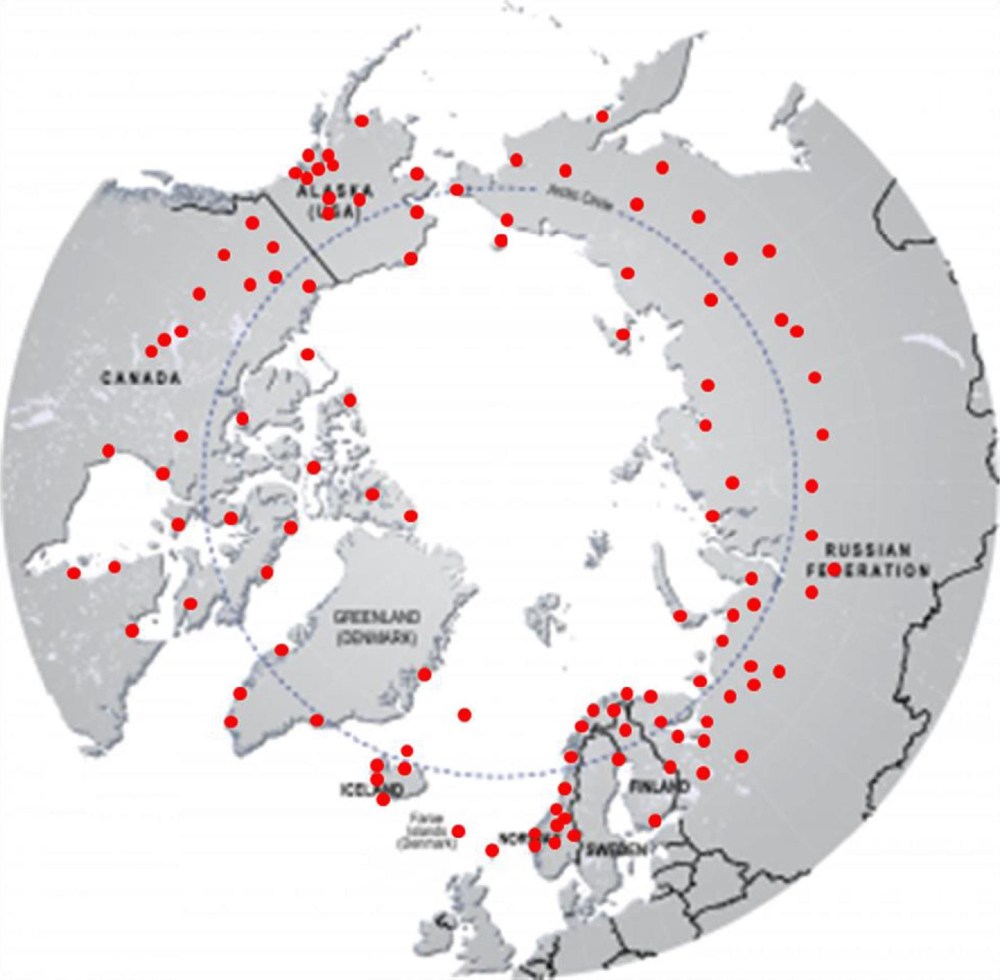
Locations of 118 arctic stations examined in this study and compared to observations at 50 European stations whose records averaged 200 years and in a few cases extend to the early 1700s.
The paper is: Arctic temperature trends from the early nineteenth century to the present W. A. van Wijngaarden, Theoretical & Applied Climatology (2015). My synopsis: Arctic Warming Unalarming
c. Arctic Warmth Comes from Meridional Heat Transport, not CO2

The “AMOC is collapsing” narrative goes like this:
Ocean circulation is driven by density differences, which depend on the salinity and the temperature of the water. Cold, salty water is heavier than warm, fresh water. When flowing water reaches Greenland, it becomes very cold and salty, causing it to sink and flow south, where the water warms and rises closer to the surface again. Some compares the process to a conveyor belt going around and around.
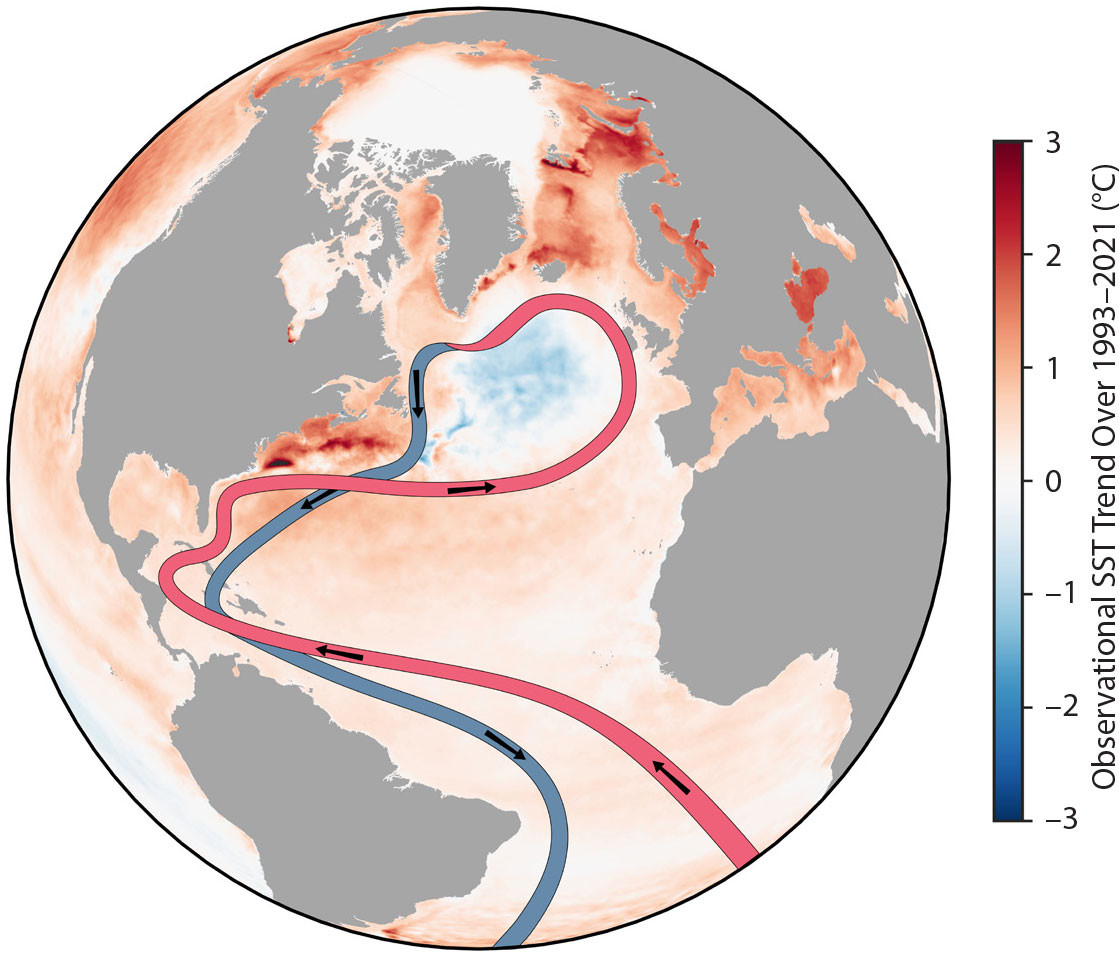
This graphic shows a highly simplified schematic of the Atlantic Meridional Overturning Circulation (AMOC) against a backdrop of the sea surface temperature trend since 1993 from the Copernicus Climate Change Service (https://climate.copernicus.eu/). Image credit: Ruijian Gou. > High res figure.
Changing the salinity of the water messes up the way the water flows. That’s why the melting of the Greenland ice sheets is a big problem: It’s injecting a ton of freshwater into the ocean far north, where the water is usually very salty. The more freshwater, the weaker the circulation—not to mention that atmospheric temperatures are also increasing, which also makes water lighter. The new study shows that if the density dynamics change enough, the conveyor belt will eventually stop moving, aka “collapse.” That means it won’t transport any water, saline, or heat across the globe.
So the scenario is that supposed amplified Arctic warming will cause iceberg calving and glacial melting, and the freshwater will slow and eventually stop the AMOC. Firstly, the above study shows seafloor configuration has greater impact than salinity changing. Secondly, the spread of freshwater is not so simple.
Role of the Labrador Current in the Atlantic Meridional Overturning Circulation response to greenhouse warming, Shan et al. 2024
Abstract
Anthropogenic warming is projected to enhance Arctic freshwater exportation into the Labrador Sea. This extra freshwater may weaken deep convection and contribute to the Atlantic Meridional Overturning Circulation (AMOC) decline. Here, by analyzing an unprecedented high-resolution climate model simulation for the 21st century, we show that the Labrador Current strongly restricts the lateral spread of freshwater from the Arctic Ocean into the open ocean such that the freshwater input has a limited role in weakening the overturning circulation. In contrast, in the absence of a strong Labrador Current in a climate model with lower resolution, the extra freshwater is allowed to spread into the interior region and eventually shut down deep convection in the Labrador Sea. Given that the Labrador Sea overturning makes a significant contribution to the AMOC in many climate models, our results suggest that the AMOC decline during the 21st century could be overestimated in these models due to the poorly resolved Labrador Current.
Uncertainties too large to predict tipping times of major Earth system components from historical data, Ben-Yami et al. 2024
Abstract
One way to warn of forthcoming critical transitions in Earth system components is using observations to detect declining system stability. It has also been suggested to extrapolate such stability changes into the future and predict tipping times. Here, we argue that the involved uncertainties are too high to robustly predict tipping times. We raise concerns regarding
(i) the modeling assumptions underlying any extrapolation of historical results into the future,
(ii) the representativeness of individual Earth system component time series, and
(iii) the impact of uncertainties and preprocessing of used observational datasets, with focus on nonstationary observational coverage and gap filling.
We explore these uncertainties in general and specifically for the example of the Atlantic Meridional Overturning Circulation. We argue that even under the assumption that a given Earth system component has an approaching tipping point, the uncertainties are too large to reliably estimate tipping times by extrapolating historical information.
“The conclusions of this study are certainly in line with my understanding of the current state of the art,” says Gavin Schmidt, a climate scientist and professor at Columbia University and the director of NASA’s Goddard Institute for Space Studies (GISS). Schmidt was not involved in the new work, but has extensively researched climate variability and systems like AMOC.
“I have not been impressed by previous or recent efforts to predict upcoming tipping points in either AMOC or ice sheets — there is more going on than just patterns in time series and we still don’t have sufficiently complex and calibrated models to have a robust idea of what will happen,” says Gavin Schmidt, director of NASA’s GISS.
In researching for this post I discovered an informative website Ocean to Climate Science news & articles on topics related to ocean and climate by oceanographer Sang-Ki Lee. Some additional examples of studies for further reading on this issue are below.
Gulf Stream’s fate to be decided by climate ‘tug-of-war’
Detectability of an AMOC Decline in Current and Projected Climate Changes
Global surface warming enhanced by weak Atlantic overturning circulation

via Science Matters
October 30, 2024 at 11:27AM

