GULF STREAM CLAIMED TO BE “ON THE VERGE OF COLLAPSING”

This story was featured in the Daily Mail, one of the UKs best selling newspapers. There is no way to verify it, as the article does not actually give any reference to the source, instead it  simply states that it came from "leading climate change scientists". It then goes on to lists the horrors that might happen. I must say that even if this did happen there is nothing whatever that we can do about it. We simply would have to adapt to the climate we get. That means we would need more cheap energy to heat our homes. The government would have to abandon net zero and get fracking.

Interestingly I have not seen this story on the BBC, which seems a bit odd.

 The Gulf Stream is on the verge of COLLAPSING, leading climate change scientists warn – plunging the UK into a new ice age | Daily Mail Online

via climate science

https://ift.tt/hOY0Jgi

October 29, 2024 at 02:54AM

Rent-Seeking Wind & Solar Scammers Stealing From Taxpayers

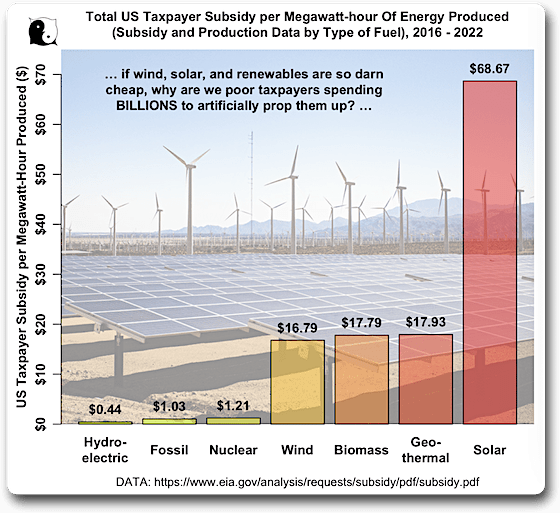
The great wind and solar scam has allowed crony capitalists to make out like bandits. While they couldn’t care less about delivering reliable and affordable power, try standing between them and a bucket of subsidies and they’ll soon respond.

When depression era bank robber, Willie Sutton was asked by a journo why he robbed banks, his simple and pithy response was “Because that’s where the money is.”

The same incontrovertible logic applies to the rent-seekers profiteering from the massive and endless stream of wind and solar subsidies.

As Robert Bradley outlines below, Sutton’s brand of self-interested, mercenary economics is being applied by America’s carpet bagging crowd.

“Green” Energy: It’s Just a Bribe
Master Resource
Robert Bradley
17 October 2024

“’I’m a businessman. I’ll take the [government green] money, that’s all I care about… I will move heaven and earth to get projects done over here’.” – James Quigley, quoted in Politico ‘s “Power Switch” (below)

In the mid-19th century, Claude-Frédéric Bastiat, a political economist, wrote:

Government is the great fiction through which everyone endeavors to live at the expense of everyone else. Every one is, more or less, for profiting by the labors of others. No one would dare to express such a sentiment; he even hides it from himself.

The Frenchman added:

When plunder becomes a way of life for a group of men in a society, over the course of time they create for themselves a legal system that authorizes it and a moral code that glorifies it.

Correct. Government does not create wealth; it redistributes it (after a large cut). Who wins and loses? The winners are government, the lobbyists, and the rent-seekers, with concentrated benefits to them and diffused costs for the rest of us. Plunder, Bastiat would say.

I was reminded of this by a news item reported in Politico‘s “Power Switch” newsletter (August 16, 2023).

“Not all Republicans want to repeal the climate law that turns 1 today,” reported Josh Siegel. “In fact, my colleague Kelsey Tamborrino and I spoke to dozens of people from all corners of the country and discovered that many GOP officials in rural areas are welcoming the billions of dollars in clean energy incentives coming from President Joe Biden’s signature legislation.”

So do you think they found Republicans that feared “climate change” and welcomed “green” energy as cheaper and better? No, the interviewed were financially captured rent-seekers, enjoying a wealth transfer from taxpayers (via Biden) to their pockets. Here is the rest of the story.

In Rogers County, Oklahoma, Republican Commissioner Ron Burrows looks at the Inflation Reduction Act and sees jobs — 1,000 of them to be exact. At least once the Italian giant Enel opens its $1 billion solar manufacturing plant there in 2025.

Burrows is not alone. Other political and economic leaders in Oklahoma, including Republican Gov. Kevin Stitt, are glad to receive the major investments they say they’d never have attracted without the climate law.

“You can imagine being in a small rural community and trying to get economic development to come — it’s a challenge,” said Rosalie Griffith, a board member of the Rural Economic Development of Inola. “But unless you develop, you’re going to die.”

Burrows said Enel’s decision to locate in his tiny town east of Tulsa — population 1,500 — would not have happened without local buy-in. “I just don’t see a company making that sort of investment without some level of comfort that it’s not adversarial, it’s not split,” he said.

By contrast, his local member of Congress — GOP Rep. Josh Brecheen — views the Inflation Reduction Act through the prism of most national Republicans. Brecheen told me he opposes the use of “taxpayer subsidization” to bolster Democrats’ favored green industries and is seeking to repeal the law.

Kelsey and I found that same disconnect between state and local GOP officials in rural areas and their federal representatives across the country.

There’s even a similar, but less dramatic, dynamic unfolding in upstate New York. GOP Rep. Marc Molinaro voted to repeal the Inflation Reduction Act’s clean energy incentives, and that’s made him a top target of Democrats in the 2024 election. His district is one of 18 that voted for Biden but are held by Republicans.

Inflation Reduction Act money catalyzed Canadian company Zinc8 Energy Solutions’ decision to locate a planned battery factory in Molinaro’s purple district. The project is expected to bring up to 500 new jobs to a Hudson Valley region still suffering from the loss of its manufacturing base in the 1990s. That’s exciting James Quigley, a Republican who drives a Tesla and is the supervisor for the town of Ulster, where Zinc8 plans to locate.

“I’m a businessman. I’ll take the money, that’s all I care about,” Quigley said. “I will move heaven and earth to get projects done over here.”

Final Comment
Gosh Josh, what did you really find our here? Are you proud of this? Did you and Kelsey Tamborrino ask the same parties if they liked the federal deficit and inflation? The present level of taxation? The wisdom of the few over the energy verdicts of the masses?

The Wall Street Journal‘s “Bidenomics and the New Political-Subsidy Economy” spoke to this issue:

Money for these subsidies has to come from somewhere, and that means the private economy in higher taxes and more government borrowing…. The IRA [Inflation Reduction Act] is the heart of Bidenomics, which is about creating a new political-subsidy economy. Perhaps all of this will effloresce into a brilliant green future. More likely hundreds of billions in misallocated investment will reduce future productivity gains and translate into slower economic and income growth. Let’s hope President Biden’s subsidies don’t boomerang like pandemic transfer payments, leaving all Americans poorer.

What a waste, what a shame. The next President needs to issue an emergency declaration that the U.S. is out of money and cease all subsidies of the Inflation Reduction Act in order to pause wind, solar, and battery subsidies. Ratepayers and taxpayers will be thankful.
Master Resource

via STOP THESE THINGS

https://ift.tt/rl8k1zp

October 29, 2024 at 01:30AM

Libertarian Party Platform: Energy and Climate

“While energy is needed to fuel a modern society, government should not be subsidizing any particular form of energy. We oppose all government control of energy pricing, allocation, and production.”

The Libertarian Party (L.P.), “the party of principle,” is running Chase Oliver for President. “Chase Oliver and [vice-president] Mike ter Maat are on a mission to remove government barriers that stand in the way of your dreams,” the campaign page states. “Be part of the movement—help us break down these obstacles and make your aspirations a reality!”

In 2016, as reported in the New York Times, L.P. candidate Gary Johnson received almost 4.5 million votes, the most in Party history and the highest third-party showing in 20 years. In 2020, Jo Jorgensen fell to 1.1 million votes.

Protesting against Kamala Harris, Oliver stated:

Kamala Harris represents the status quo – a continuation of policies that have led to skyrocketing national debt, deepening economic inequality, and erosion of individual freedoms. My campaign is about breaking away from the duopoly that has failed the American people. Unlike Harris, I’m committed to balancing the budget, reducing government overreach, and ensuring that every American has the opportunity to thrive without being crushed by taxes and regulations.

The relevant planks of the LP platform, adopted every two years, follow:

Economic Liberty

Libertarians want all members of society to have abundant opportunities to achieve economic success. A free and competitive market allocates resources in the most efficient manner. Each person has the right to offer goods and services to others on the free market. The only proper role of government in the economic realm is to protect property rights, adjudicate disputes, and provide a legal framework in which voluntary trade is protected. All efforts by government to redistribute wealth, or to control or manage trade, are improper in a free society.

As respect for property rights is fundamental to maintaining a free and prosperous society, it follows that the freedom to contract to obtain, retain, profit from, manage, or dispose of one’s property must also be upheld. Libertarians would free property owners from government restrictions on their rights to control and enjoy their property, as long as their choices do not harm or infringe on the rights of others. Eminent domain, civil asset forfeiture, governmental limits on profits, governmental production mandates, and governmental controls on prices of goods and services (including wages, rents, and interest) are abridgements of such fundamental rights. For voluntary dealings among private entities, parties should be free to choose with whom they trade and set whatever trade terms are mutually agreeable.

2.2 Environment

Competitive free markets and property rights stimulate the technological innovations and behavioral changes required to protect our environment and ecosystems. Private landowners and conservation groups have a vested interest in maintaining natural resources. Governments are unaccountable for damage done to our environment and have a terrible track record when it comes to environmental protection. Protecting the environment requires a clear definition and enforcement of individual rights and responsibilities regarding resources like land, water, air, and wildlife. Where damages can be proven and quantified in a court of law, restitution to the injured parties must be required.

Energy and Resources

While energy is needed to fuel a modern society, government should not be subsidizing any particular form of energy. We oppose all government control of energy pricing, allocation, and production.

Free Trade and Migration

We support the removal of governmental impediments to free trade. Political freedom and escape from tyranny demand that individuals not be unreasonably constrained by government in the crossing of political boundaries. Economic freedom demands the unrestricted movement of human as well as financial capital across national borders.

Omission Statement

The all-freedom, all-the-time L.P. ends its platform with this statement:

In every matter, we advocate the consistent application of the principle of the non-initiation of coercion, physical force, or fraud. Our silence about any other particular government law, regulation, ordinance, directive, edict, control, regulatory agency, activity, or machination should not be construed to imply approval.

The post Libertarian Party Platform: Energy and Climate appeared first on Master Resource.

via Master Resource

https://ift.tt/USrT6tY

October 29, 2024 at 01:11AM

Exxon Knew! First Warming And Climate, Now Plastics

Plastic recycling claims are deceptive and destructive. Wind and solar waste – never mind.  

Paul Driessen

“Exxon Knew!” The battle cry has inflamed and inspired climate activists for decades. Since the 1970s, they allege, Exxon Knew that human-caused climate change is “real” – but lied about it, claimed there wasn’t a “crisis,” and kept marketing its “planet-killing” fuels and petrochemical feed stocks.

Now activists say Exxon Knew for years that very little plastic waste is actually recycled. The oil giant is deceiving regulators and consumers with claims that all plastics are recyclable and its “advanced recycling” processes keep enormous amounts of plastics out of landfills.

ExxonMobil “campaign of deception” demands a lawsuit, says California Attorney General Rob Bonta. “Exxon Knew” that 95% of plastics in recycling bins are incinerated, get tossed onto roadways, or end up in landfills and oceans.

“Exxon knew” it was peddling lies when it promoted recycling as a “cure-all for plastic waste” – because eradicating all plastic use and disposal is impossible and many plastics can’t be recycled.

This is Mr. Bonta’s latest attack on fossil fuels. He wants a jury trial, to help ensure big lawfare payouts. But he’s ignoring inconvenient realities and engaging in rampant deceptions of his own.

Plastics are ubiquitous: from eyeglass frames and lenses, to television, computer and cell phone housings, wind turbine blades and nacelles, solar panel frames, medical equipment, devices and garments, car and airplane interiors, backpacks, skis, football helmets, shoes, grocery bags and infinitely more. Plastic packaging preserves and protects products that involve long, expensive, resource-intensive processes to grow or manufacture; it helps keep foods from spoiling or becoming bacteria-infested.

Plastics are cheap to produce, can be molded into infinite shapes and sizes, are corrosion-resistant, and don’t break easily (imagine shampoo and body wash in glass bottles). They’re lighter than glass and even paper alternatives, meaning more can be packed on trucks and transported using less fuel. In many cases, there are no viable alternatives.

Plastics are essential for our living standards, safety and modern world.

But what happens when they break, wear out or get tossed? For years they were thrown out with other trash. But environmentalists, politicians and consumers increasingly demanded that cans, glass and other throwaways be recycled. For many of us, recycling became a habit.

Recycling turns low-value plastic garbage into valuable materials: window frames, boards for siding decks and fences, pipes to replace copper tubing that thieves steal, toys and toothbrushes, plates and utensils, diapers and clothing, carpeting and lawn furniture, soccer fields, bottles, cabinets, and  more.

Neither ExxonMobil nor any other company promoted recycling as a magic solution or cure-all. It’s more expensive than virgin plastic, especially when transportation and sorting costs are factored in. Smaller items can clog sorting screens. Colored plastics have fewer recycling options than clear or white ones.

Most important, many types of plastics have little post-use demand or simply cannot be recycled. Others are integrated with electrical circuitry (motherboards and keyboards) or with paper or metal (laminates for food containers), making it impossible to separate and recycle them.

Thermoplastics can be heated, melted and reshaped or re-extruded into new products. These are the familiar #1 (PET) soda and water bottles, #2 (HDPE) milk and detergent containers, many #4 (LDPE) grocery bags and squeezable bottles, and some #5 (PP) yogurt and butter containers.

Thermoset plastics contain polymers that form irreversible chemical bonds that make strong products that cannot be remelted: vulcanized rubber for tires, Bakelite kitchenware, jewelry and circuit boards, epoxy resins, Duroplast car bodies and toilet seats, polyurethane cushions, insulation and windshields, et cetera.

Styrofoam cups and egg cartons cannot be recycled without (rare) specialized equipment and processes.

Moreover, even thermoplastics can be recycled only 2-3 times, before their polymer chains get shortened to the point where quality and durability become so low that the products are unusable.

(Newspaper, magazines, copying paper and Kraft paper bags have the same degradation problem: 6-7 trips to the recycler, and the cellulose fibers are too shortened, damaged and degraded to be reused. Steel, aluminum and glass, by contrast, can generally be recycled endless times.)

All these complexities explain why only a small fraction of plastics are recycled. ExxonMobil recycling 60,000,00-80,000,000 pounds of plastics per year may seem minuscule, compared to 73,000,000 tons of annual US plastic waste. However, it’s equivalent to 430-570 offshore wind turbine blades (350 feet long; 140,000 pounds apiece) that only end up in Grand-Canyonesque landfills.

Plus, plastic wastes can also be converted into diesel, aviation and gasoline fuels, and even electricity.

An excellent solution is to turn plastics and most other garbage into electricity for our increasingly power-hungry society – especially as AI and data centers proliferate, and politicians mandate that we convert our gas stoves, ovens, furnaces and water heaters to electric models.

A municipal waste-to-energy (WTE) / resource recovery facility operated by Reworld/Covanta performs these wondrous conversions just a few miles from my home. Enormous quantities of normally landfilled, nonrecyclable home, business, industrial, government and agricultural waste are dumped into a receiving area, sorted for unacceptable materials (eg, rocks), mixed thoroughly and emptied into the combustion chamber, where everything is burned with natural gas at 2000 degrees F, until it’s totally combusted.

Process heat is converted to steam, to drive turbines that generate 80 megawatts of electricity, enough for about 52,000 homes. Since 1990, the plant’s electricity has replaced the equivalent of some 2,000,000 barrels of crude oil each year. Dust and odor are contained within the facility; water from the wastes is recovered, treated and used as coolant; and air and water pollutants are kept well below EPA standards.

Even plastic-and-metal e-wastes (computers, monitors, keyboards, printers, and AI and data center machines) and “clean, green” energy equipment like solar panels can be “recycled” this way.

Enough iron, steel, aluminum, copper and other metals are recovered from the resultant ash to build 20,000 automobiles annually. The process also melts and recovers glass – and even recovers metals from e-wastes, light bulb bases, paper clips, staples, and metal bottoms from cardboard juice containers.

By the time the entire process is over, only nontoxic ash is left – about 5% of the original bulk mass of trash – and it gets used in cement and other applications or sent to landfills.

It reminds me of the old stockyard claim: The only part of the pig that isn’t used is the squeal.

So I have a few questions for Mr. Bonta.

* If you banish oil and gas, where will plastics, paints, pharmaceuticals and other products come from?

* Which plastics and vital plastic products do you intend to eradicate? What will doctors, pharmacists, optometrists, computer and cell phone users, and other consumers do without them?

* Recognizing that California has closed most of its nuclear, coal and gas power plants; that its net-zero, all-electricity mandates will soon double the state’s electricity needs; and that the state already imports one third of its electricity from neighboring states – why aren’t you suing to fast-track WTE plants?

* Why aren’t you suing Governor Newsom, President Biden, VP Harris, your state legislature and yourself for fraud and misrepresentation about green energy that isn’t clean, green, renewable or sustainable?

It’s time to recognize that “progressive” policies, mandates and lawsuits impose enormous costs on taxpayers, consumers and our environment – while politicians feed citizens a steady diet of lies.

Paul Driessen is senior policy analyst for the Committee For A Constructive Tomorrow (www.CFACT.org) and author of books and articles on energy, environment, climate and human rights issues.

via Watts Up With That?

https://ift.tt/M5SYihr

October 29, 2024 at 12:02AM