A Demonstration: Low Correlations Do Not Necessarily Lead to Low Confidence in Data Regressions

From Dr. Roy Spencer’s Global Warming Blog

Roy W. Spencer, Ph. D.

In a recent post I used our new Urban Heat Island (UHI) warming estimates at individual U.S. GHCN stations having at least 120 years of data to demonstrate that the homogenized (adjusted) GHCN data still contain substantial UHI effects. Therefore, spurious warming from UHI effects is inflating reported U.S. warming trends.

The data plots I presented had considerable scatter, though, leading to concerns that there is large uncertainty in my quantitative estimates of how much UHI warming remains in the GHCN data. So, I updated that post to include additional statistics of the regressions.

A Simple Example: High Correlation, But Low Confidence In the Regression Slope

The following plot of a small amount of data I created shows what looks like a pretty strong linear relationship between 2 variables, with a regression explained variance of 82% (correlation coefficient of 0.91).

But because there are so few data points, there is large statistical uncertainty in the resulting diagnosed regression slope (21% uncertainty), as well as the regression intercept (which is diagnosed as 0.0, but with an uncertainty of +/- 0.94).

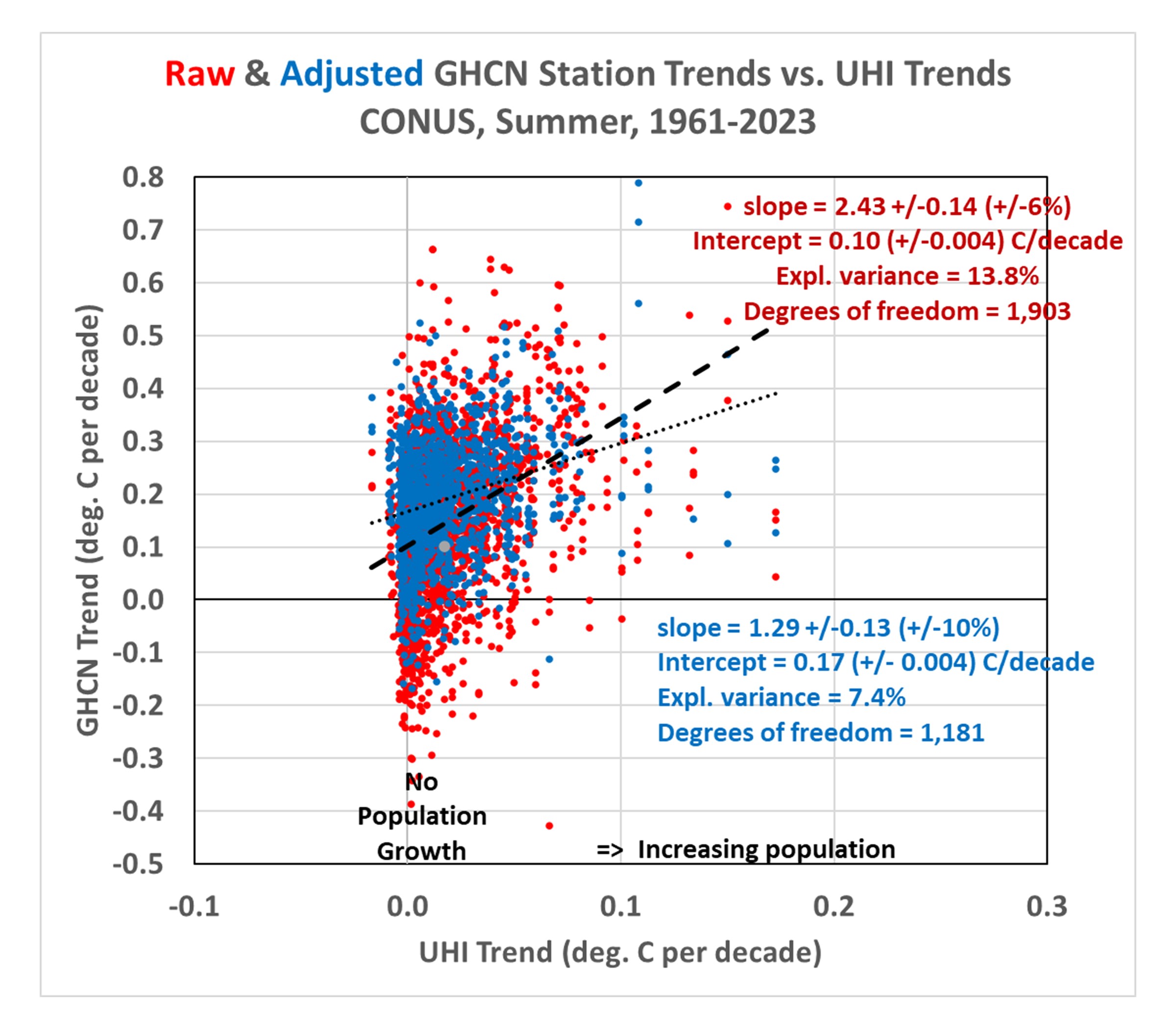
Now let’s look at the third data plot from my previous blog post, which demonstrated that there is UHI warming in not only the raw GHCN data, but in the homogenized data as well:

Importantly, even though the regression explained variances are rather low (17.5% for the raw data, 7.6% for the adjusted data), the confidence in the regression slopes is quite high (+/-5% for the raw GHCN regressions, and +/-10% for the homogenized GHCN regressions). Confidence is also high in the regression intercepts (+/-0.002 C/decade for the raw GHCN data, +/-0.003 C/decade for the homogenized GHCN data).

Compare these to the first plot above containing very few data points, which had a very high explained variance (82%) but a rather uncertain regression slope (+/- 21%).

The points I was making in my previous blog post depended upon both the regression slopes and the regression intercepts. The positive slopes demonstrated that the greater the population growth at GHCN stations, the greater the warming trend… not only in the raw data, but in the homogenized data as well. The regression intercepts of zero indicated that the data, taken as a whole, suggested zero warming trend (1895-2023) if the stations had not experienced population growth.

But it must be emphasized that these are all-station averages for the U.S., not area averages. It is “possible” that there has (by chance) actually been more climate warming at the locations where there has been more population growth. So it would be premature to claim there has been no warming trend in the U.S. after taking into account spurious UHI warming effects. I also showed that there has been warming if we look at more recent data (1961-2023).

But the main point of this post is to demonstrate that low correlations between two dataset variables do not necessarily mean low confidence in regression slopes (and intercepts). The confidence intervals also depend upon how much data are contained in the dataset.

via Watts Up With That?

https://ift.tt/G4Ud6Bc

October 28, 2024 at 08:06PM

Fear + Ignorance = Climate Alarm

Mark C. Ross explains the syndrome in his American Thinker article Fear plus ignorance equals climate change.  Excerpts in italics with my bolds and added images.

Weather is inherently mysterious. Multiple forces, such as wind, clouds, seasonal and day-night cycles, and air pressure are constantly interacting and causing continuous chaos. In the aftermath of two particularly destructive hurricanes, the fear-mongers are bloviating to the max over the catastrophic effects on the climate caused by human existence.

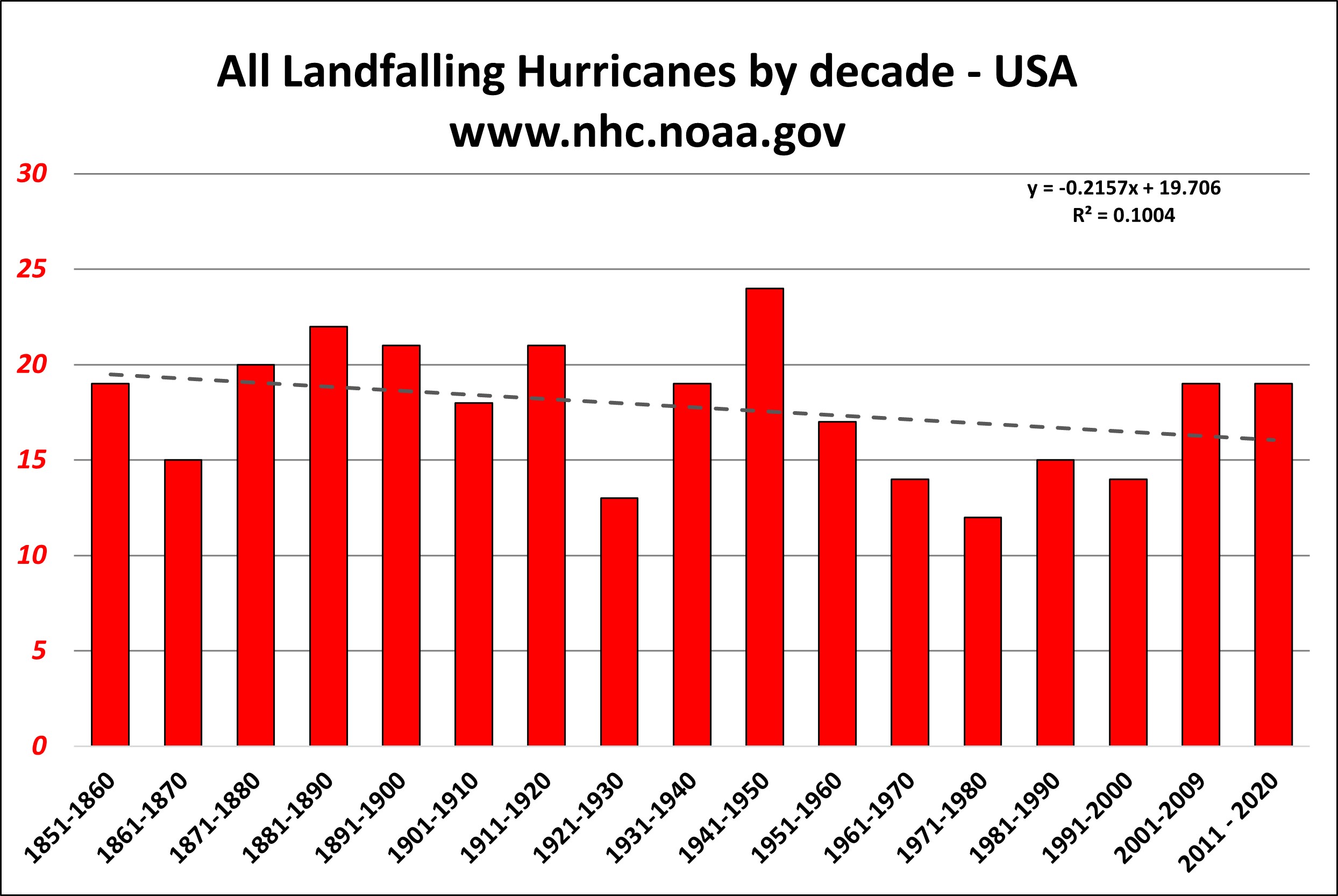
And yet there is no discernible trend toward either more storms or more intense hurricanes compiled over more than beyond the last century. (This chart by NOAA was especially easy to find.) Thus far, the decade of the 1940s saw the most seriously intense storms. Being historical data, this brings to mind a modification of Santayana’s famous adage: when people are ignorant of their history, they make it really easy for demagogues to lie to them about it.

Rather than human consumption of fossil fuels, two other factors are mostly relevant when it comes to the damage wrought by hurricanes: the path they take and the development of infrastructure within that path. Out on the open sea, a hurricane may damage a few ships, but when one goes over a population center…well, you know, it just happened.

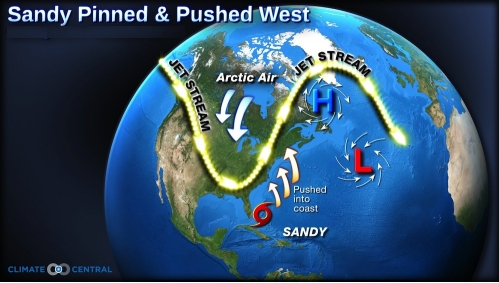
What determines the path is largely chaotic. Go figure. There’s this weird thing called the jet stream, which is sort of the result of the Earth’s continuous rotation within a tenuous atmospheric envelope. Becoming known to American aviators during World War 2, the particular details of the jet stream were kept as a military secret well into the mid-twentieth century. Ocean currents and surface temperatures are also involved. Early forecasts of hurricane paths are typically all over the map. As the time frame compresses, they tend to become more accurate, but not always.

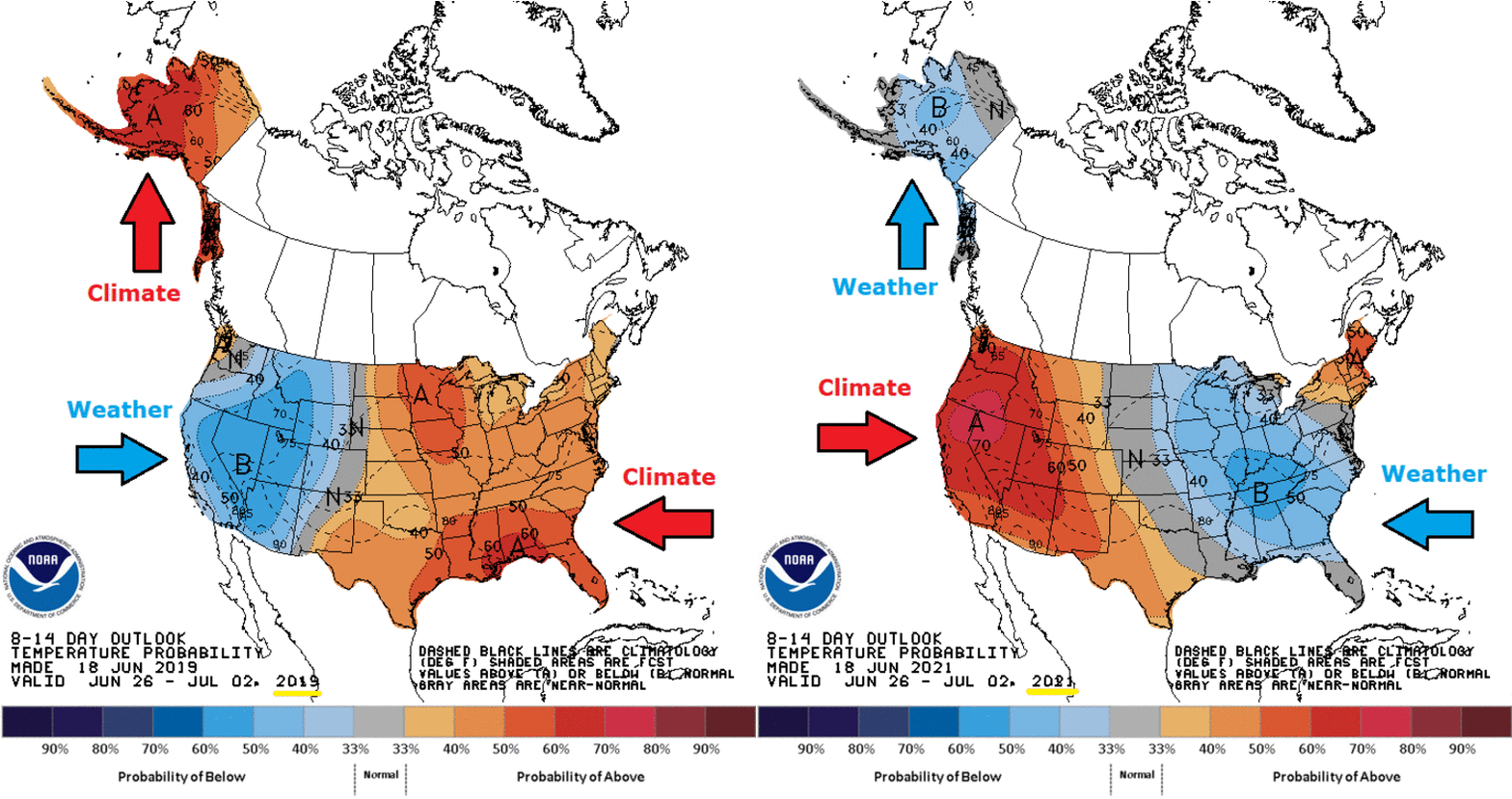
Then there’s the “atypically” warm weather that sometimes happens in early autumn. We just had some of that, along with offshore winds and seriously elevated fire danger. In the olden days, this was called “Indian summer.” Back in 1919, Victor Herbert even wrote a song by that name. Maybe I’m just a cynic, but I’m expecting the fear-mongers to start pandering to the general public’s pervasive ignorance of earth science to cause panic over yet another routine weather event.

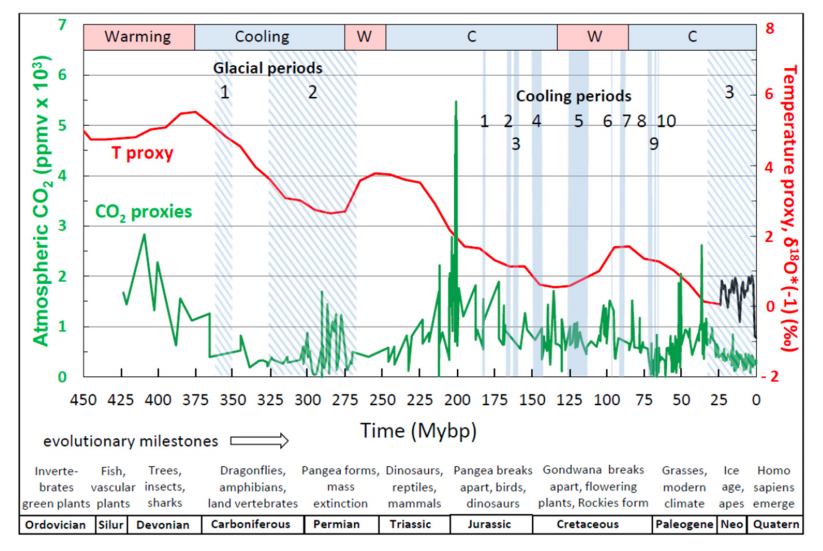
There are three scientific disciplines that are especially useful when looking at weather and climate of the distant past: geology; paleontology; and tree ring analysis, known as dendrochronology. Geology shows us the impact glaciers have had on the Earth’s surface. Paleontology shows us the now extinct life forms that thrived under previous environmental conditions. Dendrochronology shows us a preserved record of ancient weather conditions such as year-to-year rainfall and temperature.

How warm would the weather have to be for giant reptiles to flourish all over the Earth? Pretty warm, it seems. There is some work afoot to show that dinosaurs may have been warm-blooded. Good luck with that. Birds are the first known warm-blooded animals, and they evolved from reptiles and still tend to have scales on their legs. Mammals are also warm-blooded. Enormously large mammals such as wooly mammoths were common during the last ice age, the Pleistocene. Having a large size is especially beneficial for warm-blooded animals in cold climates, since surface area of the outer skin increases much more slowly than the actual body mass, making the large animal significantly more thermally efficient than a smaller one.

But why is the blatant climate change hoax still being promoted? There are two different reasons. The first is held among the true believers: humans are evil. They recklessly continue to damage the Earth’s biosphere, just for trivial benefits and without the slightest concern for the consequences of their actions. The other is political: fear can be a terrific motivator but is not all that conducive to good decision-making. That’s fine, too. The wannabe mega-state tyrants l-o-v-e to deal with fear and poor decision-making. How else can they effectively enslave the masses so as to fulfill their objectives?

And what are these objectives? Taking control of everything comes to mind. The evil players in politics are mostly after control. The rest of us just want to have the streets swept and the criminals pulled away from the rest of us. The term Statist should replace Marxist in this dialogue. Absolute government authority should overcome the self-direction of the individual — since so many among us are not really attuned to proper functionality in the modern world.

Socialism was already in the works when Karl Marx got involved. I like to say that a communist is an angry socialist. Marx injected class struggle into the quest for ownership of the means of production. Thus, the USA was a tough sell for Marxism since we are a particularly socially mobile society. The late, great Walter E. Williams would often say that the ranks of the one-percenters were constantly changing — since new ones would rise up, while others would blow it and fall away. The “Old World,” by contrast, is littered with caste systems and other forms of enforced social order.

Back to Caddell’s “elite gentry” — their desires are in mortal conflict with the aspirations of just plain folks. Or as Lincoln said, “God must love the common man, for he made so many of them.” To some, populism is a dirty word. To others, it is a path into the future. It can mean different things to different people. I like to use the term personal freedom. We can do what we want — as long as we don’t interfere with the freedom of others. But to others, “freedom” is a dirty word.


via Science Matters

https://ift.tt/fkOShjY

October 28, 2024 at 04:17PM

Leftist Academics Flee as Musk’s X Ends Their Censorship Reign: How Free Speech Sent the Ivory Tower Packing

Elon Musk’s takeover of Twitter, or X as it’s now called, has brought an abrupt shift in the dynamics of the platform. For years, X functioned as an echo chamber where progressive academics freely exchanged ideas, often without much opposition. It was an exclusive club, and Musk’s open-door policy shattered it. With censorship dialed back and banned accounts reinstated, Musk’s version of free speech drove many academics away, leading to a marked decrease in engagement among their ranks.

An article titled The Vibes Are Off: Did Elon Musk Push Academics Off Twitter ? documents this retreat. It shows a significant drop in activity, especially among verified users, following Musk’s acquisition. Emphasis below is mine.

This article addresses a narrower empirical question: What did Elon Musk’s takeover of the platform mean for this academic ecosystem? Using a snowball sample of more than 15,700 academic accounts from the fields of economics, political science, sociology, and psychology, we show that academics in these fields reduced their “engagement” with the platform, measured by either the number of active accounts (i.e., those registering any behavior on a given day) or the number of tweets written (including original tweets, replies, retweets, and quote tweets). We further tested whether this decrease in engagement differed by account type; we found that verified users were significantly more likely to reduce their production of content (i.e., writing new tweets and quoting others’ tweets) but not their engagement with the platform writ large (i.e., retweeting and replying to others’ content).

https://www.cambridge.org/core/journals/ps-political-science-and-politics/article/vibes-are-off-did-elon-musk-push-academics-off-twitter/28F45D508BE8F50C95F0F2BBEC48BB10

The data points to a familiar pattern: when left-leaning narratives lose control of the conversation, proponents either cry foul or flee​. Now, if you combine this exodus with the insights from Mitchell Langbert’s 2018 study on the political affiliations of elite liberal arts college faculty, the story becomes even clearer.

Langbert’s study from 2018, Homogenous: The Political Affiliations of Elite Liberal Arts College Faculty, reveals a staggering imbalance: liberal arts faculties are overwhelmingly Democratic, with many departments having zero registered Republicans. Across 51 colleges, the average Democratic-to-Republican ratio was 10.4:1. Excluding the two military colleges in the sample (West Point and Annapolis), the ratio jumped to 12.7:1. In the most ideologically driven fields, like gender and peace studies, there were no Republicans to be found​.

Why Political Homogeneity Is Troubling

Political homogeneity is problematic because it biases research and teaching and reduces academic credibility. In a recent book on social psychology, The Politics of Social Psychology edited by Jarret T. Crawford and Lee Jussim, Mark J. Brandt and Anna Katarina Spälti, show that because of left-wing bias, psychologists are far more likely to study the character and evolution of individuals on the Right than individuals on the Left.2 Inevitably affecting the quality of this research, though, George Yancey found that sociologists prefer not to work with fundamentalists, evangelicals, National Rifle Association members, and Republicans.3 Even though more Americans are conservative than liberal, academic psychologists’ biases cause them to believe that conservatism is deviant. In the study of gender, Charlotta Stern finds that the ideological presumptions in sociology prevent any but the no-differences-between-genders assumptions of left-leaning sociologists from making serious research inroads. So pervasive is the lack of balance in academia that more than 1,000 professors and graduate students have started Heterodox Academy, an organization committed to increasing “viewpoint diversity” in higher education.4 The end result is that objective science becomes problematic, and where research is problematic, teaching is more so.

https://www.nas.org/academic-questions/31/2/homogenous_the_political_affiliations_of_elite_liberal_arts_college_faculty

The combination of Musk’s takeover and Langbert’s findings paints a vivid picture of academia’s ideological homogeneity. For decades, liberal arts faculty have operated in environments with little to no ideological diversity, and that’s reflected in their research, teaching, and engagement on social media. Academics’ exodus from X after Musk’s acquisition wasn’t just a response to a change in management—it was a reaction to the loss of their curated, censorship-fueled dominance of online discourse.

Musk’s X dismantled what many academics had relied on: a largely one-sided conversation. Langbert’s study reveals that academia is dominated by progressive ideologies across most fields, with engineering being the only discipline approaching anything close to balance, with a 1.6:1 Democrat-to-Republican ratio​. By contrast, communications and interdisciplinary studies—fields often steeped in progressive activism—had ratios so extreme that registered Republicans were entirely absent​.

Langbert makes it clear why this matters: the lack of political diversity in academia results in biased research, limited intellectual exploration, and a diminished credibility. Without a diversity of viewpoints, echo chambers thrive. As Langbert points out, this homogeneity affects not just the research itself but also the quality of education students receive​.

Musk’s acquisition of X directly confronted this echo chamber mentality by reopening the platform to competing viewpoints. It was a move that struck at the heart of academic X, which had become a playground for virtue-signaling rather than open debate. Suddenly, those accustomed to controlling the narrative found themselves in a more competitive space. In response, many chose to exit, unable or unwilling to engage in a freer marketplace of ideas​.

But the academic retreat from X isn’t just about losing control. It also reflects the reputational risks perceived by scholars. As the Vibes Are Off study indicates, many prominent academics saw remaining on Musk’s X as tacitly endorsing his version of free speech, including the reinstatement of figures like Donald Trump. The paper notes that higher-profile accounts were more likely to disengage—these scholars were particularly wary of being seen on a platform that now tolerated broader political discourse​.

Langbert’s study gives us more context for this aversion. When the very fields these academics represent are characterized by extreme ideological homogeneity, the prospect of open debate—especially in a setting where dissent is allowed and even encouraged—is not just uncomfortable; it’s antithetical to their norms​. These are fields where intellectual diversity has been systematically excluded for decades, so it’s no wonder that scholars would find Musk’s X environment hostile.

The most telling aspect of this whole saga is that Musk’s X has, by default, become more neutral simply because those who previously monopolized the conversation have departed.

Ironically, the platform is now closer to the “diversity of thought” that academia claims to champion but rarely practices. The exodus of academics, while unfortunate for them, has leveled the playing field, allowing more voices—whether liked or not—to participate.

In sum, Musk’s X takeover and the subsequent academic retreat are case studies in how progressive institutions respond to the loss of control. When they can no longer dictate the terms of debate, they either rage impotently or exit altogether. The lesson here is not just about social media dynamics; it’s about the broader implications of free speech in an increasingly ideologically polarized society. Musk, for all his faults, has forced a confrontation with the reality that if you open the gates to a wider variety of voices, some people will pack up and leave. And as the Langbert study shows, when it comes to ideological homogeneity, academia is already well-practiced in avoiding dissent.

via Watts Up With That?

https://ift.tt/kbC61zX

October 28, 2024 at 04:04PM

Failed State: Since 2021, 10% of the population left Cuba, and now the country has fuel shortages and blackouts

By Jo Nova

Spare a thought for the people of Cuba

The situation went from awful to something much worse.

They ran out of working electrical plants ten days ago, and endured blackouts lasting for four straight days, including one hurricane. Reports coming out suggest that though electricity is partly restored, it’s often only for four hours a day. Not surprisingly, the country is semi-paralyzed — schools are still closed and “labor services” are largely non-existent, apart from hospitals, funerals and efforts to repair the damage caused by Hurricane Oscar.

Soon they may run out of people. People were fleeing Cuba before things got this bad.

The big blackout began on Friday October 18th. In the next four days they restarted the grid three or four times only to have it crash again, and while power is sort of mostly restored the structural problems appear to be dire. Nothing really sums the state of the communist economy better than one line on Vox news which described the moment the big blackout began:

“Seven of the country’s eight thermoelectric plants, which generate power for the island, were not working or under maintenance prior to the Guiteras plant’s failure. So when the Guiteras plant shut down, there were no more energy sources.”

As if “seven out of eight” is not bad enough, there’s more. Cuba can’t get subsidized fuel anymore from Russia, Mexico or Venezuela, and they can’t afford to buy fuel at market prices. The economy is kaput. They don’t make many things that the world wants to buy, and tourism dried up with the pandemic.

It appears that either the only surviving plant suffered a malfunction, or the nation actually ran out of fuel, or both. Reuters is somewhat vague:

Reuters

Long-time ally Venezuela slashed fuel shipments to Cuba by half this year as it struggles to assure supply at home. Allies Russia and Mexico have also cut exports to Cuba, forcing the cash-strapped government to seek far pricer fuel on the spot market.

The situation came to a head on Friday, when Cuba’s largest power plant malfunctioned, joining several smaller plants already offline. Foul weather had also stalled the arrival of fuel from tanker ships offshore, starving the island’s power plants. The combination prompted the entire grid to collapse.

Life is tough. Generators were only able to power hospitals for emergency situations.

Cuba

People are collecting wood in the streets so they can cook anything for dinner. Even before the blackout some 600,000 had no running water, and now that is worse. The BBC reports that some are now going hungry.

Predictably there are fears the exodus will grow

The word is that the government won’t let people protest the dire living conditions, but it will let them leave, so one million people have left in the last three years. (There go the dissidents, the ambitious, the motivated, and often the brightest). Since Cuba had a population of around ten million, effectively ten percent of the country left since 2021. There are fears this will only increase:

This crisis could fuel a further exodus; an estimated 1 million Cubans have left the country in the past three years, the largest such migration in the country’s history. One Havana-based economist, Omar Everleny, told the New York Times he’s already starting to see a new wave of emigration: “Anyone who was thinking of leaving is now accelerating those plans. Now you’re hearing ‘I am going to sell my house and go.’”

By Martin Gurri, The Free Press

This is not an exaggeration or a metaphor. The entire island went dark—even Havana, which has been protected from the worst of the recent blackouts. It was a civilizational breakdown. The economy quite literally ground to a halt, as factories and stores were ordered closed by the government. From elementary schools to universities, the educational system was put on pause. Hospitals turned people away. For three days, Cuba, already tattered and abused, entered a special circle of hell reserved for the most mismanaged nations on earth.

The material catastrophe is self-evident and can be measured empirically. The depth of human suffering is impossible to gauge from a distance. Without refrigeration, food—always hard to obtain—was spoiled. Mothers lacked milk for their children. Without fans or air conditioners, everyone, including the very young and the very old, was exposed to Cuba’s blistering temperatures. Without elevators, the old and the sick who lived in apartments were forced to sleep outdoors, in the heat and among the mosquitoes. Without traffic signals, venturing to the streets became a death-defying nightmare. Without light, the human mind itself begins to shut down—the Cuban public, frozen in place by an incompetent and antiquated regime, sank to almost metaphysical levels of hopelessness.

Bad governments can ruin a lot of lives:

People are angry. Online many people complain that the government built many fancy hotels for tourists, instead of fixing the electricity grid for the people.

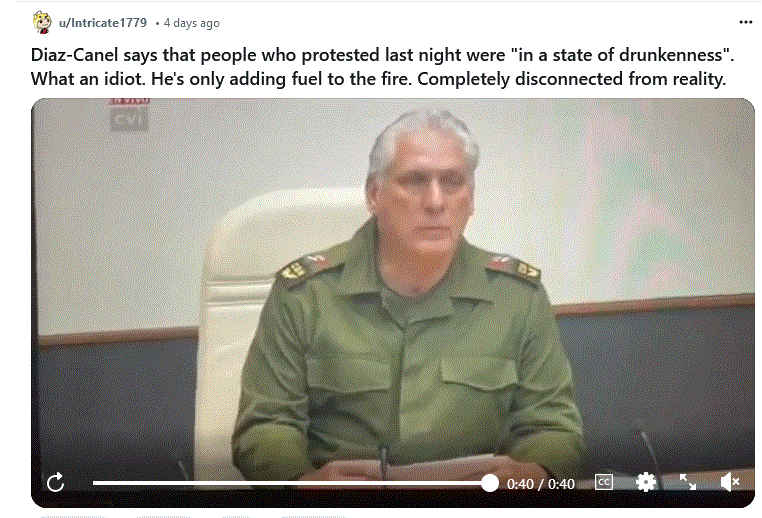
Despite the crisis and the hurricane, Cuba’s President Miguel Díaz-Canel somehow found the time to advise the citizens that “if they protest on the street they will be prosecuted”. He put on military garb and said the protestors were just drunks, as if sober people would not mind having no functional economy.
Cuba

…

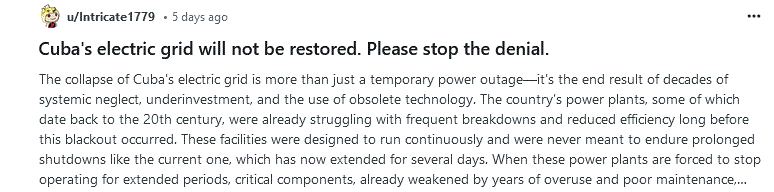
It’s hard to get stories out of Cuba but ex-pats or friends outside Cuba post opinions on Reddit and they are gloomy.
Cuba


The problems in the Cuban grid have been decades in the making.

The eight power plants are largely crude fuel oil plants of about 400MW. In total, theoretically, they could generate 2,500MW. In actuality, they are badly built, badly maintained, and 30 to 40 years old. Power generation has declined by 25% in the last five years.

Ruaridh Nicoll in Havana, The Guardian

“It’s very hard to restart a power station,” said a retired engineer from Antonio Guiteras, who asked to remain anonymous. “You need to produce a lot of electricity just to get it going.”

Antonio Guiteras was built in 1989, and is now battered and obsolete. “The truth is that it was built rotten,” said the engineer. He told harrowing stories of working with faulty safety equipment, political management who would disappear when problems arose and a system long pushed to its limit.

“There was a scheduled maintenance programme, but it was never followed,” he said. “The requirements were too tight. We were told: ‘The factory has to produce, so patch it up.’”

Somehow, despite Cuba being almost a failed state, there are glorious plans to build 26 solar farms with a capacity of one gigawatt. As the Guardian tells it, China has offered the parts to make them, in return for access to Cuba’s nickel deposit. Though there are fears that the people who might have been able to build the solar plants have already left Cuba. What then?

The megawatt of solar (if it even happens) will only provide about one third of existing demand at most, and will obviously only work in the middle of the day, and possibly not at all after the first hurricane. As Broken Hill, and Alice Springs know, when things are desperate, solar panels are not the answer. Baseload comes first.

If Cuba can’t get fuel oil, and get the grid functioning, surely food and water will run out, and people will be forced to make some very tough decisions.

If the grid can’t supply enough energy for the people, in the Capitalist world the answer is “more grid” but in the communist world, it apparently means “less people”. In this case Cubans are “lucky” enough to be allowed (at the moment) to walk or swim away, but for how long?

h/t Chad and another ian.


0 out of 10 based on 0 rating

via JoNova

https://ift.tt/2X0nriT

October 28, 2024 at 03:18PM