McKinsey Report: Large Net Zero Mineral Supply Shortfall

Essay by Eric Worrall

“… current mineral supply meets between 10 and 35% of projected 2050 requirements …”

McKinsey: Clean Energy sees Critical Minerals Supply Crisis

By Sean Ashcroft
October 25, 2024

McKinsey clean energy report part 1: Mining faces long-term critical minerals supply shortfall as demand soars for raw materials to fuel clean energy drive

Ensuring sufficient critical minerals are available to support the deployment of low-emissions technologies will require significant scale-up of their extraction and refining, a new McKinsey report says.

The report – The hard stuff: Navigating the physical realities of the energy transition – stresses how the energy transition is in its early stages, with only an estimated 10% of required deployment of low-emissions technologies by 2050 achieved in most areas.

…

McKinsey says current mineral supply meets between 10 and 35% of projected 2050 requirements. This assessment comes under the consultancy’s Achieved Commitments scenario, which models countries meeting their stated climate pledges.

The authors identify supply expansion speed as a primary constraint. They highlight uncertainties around material substitution technologies. Performance impacts of alternative materials require evaluation.

…

The consultancy forecasts nickel demand will increase by 100%. Dysprosium and terbium requirements could expand by 400%. Lithium demand faces a potential 700% surge.

…

Read more: https://miningdigital.com/sustainability/mckinsey-warns-of-critical-minerals-supply-crisis

Imagine commissioning a trillion dollar project without checking the logistics. Surely nobody could be that stupid.

via Watts Up With That?

https://ift.tt/UKAi8Fo

October 28, 2024 at 08:02AM

A Demonstration: Low Correlations Do Not Necessarily Lead to Low Confidence in Data Regressions

In a recent post I used our new Urban Heat Island (UHI) warming estimates at individual U.S. GHCN stations having at least 120 years of data to demonstrate that the homogenized (adjusted) GHCN data still contain substantial UHI effects. Therefore, spurious warming from UHI effects is inflating reported U.S. warming trends.

The data plots I presented had considerable scatter, though, leading to concerns that there is large uncertainty in my quantitative estimates of how much UHI warming remains in the GHCN data. So, I updated that post to include additional statistics of the regressions.

A Simple Example: High Correlation, But Low Confidence In the Regression Slope

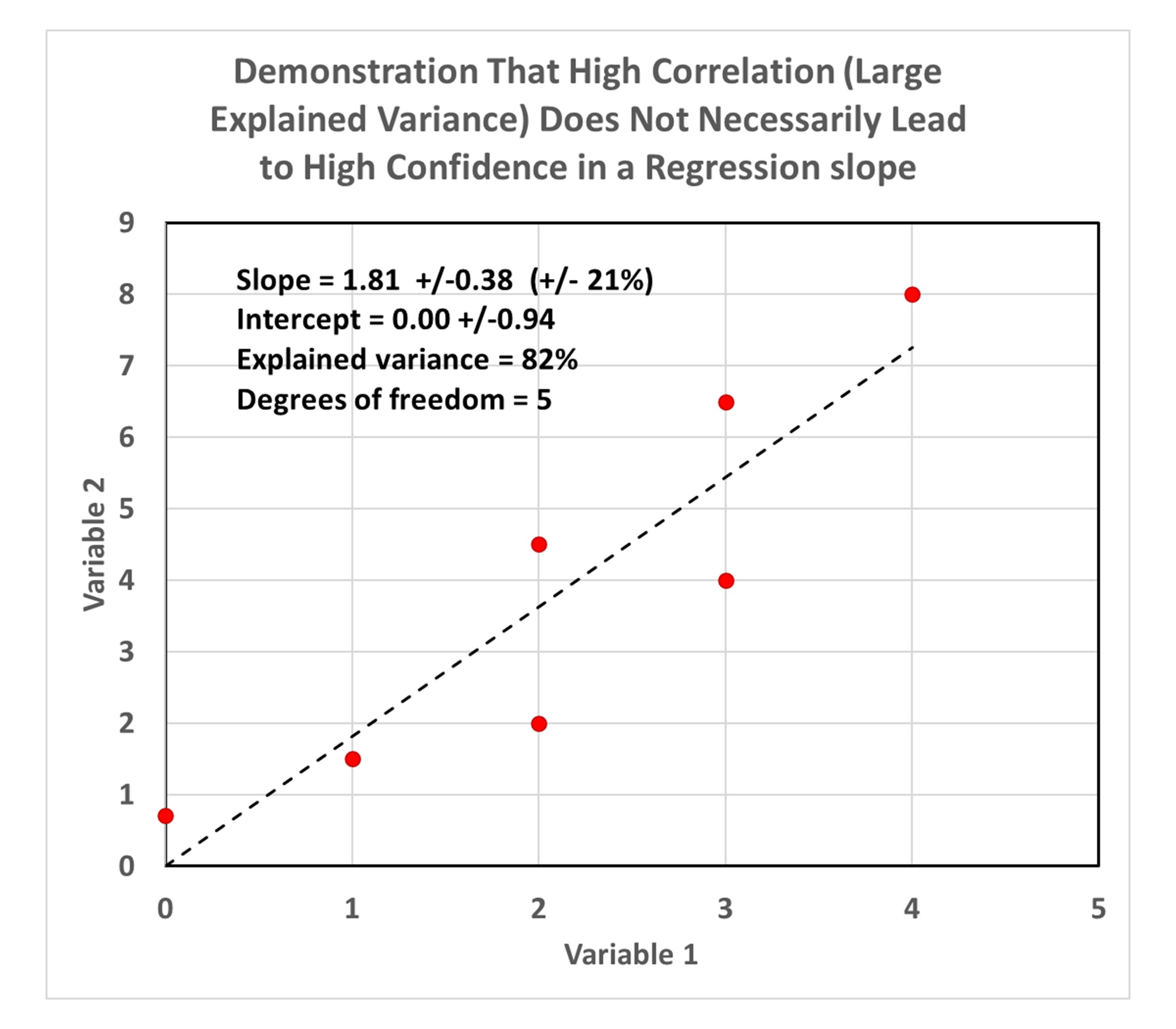
The following plot of a small amount of data I created shows what looks like a pretty strong linear relationship between 2 variables, with a regression explained variance of 82% (correlation coefficient of 0.91).

But because there are so few data points, there is large statistical uncertainty in the resulting diagnosed regression slope (21% uncertainty), as well as the regression intercept (which is diagnosed as 0.0, but with an uncertainty of +/- 0.94).

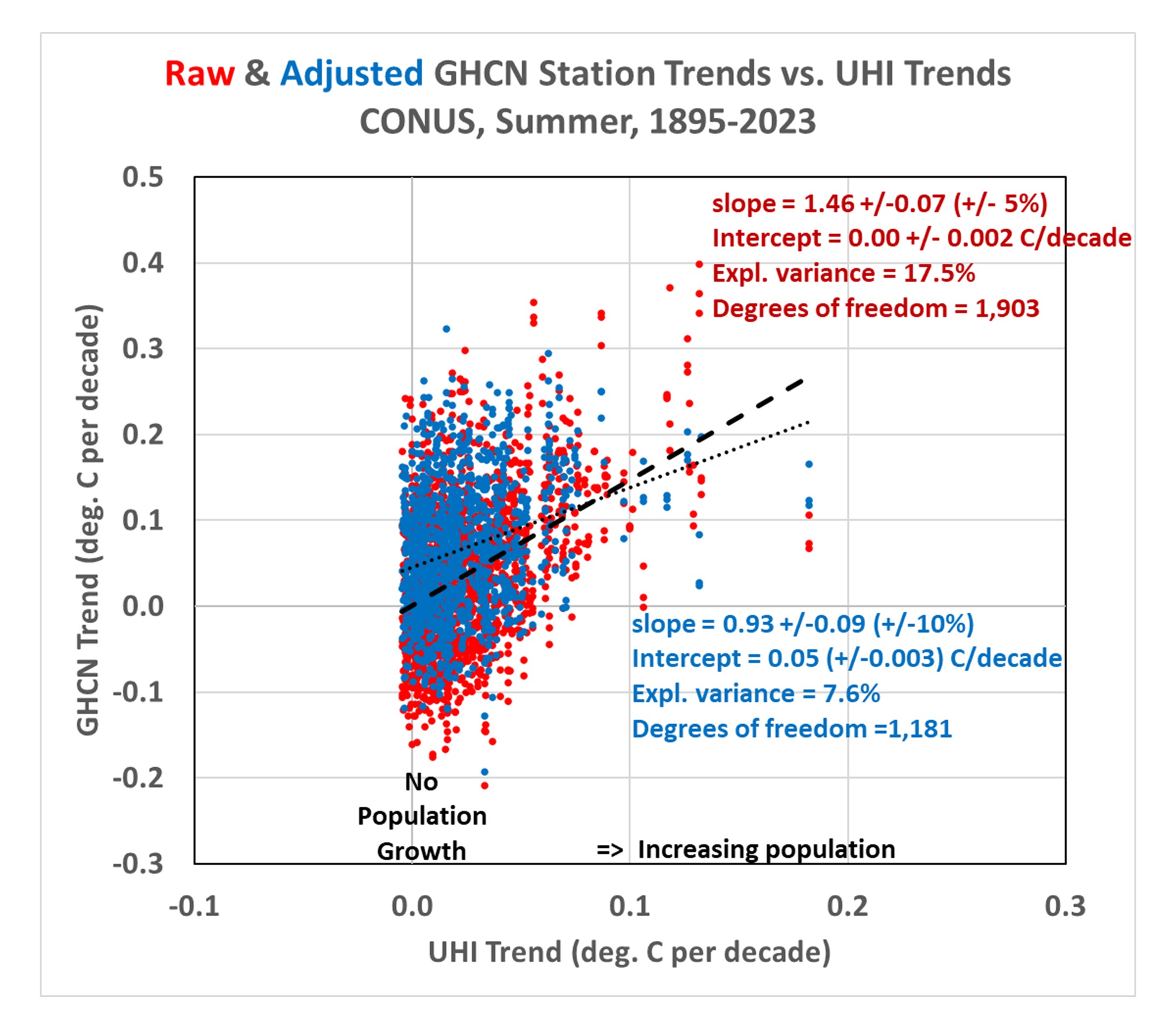
Now let’s look at the third data plot from my previous blog post, which demonstrated that there is UHI warming in not only the raw GHCN data, but in the homogenized data as well:

Importantly, even though the regression explained variances are rather low (17.5% for the raw data, 7.6% for the adjusted data), the confidence in the regression slopes is quite high (+/-5% for the raw GHCN regressions, and +/-10% for the homogenized GHCN regressions). Confidence is also high in the regression intercepts (+/-0.002 C/decade for the raw GHCN data, +/-0.003 C/decade for the homogenized GHCN data).

Compare these to the first plot above containing very few data points, which had a very high explained variance (82%) but a rather uncertain regression slope (+/- 21%).

The points I was making in my previous blog post depended upon both the regression slopes and the regression intercepts. The positive slopes demonstrated that the greater the population growth at GHCN stations, the greater the warming trend… not only in the raw data, but in the homogenized data as well. The regression intercepts of zero indicated that the data, taken as a whole, suggested zero warming trend (1895-2023) if the stations had not experienced population growth.

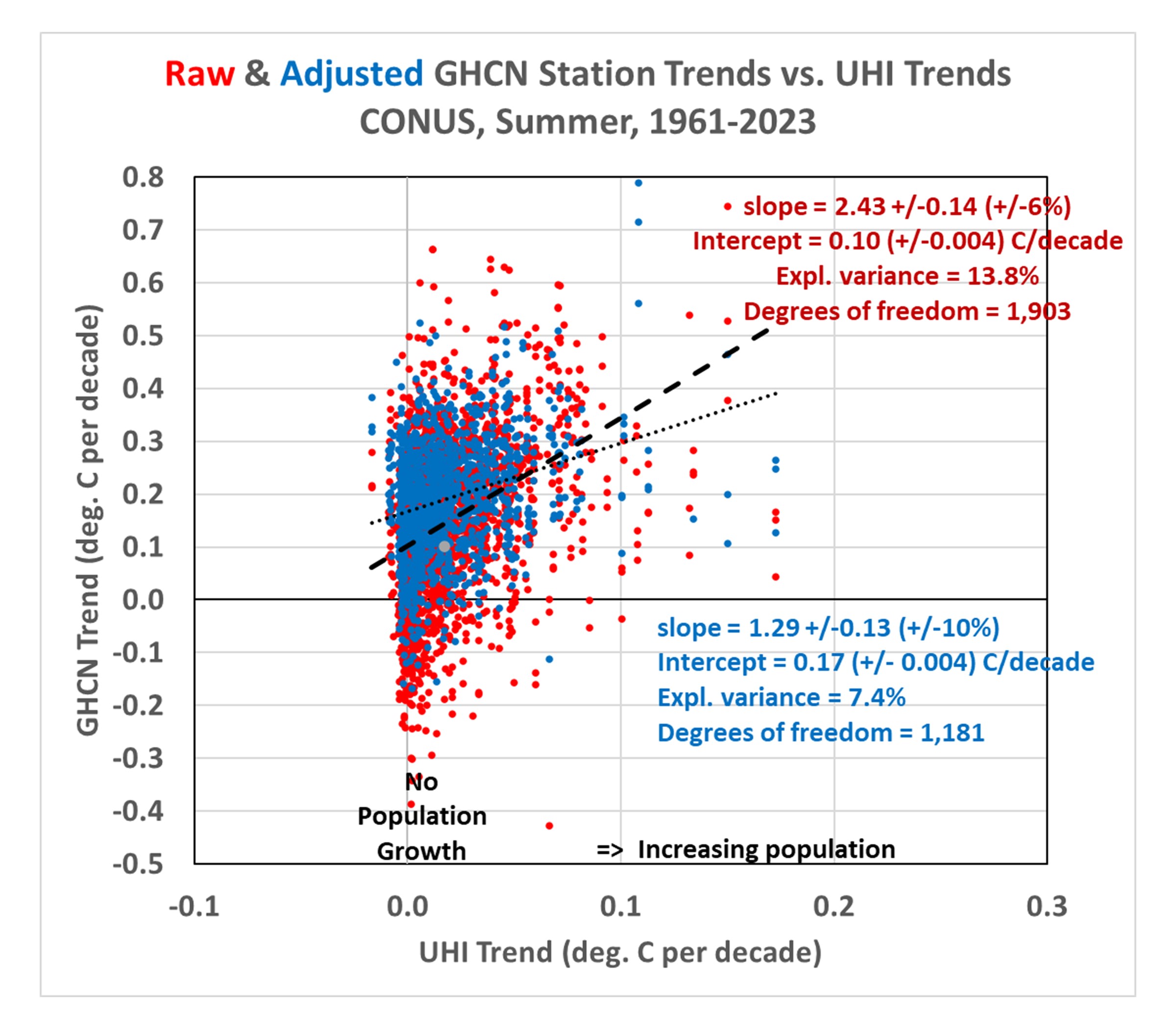
But it must be emphasized that these are all-station averages for the U.S., not area averages. It is “possible” that there has (by chance) actually been more climate warming at the locations where there has been more population growth. So it would be premature to claim there has been no warming trend in the U.S. after taking into account spurious UHI warming effects. I also showed that there has been warming if we look at more recent data (1961-2023).

But the main point of this post is to demonstrate that low correlations between two dataset variables do not necessarily mean low confidence in regression slopes (and intercepts). The confidence intervals also depend upon how much data are contained in the dataset.

via Roy Spencer, PhD.

https://ift.tt/aP2CIkK

October 28, 2024 at 07:13AM

Electric bin lorry bursts into flames in central London

By Paul Homewood


h/t Philip Bratby

Time to stop this madness before somebody dies:


 image

London's West End was closed off to traffic early Monday morning after an electric bin lorry caught fire

An electric bin lorry burst into flames on Monday, forcing roads across London’s West End to close.

Specialist crews were deployed to the fire after the £580,000 electric lorry caught alight in the morning.

The lithium battery-powered trucks were recently launched under Sadiq Khan, the Mayor of London, as part of a green initiative to reduce carbon emissions in the capital.

https://www.telegraph.co.uk/news/2024/10/28/bin-lorry-on-fire-central-london/

via NOT A LOT OF PEOPLE KNOW THAT

https://ift.tt/Ow0yPsT

October 28, 2024 at 07:08AM

IEA Optimism v Reality

By Paul Homewood

h/t Hugh Sharman


This is a thought provoking analysis by Art Berman, an energy expert with with a résumé boasting over 40 years as a petroleum geologist.

Here he takes apart the IEA’s politically determined energy projections:


 image

The International Energy Agency (IEA) shared some good news last week—clean energy is gaining ground, fossil fuel use is peaking, and carbon reductions look achievable.

But dig into the numbers, and a different picture emerges. The IEA’s forecast rests on shaky assumptions, wishful thinking, and contradictions that cast serious doubt on the credibility of its projections.

The biggest problem with the rosy headlines in World Energy Outlook 2024 is that coal use—the largest source of global carbon emissions—will decline by just 0.5% per year through 2030, and only 0.8% annually from 2030 to 2050 (Figure 1 and all charts in this post are for the IEA’s “Stated Policies” scenario—because that is the most likely case).

It’s hard to believe that significant progress is being made in the transition to clean energy when coal consumption barely declines.

Adding to that disappointment, the IEA forecasts that oil consumption will increase by 0.75% annually and natural gas use will grow at 1.6% per year over the same period. How can carbon reductions be within reach—as the IEA claims—when net fossil fuel consumption does not return to 2010 levels until 2035?

Read the full analysis here.

via NOT A LOT OF PEOPLE KNOW THAT

https://ift.tt/49OhI3P

October 28, 2024 at 05:19AM