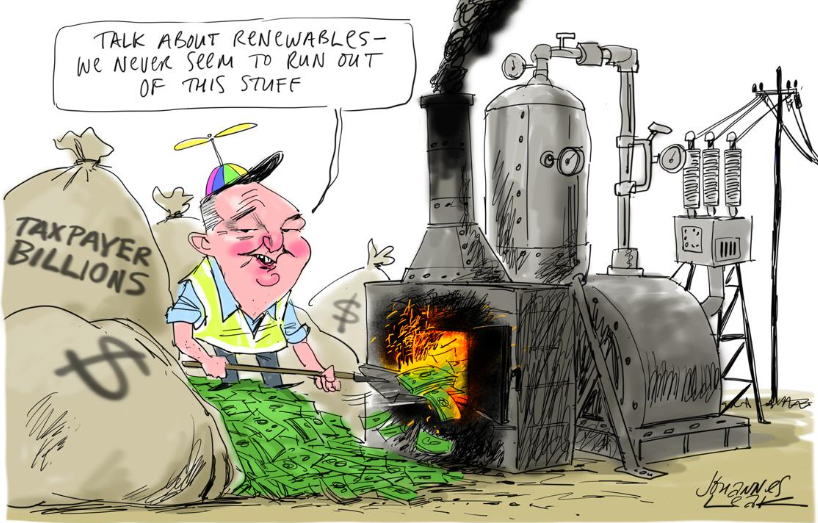
Grand Wind & Solar Transition Delivers Crushing Retail Power Bills

Propagandists pushing the wind and solar transition are struggling to explain away the crushing power bills that inevitably follow. Every state or country (without exception) that is attempting to run on sunshine and breezes suffers rocketing retail power bills.

Wind powered Denmark and wind and solar powered Germany suffer Europe’s highest power prices, by a country mile.

No self-inflicted disasters are closely followed by South Australia, which leads the Australian states in both wind and solar generation capacity and retail power prices. On a purchasing power parity basis, South Australia suffers the highest power prices in the world. And, detailed below, things can only get worse.

In the first article, Colin Packham does his very best to explain away a surge in Australian wholesale power prices, which he blames on a burst of calm weather.

Too witless to understand the idiocy of his own argument, Colin – who has been pushing the grand wind and solar scam for years, as if he’s in on it – manages to embarrass himself, by revealing his childish ignorance of both electricity production and economics. STT provides the necessary corrections.

Although, perhaps, the best answer to Colin’s starry-eyed view about the grand wind and solar transition is in The Advertiser article that follows from a month ago, reporting on the South Australian businesses being smashed with 45-60% increases in their retail power bills in just 12 months.

Wholesale electricity prices jumped in winter in blow for bill relief next year
The Australian
Colin Packham
18 October 2024

The cost of wholesale electricity rose during winter as periods of depressed renewable energy generation coincided with soaring demand for power in bitterly cold weather, data from the Australian Energy Regulator has shown, tempering hopes of sustained bill relief for households and businesses in 2025.

Electricity bills are shaping as a critical election issue, with the next annual tariffs for 2025 expected to be announced just months ahead of an election that must be held by May, and Labor is desperate for continued bill relief after jumps of more than 20 per cent amid a global energy crunch when it assumed office.

In a blow for hopes of rapid falls in electricity bills, the AER said that while wholesale electricity prices during the three months to September 30 were lower than the previous quarter, they were up significantly from the same period one year earlier.

Year-on-year prices were significantly higher across all regions, with Tasmania up 290 per cent, Victoria up 114 per cent and South Australia up 76 per cent, it said.

The increase was fuelled, the AER said, by a spike in demand for electricity in July and early August as Australia suffered through another wind drought when electricity production from the zero-emission source plunged. The issue was compounded by a drought in Tasmania, which relies heavily on pumped hydro.

[Wrong, Colin. Tasmania’s hydro output relies on its dams which store water and, after generating electricity in their hydro plants, release it once and for all in rivers, with the water flowing out to sea. There is no pumped hydro in Tasmania. However, when it stops raining for a prolonged period (ie drought), Tasmania’s hydro system will literally run dry and produce nothing much at all, as it did in 2016.]

“Variability in output in July and early August resulted in the need for more expensive firming resources such as batteries, hydro and (gas power generation),” the AER said.

[Note to Colin. That little piece of propaganda gives the impression that batteries provide a significant volume of power when wind and solar output collapses. It is in fact the reverse. Gas power generation (notably in brackets to suggest that it doesn’t even feature in the equation) sits right behind coal-fired power as the mainstay of Australia’s Eastern Grid. Batteries do not contribute any significant volumes of power, and sit at the margins, providing frequency control to prevent the grid collapsing when wind and solar output collapse. The batteries will dispatch power only long enough to allow gas or diesel generators to fire up and take over.]

The regulator noted that from mid-August to September the weather improved and wind generation increased, tempering the impact on quarterly wholesale electricity prices.

[See The Advertiser article below as to retail prices in Australia’s renewable energy capital, South Australia.]

Still, higher wholesale prices during the period are a headwind to hopes for lower tariffs known as the Default Market Offer.

The Default Market Offer is calculated annually as the AER considers the wholesale cost of electricity, the toll of transporting electricity, and the cost of compliance with government rules and regulations.

Wholesale prices are the biggest, most influential component of the Default Market Offer, but the AER will use several years of data rather than one single 12-month period so the most recent jump is not a death knell for hopes of lower bills.

[More propaganda from the AER. Australians have been hearing this guff for years. The reality is laid out in the next article from The Advertiser.]

The AER will announce a draft Default Market Offer in March, ahead of the election that pits two different visions for Australia’s future energy grid against each other.

Labor is under mounting pressure amid a cost-of-living crisis that has seen a record number of Australians unable to pay their utility bills, a stark contrast to the pledge made by Prime Minister Anthony Albanese when in opposition. Labor campaigned on a platform of electricity savings of $275 a year.

Labor has set the aggressive target of having renewable energy generate 82 per cent of Australia’s electricity by 2030, and federal Energy Minister Chris Bowen said the AER report illustrates the plan is working, with a growing number of occasions wholesale electricity prices were $0.

“This latest report shows electricity prices are going down in the majority of our east coast grid, and more instances of spot prices under $0, proving our Reliable Renewables Plan is working,” said Mr Bowen.

Negative wholesale prices occur when renewable energy generation is so plentiful that it more than meets demand. Negative wholesale prices drag down the average cost of producing electricity, which eventually determines the price paid by households and businesses.

[Colin is evidently no economist and has absolutely no understanding of how markets work. There is a world of difference between the price charged for a good or service and the cost of delivering it. Whatever happens to the wholesale price of electricity, it has absolutely no bearing on the cost of producing it for a generator . More embarrassing bunkum from Colin.]

But the Coalition will seize on the year-on-year increase as evidence of the pitfalls of a renewable energy-dominated grid. The Coalition insists relying on renewables exposes Australia to periods when the wind is not blowing or the sun is not shining, and Labor is incentivising the exit of baseload power, most notably coal, which could step in.

Coal is rapidly retiring as the traditional fuel source struggles to compete financially with renewables. Coal has much higher operational costs than renewables and ever-increasing amounts of renewable energy are driving coal out.

[Colin once again embarrasses himself. He might explain what amount of renewable energy is being produced on a calm night, for example. And explain how, when wind and solar are producing nothing at all, “renewable energy” is driving out any other reliable source, including coal-fired power? Again, operational costs have no bearing on the price charged for wind and solar, which is dependent in the first instance on the value of the Renewable Energy Certificates they receive (the $90 per MWh cost of which is included in retail power bills) and, in the second instance, on the capital cost of having coal-fired and gas-fired generators – with a combined capacity sufficient to meet total demand when wind and solar output amounts to nothing (eg calm nights) – laying idle but ready to dispatch at a minute’s notice. Taxpayers are now paying hidden capacity payments to keep those plants online to prevent total grid collapse. Another fun fact overlooked by Colin]

The Coalition has proposed seven nuclear power stations to fill the void, but has yet to release costings of its plan, though polls indicate growing support for the plan.
The Australian

Meanwhile, back in reality land, a place where households and businesses pay retail power prices based on the true actual cost of attempting to run on sunshine and breezes, South Australians are being smashed.

SA is the economic backwater heralded by cultists as the wind and solar capital of the world. A place where Labor politicians cheered when they blew up their perfectly reliable coal-fired power plants 7 years ago.

Here’s the results of that lunacy.

‘Screwing up the country’ JP Drake blames rush to renewables for power hikes crippling businesses
The Advertiser
Natalie Vikhrov
4 September 2024

A prominent supermarket boss has taken aim at the country’s “rush to renewables”, saying the rapid shift was to blame for power price hikes.

Drakes Supermarkets boss John-Paul Drake has blasted the “rush to renewables” for soaring power bills which threaten the company’s growth.

Drakes, which employs more than 6000 people, has seen energy costs rocket from $10m in 2023 to an estimated $14.5m this year and issued a grim warning about renewables “screwing up the country.”

Drakes was among iconic South Australian companies surveyed by The Advertiser to find the impact of crippling power bills — it revealed they are grappling with mammoth increases of up to 60 per cent, with one saying it has been forced to pass on costs to customers.

Mr Drake said the business needed to remain in competition with supermarket giants Coles and Woolworths which meant they could not increase the cost of goods to offset their rising power bills costs.

He believes part of the reason for spiralling bills is Australia’s “rush” to shift to renewables.

“I think this is the reason we are paying so much more for electricity, because we are trying to go all to renewables,” he said.

“I think we have got to be very cautious about trying to be green and realise how much it has screwed up the whole of the country.”

The supermarket chain has opened three new sites across the state in the past year but Mr Drake said without the burden of hefty power bills, they would be able to do more.

“It means we don’t grow as much, which means we can’t employ more people, which means we can’t buy more sites,” he said.

“It causes us to be very cautious about how we move forward, it makes us not as optimistic about what we can do.”

Businesses have told The Advertiser they are seeing significant jumps in their power prices when their contracts wrap up and they go to market for a new agreement.

Seeley International, which produces airconditioning and gas heaters, also saw an almost 60 per cent increase in their power bills.

Group managing director Jon Seeley said their electricity use has remained fairly steady but their bills have soared.

Mr Seeley said the company has had to increase prices to make up for the growing power costs.

“We have to regularly review our cost base, including power prices and wages and all other costs and we do have to pass on price increases through to our customers,” he said.

But he added they try to do this “as little as possible” and typically follow broad inflation.

To mitigate growing power costs, Mr Seeley said the business has sought to modify its electricity use which includes investing in new, more efficient equipment.

He added they were looking at including solar in their factory extension works at Lonsdale but as a company with a “relatively energy intensive manufacturing process, even if we cover our roof with solar panels, it doesn’t make a huge difference.”

According to an SA Business Chamber report, South Australia has experienced the biggest increase in electricity bills in Australia.

Angove Family Winemakers joint managing director Richard Angove said they have seen around a 45 per cent increase in their power bills after they went to market for a new energy contract last November.

In recent years the company has approximately halved its grape intake which has significantly reduced the company’s energy use. However Mr Angove said that has not been reflected in their growing power bills.

He said energy prices were an economy-wide problem leading to inflationary pressures for businesses across the board.

“The business environment has never been as tough, possibly with the exception of world wars,” he said.

“However, we’re resilient and we do have plans in place to create efficiencies where we can.

“We’re currently investigating more solar on our vineyard … we’re looking at improvements for better efficiencies.

“We’re always looking at our product portfolio, ensuring that our product mix is right, delivering the highest margins for us.”

Meanwhile, Golden North Ice Cream has seen a 48.6 per cent increase in their power bills.

Managing director Peter Adamo said in 2023, their average monthly bill was $34,000. This year, it comes around $50,000 per month.

“It’s a big cost due to refrigeration. (These are) challenging times, especially operating in a regional town in the Mid North, it just puts more cost pressures.”

Mr Adamo said while they haven’t passed on those increases to customers yet, if prices continue to go up “we won’t be able to absorb it, so there will be price increases”.
The Advertiser
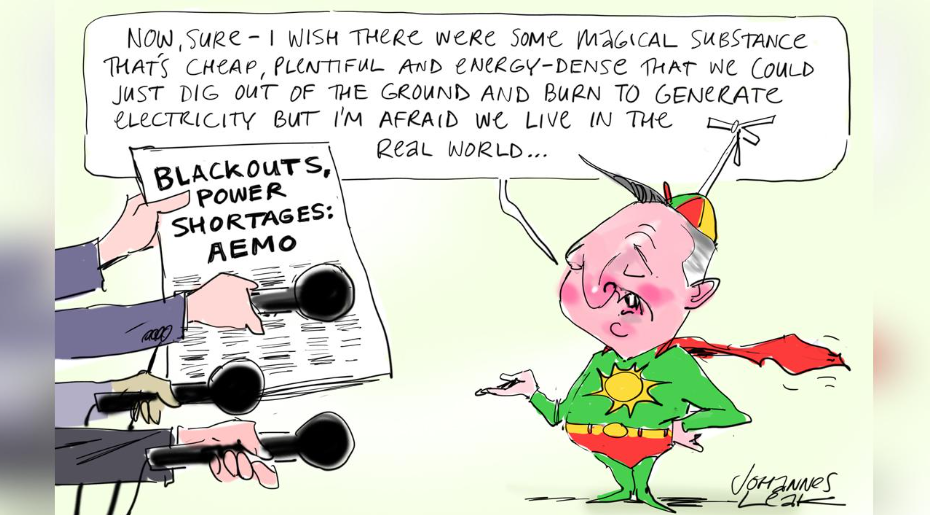
via STOP THESE THINGS

https://ift.tt/L7pUkCF

October 20, 2024 at 01:31AM

The Energy Crisis Commission is Just Another Green Blob Front

From THE DAILY SCEPTIC

by Ben Pile

Another day, another green report. This time, in response to rising energy prices, a report has been published by something calling itself the Energy Crisis Commission. But the report flies in the face of sound economics when it tries to address the hardships faced by millions of individuals and businesses due to shy-high energy prices by calling for “a clear strategy for shifting away from fossil fuels, particularly gas”. Well, guess what: that’s because the “Commission” is just another bog-standard Green Blob front! Who could have guessed?

“A new report out today from the Energy Crisis Commission shows energy experts are backing the Labour Government’s mission for Clean Power by 2030”, tweeted Ed Milliband. Well, of course they do. For when one visits the Commission’s website, it is soon revealed that, “The Energy and Climate Intelligence Unit [ECIU] is providing the secretariat for the Commission.” The ECIU is a well-connected but dysfunctional fake civil society organisation, which is wholly funded by green philanthropic outfits the European Climate Foundation (ECF) and the adjacent Meliore Foundation.

I feel that I write a lot about organisations that are wholly or mostly funded by the ECF, and it often feels that this is repetitive. But that is because most organisations active in the climate domain in the U.K. are funded by the ECF directly, or by one of the half dozen or so of the ECF’s grantor philanthropic foundations. The ECF is opaque about its sources of cash and its grantees, but it appears to be a green money-go-round – the Guardian would call it “dark money” – that puts distance between financial interests and corporate lobbying outfits styled as “civil society organisations”. What is remarkable is how many organisations that are seemingly distinct and “independent” are in fact operated under the strategic direction of their funders, whom they share accommodation with. The ECIU and the ECF are at the same “SE1 1LB” address of a virtual serviced offices – their footprints as entities being as vaporous as their output.

These aren’t real organisations; they are ghosts summoned by the will of money and ideology in some nebulous physical form to do their malign work before fading away. Green organisations – ECF grantees – have long campaigned for higher energy prices, and long attempted to distort the public discussion about how and why prices are going up, despite their false promises that renewables will be cheaper.

And so it is that the commission explains: “We consider this crisis to have started in August/September 2021, when gas prices started to rise, however the key tipping point for record prices was in February 2022 when Russia invaded Ukraine.” And I feel I am repeating myself, again, when I point out that the commission’s lazy analysis is false.

Energy traders had told me long before the Summer of 2021 that unusual price movements were signalling very high future prices. By Autumn 2021, European natural gas spot prices had reached nearly €100/MWh, way above the historical average of about €18. The immediate aftermath of Russia’s invasion prompted a small spike to about €119, followed by a summer spike up to €240, which is when the ECF-funded Carbon Brief (also located at the phantom “SE1 1LB”) produced its “wind power is nine times cheaper than gas” claim. That is to say that the most significant rise occurs before the outbreak of war. This is shown more clearly when prices are viewed on a chart with a logarithmic axis, which better shows relative growth than a chart with a linear vertical axis.

In the 22 months between the slump in demand in May 2020, to the month following Russia’s invasion of Ukraine in February 2022, EU natural gas prices rose a staggering 2,753% – approximately 16% per month. Over the next five months to the August 2022 peak, the price rose a further 68%, at approximately equivalent to 11% per month. The evidence might just as well be made to show the converse of the commission’s claim: that the invasion in fact caused gas prices to collapse. The opposite conclusion is only obtained by misreading the linear chart, which appears to show a peak in the months following the invasion – a post hoc ergo propter hoc fallacy. The far more significant features of the price signal occurred before the event – though Russian reduction of supply and EU sanctions following the invasion undoubtedly tightened supply and pushed prices up further.

The price then fell precipitously over the months to May 2023. Speculation may have driven some of this volatility, but the biggest elephant in the room causing the big splash of high prices in 2022 was lockdowns, or more precisely recovery from lockdowns, including the extraordinary money-printing that had financed economic torpor. Gas production capacity had been slashed during this period, and recovery put pressures on supplies. Russia is largely a scapegoat for the catastrophic impact of Western climate and Covid policy failures.

A Green Blob outfit paying Potemkin commissions to write sympathetic reports about the problem of energy price rises strikes me as analogous to a drug cartel financing rehab centres. One only need to imagine the complaints from the Green Blob if it had turned out to be a “commission” funded by gas companies which found that the solution to energy price rises was to invest more in gas production. But the difference is that increasing gas production would at least close the gap between supply and demand, and therefore lower price. Histrionics from greens typically frame the problem of “interested parties” putting partial advice into the public sphere. But high prices benefit producers, whereas lower prices serve consumers. Ironically, greens and oil tycoons share interests here.

So, who are these commissioners who lack any grasp of basic economics, claiming to speak for the poor? Two of the panel, former MP David Laws and Dhara Vyas, hail from Energy U.K. – the industry lobbying outfit that the new Chief Executive of the Climate Change Committee, Emma Pinchbeck has recently slithered from. Blob. Louise Hellem is Chief Economist at the Remain-fanatic, pro-lockdown Confederation of British Industry. Blob. Professor of Energy Policy at UCL, Jim Watson boasts many roles in advising Parliament, governments and intergovernmental agencies on energy security and emissions reduction among other things. Blob. These people have produced precisely the report you would expect them to. But they were joined by Gillian Cooper,  Executive Director of Partnerships and Advocacy at Citizens Advice, and Adam Scorer, Chief Executive at National Energy Action (NEA), the “national charity working to end fuel poverty”. These are organisations who we would expect to put the interests of their clients before lofty agendas.

Not so, apparently. “We must pursue the twin aims of clean heat and warm homes in lockstep,” said Scorer on X. And once again, this virtue signalling arrives with no evidence of having been tested by basic arithmetic. Despite NEA being supported by countless energy companies, charities and local and national governments, U.K. domestic energy prices have tripled thanks to green policies – and foreign and Covid policies, too – without comment from NEA.

It would seem that the British Establishment, of which Citizens Advice and NEA are a part, is as good as the ECF at spawning off-the-shelf blob-fronts, populated by individuals who are naturally happier occupying such positions than challenging the Establishment they are part of. Millions of people are facing cold and rising bills this winter, and the “Citizens Advice” to Government is apparently to close down more oil and gas fields and create more weather-dependent renewables without regard for reality.

“Successive governments had the chance to lower the U.K.’s dependence on fossil fuels and avoid some of the worst of these impacts,” says the report. But that is simply false Green Blob mythology. As has been explained in previous posts, retrofitting houses with insulation and other energy efficiency measures capable of significantly reducing energy usage are simply not cost-effective from the consumer’s point of view. Even at today’s high energy prices, they would never “pay for themselves” in any reasonable time frame. And there are simply no technologies that could provide so-called “clean heat” to consumers at grid scale in the event of a dark and windless day or week. The commission is basing its claims on fantasies.

And what of the hapless consumer? He is ensnared by the phantom institutions that represent the green ideology-addled British Establishment rather than his own interests while being fed the story of that Russia is to blame for his predicament. The U.K. could be producing its own gas and exporting plenty too, and an independent commission of energy experts could be pointing this out. But that possibility has been ruled inadmissible by the flood of phantom ‘civil society’ organisations that surround Westminster. The phantom “Commission”, convened by that swarm of spectres, adds to the chorus. At some point the public is going to discover for itself that U.K. energy and climate policy is far worse than any climate change, and that its interests have been harmed more by the British establishment than by Russia. That experience is likely to be very painful.

via Watts Up With That?

https://ift.tt/2FK5x8W

October 20, 2024 at 12:04AM

Climate Change Weekly #522: EV Owners Have Big Carbon Footprints

From Heartland

By H. Sterling Burnett

IN THIS ISSUE:

  • EV Owners Have Big Carbon Footprints
  • Green Equipment Companies Are Poor Investments
  • Most of the 10 Deadliest Hurricanes in U.S. History Happened More Than 80 years Ago

EV Owners Have Big Carbon Footprints

A recent report in the Daily Mail shows that while electric vehicle owners may virtue-signal by crowing about their green credentials, especially wealthy elites and celebrities, their carbon dioxide footprints are larger than those of most average folks who still drive vehicles that use gasoline and diesel for fuel. The Daily Mail reports:

Researchers from the University of Turku, Finland, found that on average EV drivers actually have a bigger carbon footprint than drivers who own petrol or diesel cars.

While their cars might cut down on emissions, the researchers say that EV owners’ glitzier lifestyles mean they contribute more to climate change overall.

The average EV owner churns out half a tonne more CO2 per year with owners of the sportiest models producing almost two tonnes more pollution.

The researchers surveyed almost 4,000 Finnish people about their car ownership, background and lifestyle.

The participants also provided answers about their housing, transport, and purchasing habits to estimate their carbon footprint.

Overall, someone who owned an internal combustion engine vehicle (ICEV) which runs on petrol or diesel created 8.05 tonnes of CO2 or equivalent greenhouse gases per year.

Considering that environmental concerns are a major reason for purchasing an electric vehicle you might expect EV owners’ emissions to be lower.

However, the average EV driver actually has a slightly larger carbon footprint than those who opt for cars powered by fossil fuels, producing 8.66 tonnes of emissions per year.

Owners of low-end EVs, smaller or less-expensive vehicles, who were less concerned about performance and reliability, had smaller carbon footprints than non-EV owners and EV owners concerned about those two factors. The owners of low-end EVs were also the smallest category of EV owners. Most EV owners are in the top income bracket. The average income of households with EVs in Europe was more than double the average income of households in the U.K.

According to the research, published in PLOS CLIMATE, the EV owners’ higher carbon footprint is a result of their lifestyle: multiple vehicles, including internal combustion engine vehicles, with the EV being a second or show vehicle; more travel; larger homes; multiple homes; more spending on nonessential goods, etc.

“Prior research has established that income is the strongest predictor of carbon footprint as higher income is associated with larger homes as well as more travel and consumption,” the researchers write. “’Since EV households tend to have a high income, their total carbon footprint is also above average.”

On this point the Daily Mail notes,

It’s no secret that the rich and famous who have most vocally championed electric vehicles are among some of the biggest individual polluters. This is especially true for those celebs who still enjoy flying around the world on their private planes. During a single four-hour flight, a single private jet can produce more than eight tonnes of CO2—more than the average person produces in an entire year.

Additionally, those who owned EVs typically owned more cars and reported driving significantly further than those who owned cars powered by petrol or diesel. On average, EV users drove 18,640 miles (30,000 km) which was more than double the 8,800 miles (14,200 km) covered by non-EV drivers.

Source: Daily Mail


Green Equipment Companies Are Poor Investments

Assembling wings new Dutch windturbine with large crane
123rf.com

Heartland Policy Advisor Steve Goreham conducted an analysis of the relative value of investments in companies that supply equipment of much-in-demand, heavily subsidized green technology. Goreham found that in general green equipment companies, despite being highly subsidized, are poor investments, both in absolute terms and when compared with other publicly traded companies. Goreham writes,

[R]enewable equipment firms suffer poor market returns, so investors should beware.

The Renewable Energy Industrial Index (RENIXX) is a global stock index of the 30 largest renewable energy industrial companies in the world by stock market capitalization. Current RENIXX companies include Enphase Energy, First Solar, Orsted, Plug Power, Tesla, and Vestas.

IWR of Germany established the RENIXX on May 1, 2006, with an initial value of 1,000 points. This month, the RENIXX stood at 1,013 points, essentially zero value growth over the last 18 years. In comparison, the S&P 500 Index more than quadrupled over the same period. The RENIXX is down three years in a row from 2021, losing about half its value.

The aggregate index is just a reflection of the economic difficulties faced by the vast majority of the individual companies that make it up. As Climate Change Weekly has noted previously, a number of large wind turbine manufacturers have reported massive losses, billions of dollars each, tied mostly to inflationary prices for the materials they use and unexpectedly high maintenance and repair costs.

Goreham notes that even as the stock market has grown dramatically, the stock of the world’s largest wind turbine supplier, Denmark-based Vestas Wind Systems, has risen only 7 percent since 2008, 16 years ago. More recently, its stock price has fallen dramatically, 58 percent since 2021.

“Other major wind suppliers have also been poor investments for shareholders,” Goreham writes. “The stock of Siemens Gamesa, the number two turbine maker, is down 65% since a peak in 2021 [and lost] €4.4 billion in 2023, … receiv[ing] a €7.5 billion bailout from the German government that same year.”

Other top global wind companies have reported consistent losses and/or stock declines since 2021 despite huge government support—GE, for example, which reported billions of dollars in losses by its wind division since 2021; Goldwind of China, whose stock fell 77 percent; and Nordex of Germany, with a 36 percent loss in value.

And it’s not just wind companies losing money. Goreham notes the stock prices of all seven top solar panel companies (six of which are based in China) have fallen by more than 50 percent since 2021. There is a glut in the market, with more panels being produced than buyers.

In the electric vehicle market, Tesla stands virtually alone in making a profit on its offerings, resulting in rising share prices. Of the 31 EV companies that entered U.S. stock exchanges since the beginning of 2020, only one, the Chinese firm Li Auto, saw its price rise since the initial public offering. The other 30 firms saw steep stock declines. For instance,

Fisker (-99%), Nikola (-94%), NIO (-50%), Lucid Group (-75%), and Rivian (-88%). Six others of the 31 companies went bankrupt. Tesla and Chinese firms BYD and Li Auto are the only EV firms profitable today. …

[And in] 2023, Ford lost $4.7 billion on sales of 116,000 electric vehicles, or over $40,000 per vehicle.

The losses for Ford may be much higher, according to some estimates.

Despite as much as $16 billion dollars in federal subsidies being given annually to green tech companies between 2010 and 2022, firms that produced EV charging stations and hydrogen fuel cell technologies have proven to be big money losers as well. ChargePoint, the world’s largest dedicated EV charger company, saw its stock value decline 76 percent since it launched in 2021, from $2.4 billion in 2021 to $585 million now, with losses of $458 million in the past fiscal year.

Plug Power, the 27-year-old company that has become the leading supplier of hydrogen energy systems, has never turned a profit. It has lost $1.45 billion in 2024 thus far, and its stock price dropped from an adjusted $160 per share in 2019 to less than $2 per share today.

The moral of the story is not just that that almost any green tech company one chooses to examine has proven to be a poor investment, long on hype but short on profits, but, as importantly, they wouldn’t exist at all without government mandates and subsidies premised on the purported need to fight climate change.

“Without the fear of human-caused climate change and a rising level of government subsidies and mandates, many of these green companies would not exist,” concludes Goreham. “It’s doubtful that carbon dioxide pipelines, heavy electric trucks, offshore wind systems, green hydrogen fuel equipment, and EV charging stations would be viable businesses in unsubsidized capital markets.”

Source: Real Clear Energy


Most of the 10 Deadliest Hurricanes in U.S. History Happened More Than 80 Years Ago

Despite the media hype, it turns out neither 2024’s Hurricane Helene nor Hurricane Milton was unprecedented or anywhere near as destructive and deadly as the 10 worst hurricanes recorded in modern U.S. history.

A story published by CBS News, citing data from the U.S. National Weather Service, shows five of the deadliest hurricanes to make landfall did so more than 120 years ago. Two others occurred between 80 and 90 years ago. In fact, eight of the deadliest hurricanes on record occurred more than 65 years of global warming ago, when global average temperatures were lower. Only two of the 10 deadliest hurricanes to strike the United States (including Puerto Rico) struck after 2000, during the decades decried by climate alarmists as the warmest on record.

The Last Island hurricane killed 400 people after slamming into the Louisiana coast in August 1856. The highest points of the island were left under five feet of water in the wake of the storm. According to NOAA, a resort hotel on the island and surrounding gambling establishments were destroyed, and the island was split in two and denuded of vegetation.

The Great Labor Day hurricane of 1935 ripped through Florida as the most intense ever to make landfall in the United States, causing 408 deaths.

The Category 3 Sea Islands hurricane was one of three deadly hurricanes that made landfall in the mainland United States in 1893. It struck Savannah, Georgia, in August 1893, with wind speeds topping 121 mph. It produced a 16-foot storm surge, resulting in 2,000 people killed by the storm and 30,000 left homeless.

Also in 1893, the Great October Storm wiped out the Chenière Caminada fishing village of Jefferson Parish, Louisiana. The National Hurricane Center reports that the Category 4 storm killed about 2,000 people and destroyed many fishing vessels, large portions of the town, and crops.

The Okeechobee hurricane of 1928 killed at least 2,500 people across Florida, Puerto Rico, and the Bahamas, doing the modern-day equivalent of approximately $1.5 billion in damage, about 0.14 percent of the nation’s GDP at the time.

The Great Galveston Hurricane of 1900 “decimated the island city on the Gulf Coast of Texas on Sept. 8, 1900,” writes CBS in describing the storm. “This hurricane is known as the deadliest weather disaster in United States history, killing at least 8,000 people, with some estimates as high as 12,000 people.” The hurricane left more than 10,000 people homeless, causing damage equivalent to 0.2 percent of the nation’s GDP.

CBS lists two hurricanes in the first 24 years of the twenty-first century, supposedly the warmest nearly two-and-half decades on record, as among the 10 worst: 2005’s Hurricane Katrina, a Category 4 Hurricane that caused approximately 1,200 reported deaths, and Hurricane Maria, a Category 4 hurricane that struck Puerto Rico on Sept. 20, 2017.

Despite the undeniable devastation Maria caused, I question its inclusion in the 10 deadliest list. Its initial death toll was 64 people killed directly from the storm. More than a year later, that number was revised upward to 2,975 dead. The 2018 number, however, was, as my colleague Linnea Lueken wrote recently, based on a counterfactual attribution study, the kind Climate Realism has debunked repeatedly, in which the authors looked at historical death patterns in and around the same time period when the hurricane struck, and attributed to the hurricane any allegedly excess deaths in 2017 for those days and months, to “estimate how many people would have died had Hurricane Maria not hit the island.” Had attribution studies been conducted for every hurricane on the list (and those not on it), it is likely their death tolls would have been much higher as well.

Hurricanes Helene and Milton were undoubtedly devastating, with Hurricane Helene possibly justified in making the U.S. 10 deadliest list, ahead of Maria, but neither was unusual in season, severity, or, arguably most importantly, in deadliness.

Sources: CBS News; Climate Realism | Photo of Destruction of Caribee Colony by 1935 Labor Day Hurricane: Florida Keys Public Libraries

H. Sterling Burnett

H. Sterling Burnett, Ph.D., is the Director of the Arthur B. Robinson Center on Climate and Environmental Policy and the managing editor of Environment & Climate News.

via Watts Up With That?

https://ift.tt/CTezgcF

October 19, 2024 at 08:02PM

Wyoming wind woes with Albany County Conservancy’s Anne Brande

Hear about 20+ proposed onshore wind projects planned in Wyoming from Albany County Conservancy’s Anne Brande.

via CFACT

https://ift.tt/pFOwvtB

October 19, 2024 at 05:38PM