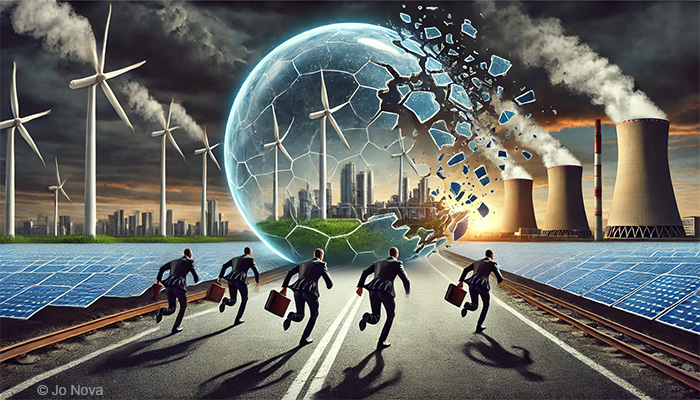
Google, Amazon, give up on national grid, ignore renewables, and buy their own nuclear plants

Renewables fantasy bubble pops. Nuclear comes alive.

By Jo Nova

Soon every tech billionaire will have their own nuclear power plant

Two weeks ago it was Microsoft reviving Three Mile Island’s nuclear plant. Now Google is buying seven small modular reactors, and Amazon is  spending $500 million USD on part of a nuclear energy company.

Too bad for the deplorables who get stuck with the expensive wind-solar-battery clunker spaghetti-grid forced on them by the arts graduates in Parliament. An AI datacentre needs all the same thing a human city does — cheap gigawatts, 24 hours a day. The number-nerd men with money have all decided the cheapest reliable answer to running their AI data center cities, while pretending to fix the weather, is nuclear power. (Coal, of course, is cheaper which is why China uses so much, but it’s against the religion).

The unwashed masses won’t get that choice, of course, to sign up with whatever generator they want. Only the uber rich get that kind of luck.

Every one of these tech giants could have poured that money into wind farms and gardens of solar panels, backed up with acres of batteries and ten thousand miles of high voltage towers. But none of them did, despite the social credit points bonanza and the bragging rights that would bring.

For twenty years these same people have been pushing the renewable hard sell on us, now overnight, without so much as a “sorry” they’ve all flipped.

Google will build seven small nuclear reactors, the first by 2030…Our PM and the CSIRO must be feeling hung-out-to-dry. They declared nuclear was the most expensive option and said Australia couldn’t even build one before 2040.

Aljazeera

Google has signed a landmark deal to use electricity produced by small nuclear reactors to power its artificial intelligence (AI) efforts.

Under the agreement with startup Kairos Power announced on Monday, the California-based tech giant will back the construction of seven small nuclear reactors capable of generating 500 megawatts of power. The first reactor is scheduled to come online by 2030, with others to follow in the coming years.

“The grid needs new electricity sources to support AI technologies that are powering major scientific advances, improving services for businesses and customers, and driving national competitiveness and economic growth,” Michael Terrell, the senior director of energy and climate at Google, said in a blog post.

Two days later, Amazon too.

EuroNews

Amazon is investing in US firm X-energy to utilise nuclear reactors to power its data centres.

Amazon and X-energy are aiming to have more than 5 gigawatts of SMR-generated power operational by 2039.

The reactors are currently under development, with none currently providing power to the electric grid in the US.

Big investors can help change that, and these announcements could be the “inflection point” that makes scaling up this technology truly possible, Huff said.

Feel the heat. Only weeks ago these same billionaires were raving about renewable energy, downranking and censoring the skeptics… now they are doing exactly what we said all along.


0 out of 10 based on 0 rating

via JoNova

https://ift.tt/7QpyEqt

October 17, 2024 at 04:02PM

Wyoming wind woes with Albany County Conservancy’s Anne Brande

Hear about 20+ proposed onshore wind projects planned in Wyoming from Albany County Conservancy’s Anne Brande.

via CFACT

https://ift.tt/VvxEpSX

October 17, 2024 at 03:46PM

Covering Climate Now

By Paul Homewood


I have been tracking Covering Climate Now for some time now.

They were set up to influence journalism worldwide, in order to push the alarmist agenda by, basically, telling lies:

image

Covering Climate Now supports, convenes, and trains journalists and newsrooms to produce rigorous climate coverage that engages audiences.

Co-founded in 2019 by Columbia Journalism Review and The Nation magazine in association with the Guardian and WNYC, CCNow invites journalists everywhere to transform how our profession covers the defining story of our time. Unless news outlets around the world dramatically improve and expand their climate coverage, there simply will not be the public awareness and political will needed to tackle the crisis.

With hundreds of partner news outlets from over 60 countries reaching billions of people, CCNow helps journalists produce more informative and appealing coverage of the climate crisis and its potential solutions.

As the climate crisis accelerates and the journalism landscape rapidly evolves, we invite all journalists and newsrooms worldwide — newsletters as well as newspapers, social media as well as television, independent investigative sites as well as a reader-funded non-profits — to join the Covering Climate Now community and help your fellow journalists produce exceptional work that engages audiences, holds power to account, and inspires change.

To learn more about the establishment of CCNow, see these pieces by our co-founders, Mark Hertsgaard and Kyle Pope: “A New Beginning for Climate” and “The Media Are Complacent While the World Burns.” For media inquiries and to see news coverage about CCNow, visit our media page. Check out our FAQs here, and donate to support CCNow’s mission.

https://coveringclimatenow.org/about/

This is their latest missive:


The Violence of Climate Change


Climate change often manifests as violence, and violence often amplifies climate change. Recent weeks have illustrated both sides of this grim coin. Amped by super-hot sea water, Hurricanes Helene and Milton inflicted death and destruction across the southeastern US. On the other side of the world, the massive amounts of oil burned by tanks, planes, and other equipment in wars in Ukraine, the Middle East, and central Africa released yet more heat-trapping pollution.


Helping audiences understand the connections between climate change and war poses challenges for journalists. When hurricanes or missiles are killing people or demolishing houses today, describing those horrors understandably seems more urgent than explaining their underlying causes and ramifications.
On October 7, Ukraine
bombed a major Russian oil terminal in Crimea, unleashing towering black plumes of carbon-dense smoke. Israel expanded its war from Gaza into Lebanon and reportedly pondered a strike on Iran’s vast oil fields. Sudan’s military bombed a market in Khartoum, adding 23 fatalities to a war that has killed tens of thousands. Rebel attacks continued in the Democratic Republic of Congo, where years of conflict have displaced a staggering 8 or more million people.

In May, a Covering Climate Now press briefing explained that modern war carries an immense, though often hidden, carbon footprint. Neta C. Crawford, a professor of international relations at the University of Oxford, highlighted the role of direct emissions, such as the carbon dioxide released by the Russian oil terminal bombing. Indirect emissions, such as the loss of carbon sinks when forests or wetlands are destroyed, also matter. “War causes climate change more than the other way around,” Crawford said.


Destruction of urban areas causes both direct and indirect emissions. Rawan Damen, the director general of Arab Reporters for Investigative Journalism, urged news organizations to make clear how the war in Gaza not only kills men, women, and children but also “uproot[s] the trees, the greenhouses, the farms… the whole ecosystem of the place is being lost in front of our eyes.” The reconstruction of areas destroyed by war is another source of emissions, which panelist Ellie Kinney of the Conflict and Environment Observatory added, makes green recovery plans critical.


Nevertheless, war’s role as a driver of climate change is obscured by a gaping loophole in international governance. As Chelsea Harvey
reported in Politico’s E&E News following the CCNow press briefing, “Nations participating in the Paris climate agreement are not required by the United Nations to report the carbon emissions from their armies and aircraft or warships and weapons.” The US military, with hundreds of overseas bases and a budget larger than the military budgets of the next nine countries combined, is the world’s single largest annual carbon emitter, Crawford calculates. 
Journalism alone cannot stop either war or climate change. But our reporting can make clear how these two instruments of violence reinforce one another and, perhaps, how they might be defused.

https://mailchi.mp/coveringclimatenow/the-violence-of-climate-change?e=26b08cfb8d

In short, they could not give a toss about all of the deaths and suffering in these wars. Their only real concern is carbon emissions!

What scum!

via NOT A LOT OF PEOPLE KNOW THAT

https://ift.tt/qOCLT6t

October 17, 2024 at 01:35PM

Climate Colonialism’s Stranglehold on Africa’s Energy Starved

By Vijay Jayaraj

European colonialism that methodically extracted wealth from Africa until the system’s collapse in the last century has been replaced by a climate colonialism that stifles the economic development that the Dark Continent desperately needs.

A highly political climate industrial complex enables Western governments and international bodies like the United Nations to exert soft power over poorer countries’ energy policies. Advancing a so-called green agenda in the name of saving humanity from a fabricated climate emergency and offering seemingly irresistible handouts of money and technology, the colonists insist on replacing fossil fuels with unreliable and expensive wind and solar energy.

Yet, the relatively high mortality and morbidity of Africans – among the world’s poorest – can only be relieved by the energy of irrationally demonized coal, oil and natural gas. This artificially induced energy gap is the difference between life and death, hope and despair. It’s a pernicious intrusion in energy markets that shortens lifespans, snuffs out newborn cries and erects barriers to progress.

Energy Poverty in Africa

In 2024, it is unconscionable that over 600 million Africans still lack access to electricity. In sub-Saharan Africa, only 28% of healthcare facilities have reliable electricity. More than 900 million people cook with traditional biomass like wood and animal dung, inhaling toxic fumes that claim over 600,000 African lives each year. Clean water remains a luxury for vast swaths of the population.

As has been shown in parts of Asia, these problems can be alleviated over time with robust investment in fossil fuels. Coal and natural gas can provide affordable and reliable electricity, and natural gas can immediately reduce deaths from the pollution of dirty cooking fuels.

Consider that a single electric car charging overnight in Europe consumes as much power as an entire African village uses in a week. Such stark disparities are not mere numbers. They represent battle lines in the daily struggle for survival of Africa’s impoverished.

In this light – or rather, darkness –nations find themselves ensnared in a global madness, their potential extinguished like fire without oxygen, smothered by the very lack of what’s needed to fuel their ascent.

Foreign-funded anti-fossil fuel activism, cloaked in the language of climate alarmism, blocks pathways to development that Western nations themselves traversed in their journey to prosperity.

The Shifting Tides of Development Funding

For decades, international financial institutions and Western donors viewed energy access as a cornerstone of African development. Many of these projects leveraged Africa’s abundant fossil fuel resources. But things have changed.

The African Development Bank announced in 2019 that it would no longer finance coal projects. In 2021, it went further and placed severe restrictions on oil and gas investments. The World Bank followed suit.

Now, even domestic efforts of Africans to rejuvenate their oil and gas sector are being opposed by paid activists from Europe. There was heavy opposition to the Africa Energy Week event in South Africa, with European-funded protesters appearing at the African Energy Chamber’s Johannesburg offices.

“Some of the protesters … from the poorest townships didn’t even know why they were there, having been promised only $5 and a meal for their participation,” said NJ Ayuk, the Chamber’s executive chairman. “Africans deserve better than to be used for foreign agendas.

“Unfortunately, climate panic and fearmongering are alive and well, and the target is Africa. The way we see it, the world’s green agenda ignores Africa—or at least, it dismisses our unique needs, priorities and challenges,” says Ayuk.

Africa’s Growth Should Be Nurtured, Not Disrupted

As they hinder African development to purportedly save the planet, Western activists are increasing the continent’s vulnerability to nature’s elements. It is a well-established fact that wealthier societies are far more resilient to environmental shocks and natural disasters like drought and pestilence.

The challenges facing Africa are immense but not insurmountable. The right policies and investments can achieve universal energy access, drive economic growth, and build prosperous societies.

But all this will remain out of reach as long as “green” policies continue to obstruct sensible energy development. An ill-informed and myopic crusade threatens to entomb African aspirations in the very darkness the crusaders claim to be dispelling.

Echoing across both sunbaked lands and misty forests is the question of whether Africans will be permitted to flick the switch of progress or be confined to the shadows of others’ destructive obsession.

As a leader of the resistance to the new colonialism, Mr. Ayuk says, “Africans must produce every drop of hydrocarbons we can find to better lives of its people and meet global energy security needs.”

He is quite right.

This commentary was first published at The Washington Times on October 17, 2024.

Vijay Jayaraj is a Science and Research Associate at the CO2 Coalition, Arlington, Virginia. He holds an M.S. in environmental sciences from the University of East Anglia and a postgraduate degree in energy management from Robert Gordon University, both in the U.K., and a bachelor’s in engineering from Anna University, India.

via Watts Up With That?

https://ift.tt/sWQ8qJk

October 17, 2024 at 12:03PM