“’I’m a businessman. I’ll take the [government green] money, that’s all I care about… I will move heaven and earth to get projects done over here’.” – James Quigley, quoted in Politico ‘s “Power Switch” (below)
Government is the great fiction through which everyone endeavors to live at the expense of everyone else. Every one is, more or less, for profiting by the labors of others. No one would dare to express such a sentiment; he even hides it from himself.
The Frenchman added:
When plunder becomes a way of life for a group of men in a society, over the course of time they create for themselves a legal system that authorizes it and a moral code that glorifies it.
Correct. Government does not create wealth; it redistributes it (after a large cut). Who wins and loses? The winners are government, the lobbyists, and the rent-seekers, with concentrated benefits to them and diffused costs for the rest of us. Plunder, Bastiat would say.
—————-
I was reminded of this by a news item reported in Politico‘s “Power Switch” newsletter (August 16, 2023).
“Not all Republicans want to repeal the climate law that turns 1 today,” reported Josh Siegel. “In fact, my colleague Kelsey Tamborrino and I spoke to dozens of people from all corners of the country and discovered that many GOP officials in rural areas are welcoming the billions of dollars in clean energy incentives coming from President Joe Biden’s signature legislation.”
So do you think they found Republicans that feared “climate change” and welcomed “green” energy as cheaper and better? No, the interviewed were financially captured rent-seekers, enjoying a wealth transfer from taxpayers (via Biden) to their pockets. Here is the rest of the story.
In Rogers County, Okla., Republican Commissioner Ron Burrows looks at the Inflation Reduction Act and sees jobs — 1,000 of them to be exact. At least once the Italian giant Enel opens its $1 billion solar manufacturing plant there in 2025.
Burrows is not alone. Other political and economic leaders in Oklahoma, including Republican Gov. Kevin Stitt, are glad to receive the major investments they say they’d never have attracted without the climate law.
“You can imagine being in a small rural community and trying to get economic development to come — it’s a challenge,” said Rosalie Griffith, a board member of the Rural Economic Development of Inola. “But unless you develop, you’re going to die.”
Burrows said Enel’s decision to locate in his tiny town east of Tulsa — population 1,500 — would not have happened without local buy-in. “I just don’t see a company making that sort of investment without some level of comfort that it’s not adversarial, it’s not split,” he said.
By contrast, his local member of Congress — GOP Rep. Josh Brecheen — views the Inflation Reduction Act through the prism of most national Republicans. Brecheen told me he opposes the use of “taxpayer subsidization” to bolster Democrats’ favored green industries and is seeking to repeal the law.
Kelsey and I found that same disconnect between state and local GOP officials in rural areas and their federal representatives across the country.
There’s even a similar, but less dramatic, dynamic unfolding in upstate New York. GOP Rep. Marc Molinaro voted to repeal the Inflation Reduction Act’s clean energy incentives, and that’s made him a top target of Democrats in the 2024 election. His district is one of 18 that voted for Biden but are held by Republicans.
Inflation Reduction Act money catalyzed Canadian company Zinc8 Energy Solutions’ decision to locate a planned battery factory in Molinaro’s purple district. The project is expected to bring up to 500 new jobs to a Hudson Valley region still suffering from the loss of its manufacturing base in the 1990s. That’s exciting James Quigley, a Republican who drives a Tesla and is the supervisor for the town of Ulster, where Zinc8 plans to locate.
“I’m a businessman. I’ll take the money, that’s all I care about,” Quigley said. “I will move heaven and earth to get projects done over here.”
Final Comment
Gosh Josh, what did you really find our here? Are you proud of this? Did you and Kelsey Tamborrino ask the same parties if they liked the federal deficit and inflation? The present level of taxation? The wisdom of the few over the energy verdicts of the masses?
Money for these subsidies has to come from somewhere, and that means the private economy in higher taxes and more government borrowing…. The IRA [Inflation Reduction Act] is the heart of Bidenomics, which is about creating a new political-subsidy economy. Perhaps all of this will effloresce into a brilliant green future. More likely hundreds of billions in misallocated investment will reduce future productivity gains and translate into slower economic and income growth. Let’s hope President Biden’s subsidies don’t boomerang like pandemic transfer payments, leaving all Americans poorer.
What a waste, what a shame. The next President needs to issue an emergency declaration that the U.S. is out of money and cease all subsidies of the Inflation Reduction Act in order to pause wind, solar, and battery subsidies. Ratepayers and taxpayers will be thankful.
“Mann is a globally renowned scholar of climate science whose many honors include the Tyler Prize for Environmental Achievement, Hans Oeschger Medal of the European Geosciences Union, Friend of the Planet Award from the National Center for Science Education, and John Scott Award from the City of Philadelphia. Elected to the Royal Society in 2024 and the National Academy of Sciences in 2020, he has been named one of the world’s most influential people in climate policy, one of the 10 most influential earth scientists, one of the top influencers in sustainability, and one of the 50 scientists who are changing the way we see the world.”
In the essay posted at Human Progess, “What Unifies the Enemies of Civilization?” the authors, Arjun Khemani and Loga Chipkin, present a sweeping critique of various modern ideologies, arguing that they share a common trait: an opposition to the very foundations of Western civilization. The text asserts that movements ranging from radical environmentalism to social justice activism are rooted in a shared disdain for progress, prosperity, and reason—the key pillars upon which modern society rests.
Summary: Anti-merit, authoritarian, collectivist ideas like socialism, environmental extremism, and doomerism are enemies of human progress because they impede innovation, limit personal freedom, and prevent societal growth. Fostering decentralized creativity, by contrast, improves the continued ability of human civilization to advance.
A significant portion of the argument revolves around the rise of what the author terms the “degrowth movement” and its broader ideological allies, such as climate change alarmists and radical egalitarians. These groups are depicted as not merely misguided but as actively working to dismantle the structures that enable human flourishing. The essay paints a picture of these movements as anti-technological, anti-capitalist, and even anti-human in their outlook.
But there is nothing moral about slowing down growth for the planet’s sake or of rebalancing our relationship with nature. Growth is not some abstract thing that greedy capitalists have made a deity of. Growth means more wealth for people in the form of lifesaving and life-enhancing technologies, from shelter to protect us from the violent forces of the Earth to mass food production to bring starvation to an all-time low.
Climate Change Alarmism as an Enemy of Civilization
One of the central villains in this narrative is the environmentalist movement, especially those advocating for extreme measures to combat climate change. The essay suggests that the underlying motivation of climate activists is not merely environmental protection, but rather a more insidious desire to deconstruct the very fabric of modern life. The call for “Net Zero” emissions, for example, is portrayed as a utopian fantasy that disregards the real-world consequences for energy production, economic growth, and human well-being.
And if something like climate change is judged by its effects on people, things have never been better thanks to growth. The Earth doesn’t care about us—but we care about each other. As philosopher Alex Epstein notes, “If you review the world’s leading source of climate disaster data, you will find that it totally contradicts the moral case for eliminating fossil fuels. Climate-related disaster deaths have plummeted by 98 percent over the last century, as CO2 levels have risen from 280 ppm (parts per million) to 420 ppm (parts per million) and temperatures have risen by 1°C.”
In fact, the author highlights that many of the proposed solutions to climate change, such as dismantling industrial economies and abandoning fossil fuels, would lead to catastrophic consequences for human progress. This critique resonates with the broader skeptical stance that climate models are unreliable and that the policies they inspire are far more harmful than the potential risks posed by a changing climate.
The author identifies six key threads that unite these groups: Socialism and centralized institutions, extreme environmentalism, scientism, relativism, dogmatism, and doomerism.
These forces are portrayed as undermining the very fabric of a prosperous and free society, attacking the cornerstones of modern civilization such as individual liberty, economic growth, and rationality. Let’s break down each of these themes in detail.
Socialism and Centralized Institutions
The essay argues that Socialism and its preference for centralized institutions represent one of the most powerful threats to human progress. Socialism, in this context, is not merely an economic system but an ideology that seeks to consolidate power in the hands of a few elites, supposedly in the name of equality or fairness. The author asserts that this is a dangerous development because centralized control inherently stifles innovation, suppresses individual freedoms, and ultimately leads to authoritarianism.
The critique here is rooted in the observation that Socialism often claims to address inequalities but typically does so by curbing the very forces—namely free markets and competition—that have historically lifted billions out of poverty. Socialism, with its disdain for capitalism, naturally aligns with central planning and top-down decision-making, which, the essay warns, can only result in inefficiency and stagnation. The reliance on large, bureaucratic institutions to solve society’s problems contrasts sharply with the spontaneous order created by free markets, and history is rife with examples where such centralization has led to disaster—from the Soviet Union to Venezuela.
The impossibility of socialist-style central planning came to light in 1989, when Boris Yeltsin, then the president of the Soviet Union, visited a grocery store in the United States. Back in Russia, people waited in line for food and other goods, but in the capitalist United States, Yeltsin could buy as much of any of the countless items he wanted, and the lines were nothing like they were back home. In recognition of the stark contrast, Yeltsin told some Russians who were with him that if Russians saw what American supermarkets were like, “there would be a revolution.”
Extreme Environmentalism
Extreme environmentalism, according to the essay, has evolved from a legitimate concern about ecological stewardship into a movement that seeks to roll back human progress in the name of saving the planet. The Net Zero agenda, for instance, is described not merely as impractical but as an existential threat to industrial society. The author sees radical environmentalists as being fundamentally anti-human, in the sense that their policies would lead to massive energy shortages, economic collapse, and the erosion of living standards for billions of people.
You may laugh at those environmentalists who throw paint at art, but they’ve been effective at halting the development of nuclear power, a potential source of abundant energy that we’ve known how to build for decades. We can’t calculate how much suffering could have been ameliorated had we been free to build nuclear power plants across the Earth.
The obsession with reducing carbon emissions at all costs, without regard to technological feasibility or the needs of the developing world, is seen as one of the most dangerous aspects of this movement. The essay suggests that extreme environmentalists view humanity as a blight on the Earth, and their ultimate goal is not to ensure sustainable progress but to reverse industrialization and shrink human activity to a bare minimum. Such a philosophy ignores the benefits that fossil fuels and industrialization have brought, including longer life expectancies, reduced poverty, and increased global wealth.
Scientism
The essay also takes aim at “scientism,” which it distinguishes from science itself. Scientism, as defined here, is the ideological misuse of science to justify policy decisions without regard for the uncertainties or limitations inherent in scientific models. This is particularly evident in the climate change debate, where complex, uncertain models are used to push drastic political agendas. The author warns that this approach transforms science from a tool for understanding the world into a dogma that must not be questioned.
Quite simply, people think that they can take science’s successes and carry them over into every other field of human endeavor. In political and cultural battles, it is often thought that he who knows the most science must be in the right. If only we put the most scientifically minded people in charge of the world, it is thought, then they could solve all our problems from on high.
Scientism conflates the predictive models of scientists with absolute truth, ignoring the fact that these models are based on assumptions that may or may not hold true in the real world. As a result, the author argues, policies based on such models are often overconfident and lead to unintended consequences, especially when they aim to overhaul entire economic systems based on the projections of what might happen decades from now. This reliance on scientism creates a technocratic elite who dictate policies without room for dissent or skepticism, under the guise of “following the science.”
Relativism
Relativism, as discussed in the essay, is the philosophical rejection of objective truth, particularly in the realms of culture, ethics, and knowledge. In its place, relativism promotes the idea that all viewpoints are equally valid, which, according to the author, undermines the foundations of Western civilization that are built on reason, debate, and the search for universal truths.
Relativism might seem open-minded and fair, but it is neither. For it is not open to the possibility that one party is in the right and the other in the wrong. It is not open to the idea that one society is open and dynamic and the other closed and static. It is not open to the notion that one country cherishes life while the other worships death.
This worldview has seeped into educational systems, media, and public discourse, leading to what the author sees as a weakening of societal cohesion. If there are no objective truths—only competing narratives—then the very idea of rational debate or progress becomes meaningless. This erosion of confidence in reason has serious implications, particularly in science and law, where objective standards are essential for maintaining order and advancing knowledge. Relativism, in this view, creates a society that is easily manipulated, as people no longer trust in a shared reality but instead retreat into their own subjective experiences and tribal affiliations.
Dogmatism
Despite the claim by many modern ideologies that they are grounded in open-mindedness or scientific inquiry, the essay argues that dogmatism is rampant in these movements. Whether it’s climate activism, social justice, or radical environmentalism, the author sees a rigid adherence to doctrines that brook no dissent. This dogmatism is presented as a betrayal of the Enlightenment principles upon which Western civilization was built—principles that value skepticism, debate, and the testing of ideas through reasoned discourse.
Because all our ideas contain errors, dogmatism always prevents us from improving on the ideas locked in dogma’s cage. Couple that with the fact that any error, no matter how small, could result in the eventual extinction of the human race, and we have good reason to rid our society of all dogmatic elements.
The rise of cancel culture is cited as an example of this new dogmatism. In the name of combating “misinformation” or “hate speech,” individuals who question prevailing narratives are often silenced, de-platformed, or otherwise marginalized. This stifling of debate is seen as not only intellectually dishonest but dangerous, as it prevents society from correcting its mistakes and refining its ideas through open discussion.
Doomerism
Finally, the essay explores the phenomenon of “doomerism,” or the belief that the world is inevitably headed toward catastrophe—whether through climate change, overpopulation, or resource depletion. Doomerism is described as a nihilistic ideology that robs people of hope and paralyzes them with fear. Instead of focusing on human ingenuity and our proven ability to overcome challenges, doomerists obsess over worst-case scenarios and use these apocalyptic visions to justify radical and often destructive policies.
Another dangerous effect of doomerism is tyranny, whether through cultural taboos, governmental regulations, or outright bans. They all amount to slowing the growth of knowledge and wealth, and of progress more generally. For if the next innovative step marks our doom, then surely a little—or a lot—of tyranny is justified! But innovation is the very panacea that doomers are worried about. It is stasis, not change, that will mark our end.
In particular, climate doomerism is called out for its exaggerated claims about the imminence of planetary collapse. The essay highlights the fact that such predictions have been made for decades without coming to pass—yet each new generation of environmentalists insists that this time the end is near. The danger of doomerism is that it fosters a mindset of helplessness and despair, which in turn justifies authoritarian measures to “save” humanity from itself. This, the author argues, is the real threat: a retreat from the optimism and progress that have defined modern civilization in favor of a future where human freedom and prosperity are sacrificed on the altar of fear.
Conclusion: A Battle for Civilization
In summing up, the essay makes a strong case that these six ideologies—Socialism, extreme environmentalism, scientism, relativism, dogmatism, and doomerism—are united in their opposition to the values that have made Western civilization successful. Each of these movements, in its own way, seeks to dismantle the structures that have allowed humanity to flourish. Whether through economic centralization, the rejection of human progress, or the suppression of free speech, these ideologies pose a direct threat to the continued success of modern society.
The author calls for a defense of the Enlightenment principles of reason, liberty, and progress, warning that if these ideologies are allowed to dominate, they will lead to a future marked by poverty, stagnation, and oppression. The stakes, according to this essay, are nothing less than the survival of civilization itself.
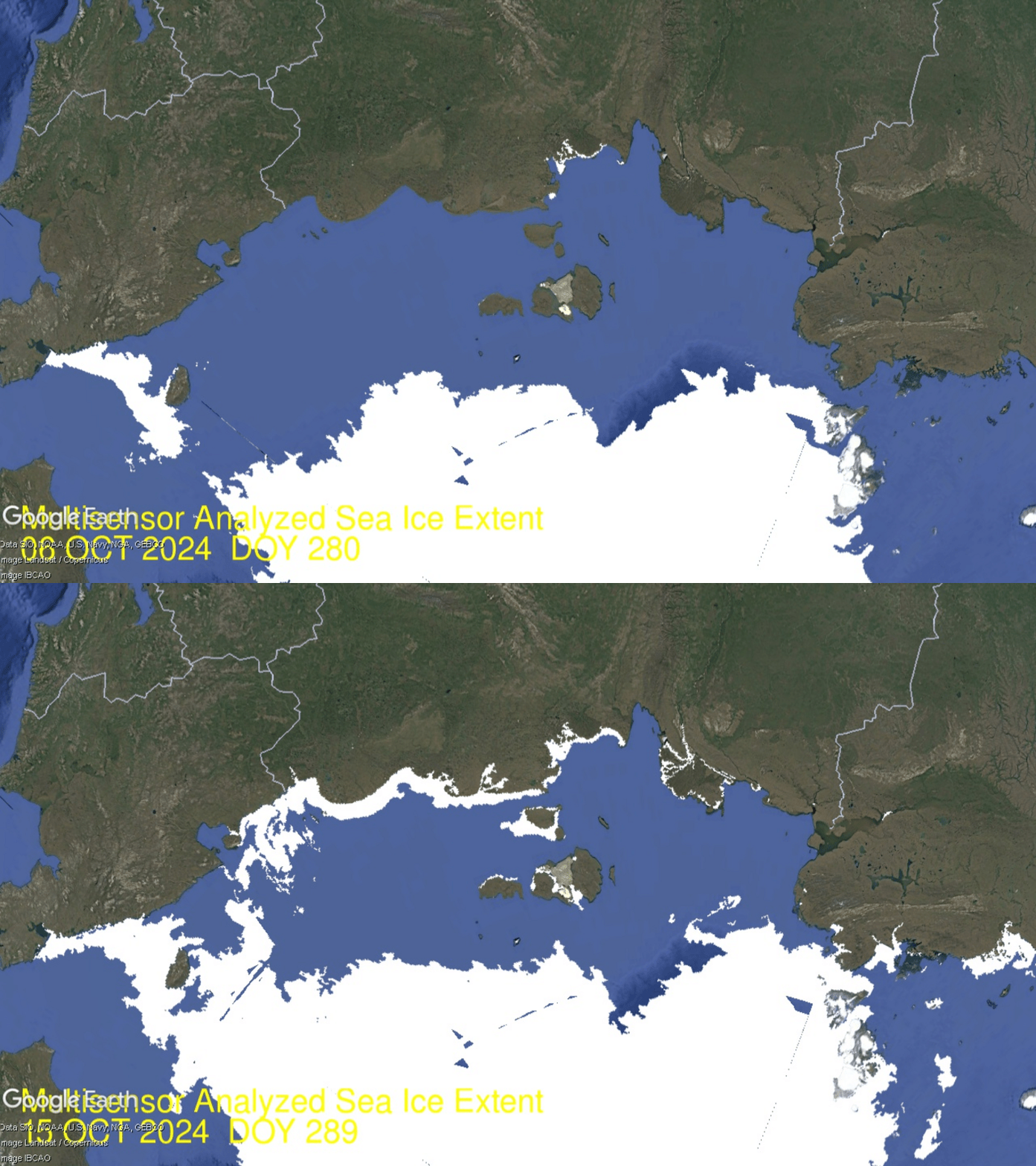
The previous post below sounded the alarm about ice halting Arctic shipping early. Now the two choke points are blocked nine days later. Chukchi sea (left) is blocking entrance to Bering sea. Laptev (right) is blocking traffic into European Barents and Kara seas.
Ice-strengthened supramax Kumpula (Arc 4) on the NSR being escorted by nuclear icebreaker Vaygach. (Source: Courtesy of ESL Shipping)
The summer shipping window on Russia’s Northern Sea Route is coming to a rapid close weeks ahead of schedule. A number of vessels and convoys are rushing to complete their transits before the route shuts down in the next three weeks.
Source: Northern Sea Route Information Office
Unlike the last couple of summers when Russia’s Arctic coastal waterways were fully clear of sea ice, residual winter ice persisted in the eastern section this year. This has resulted in the early onset of ice formation especially in the Laptev, East Siberian, and Chukchi Seas.
NSRIO: Ice is still present in the eastern sector of the NSR preventing free passage of ships without ice class. The nuclear icebreaker Sibir has been operating in the East Siberian and Chukchi Seas since the end of June together with the nuclear icebreaker Vaygach, which has been in the area since mid-July. In several areas of the Chukchi and East Siberian Seas heavy ice conditions are still observed, which directly affects the admission of low ice class vessels to these areas. The western part of the NSR is mostly ice-free. Above is a map of ice conditions as of August 7, 2024.
Russia’s Northern Sea Route Administration announced that vessels with no ice class will have to vacate the waterway by October 15, around 2-3 weeks ahead of schedule. For vessels with light and medium ice classifications the navigation season will end on October 20 and October 31 respectively.
The last permitted start of convoys heading east will be October 10, leaving just one more week for vessels to begin their Arctic transit.
This year’s early shutdown comes three years after narrowly avoiding a major incident three years ago. In October 2021 Russian authorities reacted too late to begin closing down the NSR as winter sea ice drifted into the main shipping channel and trapped two dozen vessels for more than a month. A 30 centimeter or one foot thick ice layer had formed by the end of October across hundreds of miles of Arctic Ocean. Several icebreakers, including the powerful nuclear vessel Yamal, rushed to the scene from Murmansk over 3,000 nautical miles away to help free the stranded vessels. Over the course of more than 6 weeks several icebreakers worked to break the vessels free and escort them to safety out of the eastern section of the Northern Sea Route. The situation did not fully resolve until the end of December when the last vessels were freed.
Vessels stuck in thick winter sea ice in November 2021 awaiting rescue. (Source: Rosatomflot)
Currently a number of container ships, oil tankers, bulk carriers
and LNG tankers are passing through the route.
In the Far East two LNG carriers and two oil tankers, including the Suezmax tanker Sai Baba, are currently passing through the waters adjacent to the Bering Strait. They are staying clear of multi-year ice around Wrangel Island which has persisted and troubled shipping all summer. A nuclear icebreaker had remained on standby for much of the summer keeping the shipping lane open.
Select container ships, crude oil tankers, and bulk and LNG carriers currently on the NSR. (Source: Shipatlas)
Further west along the route, the first-ever conventional Panamax container ship in the Arctic is about halfway through its transit. The vessel had originally intended to also conduct its return voyage via the Arctic, but will now likely have to return to Asia via the Suez Canal or South Africa route.
A massive Capesize bulk carrier without any ice class, Dodo, is also rushing to complete its eastbound voyage to Caofeidian, China.
Here’s ice activity in last week in the NSR from Chukchi Sea in the east (left side), and threatening in Laptev Sea (right).