“Antarctica has turned green”

0.00008% of Antarctica has turned green.

“Antarctica has turned green due to global warming: the vegetation cover has increased more than 10 times.

A team of scientists analyzed satellite images of the peninsula over the past 40 years to find out how much of the territory has turned green as a result of warming. The analysis of Landsat archives (1986-2021) was conducted using the Google Earth Engine cloud processing workflow, NatureGeoscience writes.”

“Back in 1986, the images show that only one square kilometer of the peninsula was covered with vegetation. However, by 2021, this area had grown to almost 12 square kilometers.”

This is what Google Earth imagery shows since 1985

About Tony Heller

Just having fun

This entry was posted in Uncategorized. Bookmark the permalink.

via Real Climate Science

https://ift.tt/PpUuQo3

October 9, 2024 at 02:28PM

Alarmists Attack IPCC Not Linking Disasters to CO2


Chris Morrison reports on the flap over Climate Crisis™ media tactics in his Daily Sceptic article Climate Activists Frustrated by IPCC’s Refusal to Link Extreme Weather With Carbon Emissions.  Excerpts in italics with my bolds and added images.

Last June, the state-reliant BBC reported that human-caused climate change had made U.S. and Mexico heatwaves “35 times more likely”. Nothing out of the ordinary here in mainstream media with everyone from climate comedy turn ‘Jim’ Dale to UN chief Antonio ‘Boiling’ Guterres making these types of bizarre attributions. But for those who closely follow climate science and the assessments of the Intergovernmental Panel on Climate Change (IPCC), “such headlines can be difficult to make sense of”, observes the distinguished science writer Roger Pielke. In a hard-hitting attack on the pseudo-scientific industry of weather attribution, he states:

“neither the IPCC nor the underlying scientific literature comes anywhere close to making such strong and“ certain claims of attribution”.

Pielke argues that the extreme position of attributing individual bad weather events is “roughly aligned” with the far Left. “Climate science is not, or at least should not serve as a proxy for political tribes,” he cautions. But of course it is. The Net Zero fantasy is a collectivist national and supra-national agenda that increasingly relies on demonising bad weather. With global temperatures rising at most only 0.1°C a decade, laughter can only be general and side-splitting when IPCC boss Jim Skea claims that British summers will be 6°C hotter in less than 50 years. Two extended temperature pauses since 2000 have not helped the cause of global boiling. In addition there are increasing doubts about the reliability of temperature recordings by many meteorological organisations that seem unable to properly account for massive urban heat corruptions.

The big problem for ‘far Left’ climate extremists is that event attribution is a form, in Pielke’s words, of “tactical science”. Such science serves legal and political ends and is not always subject to peer review. As the BBC and other media outlets can attest, the work is “generally promoted via press release”. It has been developed in response to the failure of the IPCC to detect and attribute most types of extreme weather including drought, flooding, storms and wildfires to human involvement, notes Pielke. Worse, the IPCC can find little sign of human involvement going forward to 2100.

Scientists cannot answer directly whether particular events are
caused by climate change since extremes occur naturally.

Meanwhile the IPCC is somewhat dismissive about weather attribution, or as Pielke terms it, “weather attribution alchemy”. It notes: “The usefulness or applicability of available extreme event attribution methods for assessing climate-related risks remains subject to debate.” The IPCC is a biased body full of climate alarmists, but its inability to attribute single events to humans is obviously highly irritating and somewhat inconvenient for activists and their media counterparts.

Dr. Friedericke Otto speaking with reporter at Oxford.

Dr. Friederike Otto runs World Weather Attribution (WWA) out of Imperial College London and is a frequent presence on the BBC. WWA is behind many of the immediate attributions of bad weather to human causes and its motives are clear. As Dr. Otto has noted: “Unlike every other branch of climate science or science in general, event attribution was actually originally suggested with the courts in mind.” Otto is clear that the main function of such studies, part-funded by Net Zero-supporting billionaires and heavily pushed by aligned mainstream media, is to support lawsuits against fossil fuel companies. She explains this strategy in detail in the interview, ‘From Extreme Event Attribution to Climate Litigation‘.

The inability of the IPCC to attribute bad weather to humans has been viewed by climate advocates as “politically problematic”, continues Pielke. He notes the work of climate activists Elizabeth Lloyd and Naomi Oreskes who are worried that the lack of attribution “conveys the impression that we just do not know, which feeds into uncertainty, doubt or incompleteness, and the general tendency of humans to discount threats that are not imminent”.

Perish the thought that there should be uncertainty, doubt
or incompleteness in the settled world of climate science.

It is of course different from all other branches of science in that all its opinions are right and consequently there is no need for the unhelpful process of constant inquiry and experiment. It need hardly be added that no doubt exists at the BBC, where former Radio 4 Today Editor Sarah Sands wrote the foreword to a WWA guide for journalists. Recalling when the late Nigel Lawson suggested there had been no increase in extreme weather, Sands noted: “I wish we had this guide for journalists to help us mount a more effective challenge to his claim.” These days, Sands enthused, attribution studies have given us “significant insight into the horsemen of the climate apocalypse”.

For her part, Otto is keen to crack down on the heretics. She was at the forefront of the recent notorious retraction of a paper in a Springer Nature journal that stated there was no evidence that the climate was breaking down. Written by four Italian scientists and led by Professor Gianluca Alimonti, they argued that a climate emergency was not supported by the data. Otto, who had previously worked in the Oxford School of Geography for 10 years, claimed the scientists were not writing in good faith. “If the journal cares about science they should withdraw it loudly and publicly saying it should never have been published,” she demanded.

A recent scientific study has confirmed that natural and climate-related disasters are declining during the 21st century. Getty Images/iStcokphoto

Declining Weather Disasters Prove Doomsters Wrong (Alimonti et al.)

Benny Peiser makes the case in his NY Post article Despite climate-change hysterics, weather disasters have decreased.  Excerpts in italics with my bolds and added images.

A recent scientific study has confirmed what climate realists have been highlighting for some time: Natural and climate-related disasters have been declining rather than increasing during the 21st century.

In a paper published this year in one of the world’s leading journals on environmental hazards, Italian scientists Gianluca Alimonti and Luigi Mariani analyzed the number and temporal trends of natural disasters reported since 1900.

A 2015 study by 22 scientists from around the world found that cold kills over 17 times more people than heat. Thus the planet’s recent modest warming has been saving millions of lives.

Based on the best available data, the two scientists concluded the 21st century has seen “a decreasing trend [of natural disasters] to 2022” which is “characterized by a significant decline in number of events.”

The researchers emphasized that their conclusion “sits in marked contradiction to earlier analyses by UN bodies which predict an increasing number of natural disasters and impacts in concert with global warming.”

“Our analyses strongly refute this assertion,” they wrote.

For years, international agencies such as the UN Office for Disaster Risk Reduction, the Food and Agriculture Organization of the United Nations, the World Meteorological Organization and the International Red Cross have claimed that climate-related disasters are escalating.
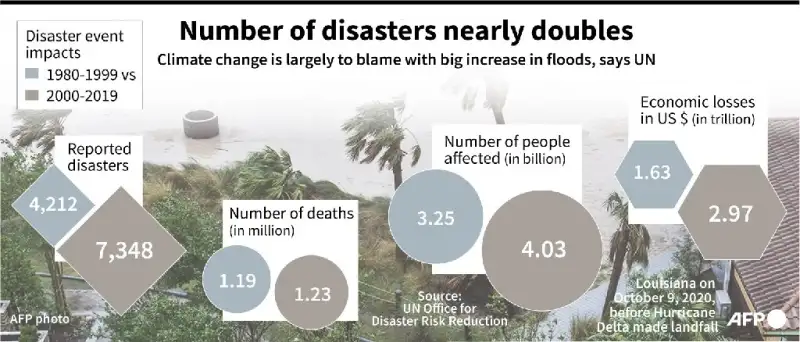
Floods lead a near doubling of disaster events from 1980 to 1999 compared to 2000 to 2019, according to a report by the UN Office for Disaster Risk Reduction.

“Weather disasters are striking the world four to five times more often and causing seven times more damage than in the 1970s,” the WMO reported in 2021.

Disaster and weather officials affiliated with the UN claim this dramatic rise is due to global warming: The changing climate, they say, is making weather disasters stronger and more frequent.
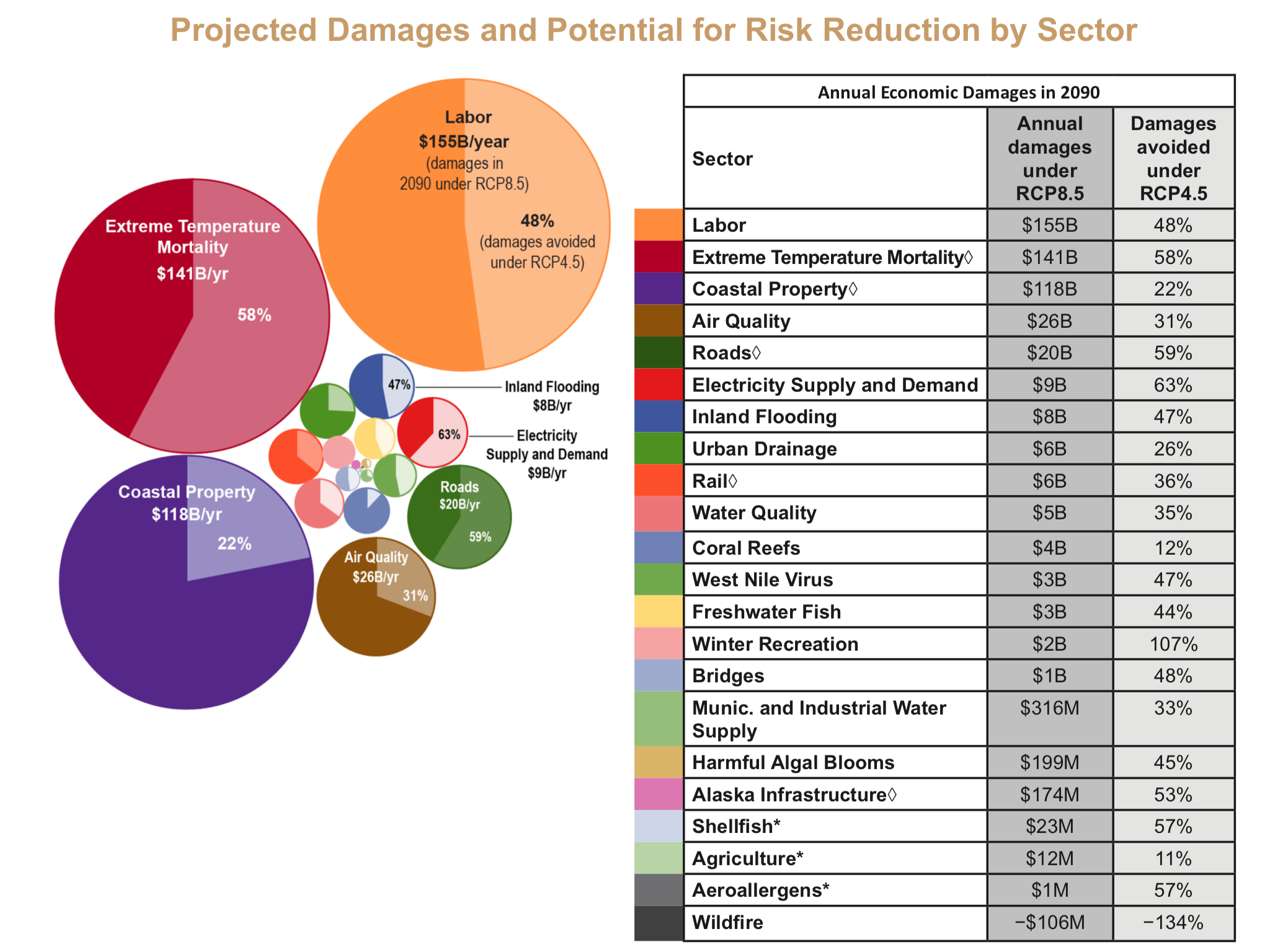
Fourth National Climate Assessment, Volume II: Impacts, Risks, and Adaptation in the United States.

The increased frequency of heat waves, droughts, flooding, winter storms, hurricanes, wildfires and other extreme weather events prove the negative impact of a warming world, according to various UN agencies and nongovernmental organizations.

Yet, as the actual data used by these organizations reveals, the last 20 years have in fact seen a significant decline in such events.

It turns out that climate alarmists have based their claims on a highly misleading comparison of disaster data of the late 20th and the early 21st centuries.

By their tally, the period from 1980 to 2000 saw about 4,200 natural disasters —with the number increasing sharply, to more than 8,000, during the first 20 years of this century.

This conclusion, however, is fatally flawed: It fails to take into account the huge increase in the global reporting of disasters engendered by the invention and rapid global dissemination of new communication technologies since the 1980s.

The arrival of the internet and other new communication tools has undoubtedly accelerated the reporting of disasters from all corners of the world — events that were significantly underreported in earlier decades.

As well, the number of people killed by natural and climate-related disasters has fallen steadily over the past 120 years — from 500,000 deaths per decade in the early 20th century down to less than 50,000 per decade in the last ten years.
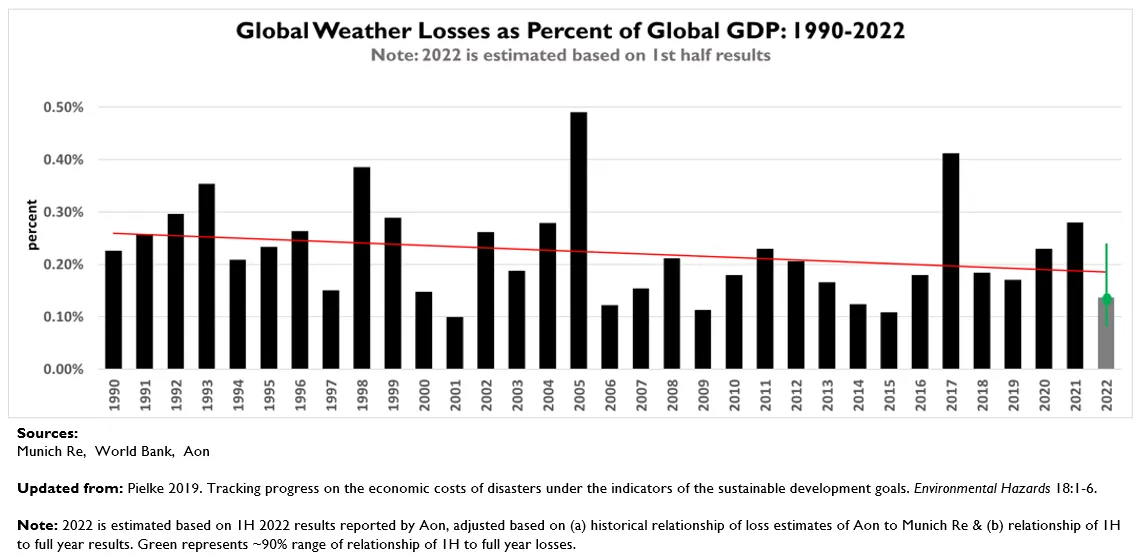
And, contrary to claims by NGOs and government officials, climate-related disaster losses have also declined as a percentage of global GDP during the last 30 years — from about 0.25% of GDP in 1990 to less than 0.20% in 2023.

The study by Alimonti and Mariani vindicates what we at the Global Warming Policy Foundation have been pointing out for a long time: Climate-related disasters are not on the rise, despite warming temperatures.

International agencies and the news media have hyped climate disasters for far too long, while ignoring the factual downward trend.

”First they ignore you, then they laugh at you, then they fight you, then you win,” as the saying goes.  UN agencies and NGOs have been misleading the public for years. It’s past time for the truth to win out.

Benny Peiser is the director of the London-based Global Warming Policy Foundation.

See also

Our Weather Extremes Are Customary in History

Figure27: Annual count of EF3 and above tornadoes in the US, 1950–2021. Source: Source: NOAA/NCEI.106, 107


via Science Matters

https://ift.tt/Zew4pWa

October 9, 2024 at 12:46PM

Hurricane Milton Preparation: Florida’s Unprecedented Response Under Governor DeSantis

As Hurricane Milton bears down on Florida’s west coast, the state’s preparation efforts under Governor Ron DeSantis’s leadership have reached unprecedented levels of scope and competence. From the strategic staging of supplies to innovative traffic management, Florida’s comprehensive approach to hurricane readiness sets a new standard for disaster preparedness.

Strategic Supply Staging

One of the most crucial aspects of Florida’s hurricane preparation is the strategic staging of supplies. Governor DeSantis has overseen the establishment of multiple staging areas across the state, including a massive operation at the Florida Horse Park in Ocala. This single location houses an impressive array of 2,000 pieces of equipment, including pumps, generators, display boards, forklifts, hoses, and bunk trailers. The governor emphasized the comprehensiveness of these preparations, stating,

“You name it, this stuff is here.”

https://www.ocala.com/story/news/local/2024/10/08/gov-ron-desantis-visits-as-ocala-florida-preps-for-hurricane-milton/75572740007/

In addition to equipment, the Florida Division of Emergency Management (FDEM) has pre-positioned vast quantities of food and water. FEMA reports having 20 million meals and 40 million liters of water in the pipeline, ready to deploy as needed

This level of preparedness ensures that even if supply chains are disrupted in the aftermath of the hurricane, essential resources will be available to affected communities.

Mobilization of Electrical Linemen

Recognizing the critical importance of power restoration after a hurricane, Florida has marshaled an unprecedented force of electrical linemen. Governor DeSantis announced that over 37,000 linemen are either already in Florida or en route to the state. This number is expected to exceed 40,000 by the time Milton makes landfall, significantly surpassing the resources deployed for previous hurricanes like Helene

The scale of this mobilization is particularly impressive given the ongoing power restoration efforts in neighboring states affected by Hurricane Helene. DeSantis noted that some linemen are traveling from as far as California to assist Florida. This massive deployment of skilled workers positions the state to rapidly restore power in the wake of the storm, minimizing the duration of outages and accelerating recovery efforts.

Comprehensive Shelter Preparation

Florida’s shelter preparation for Hurricane Milton is both extensive and meticulous. Counties across the state have opened a variety of shelters to accommodate different needs. For example, Marion County has activated multiple general population shelters, pet-friendly shelters, and a special needs shelter. These facilities are strategically located in schools and other suitable buildings that meet American Red Cross design standards to withstand hurricane-force winds

The state has gone beyond merely opening shelters by ensuring they are well-stocked and staffed. The Department of Children and Families (DCF) has delivered over 40 truckloads of food, water, cots, and blankets to shelters. Additionally, DCF is deploying 115 nurses to shelters to provide medical support

This level of preparation ensures that evacuees will have access to essential supplies and care during their stay.

Innovative Transportation Solutions

Recognizing that transportation can be a significant barrier to evacuation, Florida has implemented several innovative solutions to help residents reach safety. The state has partnered with Uber to provide free rides to local shelters for residents in mandatory evacuation zones. This public-private partnership leverages existing transportation infrastructure to ensure that even those without personal vehicles can evacuate safely. For those with special needs, Palm Beach County offers a Special Transportation Assistance Program through Palm Tran Connection.. This service provides transportation to shelters for disabled residents who live in hurricane evacuation zones. Furthermore, FDEM is operating free evacuation shuttles in Pinellas, Pasco, and Hillsborough counties, with locations and times readily available on the FloridaDisaster.org website.

Multi-Channel Communication Strategy

Effective communication is crucial during a hurricane, and Florida has employed a multi-faceted approach to keep residents informed. The state has activated the State Assistance Information Line, providing 24/7 support in English, Spanish, and Haitian-Creole

This hotline serves as a central resource for residents seeking information and assistance. Local governments and emergency management offices are utilizing various platforms to disseminate information. For instance, many counties are using their websites and social media channels to provide real-time updates on shelter locations, evacuation orders, and safety instructions. The Florida Division of Emergency Management maintains a comprehensive website (FloridaDisaster.org) that serves as a one-stop resource for hurricane-related information

Governor DeSantis has also been conducting regular press conferences, providing direct updates to the public and media. These briefings cover a wide range of topics, from evacuation orders to resource deployment, ensuring that residents have access to the most current and accurate information

Innovative Traffic Management

To facilitate smooth evacuations and prevent gridlock, Florida has implemented several innovative traffic management strategies. One of the most significant measures is the suspension of tolls on major highways in West Florida, Central Florida, and on specific routes like Alligator Alley and 595 Express. This action removes a potential barrier to evacuation and helps maintain traffic flow.

To increase highway capacity, the Florida Department of Transportation (FDOT) has implemented Emergency Shoulder Use (ESU) on key evacuation routes. This includes opening the left shoulder of eastbound I-4 and portions of northbound I-75 for travel. The Florida Highway Patrol (FHP) is actively monitoring these ESU routes to ensure safe and efficient traffic flow. To further support evacuation efforts, FDOT has expanded Road Ranger Service across impact zones. These mobile units provide assistance to stranded motorists, helping to quickly clear minor incidents and keep traffic moving. The department has also staged Intelligent Transportation System (ITS) trailers and drone teams to monitor traffic conditions and respond rapidly to any issues.

Proactive Fuel Management

Recognizing the critical importance of fuel availability during evacuations, Florida has taken unprecedented steps to ensure a steady supply of gasoline. Governor DeSantis has directed the Florida Highway Patrol to escort fuel trucks from ports to gas stations, operating around the clock as long as it’s safe to do so before landfall. This proactive approach helps prevent fuel shortages at critical moments during the evacuation process. The state is also coordinating the deployment of fuel and electric vehicle chargers along evacuation routes.

This forward-thinking strategy addresses the needs of both traditional and electric vehicles, ensuring that all evacuees can reach their destinations safely. To combat potential price gouging, the state has activated its price gouging hotline and is actively monitoring complaints. This vigilance helps protect consumers during a vulnerable time and maintains public trust in the evacuation process.

Debris Management and Infrastructure Protection

Florida’s preparation extends beyond immediate evacuation needs to include post-storm recovery efforts. The state has pre-positioned debris removal assets, including over 350 pieces of heavy equipment and trucks. In the days leading up to Milton’s arrival, state resources have already removed over 22,000 cubic yards of debris from areas affected by Hurricane Helene, demonstrating the state’s commitment to rapid recovery.

To protect critical infrastructure, FDOT has secured high mast lighting, maintenance yards, active construction projects, and other vulnerable assets. The department has also inspected and cleared drainage systems, monitored flood-prone areas, and pre-positioned pumps to mitigate potential flooding.

Coordination with Federal and Private Sector Partners

Florida’s preparation efforts are further bolstered by strong coordination with federal agencies and private sector partners. FEMA has pre-staged a full slate of response capabilities in Florida, including urban search and rescue teams, swift water rescue teams, and disaster medical assistance teams. The U.S. Department of Defense is also positioning forces to support FEMA and state partners, including helicopters for search-and-rescue operations. In the private sector, Florida has engaged with utility companies to ensure a rapid response to power outages. Major utilities like Tampa Electric, Duke Energy, and Florida Power and Light are operating from digital control centers to update customers and direct crews efficiently. This collaboration between public and private entities enhances the overall preparedness and response capabilities.

Conclusion

As Hurricane Milton approaches, Florida’s preparation efforts under Governor Ron DeSantis’s leadership stand out as a model of comprehensive disaster readiness. From the strategic staging of supplies and personnel to innovative traffic management and proactive fuel distribution, the state has demonstrated an unprecedented level of competence in hurricane preparation. The multi-faceted approach addresses not only immediate evacuation needs but also positions the state for rapid recovery in the storm’s aftermath. By leveraging technology, partnering with private sector entities, and implementing creative solutions to longstanding challenges, Florida has set a new standard for hurricane preparedness. As the storm makes landfall, the true test of these preparations will begin. However, the thoroughness and scale of Florida’s efforts provide a strong foundation for protecting lives, minimizing damage, and accelerating recovery. The lessons learned from this approach are likely to influence disaster preparedness strategies not only in Florida but across the nation and beyond.

via Watts Up With That?

https://ift.tt/E8sLuVY

October 9, 2024 at 12:04PM

Greening: Rare, Heavy September Rainfalls Have Brought Back Lakes In The Sahara!

North Africa seems to be greening as a result of climate change, which mostly occurs naturally.

Satellite photos and studies have shown that the Sahara desert has been shrinking over the past 40 years, e.g. read here and here.

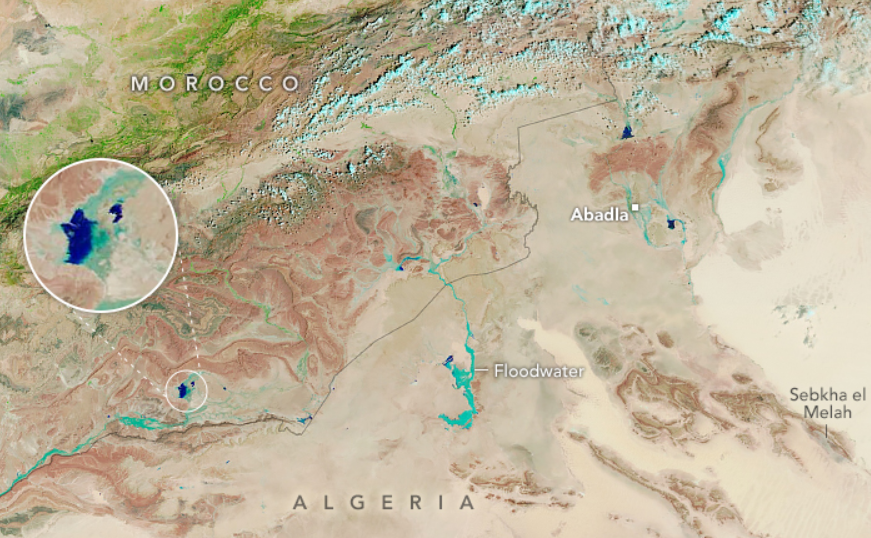
The latest news is from the southeastern Moroccan desert, which is among the driest around the world, where it is reported to have gotten up to 100 mm of rain within a 24 hour period in September. Hard hit were villages 400 miles from the capital city of Rabat, including Tata, reports Al Jazeera here.

Image: NASA Earth Observatory 

Once dry lakes are filling again

“What’s also fascinating is that normally dry lakes in the Sahara are filling due to this event,” said Moshe Armon, a senior lecturer at the Institute of Earth Sciences and the Hebrew University of Jerusalem. Several of these lakes are visible in the image as dark blue areas, including one in Morocco’s Iriqui National Park (shown in detail within the inset circle).

“It’s been 30 to 50 years since we’ve had this much rain in such a short space of time,” added Houssine Youabeb of Morocco’s General Directorate of Meteorology. See more photos here.

“Preliminary satellite analysis shows accumulations of many tens to more than 200 millimeters of rainfall in the areas affected—roughly equivalent to what the region receives in a year. The rainfall accumulation estimates are based on NASA’s IMERG (Integrated Multi-Satellite Retrievals for GPM) data,” NASA reported.

The rains, of course, are welcome, making a harsh region a bit less harsh for those living there. Nothing you’ll hear about in the climate propaganda media.

Hat-tip: Snowfan here.

Donate – choose an amount

via NoTricksZone

https://ift.tt/k28LOXK

October 9, 2024 at 10:42AM